
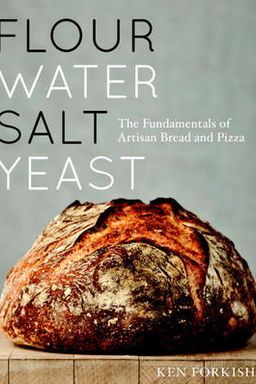
Flour Water Salt Yeast cover

Flour Water Salt Yeast

by Ken Forkish

Flour Water Salt Yeast by Ken Forkish unveils the secrets of artisan baking for home enthusiasts. Learn to master fundamental techniques and elevate your baking with hands-on guidance, transforming simple ingredients into exquisite bread and pizza. Perfect for those eager to craft their own signature style.

Time, Craft, and the Art of Fermented Bread

Ken Forkish’s Flour Water Salt Yeast is both a memoir and a complete philosophy of bread-making. It’s about more than recipes—it’s about learning to think like a baker who reads time, temperature, and fermentation as essential ingredients, not background settings. For Forkish, artisan bread is a living process: every loaf tells the story of its environment, its timing, and the baker’s decisions. The central premise is simple yet profound: mastery comes not from complexity but from attention to fundamentals—flour, water, salt, and yeast—and how you manage them with intention.

From passion to practice

The book begins with Forkish’s leap from corporate life to founding Ken’s Artisan Bakery in Portland. Inspired by Lionel Poilâne and trained alongside artisans like Chad Robertson, Forkish left spreadsheets for sourdough and built a life centered around fermentation, precision, and patience. His journey frames the book’s purpose: to bring professional discipline to home baking without industrial shortcuts. You follow him from early 3:30 a.m. bakery shifts—checking poolish, mixing baguette dough, feeding levain—to the systems that make those routines work at any scale.

Understanding time and temperature

For Forkish, time and temperature are the invisible hands shaping bread. He teaches that fermentation’s pace and flavor depend less on formulas and more on how you balance warmth and patience. Warm dough ferments faster; cool dough develops more complexity. The baker’s job is to steer that balance—what he calls the fermentation “sweet spot”—before acidity and gluten breakdown set in. His tip: aim for a final mixed dough temperature of about 78°F (26°C), adjusting water temperature to hit the mark. The moment you treat these as measurable ingredients, not mysteries, you begin to own your process.

Why pre-ferments and levain matter

The book divides leavening into three families: straight doughs, pre-ferments (poolish and biga), and levain breads. Each offers distinct flavors and timeframes. A wet poolish adds butter-like aroma and crisp crust; a stiff biga brings a musky, nutty depth. Levain—the living wild-yeast starter—is more complex and acidic, yielding rustic flavors and longer keeping qualities. You choose which to use not just for flavor but for workflow: pre-ferments shift the work to the night before, while levains reward daily rhythm and care. Forkish shows that whatever method you pick, the underlying principle stays constant—flavor comes from time spent under the right conditions.

From hand mixing to baking dark

Forkish insists that you mix dough by hand to build awareness. Using the pincer method—pinch, fold, rest—you feel gluten forming, hydration balancing, and fermentation beginning. Instead of heavy kneading, you strengthen dough through a few timed folds, letting enzymes do the hidden work during rest. Once shaped gently, the bread’s final transformation happens in a blazing-hot Dutch oven. The enclosed steam allows expansion before the crust sets, producing the signature crackling, caramelized surface Forkish calls essential. “Bake until dark,” he repeats, arguing that flavor and aroma bloom only when the crust reaches deep chestnut brown.

Science, tools, and freedom

To bring consistency, Forkish relies on tools—a digital scale, thermometer, and clear tubs—but these aren’t symbols of rigidity. They’re what grant you freedom to improvise. His recipes, expressed in baker’s percentages (flour = 100%), teach you to read doughs with scientific clarity: 720 g water means 72% hydration; 20 g salt means 2%. Once you internalize that language, experimentation becomes safe territory. You can tweak water, temperature, or yeast to fit your schedule or flour without losing control. In this sense, the book’s recipes are templates that encourage creative precision: a mindset where curiosity meets measurement.

The living culture of levain

Forkish demystifies levain maintenance. You nurture a wild yeast culture with daily feedings of flour and water, adjusting temperature and quantity to your rhythm. The starter’s character changes with its environment—your kitchen temperature, flour, and timing—not some mythical inheritance from its origin. You can refrigerate, refresh, and scale it endlessly, transforming it into a steady, homegrown ecosystem. This idea—that bread is alive and responds to care—is the emotional center of Forkish’s philosophy. A baker doesn’t control life; they collaborate with it.

From formulas to intuition

Ultimately, Flour Water Salt Yeast teaches you to think like a craftsperson. You move from dependency on recipes to intuitive judgment: adjusting water when flour changes, manipulating yeast to suit your schedule, reading dough temperature as you’d read weather. You learn through deliberate practice—recording mix temps, fold intervals, and outcomes in a notebook—and through mindful repetition. In the process, the act of baking becomes less about following steps and more about sensing transformation.

Core understanding

Bread isn’t just baked—it’s grown through time, shaped by touch, and governed by temperature. Forkish’s lasting insight is that when you master the dialogue between dough, environment, and attention, you gain both control and creativity. Every loaf becomes a living record of your craft.


Time and Temperature as Ingredients

Forkish treats time and temperature as dynamic levers you can adjust to shape bread’s flavor and structure. Instead of assuming yeast speed is fixed, you learn to manage fermentation like an equation: warmer dough speeds activity, cooler dough deepens taste. The trick is finding the sweet spot between underdeveloped blandness and the over-acidic collapse of gluten.

Finding the fermentation balance

During fermentation, yeast and bacteria feed, multiply, and release gases, acids, and alcohol. Given enough time, those processes unlock natural wheat sweetness. But too much time produces overpowering acidity and weakens glutens. Forkish’s visual metaphor of a seesaw—time on one side, temperature on the other—shows that when you lower yeast quantity or cool dough, you need more hours for the same maturity.

Practical temperature control

The ideal final dough temperature sits around 78°F (26°C). You control it by tuning water temperature, ingredient temperature, and room climate. Forkish recommends noting post-mix temperatures in a logbook, adjusting next time until you consistently hit the target. For example, in a 70°F room, using 95°F water and a short autolyse of 20–30 minutes typically lands at the desired mix temp. Refrigeration can extend fermentation overnight or longer without risk of overproofing.

Key formula

Less yeast plus more time equals better flavor—but temperature is the governor of that time. Adjust it intentionally, and your timing becomes predictable rather than stressful.

By mastering these levers, you gain the freedom to design both your bread’s schedule and taste profile. Time and temperature are not constraints; they’re your most responsive ingredients.


Pre-Ferments and Levain

Pre-ferments and levain are bread’s soul—the silent architects of aroma and texture. Forkish categorizes them into three families: poolish, biga, and levain. Each pre-ferment uses the same core ingredients but cultivates different microbial dynamics, giving you creative control over flavor and timing.

Poolish and biga

A poolish is equal parts flour and water with a tiny yeast inoculation, fermented 8–12 hours for gentle sweetness and a thin, crackly crust. Biga, by contrast, is stiffer, using about 68% hydration, yielding a nutty, earthier tone ideal for rustic loaves. Both methods push development into a preliminary step, allowing flavor while reducing the main dough’s active time the next day.

Levain: the living culture

Levain works without commercial yeast, relying instead on wild yeast and lactic bacteria. Forkish’s five-day starter plan transitions from whole wheat flour to a balanced white/whole mix to create a resilient, mild culture. Once mature, the daily feed (100 g levain, 100 g whole wheat, 400 g white, 400 g water) becomes your morning ritual. If maintained consistently around 78°F, levain turns predictable and forgiving.

Each method reflects a different relationship with time: pre-ferments let you plan ahead for busy days; levain rewards regular routine. The more consistent you are, the more your flavor signature develops. In all forms, pre-ferments and levains prove Forkish’s thesis—flavor is the echo of microbial and human rhythm working together.


Mixing, Folding, and Handling Dough

Forkish’s hand-mixing philosophy teaches you to feel dough maturity rather than guess. His preferred pincer method replaces mechanical mixers: you cut through the dough with thumb and forefinger, fold over, and repeat. This improves incorporation without overoxidizing gluten. High-hydration doughs, which may start as near-batter, become supple through rest and folding, not aggression.

Autolyse and folds

Autolyse—resting flour and water before yeast and salt—activates enzymes that loosen gluten and build extensibility. Afterward, a few timed folds during bulk fermentation build structure. The dough’s behavior between folds signals its progress: firm after fold, relaxed before the next. Forkish advises wetting hands instead of flouring to prevent stickiness, keeping handling minimal to preserve gases.

Mantra

Autolyse, pinch, fold, and protect the gas. Gentle structure replaces brute force.

Once shaped, place boules seam-side down in well-floured baskets and avoid punching down. Every bubble preserved in the dough becomes the open crumb and oven spring that define Forkish’s signature texture.


Mastering the Dutch Oven

The humble Dutch oven is Forkish’s equalizer for home bakers. Preheated to 475°F, it traps steam that professional ovens create automatically. When your proofed loaf hits that environment, water vapor from the dough condenses and envelops the loaf, delaying crust formation long enough for full expansion. The result is extraordinary oven spring and a burnished crust.

Baking until dark

Forkish’s rule: bake until deep brown, bordering on dark umber. That’s where the Maillard reaction develops caramel and nut aromas. Lightweight “blonde” loaves taste underdeveloped compared to his richly colored Saturday or Country Blondes. After baking 30 minutes covered and 20 uncovered, the crust carries roasted complexity that influences the crumb beneath it.

Practical cue

Know your oven—use a thermometer. Every 25°F difference changes flavor as much as timing or hydration does.

Through steam and heat management, Forkish shows that a cast iron pot can deliver bakery results. What emerges from the Dutch oven is not just bread—it’s the visible culmination of all time, touch, and temperature invested earlier.


Baker’s Math and the Freedom to Scale

Forkish’s embrace of baker’s percentages turns bread from a recipe craft into a fluent language. Flour is always 100%. Every other ingredient—the water, salt, yeast, levain—is a percentage of that base weight. This convention lets you scale up or down painlessly and identify key differences among formulas.

Why weigh everything

Measuring by weight introduces precision and repeatability that cups can’t. Even minor changes in flour compaction convert to major hydration shifts. With a digital scale reading grams, a consistent thermometer, and notation, you abandon guesswork. Forkish’s home formula of 1000 g flour, 720 g water, and 20 g salt scales effortlessly and stays consistent month to month.

Applying percentages to experimentation

Once you think in percentages, creativity becomes systematic. You can swap 10% rye, increase hydration to 78% for an airy crumb, or trim yeast to extend fermentation without wrecking structure. This math emboldens adaptation: as Forkish notes, when water, yeast, or time shifts, you can adjust the rest by eye and record the result for next practice.

Forkish’s insistence on weighing may seem clinical, but it’s central to his vision. Accountability to numbers makes artistry sustainable—proof that precision and intuition can coexist in every loaf.


From Levain Breads to Hybrid Loaves

Forkish distinguishes pure levain breads from hybrid ones to give bakers flexibility. A pure levain loaf, such as the Overnight Country Blonde, depends solely on your starter’s natural leavening power and slower metabolism. Hybrid loaves, including Pain de Campagne, mix a small dose of instant yeast (often about 2 g) into dough with substantial levain to ensure reliable rise and milder acidity.

Taste and scheduling differences

Pure levain leads to robust, tangy, and deeply fermented flavor, while hybrid breads suit those who prefer light, open crumb and a gentle tang. Hybrids also resist seasonal variation—commercial yeast steadies performance in warmer or cooler kitchens. For complex but tempered taste, Forkish sometimes blends poolish and levain in one dough, combining yeast vigor and wild complexity.

Workflow consistency

Both approaches follow a familiar rhythm: autolyse, pincer mix, folds, bulk rise, divide, shape, cold proof, then bake in the Dutch oven. Typical levain bulk rise reaches 2½ times its starting volume over ~5 hours at 78°F, demonstrating how time–temperature balance remains constant across styles.

Forkish urges experimentation: choose method by taste, texture, and timing preferences. Both levain and hybrid doughs flourish when you understand the underlying physics of fermentation control rather than fixate on recipe authority.


Pizza and Focaccia at Home

Forkish’s pizza and focaccia chapters adapt his bread principles to high-heat, short-time baking. Using 70–75% hydration and long fermentation, these doughs balance elasticity with aromatic richness. The same flour-water intelligence applies here: wetter dough means lighter texture but trickier handling, countered with folds and cold shaping.

Oven setup and baking technique

For Neapolitan texture, Forkish recommends a stone preheated near the broiler for 30–45 minutes, then switching to broil during the final minutes to mimic wood-oven blast. Five minutes of intense heat plus two minutes of broil yields speckled, blistered crusts rich in fermentation flavor. For those lacking stones, a cast-iron skillet delivers comparable heat retention for pan or focaccia versions.

Sauce, toppings, and variation

The pizza section celebrates simplicity—San Marzano tomatoes, olive oil, and balanced toppings. Forkish’s examples range from the classic Margherita to creative seasonal combinations. Focaccia, treated as a cousin dough, thrives on room-temp relaxations and playful toppings from olive oil to caramelized onions. Both forms confirm that the discipline of breadmaking translates naturally to spontaneous cooking pleasures.

By mastering hydration and heat consistency, home bakers achieve pizzeria-quality results without industrial ovens. In each case, Forkish’s philosophy holds steady: control what matters—time, temperature, and balance—and the rest rewards you automatically.


Adaptation and the Baker’s Mindset

Forkish ends with a lesson in empowerment: treat every formula as a starting point, not a script. Once you internalize his principles, you can modify hydration, flour blends, levain type, and timing to fit your life or your kitchen’s quirks. The key is intention. You document each change, observe outcomes, and refine.

Variables under your control

Hydration changes adjust dough strength; flour types change flavor and absorption. Yeast or temperature shifts affect schedule. Forkish suggests writing shorthand notes—water temp, end-mix temp, fold times—and adjusting next iterations. This reflective loop mirrors how professional bakers achieve consistency through logs and repetition rather than perfectionism.

Levain variation and personal flavor

Changing levain hydration or feeding schedules molds its bacteria profile and acidity. Warm, stiff starters (around 70% hydration) yield fruity profiles; liquid levains (100%) trend toward milky-lactic flavor. Whatever you maintain longest becomes your kitchen’s identity. Flavor, Forkish reminds you, is the language of microbes adapted to your habits.

Practice insight

Control variables deliberately, record results, and you will move from imitation to authorship. The baker’s art is continuous learning embodied in each baked loaf.

Forkish’s ultimate goal is independence. When you can adapt with awareness—like using cooler water on a hot day, or slightly more yeast for a winter kitchen—you own the craft. In that sense, Flour Water Salt Yeast isn’t just about baking; it’s a manual for disciplined creativity.

Dig Deeper

Get personalized prompts to apply these lessons to your life and deepen your understanding.

Go Deeper

Get the Full Experience

Download Insight Books for AI-powered reflections, quizzes, and more.