
Idea 1
The Science and Art of Rapid Persuasion
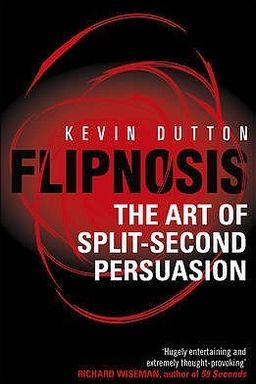
Why do some words, gestures, or moments flip people instantly? Kevin Dutton’s Flipnosis argues that persuasion is best understood as a biological and psychological reflex—evolved long before language, refined through culture, and deployed by experts from Churchill to confidence tricksters. The book’s central claim is that influence operates fastest not through reasoned argument, but through precise triggers that exploit automatic responses wired into the brain’s social and attentional systems.
Dutton names this instant persuasion flipnosis: the high‑speed psychological judo that turns resistance into compliance in seconds. You see it in a polished courtroom cross‑examination, a hostage negotiator’s calm tone, or an innocent‑looking advertising slogan. Its power lies in simultaneous simplicity and complexity—a few cues that seem benign but strike deeply rooted circuits for trust, surprise, and self‑interest.
From evolution to empathy: persuasion before words
To understand why persuasion works so quickly, Dutton starts where biology begins—with animals and infants. Ethologists describe key stimuli: the minimal cues that provoke fixed behavioral responses. Birds flee from a cardboard eagle silhouette; human adults melt at the sight of a baby’s round cheeks. These triggers bypass reason because evolution made them efficient. When you smile, glare, or cry, you aren’t inventing new behavior—you’re activating neural switches honed over millennia.
Human persuasion adds layers: language, narrative, and social context. Yet the foundation is the same. The cry that compels a parent to act operates on the same circuitry that makes a customer respond to an urgent offer or a leader follow a commanding voice. The moral: influence begins below awareness, then recruits reason to justify what emotion already decided.
SPICE and the architecture of the flip
Flipnosis runs on five interlocking ingredients—Simplicity, Perceived self‑interest, Incongruity, Confidence, and Empathy—forming the mnemonic SPICE. Together, they explain why certain appeals bypass skepticism.
- Simplicity: the clean, cognitively fluent message—like the San Francisco beggar’s sign “WHY LIE? I WANT BEER”—kills hesitation by reducing processing cost.
- Perceived self-interest: people comply when they see personal gain. Churchill’s polished response to a dinner thief let both men save dignity.
- Incongruity: surprise captures attention and pauses habitual thought, letting new frames penetrate.
- Confidence: poise implies authority; cool delivery cues safety in compliance.
- Empathy: tuning to another’s mood personalises the appeal and triggers mirroring circuits.
Together, they create high‑velocity influence. It’s not hypnosis but rapid simulation: the brain tests whether the message fits its models, finds coherence, and accepts it before fully reasoning. This formula powers advertising slogans, social manipulation, and emergency negotiation alike.
Attention, framing, and the social brain
Flipnosis works by hijacking attention—our most limited resource. Cognitive psychology confirms that when your focus is narrowed or overloaded, persuasion spikes. Keith Barrett’s con artistry and Ellen Langer’s photocopier “because” study reveal how minimal justification suffices once attention misfires. Framing and anchoring strengthen this: the first number or adjective you hear—“luxury,” “50% off,” or a high sentencing suggestion—sets the reference point for later judgment.
Because humans evolved as social imitators, affiliation and conformity complete the circuit. Asch’s lines experiment and Cialdini’s towel studies show that seeing others agree or act primes you to join. Groups amplify both insight and error: collective identity stabilizes belief yet can blind reason, magnetizing people toward extremes (as seen in cults or political polarization).
The dark side of influence
Dutton’s narrative doesn’t glorify persuasion—it warns about its ethical edges. Psychopaths, for example, embody SPICE without conscience. They radiate confidence, deploy cold empathy, and weaponize incongruity to dominate others. Likewise, environments that strip control—interrogation rooms, abusive homes, cults—teach helplessness and dependency, turning compliance into habit. Learned helplessness (Seligman) and the Stockholm effect reveal how people bond to oppressors when all agency is removed.
The countermeasure is awareness. Know when options vanish, when reciprocity is coerced, and when “confidence” conceals manipulation. Flipnosis is amoral; ethics come from intent. Used well, it rescues hostages and heals divisions. Used poorly, it cons the unwary.
Belief, resistance, and persuasion limits
Even perfect SPICE has limits. Neuroscience shows belief is not an open door but a gated circuit. Once emotion and identity endorse a view, contradictory evidence bounces off. Dissonance theory (Festinger) and confirmation bias studies (Hewstone, Gilbert) show people double down when proven wrong. Some beliefs are even neurologically insulated, as seen in brain‑injured patients with fixed delusions. Still, targeted interventions—growth mindset training, attentional rewiring, cognitive bias modification—can reopen mental plasticity.
From knowing to doing
The book closes pragmatically. You can test your own suggestibility using tools like the Multidimensional Iowa Suggestibility Scale and learn to defend against influence by reversing SPICE: increase complexity, check real benefits, spot incongruity designed to coerce, distrust empty confidence, and recover empathy. Dutton’s ultimate message blends science and ethics: persuasion is not magic but applied psychology. You already use it daily—through gaze, tone, story, and social dynamics. The difference between manipulation and leadership lies in purpose.
Flipnosis reveals that quick influence is less about talk and more about timing—leveraging the milliseconds where emotion, attention, and trust overlap. Master those, and you can change minds ethically, instantly, and lastingly.