
Idea 1
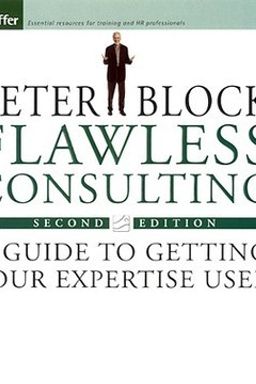
Flawless Consulting: Turning Expertise Into Genuine Partnership
Have you ever offered expert advice that seemed perfectly sound, only to watch people ignore it or misunderstand it entirely? In Flawless Consulting, Peter Block argues that the problem isn’t your ideas—it’s how you relate to others. Consulting, he insists, isn’t just about knowledge or techniques. It’s about building authentic partnerships and helping clients take ownership of their change, so your expertise is truly used. Whether you’re an external consultant, an internal advisor, a manager, or simply someone who advises others, Block’s central message applies: you have influence without control.
Block contends that consulting goes wrong when experts focus on delivering answers and managing clients instead of fostering collaboration. True impact depends on trust, transparency, and authenticity—qualities that transform a transactional exchange into a shared journey. His concept of “flawless” consulting isn’t about perfection in outcomes but integrity in process: working in a way that is congruent with your values, that creates internal commitment, and that teaches clients to solve their own problems next time.
The Consulting Dilemma: Influence Without Authority
At every level of organizational life, people are asked to give advice or help others make decisions without having direct control over actions. This is the fundamental consultant’s dilemma: how do you influence people over whom you have no authority? Block draws a distinction between consultants and managers. Managers have direct responsibility and control—consultants don’t. But that lack of control is precisely where freedom lies: consultation is a decentralized act of influence built on consent, not coercion.
This leads to the central tension at the heart of real consulting: balancing expertise with empathy. Many consultants attempt to compensate for their lack of control by becoming overly directive, imposing solutions, or acting as surrogate managers. Block argues that this undermines learning on both sides. The goal isn’t simply to solve a problem—it’s to strengthen the client’s capacity to manage their world.
The Five Phases of Consulting
Block organizes the consulting process into five iterative phases, each requiring specific skills and authentic connection:
- Entry and Contracting: defining expectations, addressing concerns about vulnerability and control, and clarifying mutual consent.
- Discovery: jointly investigating what’s really going on, moving beyond the presented problem to underlying causes and strengths.
- Analysis and Decision to Act: condensing data, naming tensions and opportunities, and focusing on what the client can control.
- Engagement and Implementation: using design and participation—rather than persuasion—to build ownership.
- Extension, Recycle, or Termination: learning from what happened and deciding what’s next.
These phases, Block notes, repeat cyclically whenever something shifts. Consulting is ultimately a learning process—a mirror that helps people see their world more clearly.
Authenticity: The Core Skill
The most powerful consulting skill, according to Block, is authenticity. Being authentic means saying what you’re experiencing right now, without manipulation or pretense. If you feel dismissed, ignored, or constrained, naming that feeling directly (but respectfully) is not risky—it’s essential. For instance, instead of hiding frustration when a client rushes through a meeting, you might say: “I sense we’re treating this as a minor issue, and that makes me wonder if it’s the right time for us to meet.” Authentic statements build trust and bring truth into relationship. They shift consulting from transactional to transformational.
Block learned this idea from his mentors Chris Argyris and Ed Schein, pioneers of organizational psychology and process consultation. They saw that genuine help involves mutual learning, not prescription. Authenticity is not aggressiveness; it’s assertiveness without blame.
Collaboration Over Expertise
Consultants, Block cautions, often fall into “expert” or “pair-of-hands” roles—doing work instead of the client or dictating solutions. The superior alternative is the collaborative role: where consultant and client become partners, blending expertise and organizational knowledge. They make decisions bilaterally, gather data together, and share accountability. This model transforms the consultation from advice-giving to capability-building. (Edgar Schein would later call this “process consultation.”)
Block’s own field stories illustrate how collaboration works: a financial services consultant involving managers in auditing procedures, or an IT consultant co-creating user interviews to uncover real technology issues. In both cases, the shift from prescription to partnership turns resistance into engagement.
The Promise of Flawless Work
“Flawless” in Block’s title doesn’t mean perfect results. It means working with integrity, courage, and awareness—even when outcomes falter. A consultant can fail to influence change and still consult flawlessly if they stayed authentic and completed the business of each phase. Clients have a right to fail; consultants have a duty to act congruently. Paradoxically, this mindset makes influence stronger because it releases the need to control others.
Block’s Central Principle
“We can be ourselves and still make a living.” This deceptively simple statement captures the heart of Flawless Consulting. Consulting doesn’t succeed through clever slides, charisma, or mandates—it thrives on consent, learning, and connection. When you act authentically and complete the business of each phase, you demonstrate integrity. And integrity, Block shows, is the most persuasive force in any consulting relationship.
Ultimately, Block’s message transcends consulting itself. It’s about how to live and work with others without manipulation—how to build trust when you can’t dictate outcomes. In an era of systems, metrics, and speed, Flawless Consulting reminds you that human connection is still the foundation of effective change.