
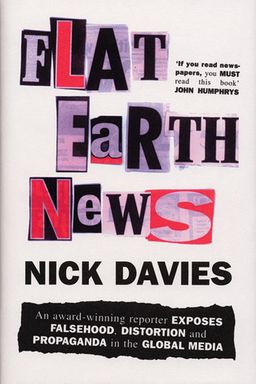
Flat Earth News cover

Flat Earth News

by Nick Davies

Flat Earth News reveals the hidden forces shaping modern journalism, exposing how profit-driven motives and external influences compromise news integrity. Nick Davies uncovers how media outlets prioritize sensationalism over truth, leaving readers to question the authenticity of what they consume.

How Falsehood Becomes News

How can whole societies accept fictions as fact? In Flat Earth News, journalist Nick Davies shows that media falsehood is not a moral lapse but a systemic one. He argues that many of the stories shaping modern politics and belief—the millennium bug, weapons of mass destruction, or the heroin panic—are products of a broken information economy. They look true, become widely accepted, and resist correction even when solid evidence disappears beneath repetition. The book calls this pattern Flat Earth News: news that feels right but is fundamentally wrong.

At its core, Davies’s thesis is that the media now manufactures ignorance as efficiently as it once manufactured truth. Speed, profit pressure, and technological change have turned newsrooms into industrialized production lines. Journalists no longer investigate; they churn: recycling unchecked material through wire services and PR channels that reward conformity and discourage skepticism.

The Anatomy of a False Story

Davies traces how an uncertain claim becomes global "truth." A small spark—often a consultant’s speculation, a corporate press release, or a government hint—is amplified by interested parties, repeated by agencies, and recycled by newsrooms under deadline. By the time the truth emerges, public belief is already cemented. The millennium bug panic illustrates this cycle perfectly: consultant Peter de Jager’s alert was recycled through the Press Association and the wires, triggering mass public spending. When nothing happened on 1 January 2000, silence followed—the non-event became a non-story.

A System Built for Error

This is not individual corruption but structural dysfunction. Journalists are pressured to produce more content with fewer staff, to meet rolling deadlines, and to rely on agencies like Reuters, AP or the UK Press Association. Cardiff University researchers found that over 80% of British national stories contained material from these supply lines—and more than half bore signs of PR influence. The industry’s obsession with cheapness and safety means journalists pick official sources, safe topics, and manufactured balance instead of truth-seeking inquiry.

Such news, Davies warns, costs society dearly. False narratives waste public money and distort public policy—from the "war on drugs" that created black markets and disease, to the Iraq invasion sold on fabricated intelligence. Flat Earth News doesn’t merely mislead—it actively reshapes how democracy functions.

The Media’s Invisible Hands

Behind much of this sit vast networks of influence: corporate PR, intelligence agencies, and military information operations. During wartime or crisis, official narratives are strategically promoted through leaks, embedded reporters, or selective briefings. Davies uncovers how the Zarqawi story in Iraq was built from a series of leaks and psychological operations—turning an obscure militant into a global villain. The same pattern recurs in Cold War campaigns, MI6’s Operation Mass Appeal, and PR manipulations like Bell Yard’s defense of the NatWest Three. The line between journalism and propaganda, once sharply drawn, now blurs into managed storytelling.

Across these examples, Davies invites you to see news not as a mirror of reality but as a map drawn by institutions, power, and profit. The book’s narrative moves from structural critique (churnalism and supply chains) to case studies (Y2K, drugs, Iraq) to systemic corruption (Fleet Street’s dark arts and investigative decline). The conclusion is not cynical resignation but informed vigilance. If you can learn how fabrication spreads—from PR offices and wire desks to your morning headlines—you can begin to resist its spell.

Core Argument

“Flat Earth News” is not deliberate deceit by lone bad actors but the predictable outcome of a news industry that prizes volume, safety, and access over verification and context.

As you move through the book’s chapters, the picture deepens: factories of news, rules of distortion, covert manipulation, and the decay of investigative standards all form interlocking parts of the same machine. Davies’s message to you is urgent and clear: trust nobody blindly—not even the press. Follow the trail of evidence, ask which voices are missing, and remember that every repetition of an unchecked claim flattens reality a little more.


The Factory of Churnalism

Davies’s vivid metaphor of the news factory captures how journalism has been industrialized. Beginning in the 1980s with Rupert Murdoch’s Wapping revolution and the corporate restructuring of newsrooms, management treated journalism like a high-speed assembly line. Cardiff University documented the consequences: by the 2000s, reporters produced three times more content with fewer staff and shorter deadlines. The result was churnalism—news assembled from press releases and wire copy rather than verified reporting.

Industrial Pressures and Desk-Bound Reporting

Within the factory, reporters often never leave their desks. Davies reproduces an actual working diary showing fifty stories produced in one week with only three hours outside the office. The emphasis is on speed and “safe copy”: wire reproductions, PR statements, or trending topics that can be packaged quickly. A Times health editor summed it up—“We are churning stories, not writing them.”

This industrial logic breeds mediocrity and despair. Journalists know their output lacks substance but face institutional incentives against deeper inquiry. If they slow down, they risk missing deadlines or being outcompeted by rival outlets who recycle faster. The profession’s morale, Davies notes, decays alongside its credibility.

Wire Agencies and the PR Supply Chain

Wire agencies act as conveyor belts feeding this factory. In the UK, the Press Association dominates—its feeds used by the BBC, national papers, and local outlets alike. When PA runs with a weak or biased line, hundreds of publications repeat it verbatim. Add corporate PR to the chain—where firms produce ready-to-run stories with photos, quotes, and pseudo-experts—and you get a production system where most reported facts come pre-packaged. Davies cites Cardiff research estimating that about 70% of British news has agency input and 54% has PR fingerprints.

The Consequences for Public Knowledge

The cost isn’t just boredom; it’s blindness. Entire categories of news—local courts, community issues, investigative stories—disappear from national consciousness. Instead, trivial PR stunts like Paul Hucker’s World Cup insurance claim tornado through the system. When every outlet covers the same formulaic press feed, dissenting evidence and overlooked truths vanish. Flat Earth News thus multiplies not because journalists conspire, but because the system rewards imitation over investigation.

Lesson to Remember

The more a newsroom depends on wire feeds and PR, the less it knows about the world it claims to describe. Churnalism doesn’t just copy the news—it replicates ignorance.

If you follow news closely today, you can spot churnalism by its sameness: the same quotes, identical story structures, and a conspicuous absence of critical voices. The news factory runs twenty‑four hours, but it rarely manufactures truth.


Rules That Distort Truth

Davies catalogues the unwritten rules of production—shortcuts that guide most daily journalism. Each rule makes operational sense in a busy newsroom but collectively ensures distortion. Knowing them helps you see how narratives take shape regardless of evidence.

Cheap, Safe and Fast

Editors prefer stories that are cheap to produce and safe to publish. Complex investigations like Bob Port’s at AP into wartime massacres are discouraged for being “big trouble.” Meanwhile, press releases and official briefings require no legwork or legal risk. The effect is a bias toward safe facts and official sources—what Davies calls the “electric fence” around controversial territory. Stories challenging the military, intelligence agencies, or corporate sponsors are quietly dropped to avoid litigation and backlash.

False Balance and Manufactured Neutrality

Journalistic “balance” becomes a trap: presenting two sides equally even when evidence overwhelmingly favors one. The Iraq WMD coverage epitomized this—scientific dissent and skepticism were diluted into “he said, she said” packaging. False equivalence not only confuses readers but lends legitimacy to fringe or dishonest views.

News as Entertainment

Commercial pressures push editors toward celebrity scandals, moral panics, and easy emotion. The death of Princess Diana, moral outrage over crime waves, and terrorist scares all became arenas for broadcasting sentiment, not verified fact. As John Birt warned, event-driven reporting replaces process-driven understanding.

Key Takeaway

When the newsroom’s rules reward speed, neutrality, and access over truth, the outcome is predictable: distortion becomes routine and truth becomes inconvenient.

Understanding these production rules reframes media criticism. The press doesn’t simply lie—it operates under constraints that make truth uneconomic. Recognizing that pattern lets you decode coverage more intelligently: always ask who benefits from the rules in play, and what facts might have been left outside the frame.


PR, Pseudo-Events and Hidden Manipulators

Public relations, in Davies’s account, is not an adjunct to journalism—it is its raw material. Modern PR supplies the stories that journalism’s factory consumes. The relationship is symbiotic: PR firms need exposure, and newsrooms need easy content.

The Craft of Fabrication

From Edward Bernays’s early “torches of freedom” campaign to contemporary corporate spin, PR creates pseudo-events: planned spectacles, paid experts, and fabricated studies designed to appear as spontaneous news. Whether through AstroTurf groups, fake surveys, or video news releases, these constructs fill newsroom schedules hungry for quick copy.

Davies’s example of the NatWest Three shows how professional spin can rewrite public sympathy. Bell Yard Communications reframed extradited bankers as victims of unfair U.S. law, not of their own actions. Staged human‑interest features, MP briefings, and orchestrated protests successfully turned a legal case into national advocacy.

Power Buys the Narrative

Because PR is expensive, those with money—corporations, governments, and elite NGOs—dominate its use. Their stories are “safe” for publication and easily amplified through the same wire agencies that feed everyone else. PR thus tilts media perspective toward the powerful. The poor, the local, and the unconventional are marginalized simply because they cannot pay to be heard.

Practical Defense

Whenever you meet a perfectly timed “study,” anonymous experts, or ready-made quotes—ask who paid for it and when it was released. In Davies’s world, truth hides in those answers.

The lesson for you is blunt: media literacy now demands PR literacy. Only by tracing funding chains and understanding PR’s staging tactics can you separate genuine reportage from manufactured myth.


Echo Chambers and Consensus Illusions

In an age of interconnected media, Davies describes the echo chamber—a global circuit where a few sources determine what billions believe. Within a 24‑hour cycle, agencies, broadcasters, and websites monitor each other so closely that repetition masquerades as fact. Cardiff researchers found Britain discussing roughly seventy-five stories per day—most originating from a single core of wire copy.

From Wire to Web

Globally, Reuters and AP still produce most international copy. Major news portals and Google News replicate their feeds almost verbatim. A single agency mistake—an embellished figure, an unverified quote—travels instantly across continents. The millennium-bug panic and countless smaller myths spread through this infrastructure: repetition gives falsehood social proof.

Illusions of Plurality

Online aggregators seem to offer abundance, but their algorithms reward repetition. One day of Google News tracking revealed 14,000 items drawn from only twenty-four distinct events. You think you’re consulting diverse sources; you’re really reading the same paragraph refracted through dozens of headlines.

Echo Chamber Rule

When enough outlets repeat a line, it becomes “common sense,” even if it began as a misreading or a PR stunt.

For you as a reader, the antidote is source diversity: seek firsthand reporting and local or specialized journalism. Only by stepping outside the echo chamber can you discern what everyone else has merely echoed.


Strategic Communication and Information War

Davies moves beyond journalism to examine strategic communication: government or military manipulation of the news environment. The case of Abu Musab al‑Zarqawi shows how intelligence leaks, psychological operations, and media management can conjure a global villain from fragments.

Building a Myth

In February 2004, U.S. forces selectively leaked a letter “from Zarqawi” to a New York Times reporter, then launched a coordinated campaign—official briefings, posters, and a $10 million reward—to elevate him as the face of Iraq’s insurgency. Internal slides later revealed this was not spontaneous; it was an organized effort “to leverage xenophobia” and shape perception. Yet later research showed that foreign fighters like Zarqawi were a minor component of insurgent forces.

The lesson: once constructed, symbolic villains gain their own momentum. Media repetition granted Zarqawi posthumous influence and even inspired imitators. Strategic communication can thus manufacture enemies and prolong conflict.

Militarized Media and Fallujah

The November 2004 assault on Fallujah became another laboratory for “information operations.” Brigades coordinated “packaged product”—video news releases, staged events, embedded reporters—to dominate coverage. The result was sanitized heroism and selective blindness: civilian suffering and use of white phosphorus barely surfaced. The Pentagon openly describes information operations as a “core military competency,” fusing PR with warfare.

Caution

When information becomes a weapon, every headline deserves the same scrutiny you’d give a battlefield claim: who gained by making it public?

Davies links this back to news factory dynamics: hungry desks make perfect targets for managed leaks. Strategic communication thrives where journalism has forgotten how to doubt.


Corruption and the Decline of Investigative Journalism

While structural forces shape distortion, Davies also documents outright corruption—what he calls the dark arts. Fleet Street’s trade in illicit information, exposed by the Whittamore case, showed journalists buying police data, phone records, and private files. The Information Commissioner found over 13,000 illegal requests from some 300 reporters. Yet prosecutions failed, and the market soon resumed.

The Ethical Collapse

Bribed officials, private investigators, and the use of hacked data became common practice. Weak enforcement and the Press Complaints Commission’s impotence let the industry police itself poorly. This open secret shaped reporting culture: ends justified means, privacy appeared negotiable, and trust eroded.

The Loss of Investigative Capacity

Contrast this with the Sunday Times’s Insight team's golden age. Under Harry Evans, journalists spent months exposing Kim Philby’s betrayal or campaigning over thalidomide victims. After Murdoch’s takeover, such long-form work perished. Tight budgets and managerial impatience birthed sensationalism and fabrication. The Vanunu episode—where the nuclear whistleblower’s safety was compromised—shows the cost of haste. As resources declined, fact-checking weakened and moral grounding disintegrated.

Enduring Question

Harry Evans asked: “If the press won’t do this work, who else can?” Davies’s answer implies despair—almost no one, unless public attention and funding realign behind accountability journalism.

The evolution from investigation to infotainment completes the Flat Earth cycle: a press born to challenge power now mirrors it. By eroding standards, both ethically and institutionally, Fleet Street helped normalize the very fabrications Davies spent his career exposing.


When False News Shapes Real Policy

Davies closes by showing the real-world consequences of Flat Earth News on governance. False or distorted reporting doesn’t vanish harmlessly—it spawns poor spending, bad law, and misguided fear.

Costly Non‑Events

The millennium bug led to massive expenditures on protection against a near‑nonexistent threat. Once the alarm was global, governments preferred overspending to political blame. Public relations campaigns, consulting industries, and politicians profited. Yet the press that exaggerated the panic stayed silent after its failure.

The War on Drugs and Beyond

Misreporting about heroin’s effects transformed a manageable medical issue into a criminal epidemic. Early British doctors who prescribed heroin safely were drowned out by moralistic tabloids. The resulting prohibition bred disease, black markets, and crime—demonstrating how a false narrative can create the very pathology it claims to fight.

Policy Built on Panic

From policing slogans like “zero tolerance” to exaggerated nuclear or vaccine scares, the same causal pattern repeats: emotive coverage drives reactive policy. When voters consume fear, politicians legislate it. Flat Earth News thus reshapes not only belief but the machinery of state.

Final Warning

Bad journalism turns bad data into law. Every time a false story hardens into policy, the citizen pays the cost—in taxes, freedom, or health.

For readers, this is the book’s final moral: the struggle for truth in media is inseparable from the struggle for rational governance. To demand better journalism is to defend democracy itself.

Dig Deeper

Get personalized prompts to apply these lessons to your life and deepen your understanding.

Go Deeper

Get the Full Experience

Download Insight Books for AI-powered reflections, quizzes, and more.