
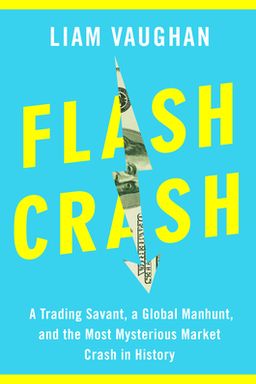
Flash Crash cover

Flash Crash

by Liam Vaughan

Flash Crash reveals the astonishing story of Navinder Singh Sarao, a trader whose actions from his bedroom sent shockwaves through global markets. This fast-paced narrative uncovers the world of high-frequency trading and raises profound questions about ethics in finance.

The Human Trader Who Outsmarted Wall Street’s Machines

Have you ever felt like modern life is ruled by invisible algorithms working faster than you can think? In Flash Crash, investigative journalist Liam Vaughan tells the strange, true story of Navinder Singh Sarao—a working-class math prodigy from West London who went head-to-head with Wall Street’s high-frequency trading titans and, unintentionally, shook the global economy. The book isn’t just a biography; it’s a deep dive into how technology transformed markets—and how one man’s rebellious genius exposed their fragility.

Vaughan contends that Sarao’s journey captures both the triumphs and moral hazards of automation. A loner with an otherworldly talent for perceiving patterns, Sarao embodied the dying breed of human traders in an age increasingly dominated by high-speed algorithms. In his quest to fight back against these machines, Sarao “pimped” his own trading software until it could manipulate markets so efficiently that regulators would later accuse him of helping trigger the 2010 Flash Crash—one of the biggest one-day market collapses in history.

A Tale of Genius and Isolation

At its core, Vaughan’s story is about obsession, autonomy, and the dangers of brilliance unharnessed. Sarao was no Wall Street insider. He was the son of Indian immigrants in Hounslow, possessed of an extraordinary numerical memory and uncanny focus. His life’s work became the futures markets—specifically, lightning-fast buying and selling of S&P 500 ‘e-minis’ from his bedroom. While banks and hedge funds were building high-frequency algorithms (HFTs), Nav relied on a mouse and raw intuition, memorizing the rhythms of the market like a grandmaster studies a chessboard.

Sarao’s worldview formed through contrast: he was the lone human facing a machine-dominated world. His mantra—“If you can’t beat them, manipulate them”—revealed both his brilliance and blindness. Where others saw an impenetrable system, he saw exploitable patterns. To him, trading was “a pure game of psychology,” and he considered algorithmic ‘geeks’ fair targets. His methods—flooding markets with massive phantom orders and canceling them—became known as spoofing, a tactic made illegal by new post-crisis rules.

Technology, Ethics, and the Fragile Machine

Vaughan uses Sarao’s story as a parable about the collision between human ingenuity and automated systems. The financial markets had become a “black box” where trades happened in microseconds—speed eclipsing logic, ethics, and human oversight. Regulators like the CFTC and SEC, designed for a slower era, lacked the tools to monitor billions of algorithmic orders. When Sarao exploited the system with his modified software, he revealed its structural flaw: the market could be moved by one man with a fast enough mouse.

On May 6, 2010, that flaw came spectacularly to light. As global fear over Greece’s debt crisis rippled through the economy, the U.S. stock market suddenly collapsed—plunging nearly 1,000 points in minutes before instantly rebounding. Billions vanished, confidence shattered, and investigators were left bewildered. Years later, they would identify Sarao’s trades as a contributing cause. Whether he truly ‘crashed the market’ is debatable (most economists say he was one factor among many), but his actions symbolized everything fragile about financial automation.

An Odyssey from Bedroom to Courtroom

The book traces Sarao’s rise, isolation, and downfall with cinematic pacing. From his days learning at Futex, a small trading arcade, to his battles with brokers, software engineers, and regulators, we see how a single-minded genius can dismantle his own fortunes. When the U.S. Department of Justice finally arrested Sarao in 2015, tabloids called him “The Hound of Hounslow.” He had made over $70 million—but lived with his parents, shunned luxury, and believed himself a victim of an unfair system. Vaughan shows us a man driven not by greed but by mastery—the need to prove that one mind could still outthink the machines.

Why This Story Matters

Beyond the courtroom drama, Flash Crash illuminates how capitalism’s new operating system—software, speed, and complexity—has outpaced human governance. It echoes the warnings of Michael Lewis’s Flash Boys and Scott Patterson’s Dark Pools, showing the rise of automated markets where ethical lines blur and accountability dissolves. Sarao’s downfall becomes a cautionary tale: intelligence without empathy, brilliance without regulation, leads to chaos. His story urges you to ask: if markets can be hijacked by one rogue algorithm, what does that say about the systems that govern your money, data, and life?

Over the next sections, you’ll explore how Nav honed his strange talent; how the high-frequency revolution rewired finance; how spoofing history repeats through centuries of deception; and how one eccentric trader forced the world to confront the ethics of speed, greed, and control. Vaughan ultimately shows that the greatest market crash may not have been technological—it was moral.


Born to Trade: Nav’s Unlikely Genius

Navinder Sarao’s story begins far from Wall Street—in a modest, two-story house under Heathrow’s flight path. From an early age, he stood out, not through charm or privilege, but through an uncanny mental ability. He could multiply numbers faster than calculators, memorize sequences instantly, and think several steps ahead—a quality Mihaly Csikszentmihalyi would call being in a state of flow. What Sarao lacked in social grace, he made up for with an iron will to master complex systems.

From Hounslow to the Trading Floor

After a failed stint in telecom sales, Nav stumbled upon a classified ad: “Wanted. Trainee Futures Traders.” This ad, run by a small arcade called Independent Derivatives Traders (later Futex), would change his life. Unlike investment banks, prop firms like Futex offered ordinary people a chance to trade with borrowed money in exchange for a cut of their profits. It was capitalism’s purest meritocracy—those who could predict market micro-movements survived; everyone else washed out. Sarao thrived.

The Birth of a Machine Mind

Vaughan details how Nav mastered the “ladder,” a live visual feed of all buy and sell orders on the S&P 500 e-mini—a futures contract tracking America’s 500 biggest companies. While others drowned in charts and noise, Nav stripped his setup to two screens and memorized the market’s rhythms through intuition. To him, the ladder wasn’t numbers; it was energy—fear and greed codified. Every movement was a pulse he could feel. Within years, he was trading hundreds of lots at a time and earning $20,000 a day from his parents’ spare room.

Risk Without Fear

Sarao’s defining trait wasn’t genius—it was fearlessness. He refused to use stop-losses (automatic exit points to prevent large losses), preferring to “let it breathe.” That meant living inches from ruin but trusting his own timing. Vaughan describes him as “impervious to risk,” his emotions frozen when money vanished. While peers screamed and quit, Nav re-entered calmly and made it back by nightfall. Trading was his identity, isolation his fuel. The irony: his very detachment—the same Asperger’s-like focus that made him a savant—would later convince prosecutors that he lacked empathy and moral awareness.

The Boy Plunger Reborn

Vaughan draws a parallel to Jesse Livermore, the early 20th-century “Boy Plunger” who once shorted the 1929 market. Both men treated markets as living creatures to outthink. Both could detach from emotion, and both courted disaster by believing they could never be wrong. When Sarao blew past the limits set by Futex’s owners, he left to trade alone—disgusted by others’ greed but blind to his own addiction to mastery. Success, for him, was no longer financial; it was existential. He wasn’t chasing profit—he was chasing control.


The Rise of the Robots

By the late 2000s, the golden age of human traders was ending. Algorithms—silent, tireless, and fast beyond comprehension—had invaded the global markets. Vaughan paints this as a technological arms race that reshaped capitalism itself. High-Frequency Trading (HFT) firms like Getco, Jump Trading, and Citadel turned milliseconds into millions, thriving on speed and data. Human judgment was replaced by mathematical precision.

A New Market Order

HFT firms engaged in microsecond arbitrage: buying low and selling high across fragmented exchanges before humans could blink. Exchanges encouraged them, selling server proximity (“co-location”) for $75,000 a month. The CME Group, host to the S&P e-mini, became one of the world’s most profitable corporations—benefiting from HFT’s lightning-fast volumes. But ordinary traders were left baffled as markets blurred. Profits soared, risk seemed to vanish, and regulators fell far behind.

The Trader vs. the Machine

Sarao saw the robots as predators feeding on human traders. On online forums, writing under the alias “That’s a Fugazi,” he railed against “the unfair advantage” of algorithmic firms that seemed to anticipate orders in advance. In one post, he declared: “If you can’t beat them, you may as well join them.” That epiphany changed his mission. Rather than accept defeat, he would reverse-engineer the algos’ logic and weaponize it against them. (In the language of today’s tech wars, he became a “white-hat hacker” turned rogue.)

Pimping His Algorithm

Sarao’s 2009 modifications to Trading Technologies’ software were his rebellion against the machine age. With help from coder Antonios Hadjigeorgalis, he designed custom “cancel if close” and “back of the book” features, creating his own primitive high-frequency system. His code allowed him to flood the market with fake orders—offers that moved prices but rarely executed. He could manipulate supply and demand, make prices dip, and then profit from the rebound. His computer became an extension of his brain—a tool that could, for seconds, command the market’s pulse.

A Dangerous Equality

Vaughan argues that Nav wasn’t trying to destroy the system; he was trying to survive within it. Like Sisyphus coding his way up a hill of data, Sarao sought fairness in an unfair race. Yet his creation revealed a paradox: in trying to level the playing field, he made it more dangerous. The algorithms that dominated the markets were predictable—but also explosive. By exploiting them, Sarao turned financial order into chaos. “Oh sheep,” he wrote online, “come join thy shepherd.” His message had become prophetic.


The Flash Crash: A Perfect Storm

On May 6, 2010, a chain of human fear and machine logic collided. What began as a normal trading day descended into chaos, wiping a trillion dollars in minutes. Vaughan reconstructs the day like a thriller—showing how millions of lines of code, a faltering Greek economy, and one guy in his bedroom combined to trigger financial history’s fastest collapse.

The Market Trembles

Europe was reeling from the Greek debt crisis; headlines screamed “Contagion.” Nav, at home in Hounslow, activated his spoofing algorithm at 3:20 P.M. London time. His machine unleashed massive fake sell orders on the S&P 500 e-mini—$200 million in phantom offerings that chased real buyers away. Within minutes, anxiety rippled across algorithms worldwide. Stocks nosedived, liquidity vanished, and trading halted. The Dow fell nearly 1,000 points, its biggest intraday drop ever. Then, just as suddenly, everything snapped back.

The Day the Machines Panicked

For the first time, humans understood what algorithmic markets meant: they could think faster than reason, and break faster than anyone could intervene. During those 36 minutes, companies like Accenture and Procter & Gamble briefly traded for a cent, while others soared to $100,000 per share. The event was later dubbed “The Flash Crash,” and though Sarao’s spoofing was just one component, it symbolized the tipping point. As Michael Lewis wrote later in Flash Boys, “We built a system so fast we could no longer see its consequences.”

The Blame Game

Initial investigations blamed a $4 billion sell order by the mutual fund Waddell & Reed. But academic researchers like Andrei Kirilenko later showed that spoofing, HFT feedback loops, and regulatory blindness all played roles. Sarao’s automated layering orders amplified an already-panicked market, acting as a spark in a room filled with gas. Whether he “caused” the crash misses the point—he revealed a deeper truth: modern markets are systems so complex that intent, causality, and control dissolve into noise.

A Mirror to the Machine Age

For readers, the Flash Crash is both spectacle and warning. Vaughan’s investigation transcends finance: it’s about how small design flaws at high speed can rewrite the fate of a global system. Sarao’s $900k trading day became symbolic of a world where one person’s code can outpace entire economies. When he later emailed the CME to say “Tell them to kiss my ass,” he wasn’t rebelling only against regulators—he was unknowingly challenging the logic of automation itself.


Fraud, Fairness, and the Birth of 'Spoofing'

Sarao’s downfall didn’t happen immediately. After the crash, he kept trading undisturbed for years, convinced that everyone was spoofing. In fact, they were—but not all were prosecuted. Vaughan shows how his case became ground zero in America’s effort to define digital-era manipulation. To understand Sarao’s guilt, you must understand the birth of the anti-spoofing law.

The Law Catches Up

For decades, ‘market manipulation’ was nearly impossible to prove. Regulators had to show four things: intent, ability, artificial price, and causation—an evidentiary Everest that few climbed. After the 2008 crisis, lawmakers rewrote the rules under the 2010 Dodd-Frank Act, outlawing “bidding or offering with intent to cancel.” This was spoofing’s birth as a crime. It made deception itself—intent—punishable. Some legal scholars (like Jerry Markham) called it a “thought crime.”

A Trader’s Game or a Moral Crime?

The moral debate still echoes. Regulators saw spoofing as lying; traders saw it as bluffing. In Vaughan’s interviews, many compared it to poker or sports—faking left, shooting right. But the CFTC worried this gray zone allowed billion-dollar players to distort prices. By the time they charged Sarao, they weren’t just prosecuting a man; they were defining the boundaries of human vs. machine manipulation.

The Price of a Precedent

Sarao’s 2015 arrest—five years after the Flash Crash—established him as the first non-American criminally charged with spoofing. Whether hero or villain, he became a symbol of what happens when innovation collides with law. Where high-frequency traders profited from milliseconds of legal advantage, Nav exploited milliseconds illegally. The difference, Vaughan reminds us, is morality—and which side writes the rules.


The Hound of Hounslow Falls

When Scotland Yard raided Sarao’s home in April 2015, his world of screens and secrecy collapsed. Imagine earning $70 million yet sleeping in your childhood bedroom. That was Nav. The U.S. Department of Justice accused him of helping to trigger a trillion-dollar flash crash. Tabloids turned him into myth: the “Rain Man of Money.” Investors who once idolized him now distanced themselves. Yet Vaughan’s portrayal is more complex—a savant who battled not greed, but a system he saw as rigged.

Isolation and Irony

In Wandsworth Prison, the absurdity hit him. The so-called market manipulator couldn’t even access his own bank account because his assets were frozen offshore in an alleged Ponzi scheme. Despite paper wealth exceeding $50 million, he struggled to post bail. His jail time revealed the darker comedy of deregulation: the man who outplayed robots ended up a pawn in global finance. Vaughan sketches him as tragicomic—an ascetic messiah of money undone by bureaucracy and trust in the wrong people.

Brains Versus Bureaucracy

As regulatory agencies raced to piece together his crimes, Sarao became the test case for 21st-century market ethics. Traders saw him as a hero who fought predatory algorithms; academics debated whether one human could crash a world market; lawyers asked whether the real culprits were the exchanges that allowed anonymous manipulation for profit. Eventually, facing extradition to the U.S., Sarao pleaded guilty—but his cooperation would expose the world’s financial machinery in new ways.

A Genius in Captivity

While awaiting sentencing, Sarao assisted regulators, teaching them how spoofing actually worked. Prosecutors, once his enemies, began using his old trading videos in their trainings. His insights helped convict other spoofers—including algorithmic firms far larger than him. In a twist of irony, the man accused of manipulation became the government’s best mapmaker of financial deceit. Vaughan closes his arc with empathy: Sarao wasn’t evil; he was emblematic—a genius adrift in systems his mind could master but his morality could not.

Dig Deeper

Get personalized prompts to apply these lessons to your life and deepen your understanding.

Go Deeper

Get the Full Experience

Download Insight Books for AI-powered reflections, quizzes, and more.