
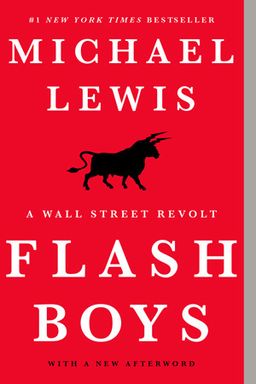
Flash Boys cover

Flash Boys

by Michael Lewis

Flash Boys reveals the dark side of Wall Street, where high-frequency trading firms exploit electronic loopholes. Follow Brad Katsuyama''s journey as he creates IEX, a transparent exchange aimed at safeguarding investors and reforming a rigged system.

The Hidden Power of Speed: How Wall Street Evolved into a Rigged Game

What if the stock market—the global symbol of free enterprise—were less a marketplace and more a high-speed race already won before you even began? In Flash Boys: A Wall Street Revolt, Michael Lewis exposes a financial world transformed by technology, secrecy, and speed. He argues that the modern American stock market has become a machine designed not to serve investors but to exploit them. It’s a system where milliseconds determine billions, and where computers—rather than people—decide who wins.

Lewis contends that a shadow revolution occurred after the 2008 financial crisis. Traditional traders were displaced by high-frequency trading firms (HFTs), which used algorithms and lightning-fast fiber-optic cables to front-run ordinary investors and make riskless profits. The book follows an unlikely group of rebels—a Canadian banker, an Irish network engineer, and a small army of programmers—who expose and fight this hidden corruption. Their quest leads to the creation of a new stock exchange, IEX, built on fairness and transparency.

A Market Transformed by Machines

The reader discovers that the iconic imagery of roaring trade floors and shouting brokers has vanished. In its place stand dark rooms filled with computer servers. The exchanges—once physical spaces governed by human judgment—are now data centers guarded like military facilities. These machines execute trades in microseconds, bypassing human comprehension. Lewis points out that this acceleration hasn’t improved the economy—it has simply created new forms of abuse. The result is a market that moves too fast for regulators, investors, or even many Wall Street insiders to understand.

The Moral of Speed

Lewis invites you to consider what speed really buys. In theory, faster markets should connect buyers and sellers more efficiently. In practice, HFT firms exploit this speed to see others’ trades first and capitalize on them, buying milliseconds before the rest of the market reacts. They do not invest or take risks—they extract value from those who do. This system turns capitalism’s engine of growth into an elaborate toll machine, draining pension funds and savings accounts in invisible increments. (As Lewis notes, even everyday investors using online platforms like TD Ameritrade are unknowingly paying this “speed tax.”)

The Rebels Who Fought Back

At the center of Flash Boys is Brad Katsuyama, a mild-mannered Canadian banker who discovers that every time he tries to buy a stock, the market shifts against him. The offers displayed on his screen vanish the moment he clicks “Buy.” He begins investigating and eventually uncovers the hidden latticework of high-speed cables, secret data tunnels, and private “dark pools” that allow insiders to cheat the system. Katsuyama’s journey—from confusion to revelation to rebellion—anchors the book’s human drama. His discovery that the market was structurally rigged leads him and his team to design tools that expose the fraud and ultimately found IEX, a trading venue engineered to eliminate unfair advantages.

Why It Matters

Lewis’s exploration isn’t just about finance—it’s about justice, trust, and technological ethics. In the same way that his earlier works (The Big Short and Liar’s Poker) revealed Wall Street’s moral decay through greed, Flash Boys exposes decay through invisibility. The book asks you to reflect on your own role as an investor or citizen in a world where information asymmetry defines inequality. It’s a call to rethink how we shape our systems when machines act faster than morals can catch up. Ultimately, the question isn’t whether computers trade faster than humans—but whether human values can still govern them.


The Rise of High-Frequency Trading

Lewis begins with the peculiar story of Sergey Aleynikov, a Russian programmer arrested for “stealing” computer code from Goldman Sachs. The FBI claimed the code could be used to manipulate markets, a statement that struck Lewis as ironic—because Goldman itself used that very code to do just that. This case becomes the book’s entry point into the world of high-frequency trading, or HFT.

Machines Replace People

In the aftermath of the 1987 stock market crash, regulators empowered computers to replace human brokers, hoping automation would stabilize markets. Instead, it opened a technological arms race. By the mid-2000s, trading had migrated to black-box data centers in New Jersey and Chicago. Fiber cables carried transactions measured in microseconds—one-millionth of a second. Traders who could shave even a nanosecond off transmission time gained massive profits by anticipating orders before others could act.

The Invisible Architecture of Speed

Lewis describes a real-world secret project symbolizing this race: Dan Spivey’s Spread Networks. With funding from Jim Barksdale, Spivey spent $300 million digging the straightest fiber-optic tunnel ever built—from Chicago to New Jersey—just to save milliseconds in communication between futures and equities markets. Construction crews were told to keep the purpose secret; some assumed it was a government project. But in truth, this fiber cable was the literal backbone of high-frequency trading. Firms paid millions to access it, turning speed into a commodity.

Speed as the New Currency

The logic of HFT defied traditional investing. Instead of making bets on economic growth or company performance, these traders focused solely on latency—the time between signal and execution. They built algorithms to detect other investors’ orders milliseconds after submission, buy up available shares, and resell them at slightly higher prices. The profits per trade were tiny, but multiplied millions of times per day. Lewis calculates that a single firm could skim billions annually—without producing any real value.

A Market Without Morality

What makes this transformation chilling is its moral neutrality. HFTs didn’t see themselves as manipulators—they saw themselves as engineers optimizing a system. They exploited loopholes created by regulation like “Reg NMS,” which forced brokers to route orders to the exchange showing the best price. But since the data that defined “best price” lagged behind reality, speed traders could profit from that delay. In Lewis’s telling, Wall Street has become a morality-free zone where fairness slowed down while greed sped up—a market truly “hidden in plain sight.”


Brad Katsuyama and the Discovery of a Rigged Market

Brad Katsuyama’s story is the book’s emotional and ethical core. A Canadian working for the modest Royal Bank of Canada (RBC), Brad represented an unlikely Wall Street hero—a banker motivated by fairness rather than profit. When he noticed that every time he tried to trade, the market moved mysteriously against him, he began to ask the question few dared: Why do stocks vanish from screens the moment I press “Buy”?

The Moment of Awakening

This strange phenomenon—the market moving before his order executed—wasn’t a glitch. It was evidence of HFT firms front-running trades. When Brad’s algorithms sent buy orders to multiple exchanges, faster traders spotted his intention on one exchange and raced ahead to other exchanges, buying shares before him and selling them back at higher prices. Each trade cost a fraction more, but over millions of transactions, the loss was enormous. Worse, it meant investors could no longer trust displayed prices.

Building Thor

To fight back, Brad partnered with programmer Rob Park to design a tool called Thor. Unlike traditional routers that sent orders simultaneously (and unevenly) to different exchanges, Thor intentionally slowed down fast routes so all orders arrived at the same time. By neutralizing latency differences, Thor prevented HFT firms from seeing trades first. When RBC traders began shouting “Thor it!” on the trading floor, they knew what it meant: finally, a fair fight.

Turning Discovery into Mission

Brad’s discovery reshaped his view of finance. He realized high-speed technology wasn’t just unfair—it eroded confidence in markets. His meetings with money managers at T. Rowe Price and Fidelity confirmed this: they too knew something felt wrong but couldn’t prove it. With Thor, Brad quantified the “invisible tax” imposed by HFT—about 0.01% per trade, equal to $160 million per day in lost value. This simple math transformed skepticism into moral urgency.

The Beginning of a Revolt

Instead of monetizing his discovery, Brad chose exposure. He began educating investors, regulators, and journalists, launching what Lewis calls “a revolt of fairness.” RBC’s clients started demanding transparency, and Brad’s ethical stance spread. In a world that rewarded manipulation, he defied convention—not by hacking the system but by fixing it. His crusade marks a rare instance of idealism triumphing in finance, echoing the spirit of reformers like John Bogle of Vanguard who fought for investors against institutional self-interest.


Ronan Ryan: The Infrastructure Whistleblower

Ronan Ryan, an Irish-born telecom engineer, provides the missing technical piece of the puzzle. His career in building faster networks for Wall Street firms gave him insider knowledge of how speed was literally sold. Before joining RBC, Ronan had built systems that allowed traders to move closer to exchange servers—what the industry called “co-location.” These arrangements cost firms millions, granting microsecond advantages worth billions.

Decoding the Map of Speed

Lewis paints Ronan as a practical technician who stumbles upon a revelation. When Brad hires him, Ronan lays out secret maps of New Jersey’s fiber-optic networks showing how signals travel between banks and exchanges. His analysis reveals that the physical routes themselves create asymmetries—certain exchanges are always reached first. His discovery explains why Brad’s orders never land simultaneously: the market’s architecture itself is biased toward the fastest insiders.

The Language of Latency

Ronan also explains “latency tables”—records used by HFT firms to identify brokers based on how fast their trades move between exchanges. By monitoring latency, HFT firms can predict investors’ behavior and front-run them before they finish trading. This insight transforms Brad’s understanding: speed isn’t just about transmission—it’s about intelligence. Whoever controls routing data effectively controls the entire market narrative.

From Enabler to Exposer

For years, Ronan had built the very systems that made HFT possible. Now he realizes he’d been arming the predators. His conversion–from supplier of speed to defender of fairness—is emblematic of Lewis’s theme: redemption through understanding. As Head of High-Frequency Trading Strategies at RBC, he becomes Brad’s translator—helping institutions grasp how they’re being exploited. His experiences show that corruption often depends not on conspiracies but on overlooked complexity.

Architect of IEX

When Brad and his team later design the Investors Exchange (IEX), Ronan’s expertise defines its structure. He ensures identical arrival times for all orders and introduces a 350-microsecond delay through a coiled fiber-optic “shoebox”—symbolically and literally slowing down the game so everyone can play it. The man who once optimized speed becomes the architect of deliberate fairness. It is technology, turned from weapon into shield.


Building IEX: Engineering Fairness into the Market

Creating a fair exchange meant redesigning Wall Street’s core logic. In 2013, Brad, Ronan, programmer Rob Park, and product manager John Schwall launched IEX—the Investors Exchange. Its radical idea: eliminate hidden advantages by slowing down everyone equally. Lewis describes this as “turning the casino into a cathedral of transparency.”

The Design Philosophy

IEX introduced three innovations: no co-location (so HFT firms couldn't place servers beside the exchange), no “rebates” (payments to brokers that incentivized routing for profit), and a built-in “speed bump”—a 350-microsecond delay applied to all orders. This delay allowed information to settle before execution, removing the edge of predatory traders who relied on instant data to front-run. The system used Ronan’s coiled fiber design to simulate fair distance. As Lewis notes, fairness was literally hardwired into the exchange.

Resistance from Wall Street

Predictably, the establishment fought back. Major banks spread rumors that IEX was secretly owned by high-frequency traders. Others refused to route client orders to it, claiming delays were risky. Brad’s meetings with bank executives reveal a constant cycle of denial, blame, and confusion. Some firms, like Goldman Sachs, eventually embraced the change after realizing that their own systems had become too complex to control. Others, like Credit Suisse, openly mocked IEX for “policing brokers.”

The Moral Experiment

Opening IEX wasn’t just technical—it was ethical. The team wanted to prove that transparency and fairness could coexist with profitability. Their innovation challenged decades of Wall Street orthodoxy, where secrecy equaled advantage. By publishing their order rules publicly and banning kickbacks, they invited trust. And when they traded 568,000 shares on their first day—far exceeding expectations—it signaled a new possibility: that investors were hungry for an honest market.

Technology as Moral Design

Lewis frames IEX as a statement: technology itself isn’t evil; design determines ethics. By turning high-frequency tools toward justice, IEX reclaims automation as a servant of integrity. It transforms software into moral architecture—making fairness measurable in microseconds. (Comparable to Clay Shirky’s argument in Here Comes Everybody: technology amplifies human intention, good or bad.) Whether IEX could reform all of Wall Street was uncertain—but it proved that reform was technically possible, which is the first step toward trust.


The Human Cost of Technological Capitalism

Beyond the numbers, Flash Boys captures the human drama inside technological capitalism—the people caught between code and conscience. Lewis juxtaposes the idealism of Brad’s team with the confusion of insiders like Sergey Aleynikov whose lives are destroyed by systems they barely control.

The Punishment of Discovery

Sergey’s arrest for uploading Goldman code reveals how far Wall Street will go to protect secrecy. The code he took included open-source software—freely available worldwide—but Goldman persuaded prosecutors that it was “dangerous.” Lewis shows how the only Goldman employee punished after the 2008 crisis was the one who exposed their technology. The irony underscores an industry that prosecutes transparency and rewards manipulation.

Fear and Silence

Inside banks, technologists were treated as anonymous servants of profit. They implemented decisions without understanding the trading strategies those systems powered. Lewis describes a culture of ignorance where coders were discouraged from asking moral questions. “Everyone lived for the year-end number,” Sergey recalls—a world where bonuses replaced values and silence preserved hierarchy.

Redemption Through Understanding

Both Brad and Sergey undergo moral awakenings. For Brad, understanding leads to revolt; for Sergey, it leads to serenity. After serving jail time, he reflects on the absurdity of fear and materialism, calling prison “a vivid benefit.” His transformation contrasts sharply with Wall Street’s moral inertia, where self-interest masquerades as virtue. Lewis ends with a haunting truth: markets aren’t inherently corrupt—people are, when they stop asking why.

People Over Machines

Ultimately, Lewis argues that technology doesn’t absolve humanity—it magnifies our ethics. The automated markets, like the financial algorithms that triggered 2008, simply execute human intention faster. To restore fairness, people must reclaim agency over the tools they built. In that sense, Flash Boys is less about markets than about how you choose to act within systems that reward silent complicity. The revolt begins the moment you decide to see clearly.


Legacy and Lessons from a Digital Revolution

In his epilogue, Lewis ties the threads together: the Spread Networks cable cutting through Pennsylvania, the microwave towers racing data across America, and the small band of reformers riding against a trillion-dollar tide. He asks a simple question: Who controls the infrastructure of capitalism—the people who build it or the people who exploit it?

The System That Doesn’t Want to Change

After IEX’s success, resistance intensifies. Banks deny wrongdoing and regulators stay passive. Goldman Sachs briefly supports IEX, then hesitates. Lewis suggests this ambivalence symbolizes a deeper reckoning: institutions rarely reform themselves unless collapse forces them. The incentives are too tangled—the profits too easy. As one insider says, “A tremendous infrastructure has been built around this.” Untangling that web would mean untangling power itself.

Technology’s Moral Test

The final image—microwave towers sending signals between Chicago and New Jersey—captures modern finance’s paradox: breathtaking engineering serving hollow purposes. The race for milliseconds mirrors society’s broader obsession with speed and precision without meaning. Lewis’s ending isn’t triumphant; it’s reflective. The challenge isn’t how fast we can trade—it’s whether we can slow down long enough to remember why we trade at all.

The Hope of the Few

Standing against this system are ordinary people armed with expertise and ethics. Brad, Ronan, and their team demonstrate that courage in complex systems doesn’t require rebellion—it requires clarity. Their success proves that you can build fairness into architecture, design ethics into code, and win trust by transparency. In an age of cynicism, that’s revolutionary.

A Rebellion Worth Following

Lewis ends not with closure but invitation. The infrastructure that powers HFT—fiber cables, towers, algorithms—still hums beneath our economy. The question remains: will fairness scale? For readers, Flash Boys offers both warning and hope. Systems may be rigged, but people can still rewrite their rules. The fight for transparency isn’t just about markets—it’s about the speed at which truth travels.

Dig Deeper

Get personalized prompts to apply these lessons to your life and deepen your understanding.

Go Deeper

Get the Full Experience

Download Insight Books for AI-powered reflections, quizzes, and more.