
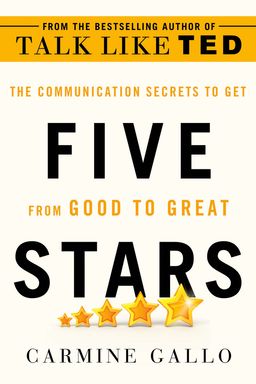
Five Stars cover

Five Stars

by Carmine Gallo

Five Stars by Carmine Gallo reveals the secrets of exceptional communication, drawing from history''s greatest orators and scientific research. Learn to captivate audiences, articulate your ideas powerfully, and transform your communication skills to achieve greatness.

The Human Edge: Persuasion in the Age of Machines

Why do some people seem unstoppable—irreplaceable—while others struggle to be heard in our digital world? In Five Stars, communication expert Carmine Gallo argues that the single most valuable skill in the modern economy isn’t coding, data analysis, or even leadership—it’s persuasion. The ability to articulate ideas with clarity and emotional resonance has become the defining edge that sets humans apart from machines and average performers from exceptional ones.

Gallo contends that automation, artificial intelligence, and globalization have disrupted nearly every industry, but they’ve also amplified the power of human connection. Machines can calculate, but they can’t dream. They can process data, but they can’t inspire. The people who thrive in this new landscape are those who combine logic and emotion—who move others to action through stories, passion, and purpose.

The Ancient Art That Shapes the Modern Age

Gallo traces this human superpower back to the Greek philosopher Aristotle, who codified the art of rhetoric—the science of persuasion—into three timeless elements: Logos (logic), Ethos (credibility), and Pathos (emotion). Successful persuaders blend all three to create clarity, trust, and emotional impact. From Thomas Jefferson’s Declaration of Independence to Martin Luther King Jr.’s “I Have a Dream” speech, history’s greatest communicators used these principles to ignite movements and change minds.

In the age of technology, these same tools help modern leaders stand out. At Google, SanDisk, NASA, and TED, storytelling and emotional appeal drive engagement, investment, and innovation. This fusion of ancient wisdom and neuroscience forms the backbone of Gallo’s argument: persuasion isn’t just about speaking well—it’s about understanding how the brain responds to emotion, narrative, and connection.

The Persuasion Gap—and How to Fill It

Gallo introduces the idea of a growing “communication skills gap.” Studies by institutions such as Harvard and Gartner show that employers consistently rank communication, creativity, and emotional intelligence above technical expertise. Yet fewer college graduates possess these skills. As automation takes over routine tasks, persuasion becomes a career survival skill. Gallo offers vivid examples—such as Haseeb Qureshi, a former poker player turned Silicon Valley engineer—who used storytelling and empathy to land offers from Google and Airbnb despite nontraditional credentials.

The Rise of Five-Star Communicators

Throughout the book, Gallo profiles “five-star communicators”—leaders who understand how to electrify audiences and inspire action. These include Bill Gates’s call for moonshot innovation, Steve Jobs’s mastery of metaphor, Nike’s founders who built culture through storytelling, and Jo Malone’s fragrance empire rooted in heartfelt passion. Each one exemplifies how communication transforms ideas into movements. Gallo adapts lessons from neuroscience and psychology—such as Uri Hasson’s brain alignment studies and Paul Zak’s research on oxytocin—to show that emotional storytelling isn’t fluff; it’s biologically hardwired to bond brains and build trust.

Why It Matters for You

By the end of Five Stars, you’ll understand why your future success depends not only on what you know but on how you communicate what you know. Whether you’re pitching an idea, leading a team, or interviewing for a job, your ability to create emotional resonance through words determines how others perceive your competence, intelligence, and value. The “five stars” aren’t just ratings; they’re a metaphor for human excellence—those rare individuals whose communication moves hearts and minds in an increasingly impersonal world. Gallo’s message is clear: if you can master the art of persuasion, you can’t be replaced.


Aristotle’s Formula for Persuasion

Gallo emphasizes that every great communicator, from ancient philosophers to modern CEOs, relies on Aristotle’s timeless formula for persuasive communication. These three pillars—Logos, Ethos, and Pathos—explain why some ideas endure and others vanish into obscurity.

Logos: The Power of Logic

Logos represents the structure and reason behind your argument. According to Gallo, logical clarity anchors a persuasive message. For instance, when John F. Kennedy launched the moonshot, he didn’t bombard NASA employees with abstract ideals. He communicated a clear, measurable goal: “Landing a man on the moon and returning him safely to Earth before the decade is out.” This tangible target gave engineers direction and united 400,000 people behind one vision.

Ethos: Credibility and Character

Ethos is the speaker’s trustworthiness. Aristotle taught that audiences follow those who display wisdom, virtue, and goodwill. Kennedy’s integrity and moral assurance galvanized a nation not only through logic but through trust. Likewise, business leaders like Apple’s Steve Jobs and Nike’s Phil Knight earned credibility by aligning words with deeds. Jobs’s obsession with design excellence and Knight’s passion for innovation embodied their messages—making them authentic and believable.

Pathos: The Emotional Core

Pathos—the emotional appeal—activates audiences. Emotion, Gallo notes, isn’t a distraction from logic; it’s the fastest route into the brain. Neuroscientist John Medina explains that emotionally charged events trigger chemical surges such as dopamine and oxytocin, helping us remember and act. Martin Luther King Jr.’s “I Have a Dream” speech succeeded because it stirred anger against injustice and hope for equality. (In Talk Like TED, Gallo similarly highlights emotion as the connective tissue of storytelling.) When you fuse logic, credibility, and emotion, you create communication that not only informs but transforms.


Storytelling That Moves Minds

Stories, Gallo insists, are not mere entertainment—they are persuasive technology. Our ancestors told stories around fire to teach, warn, and bond. Today, companies and leaders use them to inspire action. Neuroscience confirms that stories synchronize neural patterns between storyteller and listener, as Princeton’s Uri Hasson discovered—their brains literally light up in harmony.

The Three-Act Model

Effective stories follow a clear structure: setup, conflict, and resolution. Pixar’s Andrew Stanton (creator of Finding Nemo) calls this “the story cycle”—a hero faces a challenge, learns, and returns transformed. Airbnb’s CEO Brian Chesky used the same arc to pitch investors: he began with humble beginnings (setup), faced rejection and near bankruptcy (conflict), and closed with triumph (resolution). The narrative turned data into drama.

Emotional Resonance and Authenticity

Authentic stories trigger empathy. Neuroscientist Paul Zak found that tragic or heartfelt stories raise oxytocin levels—the “love molecule”—making audiences more generous and trusting. Nike’s founding tale of Bill Bowerman’s waffle iron shoes communicates humanity and creativity; it transforms a product into a legacy. Great leaders, Gallo says, become “chief storytelling officers.” Their words remind teams of a greater mission and align emotion with action.

Your Own Signature Story

Gallo encourages you to craft three types of stories: personal experiences, customer success stories, and signature moments that symbolize your brand. A heartfelt story can humanize data, elevate marketing, and strengthen relationships. Whether you lead a startup, a classroom, or a boardroom, stories transform your message from information into inspiration.


The Neuroscience of Emotion

Humans remember emotion more than information—and Gallo turns this fact into a central theme. He explores how research in neuroscience validates ancient rhetorical theory: the brain evolved to respond to feelings first and logic second.

How Emotion Shapes Memory

Experiments by UC Irvine’s James McGaugh reveal that emotional arousal floods the brain with chemicals that enhance memory consolidation. In his “ice water” experiment, participants who experienced mild stress recalled vivid details of emotional slides far better than neutral ones. For communicators, this means: add tension, humor, or wonder to make your point stick.

From Fear to “Performance Energy”

Fear of public speaking is universal, but Gallo offers concrete neuroscience-based solutions. UCLA’s Matthew Lieberman and UChicago’s Sian Beilock demonstrate that reappraisal—reframing anxiety as excitement—tames the amygdala’s fight-or-flight response. Combined with rehearsal under mild stress, it trains the brain to perform calmly under pressure. Singer Adele and investor Warren Buffett transformed stage fright into confidence through repetition and reframing.

Why Emotion Builds Connection

Neuroscientists describe storytelling as a social glue: when you share genuine emotion, listeners' brains mirror yours. Oxytocin deepens trust, dopamine boosts focus, and serotonin enhances well-being. Emotion isn’t a weakness—it’s the mechanism through which persuasion flows. Once you move hearts, minds follow.


Passion, Purpose, and the Five-Star Mindset

In Gallo’s conclusion, passion emerges as the fuel behind effective communication. Without genuine enthusiasm, innovation stalls and persuasion fails. Dr. Larry Smith of the University of Waterloo told Gallo that success in today’s world demands two qualities: passion and communication. You can’t innovate—or motivate—without caring deeply about your work.

Passion That Persists

The stories of Jo Malone, the dyslexic perfumer who built her fragrance empire from her kitchen table, and Google investor Michael Moritz illustrate what Gallo calls obsessional passion—a drive so strong it energizes creativity. Passion gives you resilience and a sense of calling, something machines can’t replicate. When you channel that passion through effective storytelling, you magnify your influence exponentially.

The Love Quotient (LQ)

Jack Ma, founder of Alibaba, introduced a term that aligns perfectly with Gallo’s philosophy: the Love Quotient. Beyond IQ and EQ lies humanity—the compassion and empathy that underpin persuasion. Machines lack heart, soul, and belief; humans don’t. Ma argues that those who combine emotional intelligence with love will thrive in an automated future.

Living the Five-Star Life

To achieve “five-star” status, Gallo urges readers to find the tune that makes their heart sing, as the Jewish proverb he cites proclaims: “Words from the heart enter the heart.” Passion gives ideas their wings, communication gives them flight. When you master both, you turn competence into charisma—and become truly irreplaceable in the age of ideas.

Dig Deeper

Get personalized prompts to apply these lessons to your life and deepen your understanding.

Go Deeper

Get the Full Experience

Download Insight Books for AI-powered reflections, quizzes, and more.