
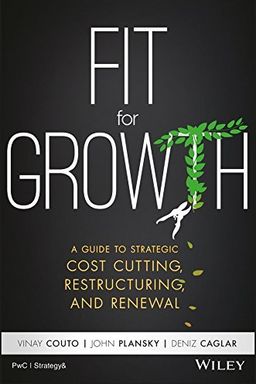
Fit for Growth cover

Fit for Growth

by Vinay Couto, John Plansky and Deniz Caglar

Fit for Growth guides businesses through strategic cost-cutting and restructuring to achieve sustainable growth. It offers practical advice on how to streamline operations, invest in key strengths, and leverage outsourcing, empowering leaders to navigate challenges with proactive strategies and visionary leadership.

Becoming Fit for Growth: Why Cutting Is the Path to Thriving

Can your company thrive in a world where competition is relentless, margins are under siege, and investors demand both growth and efficiency? In Fit for Growth, authors Vinay Couto, John Plansky, and Deniz Caglar argue that the only sustainable way to unleash profitable growth is through strategic, disciplined cost management. They contend that growth and efficiency are not opposites—when done right, pruning costs actually fuels innovation and expansion.

The authors propose a core framework that connects strategy to structure and spending: companies must focus on a few differentiating capabilities—the unique combinations of skills, processes, and tools that set them apart—then align their cost structures to support these priorities and organize for growth. This three-pillar model becomes the blueprint for companies to become truly ‘fit,’ capable of continuous renewal instead of endless cycles of boom and bust.

Fit companies, the authors show, are not lean for the sake of minimalism; they are deliberately lean in areas that don’t matter and abundant in areas that define their competitive edge. For example, IKEA’s obsessive efficiency doesn’t just reduce prices—it strengthens its purpose of providing stylish, accessible home design to the masses. Circuit City, by contrast, cut vital customer-service costs to save money, severing the muscle that kept customers loyal, and ultimately collapsed. These two stories illustrate the book’s central warning: if you cut without strategy, you destroy; if you cut strategically, you grow.

The Core Premise: Cut to Grow

Couto, Plansky, and Caglar open with a provocative claim: most companies don’t have a cost problem—they have a focus problem. Resources are too often scattered across too many projects, dull bureaucracies, and ‘pet’ initiatives with little strategic value. Leaders frequently use benchmark comparisons to justify spending, pursuing ‘best in class’ standards for every function—even ones that don’t drive their unique strategy. The Fit for Growth approach replaces this reactive trimming with a deliberate reallocation of resources toward the company’s distinct competitive advantage.

Through their extensive global consulting experience at PwC’s Strategy&, the authors reveal that companies that sustain profitable growth share three habits: they invest disproportionately in a few vital capabilities, use cost management as a continuous strategic discipline, and build organizations that are simple, empowered, and aligned to their value propositions. To prove this, they introduce the Fit for Growth Index, a data-driven benchmark that correlates companies’ capability alignment with their financial performance. Firms that score high on the index consistently achieve above-average total shareholder returns, while those that fail to align strategy and spending see mediocrity at best—and decline at worst.

The Three Pillars of Fit for Growth

The journey to becoming Fit for Growth unfolds through three interdependent steps:

  • Focus on differentiating capabilities: Identify 3 to 6 things your company does exceptionally well—your ‘right to win’ capabilities. These should cross functional boundaries and integrate skills, systems, and culture. For Apple, it’s the seamless fusion of design, technology, and brand mystique; for Walmart, it’s supply chain mastery and scale discipline.
  • Align the cost structure: Redirect expenses toward those capabilities and stop spreading resources like peanut butter. This involves deep evaluations of what to stop doing, outsource, or redesign; in other words, play favorites with your resources.
  • Organize for growth: Structure teams, decision rights, and incentives around the few things that matter most. Simplify spans and layers, empower managers, and evolve culture to sustain renewal rather than sporadic austerity drives.

These pillars are powered by human behavior, not just numbers. The authors remind readers that strategy cannot thrive without cultural alignment. Cost-cutting fails when people resist, fear, or misunderstand it—but becomes transformative when leaders communicate a clear purpose, role-model cost-consciousness, and engage employees in creative problem-solving. IKEA, again, epitomizes this: every employee knows that “wasting resources is a mortal sin,” and that makes cost discipline both emotional and operational.

A Blueprint for Action and Renewal

The remainder of the book serves as both a management philosophy and a practical playbook. The authors outline nine levers for cutting costs strategically—from portfolio rationalization and zero-basing to process excellence and digitization—and then describe how to sustain change through leadership, morale management, and cultural evolution. In later chapters, they offer templates for managing full-scale transformations, analyzing organizational structures, motivating teams, and ‘keeping the weight off’ after restructuring.

The promise of the Fit for Growth framework isn’t just short-term profit; it’s long-term resilience. Companies that make cost discipline a reflex, not a reaction, escape the boom-and-bust treadmill of corporate fitness. They become like athletes constantly training, refining, and learning—fit not for one race, but for the entire marathon of competition.


Focusing on Differentiating Capabilities

The first pillar of the Fit for Growth model challenges you to identify and double down on what your company does better than anyone else. Couto, Plansky, and Caglar call these differentiating capabilities: unique combinations of processes, skills, tools, and culture that create a distinctive edge and define your ‘right to win.’

Most companies, the authors argue, are spread too thin across too many priorities. They aim to be good at everything—from marketing to risk management—and end up excelling at nothing. The Fit for Growth philosophy insists that clarity beats breadth. Like a sculptor chipping away excess stone, leaders must decide what truly powers their strategy and ruthlessly redirect resources toward it.

Defining Your Right to Win

Differentiating capabilities are not vague strengths like “great customer service” or “innovation.” They’re precise systems of interlinked skills that deliver consistent results over time. Apple’s product mastery isn’t just design—it’s the orchestration of design, hardware, supply chain, marketing, and ecosystem. Southwest Airlines doesn’t compete on planes; it competes on simplicity and efficiency, achieved through standardized fleets, fast turnarounds, and a culture of empowerment.

The authors recommend identifying three to six such capabilities that collectively form your company’s unique DNA. These systems should work seamlessly across functions, be difficult for rivals to replicate, and clearly link to the company’s value proposition. When leaders can articulate—and employees can embody—these few priorities, everyone begins rowing in the same direction.

Playing Favorites with Resources

Once you know what matters, invest disproportionately there. This approach takes courage because it means admitting that some functions or projects—perhaps beloved legacy programs—no longer deserve top funding. The authors share examples from Walmart and Procter & Gamble: both restrict spending on nonstrategic areas while lavishly supporting their differentiating engines (supply chain for Walmart, consumer insights and innovation for P&G).

As difficult as it is, this asymmetric spending is what separates greatness from mediocrity. (Harvard’s Michael Porter makes a similar argument: strategy is “choosing what not to do.”) The authors caution that leaders who refuse to make trade-offs often end up cutting the wrong costs when crisis hits—just as Circuit City did by firing its expert sales staff, crippling its very core capability.

Capabilities Drive Costs—And Culture

Couto and his coauthors emphasize that costs are not inherently ‘good’ or ‘bad’; their value depends on whether they strengthen differentiating capabilities. When resources flow into the right areas, cost reduction actually makes the business stronger. This perspective transforms budgeting from a mechanical exercise into a strategic act of identity building.

The cultural shift that follows is powerful: employees start asking, “Does this spend make us better at what we’re best at?” In companies like IKEA, this mindset pervades daily decisions—from how designers reduce packaging size to how managers plan store layouts. Everyone steers their actions toward reinforcing the brand’s core strength: affordable, elegant home design accessible to all.

Becoming fit for growth, then, is fundamentally about focus. When you invest consciously in differentiating capabilities and accept being merely ‘good enough’ elsewhere, you set your organization up not just to survive—but to thrive in a turbulent world.


Aligning the Cost Structure

The second pillar transforms strategy into tangible numbers: aligning costs with your differentiating capabilities. Instead of viewing budgets as fixed entities, the authors remind you that every dollar spent is a strategic choice. The goal is to design a deliberate cost structure that ensures the most money flows to what drives your company’s right to win.

From Random Spending to Strategic Alignment

In many organizations, budget processes degenerate into “last year plus 3 percent.” Legacy programs cling to life, while growth opportunities starve. Aligning costs means abandoning this autopilot model. You assess all expenditures through a new lens: What do we do? Where do we do it? How well do we do it?

By answering these questions, leaders distinguish between three categories of cost:

  • Differentiating costs: investments directly tied to strategic capabilities.
  • Table-stakes costs: necessary for competition but not sources of distinction.
  • Lights-on costs: the bare minimum to operate, such as compliance or utilities.

Each type warrants a different approach. Differentiating costs may even increase as you invest deliberately, while table-stakes and lights-on costs must shrink continually. The authors introduce nine specific levers of cost transformation—from zero-basing and outsourcing to process excellence and digitization—that help execute this rebalancing.

Zero-Basing and Continuous Rejustment

One of the most potent tools discussed is zero-basing, which resets budgets to zero and forces every cost to earn its right to exist. Unlike traditional cuts that trim at the margins, zero-basing demands justification from scratch: “If we were starting anew, would we spend this?” When combined with recurring reviews, it creates a living budget that evolves with your strategy.

The authors also highlight that alignment is not a one-time project—it’s an ongoing discipline. Just as athletes recalibrate training regimes, companies must revisit cost allocations regularly, learning from metrics and market shifts to stay agile. IKEA’s yearly 2 percent price reduction mandate is a prime case: it hardwires continuous cost fitness into daily operations.

The Mindset of Investment, Not Austerity

Aligning costs doesn’t mean slashing budgets; it means treating every spend as an investment. The authors urge leaders to replace the language of “cutbacks” with one of “reallocation.” When employees see how reduced waste funds capability-building, morale improves rather than declines. For example, one company redirected savings from overhead consolidation into digital tools that empowered customer-facing teams—turning thrift into a source of pride.

In the end, your cost structure is a mirror of your priorities. If misaligned spending continues, even brilliant strategies falter. But when your dollars flow exactly where your strategic heartbeat lies, growth doesn’t just resume—it compounds.


Leading Transformations with Clarity and Conviction

Transforming a company’s cost structure is as much a test of leadership as of spreadsheets. The authors devote an entire section to the human side of strategy execution, outlining ten guiding principles for leaders to inspire trust, maintain focus, and make the tough choices that define Fit for Growth success.

The Three Questions Every Leader Must Ask

Couto, Plansky, and Caglar found that effective leaders continually revisit three questions: (1) How do I energize my organization for transformation? (2) How do I achieve cost fitness while enabling growth? and (3) How do I manage and sustain the change? These guiding queries become the leadership architecture for any transformation journey.

To energize the organization, leaders must make the case for change personally and candidly. They must paint an accurate picture of the business reality, articulating both the threats and the hopeful vision ahead. One executive described in the book insists on what he calls “brutal honesty with compassion.” Employees can accept tough news if it’s delivered transparently and paired with purpose.

Principles of Powerful Change Leadership

The authors lay out ten leadership principles derived from decades of transformation work at PwC Strategy&. A few standouts include:

  • Align the top: The senior team must be united in purpose. Skeptics should either be converted or replaced quickly to prevent cultural drift.
  • Declare a new day and grant amnesty for the past: Don’t dwell on old mistakes—focus on shared accountability for the future. This resets internal dynamics and fosters openness.
  • Showcase quick wins: Deliver visible, early results to build momentum and social proof, such as trimming low-impact discretionary spending or redundant reporting layers.
  • Put everything on the table: Sacred cows—like executive perks or legacy divisions—must be examined with equal rigor. This proves fairness and commitment to change.

In addition, leaders must communicate before, during, and after the restructuring. Silence breeds rumor and fear, while consistent communication builds engagement. The authors cite one CEO who briefed employees weekly, even when progress was slow, turning uncertainty into shared progress.

The Emotional Journey of Change

Transformation triggers anxiety across every level of an organization. Recognizing this human side, the authors devote attention to the emotions of restructuring—uncertainty, fatigue, even grief. They advise managers to lead “with empathy and firmness” and to use the change process to build careers, not crush morale. In successful transformations, middle managers emerge stronger, more adaptable, and closer to the strategic core of the business.

Ultimately, transformation leadership isn’t about heroics—it’s about creating alignment and conviction throughout the organization. When leaders model the very discipline they ask of others, credibility follows. Cost fitness, then, becomes a story not of cuts, but of courage.


Nine Levers to Cut Costs and Grow Stronger

After establishing the philosophy and leadership mindset, the book dives into nine concrete levers for achieving strategic cost reduction. These tools equip managers to trim fat without cutting into muscle, distinguishing Fit for Growth from traditional downsizing.

  • Portfolio Rationalization: Decide which businesses or products you should truly be in. Complexity kills efficiency, as seen in a conglomerate that found 15% of its portfolio generated 75% of sales. Simplifying freed up massive capital for reinvestment.
  • Zero-Basing: Justify what to keep, not what to kill. By starting budgets from zero, organizations challenge every activity’s value and avoid passively funding inefficiency. The process instills lasting discipline and cultural change.
  • Aligning the Operating Model: Redesign how and where work gets done. The authors describe four archetypes—from decentralized holding companies to highly integrated enterprises. Each must match strategy, not legacy politics.
  • Outsourcing and Footprint Optimization: Let external providers or global location shifts improve cost and flexibility. Citing Procter & Gamble’s outsourcing partnerships, the authors show how scaling vendors can boost innovation, not just savings.
  • Process Excellence: A synthesis of Lean and Six Sigma, reoriented around strategic value instead of isolated process tweaks. It simplifies work, removes bureaucracy, and improves both cost and customer experience.
  • Spans and Layers: Flatten the hierarchy and expand managerial spans. When managers shift from four to eight direct reports, decisions accelerate and overhead drops by up to 15%.
  • Strategic Supply Management: Go beyond price negotiation to reimagine the procurement value chain, capturing savings across price, cost, demand, and supplier innovation.
  • Digitization: Use technology not merely for automation but for transformation. GE’s Industrial Internet initiative, for example, turned data collection into a new revenue stream while reducing costs.

Each lever, the authors emphasize, must align with your differentiating capabilities. You can’t deploy every tool at once; effective leaders select the two or three most impactful levers that strengthen what truly makes the company unique. As you combine these techniques, their effects compound—simpler processes enable digitization, outsourcing complements footprint design, and leaner hierarchies empower faster innovation.

Together, these nine levers form the operational playbook for turning abstract strategy into measurable financial improvement—without sacrificing growth.


Managing Morale and the Human Element

No transformation succeeds by logic alone. Couto, Plansky, and Caglar acknowledge that restructuring rattles people’s sense of security. They devote several chapters to managing morale, guiding leaders to treat fear and uncertainty not as side effects but as central challenges to be addressed with intention.

Navigating the Emotional Phases

The authors outline a three-phase emotional journey employees experience: initial opportunity and hope, anxiety as change becomes real, and turmoil followed by renewal as the new organization takes hold. Managers must stay especially visible during the anxiety stage, when rumors spread fastest and engagement dips.

A practical tip: communicate even without full answers. Silence is more damaging than imperfect transparency. One IT director shared that keeping his team focused on controllable goals—like improving service metrics—kept morale intact while leadership debated strategy above their heads.

Turning Managers into Coaches

Middle managers are the front line of change. Yet they often feel both threatened and powerless. The authors encourage executives to treat them not as mouthpieces but as coaches—equipped with the facts, empathy, and discretion to lead their teams through ambiguity. When managers internalize the transformation’s “why,” they become its strongest advocates.

To ease transitions, companies should blend empathy with structure: fair assessment criteria, transparent selection for downsizing, and outplacement support where possible. When layoffs are handled with dignity, trust rebounds faster, and survivors re-engage sooner.

Culture-Led Change

Finally, lasting change depends on culture. Rather than attempting to replace it, leaders should leverage its strengths—what the authors call “working with and within culture.” Identify three or four critical behaviors that express the company’s best self, amplify them, and use informal influencers to model them across teams. Employees emulate trusted peers more readily than corporate slogans (a finding echoed by Jon Katzenbach in The Wisdom of Teams).

By remembering that transformation is about people before processes, leaders can turn cost-cutting into a shared journey of renewal—one marked by purpose, pride, and sustained performance.


Staying Fit: Sustaining Cost-Conscious Growth

Becoming Fit for Growth is only half the battle; staying fit is the real challenge. The authors compare it to keeping weight off after a diet—without sustained discipline, costs and complexity inevitably creep back. In the final section, they outline how to institutionalize fitness through strategy, operations, organization, and culture.

Strategic and Operational Fitness

Strategically, leaders must embed cost alignment into their planning cycle. The authors advocate for a sense-and-adjust planning system that continuously monitors market signals, reallocating resources dynamically rather than annually. This agility ensures investment flows to growth capabilities even as markets shift.

Operationally, they recommend building a continuous improvement (CI) capability—a small center of excellence that trains employees in Lean thinking, tracks productivity targets, and fosters grassroots innovation. When improvement becomes a norm, not a project, efficiency endures organically.

Organizational and Cultural Fitness

On the organizational front, clear decision rights and incentives preserve accountability. Every manager must own their budget and understand its strategic role. Motivators—bonuses, recognition, advancement—should reward not just performance but cost consciousness. The motto: reward results, not politics.

Culturally, sustainability hinges on modeling frugality from the top. Leaders must live the example—flying economy, simplifying perks, showing visible humility. IKEA’s founder Ingvar Kamprad’s famous dictum—“wasting resources is a mortal sin”—embodies this ethos. When thrift becomes a shared value, not an imposed rule, employees sustain discipline willingly.

A Culture of Ownership

The ultimate goal is an ownership culture where everyone treats company money as their own. Pride, not policing, fuels performance. Employees become “pride builders”—peer leaders who inspire smarter spending and operational creativity from within. This principle aligns with behavioral economics research showing intrinsic motivation outlasts external control.

By embedding these habits—strategic planning discipline, continuous improvement, empowered accountability, and humble leadership—you create an enterprise that doesn’t just get fit once, but stays fit indefinitely. Growth and efficiency then cease to be competing goals and become mutually reinforcing disciplines for sustained success.

Dig Deeper

Get personalized prompts to apply these lessons to your life and deepen your understanding.

Go Deeper

Get the Full Experience

Download Insight Books for AI-powered reflections, quizzes, and more.