
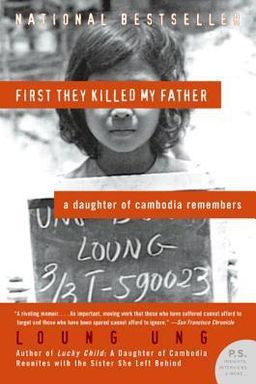
First They Killed My Father cover

First They Killed My Father

by Loung Ung

First They Killed My Father is Loung Ung''s powerful memoir of survival and resilience during the Khmer Rouge era in Cambodia. Through the lens of her childhood experiences, Ung provides a deeply personal account of enduring unimaginable horrors, showcasing the unyielding strength of family bonds and the human spirit''s capacity to overcome adversity.

Surviving the Khmer Rouge: A Child’s War and Transformation

How do you survive the total collapse of the world you knew? In First They Killed My Father, Loung Ung answers that question by taking you through her childhood under the Khmer Rouge regime in Cambodia. She writes not as a distant historian but as a survivor whose voice remains that of a child, reliving hunger, terror, rage, and the hard transformation from innocence to resilience. The book’s core argument is that survival under political terror is both a moral and psychological process—one that destroys and rebuilds identity through unimaginable choice.

Ung contends that the regime’s violence erased humanity through starvation, forced labor, and ideological indoctrination, but the human spirit fought back through imagination, family loyalty, and memory. To understand this journey, you must move through her evolving world: from a middle-class city childhood to forced evacuation, from agrarian labor and indoctrination to refugee survival and activist rebirth.

Urban Childhood and Sudden Collapse

At the start, Loung lives in Phnom Penh, a lively and cosmopolitan city where Pa works as a police officer and Ma maintains a cultured home filled with sweets and perfume. When the Khmer Rouge enters the city on April 17, 1975, the family’s comfort dissolves in hours. Loudspeakers order evacuation; Pa reads the soldiers' lies instantly, yet has no choice but to obey. The family joins thousands walking seven days under forbidding heat, transitioning from citizens to refugees in their own country. Their forced march—Pa whispering to lie about being peasants—sets the tone for a new era when survival depends on deception and silence.

Erasure of Identity and Control through Poverty

The Angkar’s control begins with stripping away clothing, possessions, and speech. Bright dresses and city accents are burned; all wear black pajamas. Words like “Pa” and “Ma” are replaced by “Poh” and “Meh,” signaling submission to collective ideology. People are divided into base and new citizens, and Loung’s family—urban evacuees—becomes suspect. Hunger replaces policy; starvation becomes structure. The transformation is psychological: losing the ability to name oneself means losing the language of resistance. As the family labors from morning to night, all private life dissolves into the Angkar’s rhythm of work and obedience.

State Terror and Loss

Terrifying disappearances mark each chapter. Pa is taken one morning and never returns; later Ma and Geak vanish, and Loung imagines their execution scenes with vivid detail—the gunfire, the small hand clutching a mother’s neck. Through these imagined memories, you see how trauma creates its own evidence: memory fills gaps that physical death leaves. Soldiers collect girls, execute “traitors,” and arrange marriages for political reasons. Each act fractures the meaning of protection or love. For Loung, this terror generates not numbness but fierce awareness: fear turns to vigilance, vigilance to rage.

Childhood, Hunger, and Moral Survival

Loung’s smallest acts—stealing rice, chewing charcoal, hiding sugar—carry enormous moral gravity. Hunger rewrites morality until theft feels sacred. When Kim is beaten for stealing corn, family loyalty confronts fear. Loung's guilt for secret theft shows how even children internalize the system’s moral distortions. Yet moral repair begins through imagination: she dreams of food, plots revenge, and vows justice. Survival becomes a spiritual act, balancing guilt and determination.

Indoctrination, Rage, and Rebellion

Children’s camps replace parents with authority figures like Met Bong who force nightly rituals praising Angkar and teaching hate. Military dances and chants transform art into propaganda. Loung’s participation teaches her to mask emotions, but a turning point arrives when she retaliates fiercely against a bully. Violence grants her control but also guilt—she begins to understand how rage functions as both protection and poison. Nightmares of hunting predators mirror her psychological shift from prey to fighter.

Family Fracture and Fleeting Hope

Brief reunions—sharing sugar cubes in a dilapidated infirmary—momentarily rebuild family bonds before soldiers destroy them again. These fleeting repairs underline the book’s emotional logic: hope is both therapy and threat. The recurrent pattern of reunion and rupture teaches you that emotional attachment under tyranny is an act of rebellion.

Escape, Refuge, and New Vulnerabilities

Flight brings new risks: pirates in the Gulf of Thailand, hunger in camps, and sexual threats from supposed protectors. Hiding under fish on the boat to Vietnam, Loung learns that even survival abroad requires vigilance. The refugee camp at Lam Sing becomes paradoxically organized—registration lines and church sponsorships replace rifle lines but carry the same bureaucratic fragility. Safety shifts from physical escape to managing new power structures.

Memory, Narrative, and Activism

Loung later writes the story in present tense to relive experience rather than recall it, arguing that child memory is not lesser memory—it is truth trapped in immediacy. Through writing, she converts trauma into testimony, joining global advocacy against landmines. Her return to Cambodia shows that healing is never total; family hugs coexist with ghosts. What remains is the ethical lesson: memory itself is a form of justice. (Note: Similar to Elie Wiesel’s claim in Night that testimony redeems suffering through remembrance.)

The Book’s Central Thread

Every act—from stealing rice to writing history—is a negotiation between survival and decency. First They Killed My Father teaches that to live through atrocity is to remember truthfully, to choose hope in defiance of systems built to erase it, and to turn personal memory into a collective form of moral resistance.


Urban Life and Sudden Displacement

Phnom Penh before the takeover glitters with family life, art, and education. The Ungs, a middle-class Chinese-Khmer family, enjoy French and Chinese schooling, street foods, and movie theaters. Pa’s position as a military policeman offers both respect and later danger; Ma’s jewelry and ornaments mark class and culture. Loung’s early childhood reflects cosmopolitan identity—something the Khmer Rouge will soon define as corruption.

The Collapse of the City

On April 17, 1975, the song of daily life ends in gunfire. Soldiers in black flood the streets. Families pack in minutes. Trucks fill with frightened people. The order—“Leave now, return in three days”—is a calculated lie. The Ungs walk seven days to the countryside, grappling with heat and loss. The scenes—soldiers seizing watches, checkpoints demanding proof of peasant status—illustrate how terror operates through bureaucracy. (Note: Like Hannah Arendt’s analysis of administrative cruelty in totalitarian systems.)

Identity Under Siege

Pa instructs the children to claim they are farmers, bury signs of privilege, and avoid eye contact. In those gestures, identity itself becomes portable and disposable. The displacement is not only geographic—it’s existential. The normal map of social life disappears, replaced by checkpoints, ration orders, and obedience scripts. Loung’s realization that her father’s uniform now endangers them marks the moment when everything civil becomes weaponized against its owners.

What Displacement Teaches

You begin to see home as not walls or possessions but shared silence and adaptability. When the Ungs stand in a field at night, sleeping beside temple wells, what remains of their identity is the small circle of trust they preserve against vast uncertainty.


Agrarianization and Control of Memory

When Loung’s family arrives at the village, the Angkar enforces uniformity in every possible way—clothing, speech, ownership, and movement. City refugees become ‘new people,’ obligated to work fields and prove loyalty. Agricultural labor replaces diversity with endurance, and language itself is redesigned to remove titles and individuality. Identity transforms into state property.

Public Rituals and Erasure

Soldiers burn bright clothes and jewelry in public fires. Everyone wears black. Even color becomes ideology. The act of burning Ma’s red dress functions as symbolic funeral for personal pasts. Speech codes—'Met' for citizen—replace familiar kinship, erasing history through forced linguistic sameness. Work meetings hammer the slogans of equality, masking hierarchy in the labor system.

Hierarchy Reversed but Reinforced

Though the Angkar preaches equality, the system divides sharply: cadres and soldiers eat first, base people live moderately, and new people starve. Control emerges through rationing—hunger becomes mathematics of power. You see how ideology disguises exploitation by calling servitude liberation. Schools vanish, leaving children only the geometry of rows in fields, a physical education in obedience.

Memory as Resistance

To remember color, to whisper old words, to keep songs in the mind—these become quiet revolts. Loung’s imagination, her dragon stories, function like hidden archives: memory gives shape to what power wants to erase.


Hunger, Guilt, and the Ethics of Survival

Under the Khmer Rouge, hunger becomes the ultimate teacher. Daily existence shrinks to a contest for rice grains and scraps of salted fish. Loung’s family barters Ma’s hidden jewelry for food, risks beatings for small thefts, and learns to live amid shame. Survival under scarcity forces new moral arithmetic—one that redefines guilt and purity.

Hunger’s Physical and Spiritual Toll

Loung and her siblings suffer swollen feet and thin limbs. The body becomes political evidence—the abject citizen. Kim’s theft of corn and near death shows how enforcement turns need into crime. Loung’s internal guilt and fantasies of punishment reveal how hunger teaches self-surveillance, not merely fear.

Shame, Theft, and Redemption

Stealing food marks Loung as both sinner and survivor. She imagines karmic justice—rebirth as a slug—but learns that compassion must coexist with need. In that tension, you read the memoir’s deepest ethical insight: survival requires imperfection. Hunger transforms ethics from rules into lived boundaries shaped by conscience.

Moral Adaptation

Starvation reforms morality so that protection becomes theft and care becomes concealment. Yet even in secrecy, family rituals of sharing sugar or rice reassert humanity. You learn that ethics under starvation are judged not by purity but by the persistence of care.


Terror, Labor, and Indoctrinated Childhoods

At the heart of the regime’s control lies a system designed to turn children into instruments. Camps enforce labor and ideology simultaneously. Indoctrination through chants and dance rituals converts innocence into obedience; labor drains strength and identity until the body itself testifies to submission.

Propaganda and Ritual

Each night, children chant praises to Angkar, clap in rhythm, and hear graphic stories about enemies. Violence becomes theater. Met Bong makes children report parents who speak ill of Pol Pot—a direct assault on love and kinship. Dance troupes rehearse movements that glorify killing, blurring art and punishment.

Labor and Dehumanization

In camps, you dig, plant, and carry water under supervision. Leeches cling to ankles like living chains. The infirmary is filled with dying workers, proving how usefulness defines survival. Hygiene, food, and rest are rationed to control behavior. Dirt becomes psychological conditioning—if you accept filth, you accept helplessness.

Rage and the Fight for Self

When Loung attacks a bully who mocks her, she learns that rage yields power. Nightmares of hunting and killing invert helplessness: she becomes the predator. This transformation shows how psychological rebellion starts when fear turns inside out. Rage becomes her language of survival but never completely erases moral memory.

Resilience through Rebellion

Even coerced children invent small acts of resistance—stealing grains, protecting siblings, or refusing emotionless obedience. In that microresistance lies the seed of future healing.


Family Rupture and the Price of Love

For Loung, family is both refuge and vulnerability. The memoir’s emotional axis revolves around repeated separations—Pa taken, Keav dead, Ma and Geak abducted. Each loss rewires the meaning of love, forcing adaptation and selective hope.

Acts of Care amid Desperation

Ma’s attempt to barter ruby earrings for chicken, Kim’s theft of corn, Meng’s protection of his siblings—these gestures are moral lifelines. In a world that punishes compassion, care itself becomes courage. Loung’s memory of sugar cubes shared in the infirmary crystallizes what survival feels like: brief sweetness against vast loss.

The Violent Absences

The abduction of Ma and Geak is narrated through imagined detail—a child’s mental picture of execution that becomes memorial art. Memory replaces sight; trauma fills silence. Afterward, Loung blacks out for days, symbolizing the body’s retreat from unbearable truth. The cycle of hope and destruction teaches emotional endurance but also psychic fragmentation.

Love as Resistance

To care in a regime that criminalizes affection is revolutionary. Loung’s continued love, even when it hurts, shows how empathy can survive terror’s machinery.


Gender, Violence, and Silenced Survival

Loung’s story exposes the gendered dimensions of war. Girls navigate threats that multiply—in public, from soldiers, and in private homes. Sexual violence becomes both weapon and wound that survivors must conceal. The memoir’s honesty lies in what she refuses to say as much as what she recounts.

Assault and Escape

A Youn soldier’s attempted rape in the brush shows how vulnerability shadows every step. Loung fights back and escapes, but silence becomes survival afterward. Under patriarchy and war, speaking of assault risks punishment. Her muteness mirrors collective silence around gendered trauma.

Domestic and Artistic Coercion

In foster homes, men’s advances and theft of her mother’s clothes compound humiliation. Performance arts tighten control: elephant grass bindings deform dancers’ bodies to make loyalty visible. Through these examples, you see how female bodies become propaganda tools and targets simultaneously.

The Hidden War

Silence after sexual trauma is its own battlefield. Loung’s restraint reveals the gaps through which many women survive—by withholding words until safe spaces exist to rebuild dignity.


Violence, Justice, and the Ambiguity of Revenge

In the aftermath of collapse, communities seek justice through vengeance. When villagers capture a Khmer Rouge soldier, collective fury erupts into public execution. The spectacle becomes communal catharsis—two women violently killing the man while the crowd cheers. Loung witnesses violence mirrored; liberation and horror blend.

The People’s Retribution

Meng’s account of women wielding knife and hammer dramatizes revenge as moral theatre. Dropping the body into a well symbolizes the abyss between justice and savagery. Loung peers inside and sees faces—an image of trauma repeating itself. The regime dies, but its methods linger, infecting the means of righteousness.

Moral Reflection

Loung’s yearning for retribution meets her awareness of futility. Killing the oppressor cannot resurrect the dead. In that realization, the memoir transcends anger and enters moral inquiry: how can survivors rebuild ethics when justice itself feels tainted? (Note: Comparable to Primo Levi's reflections on revenge and memory.)

Beyond Revenge

True justice requires memory over retribution. Loung’s insight—that vengeance creates new wounds—becomes one of the book’s final moral resolutions.


Flight, Refuge, and Reclaiming Purpose

The book’s last chapters trace physical and moral escape. Loung, Meng, and Chou flee through Cambodia and Vietnam, survive pirates, and reach refugee processing in Lam Sing. Each leg of flight builds new social dependence—trusting strangers, church groups, and sponsors. Refuge itself becomes another test of agency.

Journeys and Sponsorship

From Pursat to the Mekong Delta, to Lam Sing, Loung learns bureaucratic survival. Sponsors’ forms replace soldiers’ commands, yet fear persists. Material safety does not dissolve emotional hunger. Church workers and volunteers introduce foreign kindness but also cultural dissonance. Loung’s transition to Vermont marks both liberation and alienation—snow replaces heat, and silence replaces gunfire.

Ambivalence of Safety

Security costs identity; adapting to a new world means carrying invisible loss. The theft of Pa’s jade Buddha by pirates becomes an emblem of peace lost and reconfigured. Survival is now legal rather than physical—but the shadow memory of fear remains.

Escape as Transformation

This phase shows that safety without meaning is incomplete. Loung’s later activism transforms escape into purpose, a bridge between trauma and testimony.


Memory, Writing, and Activism

The epilogue closes the circle: memory becomes action. Loung writes in the present tense because distance feels dishonest. Her child’s perspective forces the reader to inhabit immediacy, proving that remembering through innocence can be revolutionary. Writing reclaims agency lost to silence.

Narrative Choice and Voice

Ung says she had to relive pain to write truthfully—immersing in Cambodian music, revisiting dreams. The child’s voice transforms suffering into living witness. She rejects safer past-tense narration precisely because memory must sting. (Note: Echoes the ethics of witnessing in Holocaust memoir tradition.)

Activism as Healing

Loung channels pain into advocacy, joining campaigns for landmine eradication. Her story becomes evidence and call to reform. The act of storytelling shifts trauma from private burden to social responsibility.

Return and Partial Redemption

When she revisits Cambodia, family welcomes her but dissonance remains—Western clothing recalling Khmer Rouge uniforms. Reunion proves complex; some ghosts resist closure. The memoir ends on truth, not triumph: healing persists as ongoing fight for remembrance and justice.

The Power of Testimony

Loung’s storytelling achieves moral victory: she turns outrage into empathy, personal suffering into political activism, and private memory into public witness.

Dig Deeper

Get personalized prompts to apply these lessons to your life and deepen your understanding.

Go Deeper

Get the Full Experience

Download Insight Books for AI-powered reflections, quizzes, and more.