
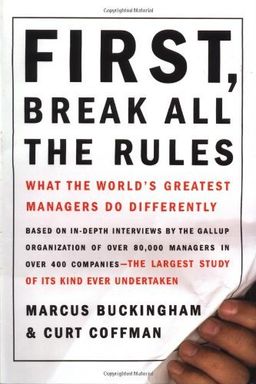
First, Break all the Rules cover

First, Break all the Rules

by Marcus Buckingham and Curt Coffman

Discover how the world''s greatest managers defy conventional wisdom to achieve excellence. ''First, Break All the Rules'' unveils the secrets to unlocking employee potential and sustaining business success through innovative management techniques.

What Great Managers Do Differently

Why is it that some teams thrive while others seem stuck in frustration, mediocrity, or constant turnover? In First, Break All the Rules, Marcus Buckingham and Curt Coffman draw on extensive Gallup research—interviews with over one million employees and 80,000 managers—to reveal that great managers don’t follow conventional wisdom about motivation, leadership, or human potential. They break the rules by focusing on what makes each person unique rather than trying to mold them into a standard model of success.

At its core, the book argues that the manager is the single most powerful variable in creating an engaging and productive workplace. Employees may join a company for its brand, benefits, or mission, but whether they stay and excel depends primarily on their relationship with their immediate supervisor. Gallup’s research uncovered twelve key questions that measure workplace engagement—questions that reveal how employees perceive clarity, recognition, trust, and growth. When managers consistently earn high marks across these twelve areas, performance metrics—from productivity and profitability to customer satisfaction and retention—all rise dramatically.

The Core Argument: People Don’t Change That Much

The revolutionary insight underlying this book is deceptively simple: great managers believe that people don’t change that much. They don’t waste time trying to fix weaknesses or teach innate traits like empathy, competitiveness, or strategic thinking. Instead, they focus on identifying each person’s natural talents—those recurring patterns of thought, feeling, or behavior—and help employees cultivate them into performance. As Gallup’s researchers put it, "Don’t try to put in what was left out. Try to draw out what was left in."

This idea overturns decades of management dogma that assumed anyone could be trained to do anything. Great managers accept human diversity and capitalize on it. They define their role as a catalyst: releasing each employee’s energy by connecting personal talents to company goals. Managers succeed not by controlling or commanding but by setting clear outcomes and allowing people to find their own path toward results.

The Structure: The Four Keys

Buckingham and Coffman organize these lessons into four simple yet transformative “Keys” that distinguish outstanding managers from their mediocre counterparts:

  • 1. Select for talent—Choose employees based not primarily on experience or skills, but on innate patterns that consistently drive performance.
  • 2. Define the right outcomes—Set clear goals but don’t prescribe methods. Let people use their natural strengths to reach desired results.
  • 3. Focus on strengths—Spend more time developing what people excel at instead of correcting weaknesses.
  • 4. Find the right fit—Help each person discover a role that matches their talents, rather than forcing promotions into mismatched positions.

Together, these keys challenge the hierarchy-driven, uniform approach of traditional management. The book argues that every role can be heroic when performed with excellence and that genuine engagement emerges when people are allowed to be “more of who they already are.”

Why This Matters

These ideas matter because disengagement is endemic. Gallup’s data show that only about 13% of global workers are engaged, and this stagnation cripples organizational morale, innovation, and profitability. First, Break All the Rules provides a data-driven, human-centered antidote. By transforming the manager from enforcer to coach—from fixer to talent amplifier—organizations gain not just better performance but genuine loyalty and growth.

Throughout the book, real company stories—from hotel chains and retail giants to creative agencies and manufacturing plants—demonstrate how managers who internalize these principles ignite their teams and outperform competitors. When you finish this summary, you’ll understand how to build a workplace where each person knows what’s expected, feels equipped and valued, and sees daily opportunities to apply their best self—a workplace where managers serve as catalysts for excellence rather than barriers to it.

“Healthy companies need strong bonds between each manager and each employee. No system or policy can substitute for this one-to-one relationship.” —Buckingham & Coffman


The Measuring Stick of Engagement

At the heart of Gallup’s research lies the question: how do you measure a strong workplace? The authors answer with the Q12, twelve deceptively simple questions that capture the essence of employee engagement. They emerged after analyzing over one hundred million survey responses. These questions reveal what employees truly need to thrive—not fancy perks or mission statements, but clarity, resources, recognition, and meaningful relationships.

The Twelve Questions

The twelve questions progress like a mountain climb—from foundational needs to higher-order aspirations. At the base, employees ask: “Do I know what’s expected of me?” and “Do I have the materials and equipment to do my work right?” As they ascend, they seek deeper fulfillment—“Do I have the opportunity to do what I do best every day?” and “Does my supervisor care about me as a person?” At the summit lie questions of growth and belonging: “Have I had opportunities to learn and grow?” and “Do I have a best friend at work?”

Gallup’s meta-analysis showed that business units scoring high on these questions outperform peers in productivity, profitability, retention, and customer satisfaction. In short, these twelve provide the measuring stick for management quality and workplace vitality.

The Mountain Metaphor

Buckingham uses a vivid metaphor of climbing a mountain to describe employee engagement. At Base Camp, workers ask “What do I get?”—clear expectations and essential tools. At Camp 1, they ask “What do I give?”—personal contribution, recognition, and development. At Camp 2, the question becomes “Do I belong?”—finding alignment with mission and coworkers. Finally, Camp 3 asks “How can we all grow?”—seeking opportunities to innovate and learn.

Managers often focus on higher camps—vision statements, teamwork programs, or innovation drives—without securing the basics of Base Camp and Camp 1. The result? “Mountain sickness”—employees who crave belonging but lack clarity and support, leading to burnout and disengagement.

What the Data Revealed

Across industries, Gallup found that differences in engagement aren’t caused by company policy but by managers. Employees form their opinions about the workplace primarily through their supervisors. One company’s study showed stores run by engaged managers exceeded profit targets by 14%, while poorly managed ones missed them by 30%. This makes the Q12 not just a diagnostic tool but a blueprint for systemic change.

“People leave managers, not companies.” Poor management drives turnover more than any benefits or salary package ever could.

In practice, a strong workplace begins when managers ensure their people can answer “strongly agree” to these twelve questions. You don’t need complex metrics; you need human awareness. A manager who knows each person’s talents, provides clear expectations, offers regular recognition, and encourages growth will organically produce engagement—and engagement, in turn, powers business results.


The Four Keys of Great Managing

What separates average managers from extraordinary ones? Gallup’s research distilled the habits of the very best into four simple keys. You can think of them as the core disciplines that create excellence across teams and roles.

1. Select for Talent

Great managers hire for natural recurring behaviors, not resumes. They know that experience, intelligence, and determination matter—but talent matters more. A nurse’s empathy, a salesperson’s persuasion, or a pilot’s composure under pressure are traits that training can’t supply. The phrase Gallup repeats: “Talent is a recurring pattern of thought, feeling, or behavior that can be productively applied.”

For example, John Wooden, the legendary UCLA basketball coach quoted in the book, said, “No coach can win consistently without talent.” A great manager is part coach, part talent scout. They ask open-ended questions to let candidates reveal their instinctive patterns: How do you respond when someone doubts you? What do you most enjoy in your work? Listening for genuine patterns—not rehearsed answers—shows what drives and energizes a person.

2. Define the Right Outcomes

Average managers obsess over process; great ones clarify results. They understand their real challenge is managing “by remote control”—influencing what people do when you aren’t there. Setting clear outcomes allows employees to use their unique talents to find their own path. This balance between structure and freedom is why top managers thrive in fluid, complex environments.

Instead of enforcing “one best way,” they specify the result and let styles vary. They define goals like customer satisfaction, safe operations, or sales volume—but not rigid scripts for how to get there. Southwest Airlines’ leaders exemplify this: their flight attendants are trained on FAA safety but encouraged to express their personalities through humor and kindness. The company thus achieves consistency in results without uniformity in style.

3. Focus on Strengths

Conventional management insists on improving weaknesses, but Gallup found that this is counterproductive. You can’t build excellence by fixing what’s broken. You build it by amplifying what works. Mandy, a design manager interviewed in the book, took an underperforming employee named John and discovered that his real talent was in building relationships. She moved him into client development—and he thrived. Focusing on strengths turned potential failure into success.

4. Find the Right Fit

Traditional career paths reward promotion for competence, often pushing people “to their level of incompetence” (a phenomenon known as the Peter Principle). Great managers reject this. They help employees find roles where their unique traits truly match the demands of the position. A top salesperson might make a poor manager, just as a superb teacher may not enjoy administration. Fit trumps hierarchy. Creating multiple avenues for growth—through mastery, mentorship, and specialization—lets people flourish without climbing rungs that don’t fit.

“When you cast people in the right role, you are paying them to be who they already are.”

The Four Keys form a complete system: hire the right talents, define outcomes that leverage them, focus on strengths to grow competence, and ensure each person’s long-term fit aligns with personal identity. When managers use these keys, they create not just performance, but devotion.


Focus on Strengths, Not Weaknesses

Buckingham’s third key—focusing on strengths—is arguably the book’s emotional core. Conventional managers devote time to fixing weaknesses, assuming people can become well-rounded. Great managers see this as self-defeating. People may improve skills, but they rarely change fundamental patterns. Excellence comes from sharpening strengths, not patching flaws.

Stories of Transformation

The book contrasts the conventional “fix yourself” narrative with real workplace stories. Mandy, the design department manager, rescued John from burnout by recognizing that his gift wasn’t analytical strategy but empathy and relationship building. Moving him into business development tapped the talent that energized him. Suddenly, his performance soared, and his confidence returned.

In contrast, managers who focus on weaknesses create frustration. “No matter how well intended,” Buckingham writes, “relationships preoccupied with weakness never end well.” The best managers instead study excellence—spending time observing top performers, learning what they do differently, and replicating those conditions for others. This makes the workplace feel less like remediation and more like inspiration.

Manage by Exception

To build on strengths, great managers must manage by exception: treat every employee as an individual. The Golden Rule—“Treat people as you’d like to be treated”—fails because it assumes everyone’s needs are alike. Instead, managers must treat people as they want to be treated. Some crave recognition in public; others prefer quiet praise. Some want autonomy; others need consistent check-ins. Managers personalize motivation by asking direct questions about preferences and goals, keeping notes, and responding accordingly. One sales manager discovered that his top performer wasn’t competitive but self-motivated; by reframing discussions around personal achievement rather than rivalry, performance soared.

“Don’t perfect people. Capitalize on their uniqueness.” Individualization turns diversity into strength.

This philosophy not only respects individuality but makes management relational, not mechanical. Each person breathes “different psychological oxygen,” and learning that is what makes a team thrive. It transforms a manager from a critic into a coach.


Creating Heroes in Every Role

One of the book’s most inspirational ideas is that every role, performed at excellence, deserves prestige. Conventional wisdom glorifies climbing the ladder, signaling that success means promotion. Great managers fight this assumption. They create heroes in every role—people who can achieve mastery and respect without moving up.

Levels of Achievement

Encouraging mastery requires clear milestones. Buckingham points to fields like medicine and law, where professionals advance through ranks—intern to consultant, associate to partner—without abandoning their craft. Applying similar graded levels to everyday roles keeps employees motivated. Gallup helped a British brewery create the “One Hundred Club,” recognizing bartenders who could remember one hundred regulars’ names and drinks. Over time, levels increased to the “Five Hundred Club,” until one bartender remembered three thousand customers, proving that mastery creates its own nobility.

Broadbanding Pay

Traditionally, pay increases only through promotion. Great managers introduce broadbanding—wide pay ranges that overlap between roles—to reward excellence without forcing upward moves. At Merrill Lynch, top financial consultants can earn more than their managers. At Stryker, best salespeople out-earn regional managers. This overlap challenges hierarchy but preserves motivation. It tells employees: mastery matters as much as management.

Creative Acts of Revolt

Managers in rigid corporate systems sometimes must rebel creatively to recognize excellence. One media manager redefined “mentors” as equivalent to “managers,” allowing brilliant graphic artists to earn director-level perks. Another engineering executive invented a “master engineer” role that freed his top technician from people management and made him a vice president. These acts of quiet defiance preserve talent by honoring expertise rather than hierarchy.

“Every role performed at excellence is valuable.” —Buckingham

Creating heroes in every role changes ambition itself—from climbing up to deepening mastery. It helps employees see growth as progress toward excellence, not escape from it. And it builds companies where recognition flows to those who make excellence sustainable.


Turning Strengths into Lasting Performance

How can managers transform talent into performance every day? The final chapters of First, Break All the Rules provide practical routines for turning the four keys into action. Great managers follow a rhythm of regular conversations about each person’s progress, goals, and growth. This isn’t bureaucracy—it’s what Buckingham calls performance management as a habit.

The Routine

Effective managers hold short quarterly meetings with each employee to discuss achievements, discoveries, and relationships. They keep the focus on the future rather than postmortems. Questions like “What are your goals for the next three months?” or “What new partnerships can you build?” promote accountability and optimism. Frequency matters more than formality—the aim is conversation, not compliance.

Tough Love and the Right Fit

Sometimes poor performance isn’t fixable—it’s miscasting. Great managers respond with “tough love”: they confront the issue honestly but compassionately, helping employees find a role that suits their strengths. One car dealership manager realized his top salesperson couldn’t handle teamwork, so he moved him back into a solo sales role—where he shone. In Gallup’s interviews, managers described moments of “manager-assisted career suicide,” when an employee subconsciously sabotaged performance to escape a bad fit. Recognizing this and acting quickly turns pain into progress.

Self-Discovery: The Fuel for Careers

Career development isn’t about climbing—it’s about self-discovery. Buckingham illustrates this through stories of people like Dr. No, the risk-averse executive who learned his true calling as a small-scale project consultant, and Mary G., the massage therapist who left management to return to direct practice. In each case, success came from finding roles that aligned with enduring talents. Great managers serve as mirrors, helping employees see themselves clearly so they can make informed choices.

“To care means to set a person up for success.” Removing misfits is an act of compassion, not cruelty.

By making performance conversations routine and growth personal, managers turn talent into enduring engagement. They stop managing tasks and start cultivating people. The result is not just higher productivity but healthier careers and stronger companies.

Dig Deeper

Get personalized prompts to apply these lessons to your life and deepen your understanding.

Go Deeper

Get the Full Experience

Download Insight Books for AI-powered reflections, quizzes, and more.