
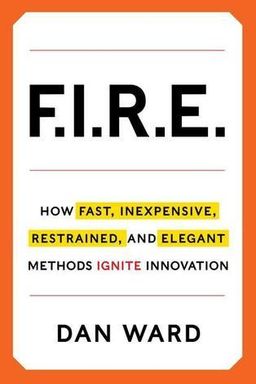
FIRE cover

FIRE

by Dan Ward

Dan Ward''s ''FIRE'' introduces the F.I.R.E. method-Fast, Inexpensive, Restrained, and Elegant-to revolutionize how you innovate. This guide shows how constraints can fuel creativity and efficiency, ensuring projects are completed on time, within budget, and with exceptional quality.

Fast, Inexpensive, Restrained, Elegant: The FIRE Method

What if the best products—the ones that innovate, endure, and inspire—weren’t the ones that cost the most, took the longest, or were built with cutting-edge complexity? In FIRE: How Fast, Inexpensive, Restrained, and Elegant Methods Ignite Innovation, Air Force engineer Dan Ward makes a bold case that the key to high performance is limitation. He argues that discipline, simplicity, and self-restraint—not boundless resources—are what produce world-class results in engineering, business, and design.

Ward’s central premise is that success in technology and creative problem-solving doesn’t come from adding time, money, or complexity. Instead, the most successful projects deliberately constrain these aspects—working fast, spending little, applying restraint, and striving for elegant, pared-down simplicity. FIRE isn’t just a formula—it’s a mindset and a value system that challenges our obsession with “bigger, slower, and more expensive.”

A Radical Reversal of Conventional Wisdom

Ward’s argument begins with a simple observation: in fields from defense technology to consumer appliances, teams with small budgets and tight timelines outperform those given unlimited resources. Drawing on decades of experience in Air Force R&D, he contrasts spectacular failures—like the F-22 Raptor and A-12 Avenger programs, which burned through billions without delivering timely results—with extraordinary successes made under tight constraints, such as the P-51 Mustang, NASA’s Stardust mission, and even a toy hovercraft made of a CD, balloon, and soap nozzle. The pattern is unmistakable: more speed and thrift equals more success.

Ward declares that “slow kills.” When projects stretch into decades, they accumulate complexity, cost, and irrelevance. By contrast, short, creative bursts produce timely, flexible, and often revolutionary results. Applying FIRE principles means finding creative advantage not in abundance but in scarcity.

The Four Principles of FIRE

Each letter in FIRE represents a principle that, together, forms a flexible but disciplined approach to leadership and design:

  • Fast – Work with short, firm schedules. Deliver quickly and avoid the illusion that “more time means better results.” Speed fosters stability and keeps products aligned with reality.
  • Inexpensive – Treat budgets as constraints, not suggestions. Spending less forces teams to innovate intelligently, using imagination instead of excess funding.
  • Restrained – Apply self-control in every dimension—team size, schedule, and scope. Fewer people, shorter meetings, and smaller documents produce clarity and accountability.
  • Elegant – Pursue simplicity that delights and performs. Elegance isn’t minimalism for its own sake; it means achieving maturity in design through clarity and effectiveness.

Unlike process-driven improvement methodologies such as Six Sigma or Agile (though FIRE shares Agile’s bias for iteration), Ward’s framework isn’t about compliance or flowcharts. It’s a philosophy of values-based decision-making. Every design decision exposes what you truly value—speed or caution, simplicity or prestige. FIRE offers a compass for those choices.

Why Constraints Create Creativity

Ward’s research shows that teams forced to innovate within tight limits naturally discover smarter, leaner solutions. In creative and technical work, constraints are not obstacles—they’re catalysts. NASA’s Faster, Better, Cheaper missions in the 1990s, for instance, delivered 10 highly successful missions for less than the cost of one traditional program. Similarly, the Air Force’s Condor Cluster—a supercomputer made of 1,760 PlayStation consoles—cost 10% of a comparable system and used a fraction of the energy.

(Creativity researcher Teresa Amabile and economist Nassim Nicholas Taleb both echo this truth: constraints and randomness are fertile conditions for innovation. FIRE operationalizes this insight.)

Ward challenges the notion that “you get what you pay for.” In fact, overspending often dilutes purpose, blurs accountability, and invites delays. Small budgets keep teams sharp and inventive, while long schedules only breed scope creep. To finish early, Ward insists, you must start early—and constrain everything else.

A Human-Centered Framework

At its heart, FIRE is not only a method—it’s a mindset grounded in humility and discipline. Ward humanizes engineering, showing that small teams working creatively and boldly can outperform large bureaucracies. FIRE replaces arrogance with agility, waste with wisdom, and bureaucracy with trust. It believes that people, not processes, make great things happen—and that large budgets often stifle the very ingenuity they’re supposed to enable.

You’ll learn in the chapters ahead how to reverse failure spirals (“snowball effects”) through smaller cycles, how NASA’s “Fast, Better, Cheaper” missions outpaced expectations, how to defeat bureaucracy using one-page project management, and how simplicity yields stability and agility. You’ll meet projects that failed spectacularly—like the F-22 and DIVAD—and those that soared, from the P-51 Mustang to the Stardust comet mission.

FIRE is ultimately a philosophy of creative constraint—a call to do more with less, to design with maturity, and to replace the illusion of abundance with the elegance of focus. In every industry, from technology to education, FIRE reminds you that excellence doesn’t require extravagance. It requires restraint.


Speed as a Virtue, Not a Vice

Dan Ward challenges one of the oldest project management myths: that taking your time ensures higher quality. Instead, he argues that speed isn’t reckless—it’s stabilizing. In technology, defense, and innovation, moving too slowly doesn’t prevent mistakes; it makes them inevitable. Projects that stretch over decades—like the F-22 Raptor program—accumulate complexity, obsolescence, and bureaucracy, becoming victims of what Ward calls the snowball effect.

The Snowball Effect

In Chapter 3, Ward analyzes how long, expensive projects spiral out of control. The F-22 jet, conceived in 1981 and delivered in 2005, ballooned in cost as delays led to more upgrades, redesigns, and new missions. Each postponement required new leadership, new technology, and more testing—feeding an exponential loop of complexity. It was, as Ward quips, a fighter built for a Soviet enemy that no longer existed.

By contrast, short, fast-moving projects like the Marine Corps’ $60,000 Dragon Eye drone or NASA’s small spacecrafts evolve quickly, maintain relevance, and cost less. They demonstrate the reverse snowball effect: when timelines are constrained, teams focus, preventing scope creep and enhancing learning cycles.

Why Fast Equals Stable

Ward shows that speed breeds stability by minimizing exposure to unpredictable forces—political changes, technological shifts, and leadership turnover. A project completed in a year experiences far fewer disruptions than one that drags on for ten. Shorter projects also build momentum and confidence, reinforcing organizational learning instead of draining it.

“Speed gives a project a great deal of stability.”

—Dan Ward

(This perspective echoes David Whyte’s poetic insight in Crossing the Unknown Sea: “Speed does not come from speed—it comes from preparation, patience, and simplicity.” True rapidity is mastery, not haste.)

Short Cycles, Big Wins

Ward encourages thinking in smaller “hills”—building a series of fast, contained projects rather than one massive, monolithic one. This lets teams test, learn, and adapt—much like modern Agile development. The Virginia-class submarine program, which delivered ships early and under budget, exemplifies this: by simplifying requirements and enforcing modular, repeatable designs, it reversed decades of defense cost overruns.

Speed, properly managed, fosters learning, commitment, and agility. It’s not about cutting corners; it’s about cutting waste. As Ward writes, “Fast doesn’t mean frantic. It means focused.”

Whether you’re launching a startup or developing spacecraft, FIRE invites you to treat speed not as a byproduct but as a discipline—a controlled, repeatable practice that stabilizes your process and sharpens creativity.


The Power of Restraint

Restraint, the “R” in FIRE, is the invisible strength behind every effective project. Ward calls it the discipline of doing less to achieve more. It applies to everything—team size, documentation, requirements, and ambition. In large bureaucracies, the instinct is to add: more review, more money, more time. FIRE demands the opposite—controlled precision, not volume.

Fighting Bureaucratic Bloat

Ward’s chapter “Cutting the Gordian Knot” describes how bureaucracy strangles innovation through endless oversight. Meetings multiply, reports expand, and management layers balloon—all in the name of control. The result is paralysis.

Using the myth of Alexander the Great slicing through a tangled knot, Ward urges leaders to apply simplicity against complexity. Don’t untangle bureaucracy—cut it. He showcases the One-Page Project Manager (Clark Campbell’s idea), a management tool that condenses an entire project into one readable page. NASA’s Near Earth Asteroid Rendezvous mission ran on a 12-line schedule and three-minute reports. Clarity, not detail, drives action.

Small Teams, Smart Decisions

Another form of restraint is designing lean, empowered teams. Ward notes that large groups dilute responsibility—the “bystander effect” of bureaucracy. A small team of “committed creators,” as seen in NASA’s Stardust mission or Special Operations Command (SOCOM), can make faster decisions and build better systems with less friction. As Ward quips, “A project leader’s influence is inversely proportional to the budget.”

In SOCOM, 88% of projects were small and fast—with 60% delivered on time and budget. Their motto could be FIRE itself: “More bureaucracy does not mean better results.” (Ward complements thinkers like Peter Drucker and Richard Danzig, who likewise argue that decentralization and small-scale autonomy foster strategic agility.)

Elegance Through Editing

Ward’s restraint isn’t deprivation—it’s design. He promotes the practices of stormdraining (deleting bad ideas), trimming (removing unnecessary parts), and reductive thinking (subtract to reveal the essence). These mirror artistic skills like sculpture and whittling, where beauty emerges by cutting away. To illustrate, he tells the story of building a toy hovercraft from a CD, soap nozzle, and balloon—a project defined by joyful limits. Three parts, one page of instructions, and infinite educational potential.

“Constraints foster creativity,” Ward insists. Whether you’re a manager, designer, or engineer, restraint doesn’t limit imagination—it channels it. Each “no” makes your remaining “yes” stronger.


Simplicity as a Design Superpower

Ward sees simplicity as the highest form of sophistication, echoing Steve Jobs’s mantra. The “E” in FIRE—Elegant—means simplicity that enhances performance, not minimalism for its own sake. Simplicity eliminates friction, confusion, and waste, allowing great design and leadership to flourish.

The Simplicity Cycle

Ward introduces a powerful concept: The Simplicity Cycle. In the early phases of any design, adding details improves performance and understanding. But after a certain point, every addition creates disorder, not value. The solution isn’t to keep adding—it’s to start removing. Mature designs become simpler and better, following a path “down and right” on Ward’s graph. Immature, overcomplex ones go “up and left.”

“Complexity is the hallmark of an immature design, not a sophisticated one.”

This insight transforms how you measure progress. More lines of code or pages in a report don’t equal better results. Like a sculptor carving marble, quality work makes the design smaller, clearer, and more refined. (Ward’s framework mirrors Antoine de Saint-Exupéry’s axiom: “Perfection is achieved when there is nothing left to take away.”)

Tools for Simplicity

Ward equips readers with practical tools such as trimming (remove nonessential parts), stormdraining (celebrate deletions), and reductive thinking (create by subtraction). Like sculptors working from stone, great teams know what to preserve and what to cut. Fewer moving parts mean lower cost, less maintenance, and fewer failure modes—all powerful incentives for simplicity.

He celebrates designer Susan Kare’s Macintosh icons—tiny visual metaphors that simplified early computing. Their simplicity made them intuitive, beautiful, and timeless. Ward also draws lessons from steampunk culture’s ornate machinery, using it to show why excessive complexity can be alluring but ultimately impractical.

At its best, simplicity creates clarity and calm. It’s what allows spacecraft like Stardust or websites like Allen Woods’s £65,000 British MOD database to outperform lavishly funded competitors. Simplicity is both art and advantage—the purest expression of elegant design.


Learning from Failure

Failure, in Ward’s world, is not defeat—it’s data. FIRE’s discipline reframes failure as an inevitable and valuable outcome when you move fast and experiment often. The choice is not between success and failure but between epic and optimal failures.

Epic vs. Optimal Failure

Ward contrasts two scenarios. In one, a project spends ten years and a billion dollars pursuing a perfect product—and fails once, catastrophically. In another, the same investment funds ten one-year projects, eight of which fail, but two succeed brilliantly. The second approach, FIRE-style, fails more frequently but at lower cost, learning from each misstep. These are optimal failures: small, fast, instructive, and survivable.

The disastrous Division Air Defense (DIVAD) gun and the Northrop F-20 Tigershark exemplify the difference. DIVAD pretended to be FIRE—fast and thrifty—but cut corners thoughtlessly and delivered an unfinished, malfunctioning weapon. The Tigershark, by contrast, embodied true FIRE principles: fast, simple, cost-effective—but was commercially doomed by market perception, not performance. Both failed, but in opposite ways: one wasteful, the other wise.

The Courage to Cancel

Ward’s Clark Rule sets a bold boundary: cancel any project whose cost growth exceeds 15%. This principle, inspired by NASA’s canceled Clark satellite, teaches leaders to value integrity over sunk cost. NASA canceled Clark early and painlessly, saving millions—unlike the Army’s Comanche helicopter, which burned through 22 years and $6.9 billion before termination. Building discipline to stop early protects creativity, morale, and capital.

In a FIRE culture, small bets and frequent learning reduce existential risk. As Ward notes, “To fail optimally is to win incrementally.” Failure, handled wisely, is simply another step toward eventual mastery.


Agility and Adaptation

Once speed, thrift, and simplicity align, the last piece of FIRE emerges: agility. Ward illustrates this through pop-culture metaphors—Superman versus the Death Star, Mr. Bean and the Millau Viaduct, and the TV show Quantum Leap. These playful comparisons deliver a serious truth: agility beats force—in business, technology, or warfare.

Agility Beats Size

The Death Star’s brute complexity made it vulnerable to Luke Skywalker’s fast, focused attack. Likewise, bloated projects are easy to topple. Agility stems from being small, mobile, and adaptive—the essence of FIRE. Colonel Chris Quaid’s “Moving Target Theory” captures this: “Get in, get done, get gone before anyone knows you were there.” It’s how small, visionary teams succeed inside vast bureaucracies—they act faster than structural resistance can catch them.

This aligns with leadership expert Peter Senge’s distinction between compliance and commitment: committed people do what’s right without waiting for permission. FIRE thrives on commitment, improvisation, and speed of execution.

Adaptability as a Core Capability

Ward likens organizations to Sam Beckett from Quantum Leap: forever dropped into new challenges with limited tools. Success comes not from prediction but from adaptability. By designing modular, open architectures and developing “portable equity” (shared, reusable skills and components), teams can pivot fast when contexts shift. In The Black Swan and Antifragile, Nassim Taleb calls this antifragility—systems that get stronger through shocks. FIRE projects embody this resilience.

Whether it’s a nuclear submarine or a startup app, agility isn’t an accident—it’s built through discipline, small scope, low friction, and humility. FIRE organizations survive change not by resisting it but by dancing with it.


The Simple Magic of Mastery

Ward closes FIRE with the metaphor of a magician. The best illusions look effortless because their simplicity hides hours of practice and precision. Likewise, great engineering, leadership, and creativity aren’t complex—they’re refined. FIRE’s elegance lies in mastering simplicity so deeply it looks like magic.

In the final chapter, he recalls his youth as a magician and juggler. Audiences, he notes, always assume the trick involves invisible strings or elaborate machinery—never realizing the “secret” is a single, practiced movement. The same illusion pervades technology: we think extraordinary outcomes demand complexity. In truth, simplicity and discipline deliver the wonder.

Magic in Restraint

Like a magician revealing a sleight to another magician, Ward presents FIRE’s revelations not to impress but to empower. The book’s final insight: wisdom lies in simplicity deliberately achieved, not complexity accidentally accumulated. He warns that when speed becomes haste and thrift becomes cheapness, simplicity devolves into mediocrity. Mastery balances restraint with courage.

He sums it up with a “Deliberately Incomplete List of Heuristics”—concise, witty rules of thumb such as “Speed validates the need,” “A kick-ass half is better than a half-assed whole,” and “No more than one miracle per project.” They recall both Agile principles and Zen maxims: flexible, humble, and alive with experience.

In the end, FIRE is a philosophy of intentional simplicity—as applicable to startups and classrooms as to space probes and fighter jets. It teaches that genuine mastery isn’t building invisible wires—it’s learning to make something fly without them.

Dig Deeper

Get personalized prompts to apply these lessons to your life and deepen your understanding.

Go Deeper

Get the Full Experience

Download Insight Books for AI-powered reflections, quizzes, and more.