
Idea 1
Playing for Keeps—or for Life: The Central Insight of Finite and Infinite Games
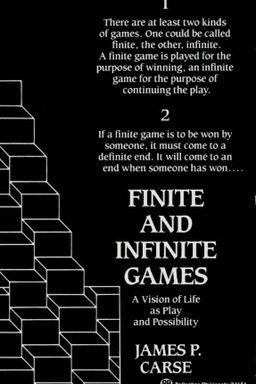
Have you ever caught yourself chasing a goal—maybe a promotion, a prize, or even an argument win—only to wonder what happens after you achieve it? James P. Carse’s Finite and Infinite Games begins with this very question. He argues that nearly everything we do can be understood as a kind of play, but there are two very different kinds of games we can play with life itself: finite games, played to win, and infinite games, played to continue the play.
Carse’s deceptively simple distinction opens a radical way of seeing art, politics, love, science, religion, and even death. In Finite play, we fight for titles, trophies, and the power that follows them. In Infinite play, we live for growth, transformation, and the deep joy of ongoing participation. The book’s purpose, Carse tells us, is not just to describe these two ways of playing—but to invite us to choose to live infinitely, knowingly, and playfully, rather than seriously, competitively, and fearfully.
Finite Play: The Game of Winning
Finite games—everything from football to courtroom battles to corporate careers—are designed for an ending. They have explicit beginnings, rules, players, and goals. Whoever wins claims a title, a public recognition that marks the game’s close. As Carse writes, a finite player plays to be powerful, to resolve the drama, and to become a "winner." Finite games are serious, not playful. They depend on self-forgetting—taking on roles like mother, lawyer, or patriot so seriously that they seem compulsory rather than freely chosen.
Finite players pursue eternity through victory, but ironically their achievements depend entirely on the consent of others. A general’s military glory only exists because others agree to call the war finished. A CEO’s power depends on employees who agree to recognize it. Power, Carse reminds us, is never one’s own—it is granted. Thus, finite play inherently contradicts itself: it aims for control and closure, yet depends on the constant cooperation of others to exist at all.
Infinite Play: The Game of Continuing
Infinite play is the opposite impulse. It has no beginning or end, no outer boundaries of time or space. Its players change the rules as they go, not to cheat, but to ensure that play continues. The point is not to win but to deepen the play itself—to move always toward the horizon, not toward a finish line. Infinite players do not take their masks too seriously; they wear them knowingly, creatively. They play roles within life without mistaking them for life itself.
In infinite play, the essential challenge is not how to find respite from life's finite demands, but how to keep play alive within them. Politics, property, sexuality, and art—all of which societies try to fix and define—are reinterpreted as living, creative, open-ended dialogues. Infinite players live in paradoxes rather than contradictions: they play as mortals, not to defeat death, but to include it within their play. Their reward is not a title but a name—the continuing identity of a being in motion.
The Stakes: Seriousness vs. Playfulness
Why does this distinction matter? Because, Carse argues, most of human history—and our personal anxieties—stem from forgetting that the finite games we invent are self-imposed. We make rules, hierarchies, nations, institutions, and then deceive ourselves into believing they are necessary, natural, or divinely ordained. This forgetfulness makes life heavy, serious, and violent. "Whoever must play, cannot play." Seriousness is the death of play.
By contrast, infinite play restores the lightness of being. Just as an artist plays with materials to reveal new meanings, infinite players play with boundaries to keep expanding possibility. This way of life rejects final victories and instead cultivates joy in continual becoming. Freedom, for Carse, is not the absence of constraint; it is the continual re-creation of rules through mutual choice. To live infinitely is to live generatively—politically without having a politics, religiously without a religion, artistically without a script.
From Society to Culture, from Control to Creation
This overarching distinction stretches across the whole book. Where finite play creates society—bounded, ranked, rule-driven—Infinite play generates culture: open, spontaneous, self-renewing. Finite play seeks to control nature through technology and mastery; Infinite play tends the garden of nature by responsiveness and respect. Finite players fight wars for boundaries; Infinite players seek horizons and vision. Even art, Carse suggests, turns from property to poiesis—the creative happening that keeps culture alive.
In short, this is no mere philosophical abstraction. It is a call to live differently. Carse’s vision suggests that each time you choose curiosity over control, dialogue over dominance, or laughter over seriousness, you become an infinite player. You move from the theater of finite outcomes into the drama of infinite possibility.
“The joyfulness of infinite play lies in learning to start something we cannot finish.”
That is the book’s paradoxical promise: the deepest fulfillment in life is not to finish anything, but to live continually in play. Throughout the subsequent key ideas, we’ll explore how Carse applies this lens to freedom, power, property, sexuality, art, culture, and the natural world—each one a chapter in humanity’s ongoing infinite game.