
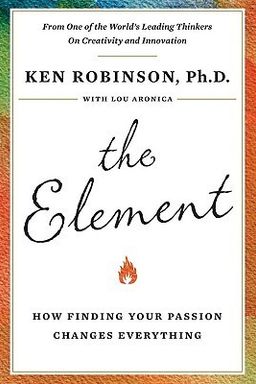
Finding Your Element cover

Finding Your Element

by Ken Robinson

Finding Your Element by Ken Robinson is a transformative guide to discovering your unique talents and passions. With wit and wisdom, it offers practical advice to reorient your life, enhancing productivity, happiness, and overall quality of life.

Finding Your Element: Where Passion Meets Purpose

What would your life look like if you spent most of your time doing what feels completely natural—work that energizes rather than drains you? In Finding Your Element, Sir Ken Robinson argues that every person has a deep well of natural talent and innate passion waiting to be discovered. When those two forces—aptitude and passion—intersect, you enter your “Element,” the zone where your life’s potential and purpose align.

Robinson contends that modern society, particularly through its education and work systems, has conditioned people to ignore their unique gifts. Instead of cultivating creativity and curiosity, we’re trained to follow conventional paths and make safe choices. The result? Too many people endure their lives rather than enjoy them, waiting for weekends or retirement to feel alive. As Robinson puts it, finding your Element isn’t just about career; it’s about discovering who you really are and living a life filled with passion, meaning, and joy.

A Quest of Inner and Outer Discovery

The book frames finding your Element as a quest—a journey of self-discovery and risk-taking. Like all quests, it involves both an inner and outer journey. The inner journey is about self-reflection: exploring your aptitudes, passions, attitudes, and sense of happiness. The outer journey is about translating those insights into tangible opportunities and environments where your talents can flourish. This dual navigation mirrors the Hero’s Journey described by Joseph Campbell (whom Robinson invokes): venturing into unfamiliar territory, facing obstacles, finding mentors, and returning transformed.

Robinson insists that this pursuit isn’t a 10-step formula—it’s an organic process shaped by curiosity, imagination, and courage. What defines success is not a rigid destination but the capacity to explore, adapt, and grow from experience. As he writes, “Your life is unique. You create your own life. And your life is organic.”

Why It Matters—Personally, Socially, and Economically

Robinson argues that finding your Element matters on three levels. First, it’s personally essential—it brings purpose, fulfillment, and energy, enabling you to live authentically rather than mechanically. Second, it’s socially vital—many societal problems stem from people being disengaged from their work and education. Too many students feel alienated, and too many professionals work in jobs that dull their spirits, leading to widespread depression and disconnection. Finally, finding your Element has profound economic implications. In an era of constant change, creativity and adaptability—not rote skills—are the markers of success. When people do what they love and are good at, organizations thrive, innovation blooms, and societies progress.

How This Book Guides You

Robinson structures Finding Your Element as a practical companion to his earlier work The Element. While the first book inspired people to rethink their approach to creativity and talent, this one offers hands-on methods to help you discover your own path. Across ten chapters, Robinson blends stories, exercises, and research to help you uncover what makes you tick:

  • Understanding your natural aptitudes and how to recognize hidden talents
  • Distinguishing between skills you’re good at and those that truly excite you
  • Learning how attitude shapes your success as much as ability
  • Exploring happiness, meaning, and positive emotions as keys to fulfillment
  • Finding your “tribe”—others who share and nurture your passions
  • Mapping out your next steps toward a life of passion and purpose

From Insight to Action

Robinson urges readers not just to reflect but to act. He includes creative tools like mind maps, vision boards, automatic writing, and meditation exercises—methods designed to bypass surface-level thinking and reach deeper insight. These techniques echo approaches used by Julia Cameron (The Artist’s Way) and Tony Buzan (The Mind Map Book), turning abstract introspection into tangible exploration.

“Being in your Element is not merely doing what you’re good at—it’s doing what you love. When you lose track of time and feel most yourself, that’s when you know you’re there.”

The Human Element

Ultimately, finding your Element is about redefining success—not as accumulation or status, but as alignment with your authentic self. It’s about moving from passive existence to active living, from following expectations to pursuing discovery. Robinson’s message is both revolutionary and compassionate: our world wastes enormous potential when people’s talents go unrealized. By finding your Element, you don’t just enrich your own life—you contribute your creativity and vitality to the collective fabric of humanity.


Understanding Your Natural Aptitudes

Ken Robinson begins with the foundation of your Element: your natural aptitudes. These are not learned skills but innate inclinations—abilities you were born with that make some things feel effortless. You may instinctively understand numbers, rhythms, designs, or interactions. They are the raw materials of your potential, waiting to be refined through practice and experience.

Aptitude vs. Ability

Robinson differentiates between aptitude—your inherent leanings—and ability—skills developed through learning and discipline. Having aptitude doesn’t guarantee mastery; it simply makes learning more natural. For instance, language aptitude enables you to grasp words quickly, but only practice makes you a skilled writer or speaker. This duality between nature and nurture parallels the views of psychologists like Howard Gardner (Frames of Mind) on multiple intelligences—each person possesses distinct cognitive strengths, but these must be cultivated.

Hidden Depths and Missed Chances

Many of us never discover our aptitudes because the right circumstances don’t arise. Robinson uses El Sistema in Venezuela—a classical music program started by José Antonio Abreu—as an example. Thousands of children from impoverished backgrounds discovered musical talent they’d never known existed simply because they were given instruments and mentorship. Without such exposure, their gifts would have remained buried. The lesson? You may be far more capable than your environment has allowed you to realize.

The Role of Opportunity

Discovering aptitude requires experimentation. Robinson shares stories like Jamie Oliver, who “blossomed in the kitchen” despite academic struggles, and Elizabeth Payne, who found costume design after her mother’s art hobby sparked her creativity. Others, like Noppadol Bunleelakun—a blind jazz pianist—prove that adversity can reveal unexpected talent. The pattern is clear: aptitude emerges when curiosity and opportunity intersect.

Testing and Reflection

Robinson points out that standardized aptitude tests can sometimes help—but warns against taking them too seriously. Generic quizzes often exploit the Barnum Effect, tricking you into identifying with flattering but inaccurate statements. Instead, real insight comes from self-observation and experience. He recommends creative methods: mind mapping, journaling, and even autobiographical interviews (like those used in Brian Schwartz’s holistic SuccessDNA program). The goal isn’t labeling yourself—it’s remembering times when you felt alive and capable.

“Finding your aptitudes is not about choosing from a list—it’s about noticing where your energy flows naturally and following that current.”

When you understand your aptitudes, you gain a sense of confidence and direction—a compass pointing toward environments where you’ll thrive instead of struggle. Robinson concludes that knowing what you’re naturally good at is the first essential step in discovering what you’re meant to do.


Discovering What You Love

You can be good at many things but still feel empty doing them. Ken Robinson insists that your Element is not just about competence—it’s about love. Passion fuels purpose, and purpose sustains growth. The activities you love draw you in so deeply that time seems to disappear; they nourish your spirit rather than deplete it.

The Power of Passion

Robinson explores passion through vivid examples. Emily Cummins, for instance, fell in love with invention while hammering nails with her grandfather as a child. That early spark led her to design sustainable devices for impoverished communities in Africa. Her story illustrates how passion transforms challenges into purpose. Similarly, Randy Parsons rediscovered his love of guitars—not by playing them, but by building them from scratch after a visionary moment in the shower. His passion turned into mastery, leading him to craft instruments for legends like Jack White and Jimmy Page.

Energy and Spiritual Connection

Passion ignites what Robinson calls spiritual energy. When you’re in your Element, you gain energy instead of losing it—it’s a human symphony of vitality. He distinguishes between physical energy (which relies on sleep, diet, and movement) and spiritual energy (which depends on emotional engagement). You might feel tired after hours of work, yet inwardly alive and fulfilled. This alignment, Robinson says, is the surest sign you’ve found your Element.

Internal Motivation Over External Reward

Drawing on creativity researcher Teresa Amabile, Robinson argues that internal motivation trumps external incentives. True passion pulls you forward from within; it’s not a carrot dangling from outside. You work harder because you love the process, not just the reward. This explains why people like musician Hans Zimmer—who can’t even read traditional notation—created groundbreaking film scores simply by following his instinct for patterns and sound. Passion sharpens focus and calls forth genius.

Love as a Choice

You may wonder: what if I have no passions? Robinson reassures that passion is rarely absent—it’s simply undiscovered or dormant. You uncover it through exploration and play, not analysis. He encourages you to ask two questions: “What do I love?” and “What do I love about it?”—questions that shift your attention to the emotional core of enjoyment. Sometimes, finding your Element feels like falling in love at first sight, as when a school visitor realized he was meant to be a chef after stepping into a kitchen. Other times, it blooms gradually, as it did for his wife Thérèse, who discovered her passion for writing midlife after decades of teaching and parenting.

“If you love what you do, you’ll never have to work a day in your life—but you will live every day with purpose.”

Love isn’t a sentimental cliché—it’s a guiding force. When you align passion with aptitude, you create a life not just of productivity but of meaning. Finding what you love begins with listening to your own spirit and refusing to settle for less than joy.


Attitude Shapes Destiny

Once you know what you’re good at and what you love, Ken Robinson says there’s still one decisive factor: your attitude. Talent and passion mean little if you lack the courage, perseverance, and optimism to pursue them. Your mindset determines whether your Element remains a fantasy or becomes a reality.

Fixed vs. Growth Mindset

Robinson draws heavily on psychologist Carol Dweck’s concept of the “growth mindset.” A fixed mindset believes ability is innate and unchangeable; a growth mindset sees it as improvable through effort. Those with fixed mindsets doubt their capacity to change, while growth-oriented people embrace challenges as part of learning. Sue Kent—a massage therapist born with severely underdeveloped arms—exemplifies this. Using only her feet, she developed a thriving practice and worked with British Paralympians, proving that attitude can turn obstacles into innovation.

Seeing Possibility Instead of Limitation

Like Jef Lynch, the mechanic turned teacher who refused to see barriers, Robinson encourages you to challenge your assumptions about what’s possible. Lynch rose from neighborhood garage work to writing technical manuals for General Motors. He succeeded not because he was qualified by degrees, but because he stepped forward with confidence when others hesitated. His motto—“I don’t see the barriers other people see”—illustrates the transformational power of perception.

Your Temperament and Disposition

Your overall outlook—whether you see your glass half full or half empty—shapes how you handle challenges. Robinson explores personality dimensions from ancient typologies (like Hippocrates’ humors) to modern ones (Myers-Briggs). None of these, he warns, define you completely but can provide insight. For instance, whether you’re introverted or extroverted affects where you draw energy: solitude for introspection or social environments for stimulation. Understanding your temperament helps you design contexts—jobs, communities, or hobbies—that suit your natural rhythm.

Courage and Self-Belief

Robinson insists that attitude is not merely optimism—it’s self-belief in action. It’s the willingness to sail into unpredictable seas, as Ellen MacArthur did when she left England at eighteen to become the world’s fastest solo sailor. Her journey defied expectations and embodied what Robinson calls the “growth mindset”—a faith that learning and persistence outweigh fear. Whether you’re shifting careers, starting a creative project, or confronting doubt, the key is to act, not merely wish.

“In the end, it’s not your abilities that define you—it’s your attitude toward them.”

By cultivating courage and flexibility, you transform uncertainty into possibility. The quest for your Element isn’t guaranteed to be smooth—but with the right mindset, every challenge becomes a stepping-stone rather than a wall.


Redefining Happiness Through Purpose

Ken Robinson explores happiness not as fleeting pleasure but as sustained well-being. To be happy, you must live with purpose—doing what fulfills you while serving something larger than yourself. Many people mistakenly chase happiness through success, wealth, or status, only to realize those attainments don’t satisfy the soul.

Beyond ‘If Only’ Thinking

Robinson critiques the illusion of happiness built on “if only” conditions: “I’d be happy if I had more money… more time… a better job.” True happiness doesn’t hinge on circumstances. Studies cited from Sonja Lyubomirsky and Andrew Weil show that life satisfaction stems less from external achievement than from inner alignment—knowing you’re living the life you were meant to live. This state arises naturally when you’re in your Element.

The Role of Meaning

Drawing from Viktor Frankl’s Man’s Search for Meaning, Robinson reveals that purpose transforms suffering into growth. Frankl’s logotherapy taught that meaning sustains life even in hardship. Yasmin Helal, a Cairo engineer and basketball player, discovered this firsthand when she left her job to start Educate-Me, an organization sponsoring underprivileged children’s schooling. Her story demonstrates that happiness deepens when your actions serve others, aligning both personal fulfillment and social contribution.

Well-Being and Balance

Building on Martin Seligman’s model of well-being, Robinson identifies five pillars: positive emotion, engagement, meaning, relationships, and achievement. These echo Gallup’s global research on happiness, adding career fulfillment—doing work you love—as a cornerstone. People who feel purpose in their everyday work are twice as likely to report high well-being. Without that sense of meaning, other areas—health, social life, finances—inevitably suffer.

Creating Happiness Through Behavior

Your choices, Robinson insists, account for a large share of happiness. Genetics and circumstance play roles, but intentional actions—what you do daily—shape your emotional climate most. Practices like mindfulness, gratitude, creative play, and volunteering expand joy. Buddhist monk Matthieu Ricard, dubbed “the happiest man in the world,” calls happiness a skill: one you develop through awareness and compassion. Robinson shares this view—happiness arises when you align your energy with your values.

“Happiness arises spontaneously when what you do and who you are finally align.”

Finding your Element transforms happiness from a pursuit into a byproduct of purpose. When you live from your passions, the joy that once seemed elusive becomes simply how you move through the world.


Finding Your Tribe

Ken Robinson reminds us that creativity and growth rarely happen alone. Your ‘tribe’—the people who share your interests and values—can become the ecosystem that sustains your Element. Tribes provide affirmation, collaboration, guidance, and inspiration, helping you deepen your craft and thrive in connection.

Affirmation and Belonging

When you find others who speak your creative language, you gain validation. Robinson compares this to “companion planting” in a garden: certain plants grow better together, just as people whose energies align amplify each other. El Sistema showed how orchestras give children not only musical skill but belonging. Neroli Makim, the Australian artist who left office life for creative freedom, found her tribe among other creators who valued authenticity over conformity.

Collaboration and Mentorship

Tribes can offer guidance and mutual learning. Robinson recounts how blogger Chris Bird built BirdBanter Media after connecting with experienced “mompreneurs” like Barb Likos, who freely shared expertise. Similarly, lawyer Kimberley Spire-Oh found her calling in special education advocacy and was mentored by others in her field. In true tribes, competition gives way to collaboration—members help one another because they care about shared purpose more than personal gain.

Inspiration and Growth

Tribes raise collective standards. The New Nordic Cuisine movement, launched by Danish chefs Claus Meyer and René Redzepi, demonstrates how collaboration can revolutionize a field. Their joint manifesto transformed Scandinavian cooking into an internationally admired art form. Similarly, writer Ethan Cross found validation and confidence through his tribe at ThrillerFest, a conference of thriller authors. Within tribes, inspiration multiplies—each achievement sparks another.

Finding Your Community

  • Use online platforms and social media to connect with people who share your interests.
  • Join associations or attend meet-ups to experience real-world energy and exchange.
  • Consider volunteering, taking classes, or becoming an intern to learn alongside your peers.
  • Seek mentors—those who model the creative courage you aspire to.

“When you find your tribe, you find both the mirror that reflects your best self and the wind that carries you forward.”

No discovery happens in isolation. The people who understand your journey help you celebrate successes, survive failures, and sustain your purpose. Finding your tribe, Robinson concludes, is finding the community that makes your Element thrive.


Taking Action and Living with Purpose

The final step in Finding Your Element is turning insight into action. Ken Robinson insists that reflection means little unless you move forward. Life is organic, not linear—you can’t plan every detail, but you can steer your ship. Each choice is a stroke that shapes your journey.

Start Where You Are

You don’t need perfect conditions to begin. Robinson illustrates this through Mariellen Ward, who—after personal losses—rediscovered purpose by traveling to India and writing about transformation. Others, like Mark Frankland, found their path unexpectedly when job loss forced them to explore passions they had long suppressed. Wherever you start, momentum builds once you act.

The Power of Imagination

Imagination, Robinson says, is your greatest creative resource. It allows you to envision possibilities beyond current reality. Like pathologist Dr. Jeffrey Myers, who returned to his teenage passion for rock music after decades in medicine, imagination lets you reconnect with forgotten dreams. It reminds you that you can reinvent yourself at any age. (Civic Ventures’ Purpose Prize for innovators over 60 proves that reinvention transcends youth.)

Courage in Uncertain Waters

Robinson closes the book with real-world insight from motivational writer Bronnie Ware, who recorded the most common regrets of the dying: not living true to oneself, working too hard, suppressing feelings, neglecting friendships, and not allowing happiness. Each regret underscores the urgency of acting now. As Mark Twain said, “Throw off the bowlines. Sail away from the safe harbor. Catch the trade winds in your sails.”

Organic Progress

Begin with what Robinson calls an “initial action plan.” Create overlapping circles—aptitudes, passions, attitudes, and opportunities—and identify next steps in each. Instead of rigid goals, treat your plan as a living map that adapts as you grow. Whether your dream is to start a nonprofit, write a book, or learn tango, progress will come from small, consistent actions.

“There is nothing more painful than remaining tight in a bud when you were meant to blossom.”

—Anaïs Nin, cited by Ken Robinson

To live a life of passion and purpose is to honor that blossoming—to trust your own timing, follow curiosity, and act with faith even when the path is unclear. You don’t need to see the whole staircase, Robinson reminds us—just take the first step. Because in each step toward authenticity, you not only find your Element, but you find yourself.

Dig Deeper

Get personalized prompts to apply these lessons to your life and deepen your understanding.

Go Deeper

Get the Full Experience

Download Insight Books for AI-powered reflections, quizzes, and more.