
Idea 1
Finding and Nurturing the Next Steve Jobs
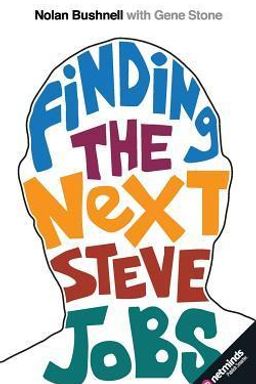
How do you find the next revolutionary thinker—the next Steve Jobs—in a sea of resumes and rule-followers? In Finding the Next Steve Jobs: How to Find, Keep, and Nurture Talent, Nolan Bushnell, the founder of Atari and Chuck E. Cheese’s, argues that the key to innovation lies not in rigid corporate hierarchies or polished credentials, but in cultivating creativity at every level of your organization. Creativity, he insists, isn’t optional; it’s the very engine of progress, survival, and competitive advantage in today’s accelerating world.
Bushnell’s book—half memoir, half management manifesto—spins out from his own encounter with a young, barefooted Steve Jobs at Atari in the 1970s. Back then, Jobs wasn’t yet the world-changing figure he’d become, but even in his unwashed jeans he radiated a rare intensity and vision. Bushnell realized something profound: while everyone wanted a Steve Jobs, almost no company created an environment where a Steve Jobs could thrive. This insight became the foundation for the book’s fifty-one “pongs”—his playful term for pieces of situational advice, as flexible as the simple bouncing ball in Atari’s first game.
Creativity Is the Ultimate Competitive Advantage
Bushnell opens by asserting that every company, whether it builds software or sells soap, lives and dies by its capacity for creativity. In an economy moving at unprecedented speed, the ability to learn and adapt faster than competitors (echoing Peter Drucker) is the only sustainable advantage. Rules, routines, and bureaucracy—the trappings of the industrial age—now hinder innovation. As Bushnell says, most organizations are overrun by people who manage the past rather than invent the future. The future belongs to those who make room for creative thinking.
To show what this looks like in practice, Bushnell draws from his storied career. At Atari, corporate life mixed with play: jungle-themed lobbies, Friday beer parties, spontaneous experiments, and weird titles created an ecosystem that functioned as both workplace and advertisement for creativity. Out of this quirky, anarchic energy came pioneers like Jobs and Al Alcorn—the engineer behind Pong—proving that when people have freedom to explore, genius surfaces naturally.
Rules Kill, Flexibility Revives
The most radical proposition Bushnell offers is to replace rules with pongs. Rules, he says, are blunt instruments—policies that smother edge cases and exceptional people. A pong, by contrast, is adaptive wisdom: guidance applied only when useful. For example, at Atari a “no dogs” policy would’ve cost them a brilliant engineer who refused to work anywhere his dog wasn’t welcome. So Bushnell scrapped the rule, created exceptions, and even “hired” the dog. Creativity depends on this kind of flexibility, where exceptions aren’t seen as threats but as sparks.
In this spirit, he encourages managers to turn their companies into creativity incubators—playgrounds where experimentation triumphs over conformity. As he reminds readers, the most successful enterprises in history reinvented themselves constantly: Tiffany’s evolved from stationery to luxury jewelry, 3M from minerals to Post-it Notes, and Nokia from paper mills to mobile phones. Reinvention, not repetition, defines longevity.
From Finding to Keeping Geniuses
The book divides into two halves: first, how to find the next Steve Jobs; second, how to keep and nurture them. In the first section, Bushnell dives into unconventional recruiting—from judging candidates by their passions and hobbies to hiring “obnoxious” geniuses and “crazy” visionaries others overlook. He urges leaders to ignore traditional credentials and instead look for curiosity, resourcefulness, and obsession—qualities colleges can’t teach. A great hire, he says, may be the tattooed dropout who spends weekends soldering robots or running a Dungeons & Dragons club. Those quirks aren’t liabilities—they’re predictive of creative drive.
The second section focuses on retention: how to create ecosystems where eccentric, brilliant people actually want to stay. Bushnell advocates celebration, anarchy, humor, and fairness. He promotes what Google later echoed as its “20 percent time”—structured chaos in which experimentation is expected. He praises pranks (as long as they stay good-natured), flexible structures, and small “skunkworks” teams isolated from corporate sclerosis. Rules, he insists, should be ducked; accountants should not run the show; naps should be institutionalized; and risk—and failure—should be celebrated. A company that punishes misfires destroys the very creativity it claims to value.
Why It Matters Now
Bushnell’s argument feels especially relevant in an era of automation and rapid change. When AI transforms routine work, creativity becomes humanity’s last great advantage. Yet, paradoxically, most organizations still structure themselves to suppress it. They hire for “culture fit,” reward predictability, and fear chaos. Bushnell says real innovation requires courage—to hire misfits, to risk embarrassment, to throw dice and reorder the rules. “You must act!” he commands in his final pong. Ideas, like electrons, die if they aren’t set in motion.
Ultimately, Finding the Next Steve Jobs is as much a reflection on human potential as a handbook for corporate reinvention. Bushnell reminds us that behind every breakthrough—be it Pong, Apple, or Pixar—stood someone willing to bet on creativity when others played it safe. If you want to lead such breakthroughs yourself, his message is simple and urgent: stop looking for rules to follow. Instead, build places where the weird, the wild, and the brilliant want to work—and then get out of their way.