
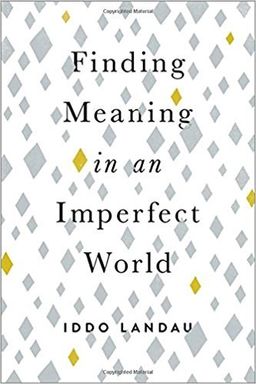
Finding Meaning in an Imperfect World cover

Finding Meaning in an Imperfect World

by Iddo Landau

Finding Meaning in an Imperfect World demystifies the pursuit of life''s meaning. Iddo Landau skillfully guides readers through philosophical insights and practical advice, showing how everyone can discover and enhance meaning in everyday life, irrespective of life''s imperfections.

Meaning as Value and the Art of Living Well

Why do so many intelligent people claim that life has no meaning? Israeli philosopher Iddo Landau argues that this despair often rests on a confusion: we equate “meaning” with cosmic significance or flawless achievement, when what we really mean is value or worth. In Finding Meaning in an Imperfect World, Landau systematically dismantles perfectionist and pessimistic assumptions, urging you to recognize that life’s worth is plural, gradational, and recoverable even under loss, suffering, and mortality.

Landau’s core claim is disarmingly humanistic: to say life is meaningful is to say that it contains enough of what is truly valuable. From that premise, he rebuilds a practical philosophy that combines analysis, moral psychology, and existential care. Drawing on thinkers from Tolstoy to Frankl and Nagel, he tells you that meaning is not a mystical formula but an evaluative question you can investigate, debate, and reform in practice.

The Nature of Meaning: Worth, Not Wordplay

When you ask if life has meaning, you are not asking a linguistic question (“what does the word life mean?”) but an evaluative one (“is my life worth having?”). Landau shifts the conversation from abstract metaphysics to ethical clarity: meaning equals value in its broadest sense—love, knowledge, creation, or moral excellence—whatever genuinely enriches existence. Complaints of meaninglessness, he shows, usually signal a perceived loss of worth rather than an intellectual discovery about the universe.

(Note: This echoes Viktor Frankl’s insight that even in concentration camps, meaning persisted when prisoners focused on what they still valued—helping others, recalling beauty, or preparing to love again.)

Degrees, Changeability, and the Myth of All-or-Nothing Meaning

For Landau, meaning exists along a spectrum; you are never purely meaningful or meaningless. Most lives fall in the middle, shifting as love, creativity, education, or illness reshape your values. Perfectionist all-or-nothing thinking—demanding divine purity before calling life valuable—creates emotional torture and intellectual confusion. When you feel empty, you are usually facing a decrease, not total erasure, of meaning. And because value can increase again through reflection and deliberate effort, the sense of meaninglessness is often treatable, not final.

Rejecting Perfectionism and Reclaiming the Ordinary

Landau’s fiercest target is perfectionism—the claim that only extraordinary achievements justify existence. He replies that such standards are inconsistent, cruel, and corrupting: we don’t call our friends’ love worthless because it isn’t Shakespearean. Meaning belongs also to the modest and the partial. Drawing on religious and literary traditions—the Hasidic benoni, Voltaire’s “we must cultivate our garden,” Hesse’s river scenes—Landau defends nonperfectionism as both philosophically coherent and emotionally liberating. Ordinary life, lived attentively and kindly, offers more than enough moral substance to ground meaning.

(Parenthetical note: The Stoics and Buddhists reach similar conclusions—tranquility and right attention, not superhuman exploits, underwrite value.)

Facing Death, Contingency, and Cosmic Insignificance

Landau directly handles the classic threats: death, determinism, and the cosmic scale. Against Tolstoy’s terror of annihilation, he argues that finitude diminishes but does not nullify worth. Your joys, loves, and virtues remain real even if time will wash them away. From the cosmic perspective, your life may look small, but smallness is not worthlessness: standards of human value—kindness, understanding, art—do not depend on astrophysical size. And determinism does not erase meaning either, since many valuable activities—comprehension, affection, moral learning—do not require metaphysical libertarianism to matter.

The Work of Recognition and Choice

Even when objective goods exist, you can fail to see them. Habituation, bitterness, and perfectionism numb perception. Landau trains you to recover “recognition”—the ability to notice and feel the worth that already surrounds you. Through thought experiments (negative visualization, aesthetic attention), you reawaken gratitude. He also supplies clear tools for discovering additional meaning: asking what you admire, running “deathbed” tests, and experimenting with feasible, incremental changes rather than grandiose self-overthrows. The goal is balance: cultivate both recognition and achievement, both constancy and growth.

Hope in a Finite, Imperfect World

For Landau, salvation comes not from cosmic guarantees or heroic autonomy but from learning to adjust your evaluative lens. Religion can inspire, but meaning can thrive in secular life too. Instead of despairing that humanity is corrupt (a view the media often reinforces), you can counterbalance with the truth of goodness—ordinary decency and cooperation quietly sustain our species. Above all, Landau leaves you with an ethical optimism: meaning is plural, resilient, and partially within your control. You achieve it not by being flawless, but by valuing intelligently and living fairly.

Core Understanding

Meaning is not rare genius or divine revelation. It is the texture of a life shaped by discernment, fair self-judgment, loving involvement, and the deliberate noticing of value. The world’s imperfection is not a refutation of meaning—it is the medium through which we earn and understand it.


Gradations and Growth of Meaning

Landau insists that meaning unfolds along a continuum—from shallow to deep—not as a switch that flips on or off. Like happiness or beauty, it can increase or decrease, and that realization gives you both diagnostic and therapeutic power. You do not suffer from the absence of meaning so much as from its insufficiency.

Avoiding All-or-Nothing Thinking

When you say, “My life is meaningless,” you likely exaggerate, overlooking parts that remain worthwhile. A parent grieving a child or an ex-idealist after political disillusionment experiences a deficit in one domain, not the nullification of all value. Recognizing degrees lets you treat your life as improvable, not bankrupt, and motivates realistic restoration rather than despair.

Thresholds, Standards, and Self-Compassion

Each person sets a private threshold for what counts as meaningful. Perfectionists put it so high they rarely clear it; others place it too low and stagnate. Landau advises adjusting your bar with fairness. Treat a good life as good even if it’s not the best. This simple cognitive shift reduces unnecessary suffering and opens appreciation of incremental progress.

Practical Agency

Because meaning changes, you have agency: by fostering valuable relationships, learning, or artistic practices, you can usually move upward on the scale. You can also diversify your sources of meaning—family, art, morality, curiosity—so that loss in one area does not collapse your entire world. This principle of diversification makes meaningfulness more resilient and attainable.

Key Reflection

Meaning seldom dies outright; it fades and can be rekindled. By treating it as quantitative and improvable, you regain control over the story of your life.


Rejecting Perfectionist Traps

Landau devotes early chapters to dismantling the assumption that meaning requires greatness. Perfectionism measures value by rarity—so only Mozarts and saints qualify. Against this, Landau offers six objections and an alternative mindset grounded in realism and kindness.

False Standards, Cruel Demands

Perfectionist metrics are inconsistent (we accept mediocre landscapes as beautiful yet demand cosmic excellence from human lives), implausible (no finite creature can be omniscient or eternal), and cruel—encouraging continuous self-blame. Treating 98% as failure erases joy and blocks gratitude. Perfectionism also masks vanity: the wish to be unique in glory rather than simply good.

Competitive vs Noncompetitive Goods

Landau distinguishes competitive value (stemming from rarity) from noncompetitive value (stemming from inherent worth). You cannot measure love or decency by medals. When you apply competitive logic everywhere, you trivialize life’s nonrival treasures. The corrective is humility: you are meaningful not because you outshine others, but because you participate in enduring kinds of value.

Cultural Continuities of Nonperfectionism

Traditions across faiths and art already celebrate ordinary virtue: the benoni of the Tanya, Voltaire’s gardener, Hemingway’s careful fisherman, Bergman’s domestic vision in The Seventh Seal. These works affirm repair, attention, and care as meaningful acts. Ordinary life is not failure; it is the field of attainable goodness.

Moral Lesson

Reject cruel standards that demand divinity from humans. Perfectionism blinds you to real worth and turns self-evaluation into psychological violence.


Finitude, Freedom, and Cosmic Scale

You might fear that mortality, determinism, or cosmic smallness makes life meaningless. Landau replies that these threats distort scale or misapply categories: finitude changes meaning’s extent, not its possibility.

Death and Continuity of Worth

Death limits time but does not erase the value of what occurred. Like a tree that bore fruit, your life retains the goods it generated. Sisyphus is absurd because his labor is empty and forced, not because all effort is finite. Bernard Williams’s argument that immortality bores us suggests that mortality may even preserve freshness and urgency.

Determinism and Contingency

Even if every choice is caused, meaningful activity survives. Acting from your own deliberation, loving, creating, or learning still carry internal value. Likewise, life’s contingency—its reliance on accidents—does not nullify worth. A painting’s chance colors can still move you profoundly.

Cosmic Insignificance and Human-Scale Standards

From a cosmic view, your actions alter almost nothing, but that scale is irrelevant to meaning. Standards of love or justice remain valid at human resolution. (Landau notes: even a theistic God, aware of galaxies, could still care for a single act of kindness.) Therefore, perspective does not equal standard; you can be cosmically small yet existentially full.

Guiding Thought

You need not conquer eternity to make life matter. Finitude and causation frame your story—they do not cancel its meaning.


Purpose, Knowledge, and Value Relativism

Some fear that if we cannot know ultimate truth or agree on universal goals, meaning collapses. Landau’s response is pragmatic: doubt does not entail nihilism. You can have well-grounded values without certainty, and purposes without cosmic endorsement.

Fallibilism and Rational Confidence

You regularly rely on provisional knowledge in science or daily life. Treat moral and existential reasoning similarly: demand reasons, not absolutes. What matters is coherence, reflection, and action consistent with your best judgment.

Relativism Without Anarchy

Cultural and individual relativism simply note diversity of standards. They do not forbid rational preference or improvement. You can endorse local but robust goods—community service, art, love—as meaningful within your context. Not everything must be cosmically objective to bind or fulfill you.

Purpose and the Paradox of the End

Meaning can exist both in means and ends. But beware the paradox of the end: achieving goals often empties them of felt value. Mill’s breakdown after political success exemplifies this. The cure lies in choosing regulative, ongoing aims—learning, moral refinement— and cultivating intrinsic enjoyment in the process. Achievement should evolve into engagement, not exhaustion.

Working Principle

Seek ends that enrich experience both on the way and at arrival. Certainty is optional; participation and evaluation are enough.


Suffering, Evil, and the Search for Balance

When pain seems dominant and history overflows with cruelty, Landau invites you to resist fatalistic conclusions. He engages Schopenhauer, media bias, and moral psychology to argue that suffering and evil are serious but not totalizing.

Critiques of Pessimism

Schopenhauer’s claim that life’s pain outweighs its pleasure mistakes intensity for dominance and neglects adaptation and agency. Empirical studies show that many recover equilibrium after severe loss. As Viktor Frankl, Mother Teresa, and countless survivors show, meaning can coexist with agony when anchored in love or service.

Media and Historical Negativity Bias

Media and textbooks highlight catastrophe because it sells or appears eventful. The quiet millions of benevolent acts go unreported. This skews perception toward despair. Landau urges balance: seek stories of decency and improvement to restore a fair view of humanity.

Human Malleability and Hope

Experiments like Milgram’s are often oversimplified. Humans can be corrupted—but they can also learn and reform. Education, justice, and community build moral resilience. If malleability produces evil, it can equally produce goodness, and you can amplify that direction intentionally.

Ethical Balance

Suffering and evil diminish but don’t delete meaning. Recognize them, fight them, and remember: the unnoticed good remains vast, quiet, and real.


Recognizing and Cultivating Value

After dismantling false obstacles, Landau turns to practice: how to perceive, recover, and build meaning. Two complementary capacities—recognizing existing value and identifying future value—anchor his method.

Overcoming Blindness to the Good

You often miss nearby goodness because of habituation, perfectionism, or excessive criticism. Legal, journalistic, or academic work can narrow focus to faults. The cure involves rebalancing perception: use gratitude journaling, aesthetic close-looking, or Stoic negative visualization to re-sensitize appreciation. Realize that decent acts and small beauties already fill much of life’s landscape.

Self-Forgiveness and Fair Judgment

Landau coins the “Reversed Golden Rule”: stop treating yourself worse than you treat others. When you forgive others for limits but not yourself, you sustain unwarranted guilt. Correction lies in symmetrical compassion—judge yourself by the same humane scale you apply elsewhere.

Discovering and Choosing New Sources

Landau’s reflective questions help you find new or neglected sources of meaning: what would you regret on your deathbed? what do you admire in others? which pursuits already feel valuable? He warns against the “Strickland model” of abrupt self-erasure; gradual improvement often serves better. You can redesign meaning through feasible adjustments that integrate with existing goods.

Action Message

Notice what’s good, forgive your imperfections, pursue attainable values. Recognition is not complacency—it is the foundation of sane striving.


Integrating Lessons into a Meaningful Life

Landau concludes by uniting his theoretical and practical insights into a philosophy of everyday hope. Neither divine command nor cold existential heroism is required. Meaning is a human-scale craft, built by steady discernment, balance, and community.

Five Working Principles

  • Avoid perfectionism: most lives are imperfect but profoundly significant.
  • Be fair to yourself: cruelty achieves nothing; proportional self-critique allows growth.
  • Value your time: treat life as non-rehearsal; commit to what truly matters.
  • Work steadily and wisely: meaning needs practice, but rest and recognition sustain it.
  • Build companionship: friendships, families, and communities support and magnify meaning.

Hope Beyond Absolutes

Landau acknowledges religion as one rich source but not a necessity. Secular meaning grows where people act with care and comprehension. He closes with humility: philosophical reflection helps, but therapy, art, and love often complete the task. Life’s imperfection is not disproof—it is the condition that allows moral effort and appreciation.

Final Encouragement

Meaning is plural, partial, and achievable. You live well not by escaping imperfection, but by engaging it intelligently and gratefully.

Dig Deeper

Get personalized prompts to apply these lessons to your life and deepen your understanding.

Go Deeper

Get the Full Experience

Download Insight Books for AI-powered reflections, quizzes, and more.