
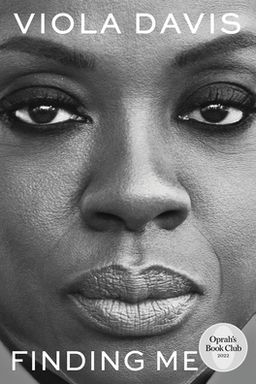
Finding Me cover

Finding Me

by Viola Davis

Finding Me is Viola Davis’ candid memoir, chronicling her journey from a childhood marked by poverty and trauma to Hollywood stardom. With raw honesty, Davis shares her struggles and triumphs, offering a powerful testament to resilience and the transformative power of embracing one’s past.

Finding Home Through Radical Self-Acceptance

How can you learn to stop running from your past and finally find home within yourself? In Finding Me, Viola Davis argues that true freedom isn’t found through fame, success, or external validation—it’s found in radical self-acceptance. Davis contends that the journey to self-love begins by embracing the wounds, secrets, and scars you’ve tried to forget. Only by acknowledging your pain rather than escaping it can you reclaim the power to be fully alive.

This memoir is both a personal excavation and a universal guide for transformation. Across her life story—from her dirt-poor childhood in Central Falls, Rhode Island, to her meteoric rise as one of the greatest actors of her generation—Davis shows how trauma, shame, and perseverance intertwine to create identity. She roots each lesson in vivid experiences: racial bullying, poverty, sexual abuse, and the complex love of her parents. Yet she also draws from her triumphs—her Juilliard training, Broadway successes, and Oscar-winning performances—to illustrate that personal healing is more courageous than public victory.

The Pain That Shapes Us

Davis begins with an image of herself running every day after school—literally chased by hatred and racism. That little girl, barefoot in the snow, becomes the metaphor for her life. Throughout the book, she wrestles with shame—the feeling of being “ugly,” unwanted, and invisible. As a child, she lived with hunger and fear, urinating in corners because her home had no functioning plumbing. When the world tells you that you aren’t worthy, Davis says, you begin to internalize that lie. The greatest tragedy isn’t the external abuse—it’s the moment you start believing it.

Healing Through Memory and Art

The turning point of her life comes during therapy, when she’s asked, “Can the eight-year-old girl who survived hug you now?” That moment reframes her pain: she realizes that her wounded child isn’t broken—she’s strong. Healing, Davis argues, isn’t erasing the past; it’s honoring the survivor who carried you here. She also equates this process with artistic creation, citing Joseph Campbell’s concept of the hero’s journey. An actor, like a hero, must confront her fears, swallow her shadow, and return transformed. In Davis’s case, acting isn’t about pretending—it’s about truth-telling. It becomes her vehicle for freedom.

The Intersection of Faith and Identity

Davis constantly references faith—not as religious doctrine, but as spiritual conviction. From Anton Chekhov’s epigraph about the necessity of believing in life’s meaning to her own prayers as a terrified child, faith is portrayed as both rebellion and survival. She connects her personal faith to the legacy of Black women like Cicely Tyson, whom she calls her muse. They believe in radical dignity—an insistence that even broken things are divine. For Davis, faith means persistence: staying alive until you can rewrite your story.

Finding “Home” as Self-Ownership

In the final chapters, Davis reframes success as finding home—not the physical kind but the emotional one where your lost selves can finally rest. She defines home as “the Viola of now,” a place where the past doesn’t rule but belongs. That home includes embracing the complexities of race, womanhood, and power. Her journey from poverty to Hollywood didn’t make her whole; what healed her was the ability to stand before the world unapologetically as herself. In rejecting perfection and embracing authenticity, Davis gives you permission to stop running too.

Key takeaway: Your story—every messy, painful part—isn’t what makes you less worthy; it’s what makes you human. The path to peace isn’t about fixing what’s broken, but holding it with love until it becomes something sacred.


Childhood as a Battlefield

Davis’s childhood in Central Falls is not romanticized; it is portrayed as a war zone. Her family lived in squalor within a condemned building at 128 Washington Street. Her father, Dan Davis, was a violent alcoholic and her mother, Mae Alice, bore the weight of both survival and motherhood. Rats, hunger, and humiliation were constants. Davis’s siblings formed a sisterhood platoon, unified by shared adversity. “We were soldiers fighting for significance,” she writes.

Survival as Identity

From early on, survival shapes Davis’s personality. Her mother’s lesson—“You jug ’em,” meaning fight back—instills defiance. Yet even that defiance comes wrapped in vulnerability. In one of her memories, she is chased daily by a gang of boys screaming racial slurs. When she confronts their leader and calls him Black, he hits her with denial and violence. That moment becomes her first confrontation with internalized racism. It teaches her that people will fight to reject their own reflection.

Family Patterns and Generational Trauma

Davis’s parents embody the inherited wounds of Jim Crow America. Her mother survived colorism and abuse in the South; her father was haunted by educational deprivation and racial humiliation at work. Both escaped through rage and addiction. Yet Davis finds compassion for them. They were victims of history, doing their best with broken tools. That realization—seeing parents as products of trauma rather than monsters—becomes foundational to her later forgiveness.

Imagination as Refuge

Even amid the chaos, creativity becomes survival. Davis and her sisters invent alternate worlds—playing Beverly Hills matrons or forming their musical group, the Hot Shots. Pretending isn’t escape; it’s resistance. It’s the first seed of her acting career and a coping mechanism to transmute pain into art. As she later learns from Joseph Campbell, heroes must descend into darkness to find their “elixir.” For her, that elixir begins in the make-believe of poverty.

Lesson: You can’t erase your origin story. The survival traits you learned in chaos may one day become the armor you need to lead others through their own darkness.


Art as a Path to Freedom

For Viola Davis, art is salvation. Her first exposure to real representation—seeing Cicely Tyson in “The Autobiography of Miss Jane Pittman”—is portrayed as a spiritual conversion. Tyson’s dark skin and regal beauty open a sacred door. Davis realizes that art can be a mirror for her existence. Acting becomes both vocation and therapy.

Performance as Healing

Davis’s early contests, like the skit competition “The Life Saver Show,” show how performing grants her belonging. When her sisters and she win, she feels momentarily seen—not as poor, but powerful. Yet Davis later recognizes that winning was a “smoke screen,” hiding the inner terror of her father’s violence. Art can offer temporary asylum, but real freedom requires truth beneath performance. (Compare this with James Baldwin’s idea that artists must disturb the peace before healing it.)

Training and Transformation

Her formal education at Rhode Island College and Juilliard refines technique but confronts racism. Juilliard, she says, “was about white excellence.” Black students were forbidden to perform jazz or gospel, pressured to neutralize identity to fit Eurocentric ideals. Davis rebels by writing essays and channeling what she calls her “warrior fuel” from Africa and ancestors. Her later trip to The Gambia becomes a catalyst—she discovers drumming, ritual dance, and the spiritual rhythm of the Mandinka tribe. “Africa exorcised my demons.” It reconnects her artistry to the body and soul of Black expression.

Theater as the Hero’s Journey

Davis frames her career through Joseph Campbell’s mythic lens. Each role is a call to adventure—Seven Guitars, Fences, Doubt, The Help, all demand descent into pain. Acting isn’t imitation; it is resurrection. It’s how she revisits the buried memories of Central Falls and transforms shame into empathy. For Davis, art becomes the means by which you stop running, confront ghosts, and come home to yourself.

Insight: Creativity isn’t escape—it’s confrontation. The stage isn’t where you pretend to be someone else; it’s where you finally meet who you’ve been avoiding.


Breaking the Silence of Shame

One of the most haunting themes in Finding Me is the weight of secrecy. Sexual abuse, poverty, and family violence linger like ghosts. Davis’s story challenges the culture of silence surrounding trauma, especially in Black families. “Secrets are what swallow us,” she writes. Her power lies in naming them.

Naming as Liberation

When she tells her mother about being sexually abused, silence fills the room. It’s not denial—it’s generational grief. Her mother’s own abuse becomes the unspoken thread connecting them. Davis realizes that secrecy is inherited trauma, passed down because shame feels safer than truth. Breaking silence means risking rejection but gaining voice. It’s how she reclaims her humanity.

Forgiveness Without Forgetting

Davis defines forgiveness as “giving up all hope of a different past.” It’s not condoning abuse or betrayal but releasing the fantasy that life could have been otherwise. She recounts forgiving her father, Dan Davis, when he grows old and tender. The man who once beat her mother now weeps through her Broadway performance of Seven Guitars. Forgiveness turns victims into storytellers—not erasing scars, but transforming them into maps of survival.

Core idea: Shame thrives in silence. Healing begins the moment you dare to speak the unspeakable and see yourself not as damaged, but as whole beneath the wreckage.


Love and Becoming Whole

The arrival of Julius Tennon, Davis’s husband, marks her emotional rebirth. After years of failed romances and loneliness, she prays for a partner who is “country, Black, an ex-athlete, already a father.” Weeks later, Julius appears—her answered prayer. Their relationship symbolizes adult love built not on rescue but reciprocity.

Partnership as Healing

Julius teaches Davis what safety feels like. His protectiveness—keeping a baseball bat by the door, attending church with her, helping her find joy in small rituals—replaces fear with trust. It’s her first experience of love that doesn’t demand invisibility. “I could create my own family,” she says. Through him, Davis redefines love from chaos to calm, from survival to peace.

Reclaiming Joy Through Motherhood

After years of surgeries and miscarriages, Davis adopts her daughter Genesis. She calls motherhood her “second baptism.” The process—background checks, home inspections, hundreds of pages of questions—mirrors her lifelong search for worthiness. But holding her child, she understands: “I mastered hard. Now I wanted joy.” Genesis becomes the living reflection of self-love embodied—a relationship that teaches her the power of nurturing without condition.

Marriage as Self-Definition

Even in marriage, Davis faces growth. She laughs about her wedding nightmares but interprets them spiritually: “Getting married is like dying of one self.” She describes three ceremonies, each representing rebirth. Partnership doesn’t complete her; it lets her witness her own evolution. Julius, like her art, becomes a mirror through which she finally sees herself whole.

Message: You can’t wait for others to love the parts of you you’ve abandoned. Healing relationships blossom only when you’ve learned to love yourself first.


Becoming Visible and Redefining Power

The final chapters of Finding Me chart Davis’s movement from invisibility to influence. Her rise—from Doubt to The Help to How to Get Away with Murder—becomes an allegory for reclaiming representation. She uses her platform to challenge colorism, sexism, and the dehumanization of Black women in art.

The Politics of Representation

Davis calls out Hollywood’s hypocrisy: she received Oscars yet was still offered bit parts playing maids or addicts. She notes how even Black directors preferred light-skinned leads to be “interchangeable.” Her groundbreaking role as Annalise Keating—a complex, sexual, dark-skinned female lead—redefines who can be seen as powerful and desirable. By removing her wig on camera, Davis turned vulnerability into revolution. “Taking off the wig was my duty to honor Black women,” she insists.

Art as Activism

Her performances in Fences and How to Get Away with Murder reveal not just skill but philosophy. Acting becomes activism—a way to humanize the marginalized and rewrite cultural narratives. Working with Denzel Washington on Fences, she learns to “remember the love,” balancing pain with dignity. Through How to Get Away with Murder, she redefines female sexuality as self-actualization, not male fantasy. She embodies the truth that complexity is power.

Owning the Narrative

Davis concludes with an epiphany: “I’m no longer ashamed of me.” She found her “elixir”—the courage to tell her story without apology. By founding JuVee Productions with Julius and mentoring others, she leaves not something for people, but something in them. Her legacy is radical self-definition, the audacity to be fully seen.

Final insight: Real power doesn’t come from being admired—it comes from being authentic. When you claim your truth, you give the world permission to see its own.

Dig Deeper

Get personalized prompts to apply these lessons to your life and deepen your understanding.

Go Deeper

Get the Full Experience

Download Insight Books for AI-powered reflections, quizzes, and more.