
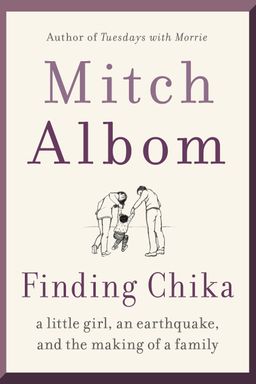
Finding Chika cover

Finding Chika

by Mitch Albom

Finding Chika is a heartwarming true story of a Haitian girl who survives an earthquake, only to face a greater battle against a brain tumor. Under Mitch Albom''s guardianship, Chika teaches invaluable lessons about love, family, and embracing life’s fleeting moments, reshaping his world forever.

Love Beyond Biology: The Heart of Finding Chika

What makes a family? Is it bloodlines, biology, or the love we choose to give? In Finding Chika, Mitch Albom reflects on these questions through the profoundly tender story of a little girl from Haiti named Chika Jeune, who reshaped his understanding of parenthood, faith, and the human bond. Albom argues that parenthood is not reserved for those who share DNA—it’s written in acts of love, sacrifice, and courage. Through Chika’s illness and their shared journey, Albom contends that real family transcends flesh and blood, and that the truest gifts of life often come through heartbreak.

When Albom brought Chika from his Have Faith Haiti orphanage to America for medical treatment, he thought he was offering her a few months of care. Instead, those months became years, and in that time, she became his daughter. Her diagnosis—Diffuse Intrinsic Pontine Glioma (DIPG), a fatal childhood brain tumor—became the shadow under which their love deepened. Albom’s account blends memoir, spiritual reflection, and journal of grief. It’s his meditation on what children teach adults—that time is precious, love is limitless, and life’s purpose is found not in achievement, but in caring.

A Conversation Between Worlds

The book unfolds as an ongoing conversation between Albom and Chika after her death. In his study, she reappears like a vision—a playful, confident spirit urging him to write her story. These imagined exchanges give the memoir structure and emotional immediacy. Through them, Albom examines lessons she taught him about protection, faith, patience, wonder, and love. Each visit feels like both memory and miracle—a father still speaking to his child, and a writer still trying to understand what she meant to him.

This conversational tone is Albom’s hallmark (as in Tuesdays with Morrie), but here it’s more intimate. Chika’s voice interrupts him, corrects him, teases him. Their banter becomes a metaphor for love’s endurance—the way bonds persist even when one life ends. The fusion of grief and joy, death and dialogue, transforms Finding Chika from a tragedy into an affirmation: love doesn’t vanish; it changes its form.

Parenthood as Redemption

Albom confesses he once feared parenting. His youth was defined by ambition, not nurture. But when Chika arrived, all his old notions collapsed. He discovers that love is not something you plan—it demands surrender. Caring for Chika forces him to slow down, to be protective, patient, and selfless. As he writes, “A child is both an anchor and wings.” He learns that being needed reshapes time itself—work can wait, but her laughter cannot. In parenting her, he rediscovers life’s rhythm and purpose.

This transformation echoes the spiritual message in Albom’s previous works (Have a Little Faith and The Five People You Meet in Heaven): the divine hides in human connection. The more Albom gives himself to Chika’s care—comforting her through radiation, holding her through fevers—the more he understands that doing “the most important work” often means tending to a child, not a career.

The Universal Lessons in Loss

Chika’s story is not merely about sickness—it’s about strength. Albom calls this “kid tough,” the unique resilience children show when facing pain with courage and humor. Even as her disease steals movement and speech, she mocks her own stumbling with jokes like “I fell on my BUTT!” Her laughter comforts the adults who can’t bear to watch her decline. Through her, Albom learns that strength is not stoicism—it’s grace under suffering.

“You never lose a child. You are given one.” —Mitch Albom

The memoir culminates in that truth: Chika’s death does not mean loss. It means having been entrusted with love so pure it changes everything after it. Albom’s time with her becomes a blueprint for compassion—how to show up even when outcomes are hopeless, how to offer laughter amid despair, and how to find holiness in ordinary care. These are lessons that linger well beyond this story. They remind you that every act of kindness survives, even when the one who inspired it is gone.

Through seven lessons woven into his dialogue with Chika—protection, time, wonder, toughness, parenthood, family, and carrying what matters—Albom crafts a universal guide to living bravely and loving deeply. Finding Chika is both elegy and embrace; it invites you to ask not how long life lasts, but how fully it is lived—and with whom.


Lesson One: I Am Your Protection

The first lesson Albom learns from Chika centers on the meaning of protection—both its power and its limits. As the overseer of the Have Faith Haiti orphanage, Albom believed that his role was to keep the children safe: from starvation, accidents, and poverty. But when Chika’s face drooped and her gait faltered, he confronted the terrifying truth that some dangers can’t be guarded against. His protective instincts evolved from preventing harm to offering presence—the deeper kind of protection that comes through love.

From Saving to Shielding

When Albom first hears the words “There is no one in Haiti who can help her,” his world shifts. Protection, he realizes, isn’t about keeping disaster away; it’s about refusing to walk away from it. He brings Chika to America, navigating hospitals and procedures he barely understands. As her guardian, he learns that real care means standing beside the child—even as fear looms. The moment a nurse asks, “What is your relationship to the patient?” and the hospital badge prints the word Parent above his picture, Albom knows protection has changed him forever.

(In Tuesdays with Morrie, Albom learns from his dying mentor how embracing vulnerability transforms strength. Finding Chika continues that arc—showing the author’s surrender to a protector’s role not out of heroism, but humility.)

Facing Powerlessness

Throughout the book, Albom confesses his obsession with control—he thinks vigilance can prevent tragedy. But Haiti teaches him otherwise. Earthquakes, illness, and poverty defy human efforts. When doctors call Chika’s tumor inoperable, Albom must face the hardest parental paradox: you can’t save those you love, but you can shelter them through your presence. “She fights; we fight,” he writes—a mantra that captures both his helplessness and hope.

The Grace in Guarding

Eventually, Albom learns that love itself is a form of protection. He cannot stop the pain, but he can ensure Chika never feels alone. He measures each sunset as a victory, each day as another chance to stand watch. In doing so, protection becomes spiritual: faith stepping in where medicine cannot. He begins to trust that God will “handle the things I cannot,” discovering peace in surrender—a lesson echoed by his father’s calm and Morrie’s acceptance of mortality.

Like parents everywhere, you may not always shield your loved ones from suffering, but Albom suggests that love is the most impenetrable armor. Through Chika, he learns that the strongest protection isn’t insulation from pain—it’s unwavering presence amid it.


Lesson Two: Time Changes Everything

Time, Albom discovers, has two speeds: the one you control and the one a child teaches you. Before Chika, his days were driven by deadlines and ambition. But once she entered his world, time grew elastic—measured in breakfasts, bedtimes, and laughter instead of minutes. “A child is both an anchor and a set of wings,” he writes. Living with Chika redefines time not as currency, but as communion.

The Slow Miracle of Routine

In the mornings, Chika’s unhurried pace—eating eggs slowly, studying squirrels outside—forced Albom to decelerate. He discovers that paying attention to a child is paying attention to life itself. The same world he once rushed through now glows with discovery: clouds, colors, and the wonder of hot water from a tap. Miss Janine adjusts easily; Albom resists. But eventually, he learns that giving time freely is the purest form of love. “The most precious thing you can give someone,” he writes, “is your time, because you can never get it back.”

Time as Transformation

This slowing does more than shape their daily rhythm. It awakens Albom to presence—something his busyness had stolen. When he tiptoes around Chika’s makeshift bed, when he listens to her sleepy voice saying “Mister Mitch, I have to go potty,” these small exchanges become sacred rituals. They mark his evolution from man of career to man of care. Time, Albom realizes, isn’t something you manage—it’s something you give away until you become part of someone else’s story.

(Psychologist Erik Erikson described this shift as generativity—the adult stage in which meaning emerges from nurturing the next generation. Albom’s experience embodies that arc perfectly.)

When Every Moment Counts

As Chika’s illness worsens, time tightens. Months become milestones; each moment is “a vine to swing from.” They chase new treatments across countries, praying for “someone in a lab to whisper, ‘Look, it’s working.’” In those prayers lies both desperation and devotion—the realization that even borrowed time can be luminous. By the end, Albom sees that time is not measured by years but by depth of love shared within them.

In your own life, Albom invites you to treat time as grace, not schedule. Stop counting days by productivity; start counting them by connection. The clock will still tick—but the hands may hold you closer.


Lesson Three: Seeing with Wonder

Adults look at the world; children marvel at it. Through Chika, Albom relearns the lost art of wonder—the ability to see holiness in everyday moments. Whether it’s duck-chasing at Disneyland or finding beauty in a snowflake, Chika embodies the spiritual clarity that curiosity brings. This lesson reminds you that awe is not naive—it’s the purest form of gratitude.

Rediscovering the Miracle of Small Things

In Disneyland, while other kids rush toward rides, Chika runs after a duck. Albom realizes that wonder doesn’t need spectacle; it thrives on attention. “Look!” becomes her favorite word—and the single most sacred prayer he learns. Her joy in ducks, frogs, windows, and stars reconnects him to presence. In slowing down to look with her, he glimpses the divine that hides in the ordinary.

(Spiritual writers like Henri Nouwen and Anne Lamott often describe this posture—seeing God in the mundane—as the heart of contemplative faith. Albom, through Chika, achieves it intuitively.)

The Child as Teacher

Chika’s wonder is not cute—it’s instructive. Each discovery becomes an invitation to participate: “You smell it,” she says, offering flowers; “You eat it,” holding chocolate. In joining her play, Albom reconnects with imagination and patience. Her learning through laughter, calling the pool edges “America” and “Haiti,” turns geography into a game and sadness into joy. This playful theology—finding heaven in humor—blesses him more than any sermon ever could.

Faith Renewed Through Innocence

Chika’s innocent prayers—asking whether God protects horses or if He ever “isn’t looking”—reignite Albom’s conversation with faith. He admits that her illness tested him more than any doctrine. Yet her simple words remind him of what his mentor, the rabbi Albert Lewis, once said: having something to cry to is better than having nothing at all. Wonder becomes not just amazement but belief—the act of trusting even when you don’t understand.

As life grows complicated, Albom urges you to reclaim the child’s “Look!” within yourself. Wonder isn’t childish—it’s a way of staying alive to mystery. To see through Chika’s eyes, even briefly, is to remember your own tenderness waiting to awaken.


Lesson Four: The Courage of Kid Tough

What does it mean to be tough? Albom redefines toughness through Chika’s resilience—the kind of strength that laughs through pain. When his young friend Chad Carr dies from the same disease, Albom calls this bravery “Kid Tough,” a title earned not by endurance alone but by joy amid suffering. Children, he realizes, carry adults through tragedy by showing how to live while dying.

Resilience in Its Purest Form

At Sloan Kettering Hospital, hours after a dangerous infusion, Chika climbs out of bed, dragging her catheter tubes behind her, insisting she wants to go to the toy store. Doctors stand stunned. Albom, terrified, sees something deeper than recklessness—he sees refusal. The child’s body may be fragile, but her spirit is indestructible. Even as she falls, drools, or vomits, she cracks jokes about her “tickling foot.” Her humor becomes her armor—and her gift to those who watch helplessly.

Finding Light in Pain

Chika’s laughter doesn’t deny suffering; it reframes it. When she stares in the mirror and mocks her drooping eye, she reminds Albom that acceptance can be joyful. He cries privately while she plays beneath the kitchen island, lowering the world to her level. Her ease with hardship comforts those around her. “Her toughness far exceeded mine,” Albom admits—a humbling revelation for a man used to control.

(Medical memoirs like Paul Kalanithi’s When Breath Becomes Air echo this insight: courage is not conquest but grace—continuing to love while your body fails.)

The Call to Keep Fighting

For Albom and his wife Janine, Chika’s toughness becomes contagious. Even as medicine offers diminishing hope, they fight for her anyway, guided by her mantra “Why can’t I be the first?” Their battle against DIPG shifts from medical victory to moral witness—proof that love fights, even when science quits. Chika’s resilience—her childlike toughness—teaches that the bravest thing you can do is refuse despair.

Every adult, Albom suggests, carries an inner Chika—the part that laughs through tears and believes the story isn’t over. Kid Tough reminds you that love is stronger than fear when it becomes play, prayer, and persistence combined.


Lesson Five: When Children Are Yours and Not Yours

One of Albom’s most painful realizations comes from Haitian reality: in orphan care, parental rights are complicated. So whose child is Chika? Legally, Albom is her guardian; emotionally, he is her father. This tension defines his lesson about possession, identity, and the ethics of love that transcends title.

Belonging Without Ownership

When a biological father reclaims another child from Albom’s orphanage, the team is helpless. Haitian law favors bloodlines over bonds. Watching the boy leave, Albom aches with awareness that love isn’t always enough against bureaucracy. So when Chika’s own father resurfaces, he fears the same: what if the man who left her now claims her back? Visiting her father’s home—a single room under the breadfruit tree—Albom sees poverty, detachment, and quiet resignation. The man says, “Whatever you think is best.” The phrase both frees and haunts him.

The True Measure of Parenthood

Science defines parenthood through biology; Albom learns it is defined by care. He ties shoes, feeds medicine, carries her limp body through airports. When others remark, “It’s great what you’re doing for a child that’s not yours,” he grows uneasy. To him, there is no distinction. “I was yours,” he tells Chika, “even if you weren’t mine.” In that confession lies moral clarity: love determines family, not ancestry.

(In The Adoption Papers by Jackie Kay, similar truths echo—the bonds that raise a child outweigh the ones that birth them.)

Love Without Borders

Albom expands this lesson beyond their story. At the orphanage, older boys now placed in colleges abroad still keep photos of Chika on their desks. One studies medicine to help other sick children “because of what happened to you.” Their love becomes Chika’s legacy—proof that family can ripple outward across borders, turning grief into purpose.

In the end, Albom teaches you to stop asking who a child “belongs” to. No child belongs; every child deserves belonging. The difference changes everything.


Lesson Six: When a Marriage Becomes a Family

When Chika enters their lives, Mitch and Janine Albom’s marriage transforms from partnership to parenthood. Through caring for Chika, they rediscover each other—and the deeper meaning of love shared through a child. This lesson captures Albom’s gratitude for what his wife revealed during those years: the beauty of a heart opening fully to protect another.

Janine’s Quiet Heroism

Janine, who never hesitates to take in Chika, becomes a mother without the title. She bathes her, dresses her, and comforts her during fevers and embarrassment. Her patience anchors their home. Albom admits he once feared fatherhood; Janine simply steps into it. Watching her brush Chika’s hair or whisper Bible verses, he sees maternal devotion revealed in its rawest form. “She triggered something new in Janine,” he writes—an awakening decades in the making.

The Expanding Circle of Love

Children, Albom learns, widen love’s horizon. Family is not smaller because it shares affection—it grows richer. The intimacy between Janine and Chika gives him new eyes for his wife; he falls in love with her all over again through the tenderness she offers. Their Thanksgiving scenes—Chika snuggling close, Janine laughing—turn marriage into family, and home into sanctuary.

Love That Survives Loss

When doctors warn them that grief ruins marriages, Albom insists it will not ruin theirs. By reaffirming shared faith and gratitude, they protect their bond from despair. Janine’s words, “We can’t lose her, Mitch,” linger as prayer and promise. Through Chika, they learn that even after a child passes, the love she sparked keeps a marriage alive. You cannot lose what has permanently reshaped your heart.

Whether in marriage or friendship, Albom’s insight applies universally: love expands by giving, not possessing. A family begins not with birth—but with care freely offered and reciprocated in grace.


Lesson Seven: What We Carry

The final lesson Albom draws from Chika—perhaps the hardest—is about carrying what matters. As her illness reaches its end, their home fills with medical machines and prayers. Yet through every breath, Chika teaches him that love’s weight is worth bearing. “Your job is carrying me,” she says—and with those words, transforms burden into blessing.

The Prayer of Persistence

When others see hopelessness, Albom sees duty. He refuses to stop fighting, even as hospice workers prepare for her death. At dawn on April 6, he performs chest thumps and suctioning that momentarily revives her heartbeat—a miracle of defiance. “She fights; we fight.” The phrase echoes through the home like liturgy. In her strength, he finds his.

The Burden That Defines Us

Parenting, Albom realizes, means carrying both life and loss. The bags of liquid nutrition, the sleepless nights watching pulse monitors—all become sacraments of devotion. He skips the Super Bowl for the first time in thirty-two years because “those things I carried before—all the work—were dumped out.” Chika’s needs weigh upon him, yet they purify his priorities. Love becomes labor; labor becomes love.

Carrying Forward

Even after her death, Albom carries Chika through her memory’s continuation—the orphanage’s children who pray for her, the brother and sister they later adopt. He understands now what his father and Morrie taught: what we carry outlives us. “Families are like pieces of art,” he concludes, “made from many materials. You cannot lose a child. We were given one.” Grief becomes gratitude; carrying becomes continuation.

Every person holds a weight—be it responsibility, love, or loss. Albom’s story reminds you that bearing that weight with tenderness is the highest human calling. In carrying others, we carry ourselves closer to grace.

Dig Deeper

Get personalized prompts to apply these lessons to your life and deepen your understanding.

Go Deeper

Get the Full Experience

Download Insight Books for AI-powered reflections, quizzes, and more.