
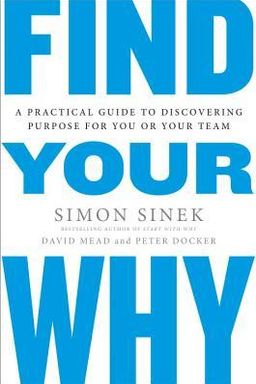
Find Your WHY cover

Find Your WHY

by Simon Sinek, David Mead, Peter Docker

Find Your WHY provides a roadmap for discovering the core motivations that drive you and your team. Through practical strategies and exercises, Simon Sinek and co-authors guide you to uncover your purpose, transforming daily routines into meaningful endeavors and enhancing personal and professional fulfillment.

Finding Purpose That Inspires You and Others

What gets you out of bed in the morning? Is it your paycheck, deadlines, or a deeper sense of purpose? In Find Your Why, Simon Sinek, along with David Mead and Peter Docker, argues that truly fulfilled people and organizations don’t simply work for profit or performance—they operate from a clear sense of purpose, their WHY. Your WHY is your personal or collective cause—the reason you exist beyond making money or achieving status. It's your compass for making decisions, building trust, and inspiring others to follow your lead.

Sinek contends that every individual and organization has a WHY, but few can clearly articulate it. When you can describe not only what you do but why you do it, you move from surviving to thriving. This book is a practical field guide for uncovering that WHY and applying it in daily life and business. Where Sinek’s famous earlier book, Start With Why, made the case for leading with purpose, Find Your Why provides the detailed roadmap for actually finding it.

The Golden Circle: Thinking From the Inside Out

At the heart of the book lies Sinek’s model called The Golden Circle. It has three layers: WHY (your purpose or belief), HOW (the actions that bring that purpose to life), and WHAT (the products, services, or roles you perform). Most people and companies communicate from the outside in—they start with what they do and how they do it. Inspiring leaders like Apple, Martin Luther King Jr., and the Wright brothers do the opposite: they think and act from the inside out. They start with WHY and let that belief drive every decision.

Biologically, this mirrors how our brains function. The outer neocortex handles rational thought and language (the WHAT), while the inner limbic brain drives emotion, trust, and decisions (the WHY). Because the limbic brain has no capacity for language, we struggle to explain gut feelings. Knowing your WHY gives you the words to articulate what your instinct already knows, helping you inspire trust and loyalty.

Purpose Turns Work Into Fulfillment

The book begins with a story about Steve, a man who sold steel for over two decades but didn’t realize that his enthusiasm for his job came not from the material itself but from what it represented—using natural resources responsibly to preserve the planet for future generations. By finding the deeper purpose behind his work, Steve rediscovered meaning in what could easily seem like an uninspiring role. This example highlights that happiness comes from what we do, but fulfillment comes from why we do it.

Fulfillment, unlike happiness, lasts. Happiness is a fleeting emotion tied to achieving goals or acquiring rewards. Fulfillment arises when your work aligns with your deeply held beliefs. It’s the difference between liking your job and loving your life’s work. Sinek believes fulfillment is not a privilege for a lucky few but a right for everyone—and finding your WHY is the key to achieving it.

Turning Insight into Action

Once you uncover your WHY, you can use it as a filter for everything—from choosing jobs and partnerships to making major life decisions. For organizations, the WHY becomes the engine of culture, guiding everything from hiring to innovation. Sinek emphasizes that discovering your WHY is only the start; you must also identify your HOWs (the behaviors that make your purpose real) and your WHATs (the tangible outcomes). Together, they create your Golden Circle, a framework for authentic living and leadership.

Throughout the book, Sinek and his coauthors break down a step-by-step process for individuals, teams, and whole organizations. They teach you how to recall personal stories, identify recurring themes, and turn those insights into a simple, actionable WHY statement. For example, “To empower people to believe in themselves so that they can create a better future” captures both a person’s contribution (“to empower”) and the impact (“create a better future”).

Applying the WHY Across Life and Work

If identifying your WHY helps you live with purpose, living it every day is the true challenge. The authors walk you through how to share your WHY with others, embody it through your actions, and teach it to teams. Whether you lead a startup or work within a large company, the same principle applies: people are inspired not by what you do, but by why you do it. Leaders who communicate from their WHY create trust, attract believers, and foster enduring loyalty (much like Apple, Patagonia, or Southwest Airlines).

In the end, Find Your Why is both a philosophy and a toolkit. It insists that life and leadership anchored in purpose unleash creativity, connection, and resilience. The book’s greatest gift is its practicality—it transforms an abstract idea into a repeatable method so that you, your team, or your organization can move from success to significance.


The Golden Circle Framework

Sinek’s Golden Circle is the cornerstone of his work. It explains why some people and companies consistently inspire loyalty and outperform others, even when competitors have more resources or talent. The circle’s three concentric layers—WHAT, HOW, and WHY—represent different levels of communication and decision-making. The goal is to start with WHY and work outward, not the other way around.

WHAT: The Tangible Output

The WHAT refers to the tangible activities, products, or services you produce. It’s the easiest to describe—‘I’m a teacher,’ ‘we sell cars,’ or ‘we make paper.’ Most people stop here because it’s clear and measurable. But WHAT alone can’t inspire loyalty. If your competitors can do the same WHAT, you’re just another option in the marketplace.

HOW: The Process or Differentiation

The HOW explains the things you do that make you or your organization unique—your values, principles, and methods. These are your behaviors or strengths that make your WHAT stand out. For Apple, the HOW includes a commitment to design, simplicity, and user experience. For Southwest Airlines, it’s about humor and warmth. The HOW brings the WHY to life through consistent action.

WHY: The Deep Purpose

The WHY is your cause, belief, or purpose. It’s the reason beyond money or success that drives you to do what you do. Most people and companies can’t clearly articulate it. Yet when you start with WHY, your message resonates because it connects with the emotional limbic brain—the same part that governs trust and decisions. That’s why we buy from, follow, or work with people who reflect what we believe.

“People don’t buy what you do; they buy why you do it.”

Sinek illustrates this with the simple example of paper sales. Instead of saying, “We sell the highest-quality paper at a great price,” imagine saying, “We believe ideas can change the world, and to share them, we make great paper.” Suddenly, a mundane product becomes meaningful, and customers feel part of something bigger.

Why This Matters for You

Whether you’re an individual or an organization, starting with WHY helps you stand out in a crowded world. It moves your communication from transactional to inspirational. When you lead with WHY, you attract the people who share your beliefs, not those chasing the lowest price. This creates long-term loyalty, engagement, and innovation—qualities driven by purpose, not pressure.


Discovering Your Personal WHY

Every person has a WHY, even if they can’t yet name it. To uncover yours, Sinek, Mead, and Docker provide a structured process rooted in storytelling. Instead of creating your WHY from scratch, you discover it by examining your past—the highlights and hardships that shaped who you are at your best.

Step 1: Gather and Share Stories

Your story archive is the key. Think of five to ten moments that made a lasting impact—times you felt proud, fulfilled, or deeply connected. Both joyful and painful experiences matter because they reveal your values. For instance, a childhood memory of standing up for a friend may show your drive to protect others, while a career win might reveal a passion for empowerment.

You won’t do this alone. Find a partner—someone curious, objective, and willing to listen. They’ll serve as your mirror, reflecting themes you might overlook. Interestingly, Sinek warns against choosing someone too close, like a spouse, because their familiarity can cloud objectivity.

Step 2: Identify Themes

As you tell your stories, your partner listens for emotional cues and patterns. What moments bring energy to your voice, or tears to your eyes? Those are clues to your core values. For instance, in the book, Todd—a man once struggling with addiction—realized his turning point came when he gave his spare change to a child’s lemonade stand. That small act awakened his compassion, revealing his WHY: to ignite people’s imagination about what’s possible so they can change their lives.

Step 3: Craft a Why Statement

Your WHY always follows a structure: To [contribution] so that [impact]. This keeps it actionable and focused on service to others. For example: “To encourage people to speak their truth so that they can inspire change,” or “To bring order to chaos so that teams thrive under pressure.” Draft a few versions, test them with your partner, and refine the wording until it feels authentic and memorable.

Step 4: Validate and Refine

Try your draft on close friends. Ask them why they’re drawn to you or when they’ve seen you at your best. If their answers align with your statement, you’re close. If something feels off, sit with it and tweak. Your WHY should make you feel proud, grounded, and emotional—it’s not a slogan but a mirror of your best self.

This exercise isn’t about inventing a new identity. It’s about naming the thread that has run through your life all along. When you can express that in a single sentence, you hold a compass for choosing work, relationships, and goals that align with who you truly are.


Finding a Team or Organization’s WHY

Organizations, like individuals, have a collective WHY—the core purpose that inspires their people and connects them to customers. Discovering it requires what the authors call the Tribe Approach, a group process designed to uncover the shared stories, emotions, and values that define the group at its natural best.

Building the Right Tribe

A tribe is any group that gathers around shared beliefs—your team, division, or an entire company. The process ideally includes 10–30 people with diverse roles and long-term experience, especially those passionate about the culture. In large companies, each subgroup may even have a Nested WHY—a version of the organizational WHY tailored to its unique contribution (like branches on a tree all rooted in the same purpose).

The Three Conversations

The workshop unfolds through three rounds of storytelling:
1. The Human Difference: participants share moments when they felt proud to be part of the organization.
2. The Contribution: they identify how their actions improved others’ lives, captured as verbs (to connect, to build, to inspire).
3. The Impact: they define what difference that contribution made—how people’s lives changed as a result.

For example, when La Marzocco, the Italian espresso machine maker, ran a Tribe Why Discovery, stories about connection—hosting global coffee events, supporting Tanzanian farms—emerged as central themes. Their WHY became: “To cultivate relationships so that the lives of others are enriched.”

From Stories to Statement

The facilitator gathers common verbs and impacts from the group’s flip charts, then helps participants combine them into a draft WHY statement: “To [contribution], so that [impact].” Two versions may be drafted and refined into one unifying statement. For alignment, the goal isn’t perfection—it’s 80% clarity and 100% conviction. The final words can evolve, but the feeling behind them remains fixed.

Sinek emphasizes that discovery, not invention, is the key. A corporate WHY is not aspirational marketing; it’s descriptive. It must reflect who the group already is when it operates at its best, because authenticity is the foundation of trust. As the authors put it, “Before we can stand out, we must get clear on what we stand for.”


Creating a Culture That Lives Its WHY

Finding your WHY is only the first half of the journey. The true test comes next—living it consistently, both as individuals and organizations. Sinek and his team teach that once you know your purpose, you must communicate it regularly, embed it into systems, and turn it into daily action through HOWs and WHATs.

Your HOWs: The Expression of the WHY

HOWs are the principles and behaviors that bring your WHY to life. They are not lofty values like “integrity” or “innovation.” Instead, they describe *how you act* when you’re at your best. For individuals, themes that didn’t make it into the Why Statement become HOWs—like “keep it simple,” “find the silver lining,” or “learn from everyone.” For companies, HOWs are the cultural habits employees demonstrate daily.

For example, Costa Rica’s Cuestamoras group defines its HOWs as “break new ground,” “work together,” and “do what is right”—behaviors that align with their WHY “to innovate relentlessly to create opportunities for everyone.” This consistency between WHY and HOW guards authenticity and shapes trust.

Avoiding Empty Values

Many corporations fail here because they rely on generic, aspirational values that sound good but lack specific meaning. “Integrity” and “teamwork” mean different things to different people. Transforming these into HOWs (“always tell the truth,” or “recognize small wins”) grounds ideals in action. Employees then know exactly what those values look like in practice.

The WHY as Cultural Compass

Once your HOWs are defined, they become filters for decision-making and hiring. New projects, partnerships, and leaders are chosen by asking, “Does this align with our WHY?” Organizations like Southwest Airlines excel because every employee—from pilot to gate agent—embodies the company’s belief in caring for people. When leaders start making choices aligned with their WHY, loyalty and innovation naturally follow.

Ultimately, your WHY only stays alive when it’s lived. It’s not a plaque on a wall but a daily practice—a north star guiding “how we do business here” and “who we want to be together.”


Sharing and Sustaining the WHY

Once you’ve defined your WHY, the next challenge is to keep it alive and share it with others. Sinek warns of a phenomenon he calls the split: when growing organizations start focusing more on WHAT they do than WHY they do it, their culture cracks. To prevent this, the book offers tools for communicating and scaling your WHY authentically.

Sharing the WHY

To onboard new people or reenergize your team, hold workshops that revisit the organization’s WHY. Begin by sharing experiences from the discovery process—stories that made the purpose tangible. Then let participants tell their own stories of when they felt proud to be part of the team. This emotional storytelling bridges intellect and inspiration, helping everyone take ownership of the WHY.

Exploring Conversations of Possibility

Once people connect emotionally, they’re ready for what the authors call a Conversation of Possibility—a brainstorming session guided by the WHY rather than “resource constraints.” In this space, “impossible” is banned; every idea must align with the organization’s purpose. These talks reignite creativity and empower teams to reimagine products, policies, and processes that reflect who they truly are.

Keeping the WHY Alive Through Storytelling

The simplest way to sustain purpose over time is through storytelling. Every new success or challenge becomes a reminder of the WHY in action. Southwest Airlines’ story of a captain helping a flight attendant load bags illustrates this perfectly—their shared belief in caring for people comes alive through behavior, not slogans.

Sinek closes with a call to vigilance: even great companies can drift from their WHY as they scale. Ultimate Software, for example, actively prevents this by training leaders to align every decision with their purpose: “to provide for people so that they thrive and feel empowered to do the right thing.” Purpose, when guarded like this, outlasts founders and products alike.


From Knowing to Living Your WHY

Purpose means nothing if it stays theoretical. Find Your Why concludes by urging readers to act on their purpose daily—to live their WHY in how they lead, decide, and communicate. It’s about letting consistency between words and deeds earn trust.

Practice Sharing Your WHY

Practice articulating your WHY in real conversations. When someone asks, “What do you do?”, don’t start with your job title—start with your purpose. For example, instead of saying, “I’m a manager at a design firm,” say, “I help people bring ideas to life through visual storytelling.” At first it will feel awkward, like learning to ride a bike. You’ll stumble. But over time, it becomes second nature—and deeply magnetic to those who share your beliefs.

Use Your WHY as a Decision Filter

Every day presents choices: jobs, strategies, relationships. Use your WHY to filter them. Ask yourself: Will this move me closer to living my purpose or away from it? When words and actions align, you build authenticity and trust—a currency stronger than profit or prestige. As Sinek notes, “Our actions either add to or take away from the trust and loyalty others feel toward us.”

Inspire Others to Discover Their WHY

Finally, Sinek invites you to help others find their WHY—friends, colleagues, even entire teams. Leaders who serve others’ growth become multipliers of inspiration. The authors share how facilitating Why Discoveries remains their most fulfilling work because each story reinforces their belief in a more inspired world.

The book ends with an invitation that echoes its opening message: finding your WHY is not the finish line—it’s the starting gun. Once you know it, your work is to live it, share it, and help others do the same. As the authors say, “The goal is not simply to cross the finish line but to see how many people you can inspire to run with you.”

Dig Deeper

Get personalized prompts to apply these lessons to your life and deepen your understanding.

Go Deeper

Get the Full Experience

Download Insight Books for AI-powered reflections, quizzes, and more.