
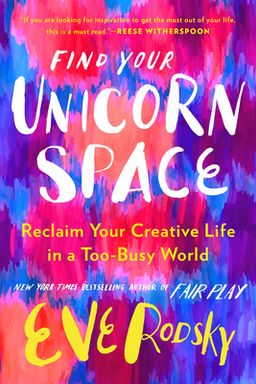
Find Your Unicorn Space cover

Find Your Unicorn Space

by Eve Rodsky

Find Your Unicorn Space by Eve Rodsky invites readers to reclaim their creative lives in a hectic world. The book offers practical guidance on carving out personal time for self-expression, fostering well-being and fulfillment, and balancing life''s demands. Rediscover your passions and learn to thrive by prioritizing your unique creative spirit.

Reclaiming Your Creative Life Through Unicorn Space

When was the last time you lost yourself completely in something you love—something done solely for you, not for work or family? Find Your Unicorn Space by Eve Rodsky asks this piercing question, challenging you to rediscover the essential part of yourself buried under daily obligations and endless to-do lists. Rodsky argues that creativity isn’t a luxury or hobby—it’s an imperative for mental, emotional, and physical well-being. In a world that glorifies productivity and self-sacrifice, especially for women, reclaiming time for self-expression becomes a radical act of self-preservation.

Building on her first book, Fair Play, where she dismantled the gendered inequities of unpaid labor, Rodsky takes the newfound “free time” this balance creates and gives it purpose as Unicorn Space—the active and open pursuit of self-expression in any form that brings joy and meaning. It’s not leisure, not self-care, and definitely not just a pastime. It’s the time you carve out to express who you truly are and to share that gift with the world. Like the mythical unicorn, it doesn’t exist until you give yourself permission to create it.

The Central Claim: Creativity Is Essential, Not Optional

Rodsky contends that creativity is as fundamental to health as exercise or sleep. She presents mounting evidence—from Barbara Fredrickson’s “broaden and build” theory of positive emotions to Tony Wagner’s research on resilience—that engaging in creative expression initiates upward spirals of joy and flourishing. Pandemic-era data only strengthened her case: women overwhelmed by unpaid domestic work reported feeling like they were “drowning,” but those who found moments of creative renewal described themselves as “breathing again.” The difference wasn’t privilege or circumstance—it was permission.

The book’s title speaks to the mythical quality of self-created time. Unicorn Space doesn’t appear magically; you must claim it, protect it, and express it. Rodsky invites readers to embrace creativity not as indulgence but as transformative coping—a tool to weather life’s storms. As hip-hop dancer Shige-boh says in the book, “I am very happy when I’m dancing.” His joyful abandon becomes a metaphor for dancing in the rain rather than waiting for the storm to pass.

Why We’ve Lost It—and Why It Matters

Our modern culture celebrates achievement and selflessness but undervalues creative self-expression, especially for women. Rodsky recounts conversations with women like Jessica, her cousin and the survivor of a turbulent marriage, who responds incredulously to the question “What do you do for fun?” Fun feels impossible when life demands constant care and efficiency. In this exhaustion lies Rodsky’s insight: when domestic and professional spheres devour all time and identity, we lose the spark of individuality—the part capable of joy and imagination. “You can’t dance in the rain,” she warns, “if you’re underwater.”

The consequence of missing Unicorn Space is deep and measurable. Rodsky links the absence of creative outlets to anxiety, resentment in partnerships, professional burnout, and what she calls FOMM—the “fear of missing me.” You may tick every societal box of success yet feel hollow inside. Rediscovering creativity revives purpose, resilience, and interpersonal harmony. When each partner supports the other’s personal pursuits, relationships not only survive—they thrive.

The Framework: Permission and the Three C’s

Rodsky structures her argument across three phases: Permission (Part II), The Three C’s of Creativity (Part III), and Completion (Part IV). Each section offers pragmatic steps to reclaim your time, your curiosity, and your connection to others.

  • Permission to be unavailable: You must guard your time fiercely—say no, set boundaries, and let yourself be unreachable sometimes without apology.
  • Permission to burn guilt and shame: Shed internalized expectations that your value comes from service or productivity. Creativity isn’t selfish—it’s survival.
  • Permission to use your voice: Communicate openly—whether negotiating time with a partner or sharing your art with the world. Expressing your “why” shifts others from resistance to support.

Once you establish permission, you cultivate the Three C’s—the heart of creative living: Curiosity (follow your inklings), Connection (share your creative energy with a community), and Completion (finish imperfectly but authentically). Each step mirrors the natural human desire to explore, relate, and create meaning—a process psychologist Mihaly Csikszentmihalyi calls “flow.”

Why It’s a Cultural Wake-Up Call

Rodsky’s research blends sociology, psychology, and hundreds of personal stories from diverse backgrounds to expose a universal truth: creativity doesn’t belong to artists alone—it belongs to everyone with curiosity. Yet society still conditions women to equate worth with sacrifice. She spotlights voices like Kalima DeSuze, the Afro-Latinx owner of Café con Libros, who urges marginalized communities to see joy itself as a radical act. The pursuit of Unicorn Space becomes not just personal revival but social justice—a refusal to let inequity dictate who gets to create.

“It may sound like glitter and rainbows, but Unicorn Space is the magic that will light you up as you inevitably face the hardships of life.”

At heart, Find Your Unicorn Space isn’t about painting, dancing, or baking. It’s about reclaiming the time and identity to feel alive. Rodsky’s message to every reader—especially women stretched thin between caregiving and work—is that creativity is essential, not optional. And through curiosity, connection, and completion, anyone can rediscover that luminous part of themselves waiting quietly beneath the surface. It’s your turn to dance in the rain.


Permission to Be Unavailable

Rodsky opens her three-part “Rules of Permission” with what may be the hardest challenge for modern adults—especially women—to accept: you have the right to be unavailable. More than self-care, this is about boundary setting and reclaiming agency over your schedule and mental attention. Without it, creativity remains a fantasy drowned by daily interruptions.

The Finite Nature of Time

Rodsky compares time to diamonds—finite and valuable. Yet many people, as she discovered through her interviews, act as though their time can expand infinitely for others. She recounts the “Case of the Unavailable Post-it,” where she tried signaling her family to respect her writing hours with a literal note stuck to her shirt. Unsurprisingly, her husband and kids ignored it. Only when she learned to express boundaries collaboratively—“I love you, and I need two hours to write so I can be more present later”—did the family respond positively. The key was respect, not resentment.

Creating and Guarding Flow

You can’t dance in the rain or write, paint, or design without uninterrupted time. This chapter introduces the concept of flow, described by psychologist Mihaly Csikszentmihalyi as “total absorption.” When you’re in flow, time dissolves and creativity accelerates. Rodsky argues that achieving flow requires both physical and mental space—no multitasking, no guilt, just sustained attention. It’s why professional boundaries matter: workplaces that demand constant availability destroy creative focus and fuel burnout.

Tools for Boundary Setting

Rodsky offers tangible strategies for carving your boundaries:

  • Reframe time as limited—say, “I have twenty-four hours” rather than “I’ll figure it out.”
  • Negotiate fair division of household labor so you can schedule uninterrupted creative sessions.
  • Speak boundaries clearly and calmly rather than signaling indirectly with frustration.
  • Make absence intentional; being unavailable for a few hours benefits relationships long-term.

Her conversations with psychiatrist Pooja Lakshmin reinforce this point: no one will grant you permission to be unavailable—you must sign your own “permission slip.” This act isn’t selfish; it’s the foundation for sanity, creativity, and stronger connections.

Why Boundaries Heal Relationships

Intriguingly, when both partners respect boundaries, mutual satisfaction increases. Rodsky shares the “Case of the Extended Sunday,” when she and her husband Seth each agreed to take entire days for personal pursuits. The result wasn’t chaos—it was cohesion. The kids adapted, the resentment subsided, and their marriage flourished. This echoes Stew Friedman’s leadership theory: successful partnerships align values so both thrive individually and together.

“You are complicit in your own oppression when you willingly put yourself and your time second or last.”

The antidote to creative paralysis, Rodsky insists, is unavailability. Only by saying no—to others’ expectations, endless digital distractions, and internal guilt—can you say yes to yourself. Protecting your time doesn’t pull you from connection; it ensures you return to it with clarity, purpose, and joy.


Permission to Burn Guilt and Shame

Of all the emotional barriers to creativity, guilt and shame are the most insidious. Rodsky declares war on them both, inviting you to “burn” these entrenched feelings—literally and metaphorically. This bold chapter reframes how you view self-sacrifice and introduces rituals and reframes that replace guilt with conviction and self-respect.

The Tyranny of Self-Sacrifice

Rodsky describes American culture’s addiction to martyrdom, particularly among mothers. Through interviews with psychiatrist Pooja Lakshmin, she identifies Human Giver Syndrome—the belief that women must give every drop of their humanity in service to others. This toxic narrative tells mothers their worth lies in exhaustion. When men take “untouchable time” it’s called leisure; when women do, it’s selfish. Rodsky exposes this hypocrisy through real examples, from “Mom guilt” at the nail salon to couples who treat women’s rest as optional.

Transforming Guilt into Intention

The solution isn’t ignoring guilt—it’s reframing it. Psychologist Sheryl Gonzalez Ziegler suggests replacing “I feel guilty because…” with “I made this choice because…” It’s a subtle switch that transforms guilt into agency. Rodsky also reveals her own personal ritual: writing “Guilt and Shame” on origami paper and burning it before leaving for her book tour. Through this act, she symbolically released generations of internalized expectations—the belief that leaving home for creative work was betrayal. Instead, she redefined it as legacy building.

Building Your Fire Wall

This practice leads to what Rodsky calls a “fire wall”—a psychological boundary protecting creative time from emotional interference. When guilt reemerges (“I’m missing bedtime”), she reframes it calmly (“I chose to attend this event because my mission matters”). This builds consistency and removes fear of judgment. Over time, burning guilt and shame becomes not just metaphor but mindset—a transformative coping mechanism aligned with Martha Beck’s principle that despair lifts only when you release suffering’s false rewards.

Rodsky grounds this idea in research: mothers report higher work-family guilt than fathers, but reframing guilt increases emotional stability across families. Her “F*ck Mom Guilt World Tour” anecdote, inspired by journalist Katherine Goldstein, turns guilt into rebellion—a public manifesto that says, “Stop apologizing. Start getting angry.” This righteous anger fuels creative fire rather than extinguishes it.

“You are not required to set yourself on fire to keep other people warm.”

In Rodsky’s universe, a liberated creator knows that guilt is just mental noise and shame is social control. Burn them both, she insists, until what remains is conviction—your clear “why.” Free from obligation, you can finally pursue what makes you vibrant. Creativity isn’t a betrayal of others; it’s a celebration of yourself—and, paradoxically, the greatest gift you can offer those you love.


Permission to Use Your Voice

The third permission—using your voice—translates inner resolve into outward action. Rodsky recognizes that communication is the bridge between having dreams and living them. You can imagine your creative project all day, but until you express what you need and why, it remains locked inside you.

The Cost of Silence

Many women, she observes, would rather ask for a divorce than ask for what they need. Through stories of friends like Bianca constantly fighting with her “marathon-training” husband over free time, Rodsky lays bare the silent wars in relationships where communication equals confrontation. Psychologists, including Jennifer Petriglieri and William Ury, confirm that avoidance and resentment are fatal to connection. Silence isn’t peace—it’s paralysis. When you fail to use your voice, you allow others to script your life.

Designing Conversations That Matter

To rewrite this dynamic, Rodsky borrows from conversation designer Daniel Stillman: start with an invitation rather than a confrontation. Instead of “We need to talk,” say “Let’s plan ways for both of us to have time for joy.” She outlines what she calls a communication container—a protected space and time for dialogue when emotions are low and cognition is high. For her and her husband, this meant nightly ten-minute “check-ins” over ice cream, where they aligned schedules, renegotiated expectations, and laughed together. By ritualizing conversation, they transformed discussion into collaboration.

Clarifying Your “Why”

Effective communication leans on vulnerability. When Rodsky told her husband she was writing another book, he asked, “Why?” Her answer—“Because this work makes me better for you, for our kids, and our community”—shifted skepticism into support. Expressing the why, psychologist Greg McKeown explains, draws others in through empathy. You’re not just demanding time; you’re sharing purpose. Examples like Steve and Bianca show how this can transform resentment into partnership: once Bianca understood Steve’s reason for running (“to stay healthy after his father’s death”), she rooted for him instead of resenting him.

Tell Your Story—Not Theirs

Rodsky warns against inventing stories about others—assuming, “They’ll say no,” “My partner won’t help,” or “My boss won’t understand.” According to Stewart Friedman’s relationship studies, most partners actually overestimate each other’s resistance. The cure? Speak up. Test the assumption. Ask. It’s liberating to realize that clear communication opens doors faster than silent frustration. She reminds readers of her friend Kelly’s revelation after watching Puff the Magic Dragon: reclaiming her voice wasn’t just about herself—it modeled courage for her daughter.

“Use your voice, tell your story, and start the conversation that transforms relationships from opposition into collaboration.”

This rule completes the permission triad. Through voice, guilt dissolves and space opens. Each dialogue builds trust; each request becomes affirmation of worth. Using your voice is creative expression itself—the act of designing conversation and carving boundaries not just with words, but with truth.


Cultivating the Three C’s: Curiosity, Connection, Completion

After mastering permission, Rodsky introduces the framework of the Three C’s—Curiosity, Connection, and Completion—the trilogy that makes creative living sustainable. Together, they trace the natural rhythm of creative growth from inspiration to expression to fulfillment.

Curiosity: Following the Spark

Curiosity is the ignition point. Rodsky rejects the cultural pressure to “find your passion” as unrealistic. Passion, she says, is too high a bar—it intimidates. Instead, start with curiosity. Ask, “What interests me?” She recalls Michelle, a woman so accustomed to checklists that when given free time she didn’t know what to do. The antidote: follow small delights. For some, it might be gardening or learning astrology like Aisa during the pandemic. For Rodsky’s cousin Jessica, hip-hop dancing reignited joy. These minor sparks create momentum that leads to flow.

Connection: Sharing the Spark

Once you’ve found what lights you up, connection magnifies the glow. Creativity flourishes when shared—through community or collaboration. Rodsky cites painter Lacy Freeman, whose animal portraits evolved into a thriving art business after she dared to exhibit her work publicly. Whether you volunteer like chef Diep Tran, join exercise tribes like Dolores’s Butterfly group, or teach like Rico Phillips, sharing creative energy multiplies meaning. Studies support this: as psychologist Laurie Santos explains, purpose and joy amplify when you contribute beyond yourself.

Completion: Embracing Imperfection

Completion is not perfection—it’s progress made visible. In her book’s final act, Rodsky urges readers to finish “messy” work and release it into the world. Potter Julie Burstein told her: “At some point, clay must go into the fire.” Make one, make a hundred, but put them in the kiln. Each imperfect finish creates room for the next creation. Whether dancing at forty or writing a book over thirteen years like novelist Robert Jones Jr., mastery grows through continuation. Completion signals that you’re alive and evolving, not flawless.

“Creativity is a collaboration with the fire—you must let go of perfection to reach the next stage of your life.”

In uniting the Three C’s, Rodsky transforms creativity into a living practice. Curiosity asks, Connection shares, Completion releases. It’s both process and philosophy—a reminder that meaning happens through motion. Creativity is not what you do once; it’s how you live every day.


How to Face Fear and Keep Going

Fear, Rodsky admits, is the greatest inhibitor between dream and action. Her “Ready, Set, Go” framework teaches you how to move through fear systematically using preparation, friendship, and courage.

Ready: Prepare

Preparation tames anxiety. Borrowing from leadership lessons of Navy SEAL Robert Harward, Rodsky echoes: “You’d be crazy not to try.” Her own fear—narrating her audiobook—became an experiment in preparation. She took voice lessons, rehearsed, and dared to “suck.” Practice converts fear into familiarity. As TED speaker Jill Bolte Taylor proved, rehearsing moments of discomfort transforms panic into flow.

Set: Find Spiritual Friends

Next, surround yourself with what she calls spiritual friends—people who believe in your creative journey. They can appear anywhere: a writing partner, an encouraging teacher, even the stranger sitting next to you in a workshop. These allies hold you accountable while cheering your progress. Rodsky’s friend Brenda’s success as a novelist began when her best friend gifted her a writing class for her 30th birthday—proof that one act of support can redirect a life.

Go: Act Despite Fear

Finally, go. Action dissolves doubt. Rodsky gathers stories like that of race car driver Renée Brinkerhoff, who began racing at age fifty-six after raising four children. Terrified yet determined, Brinkerhoff’s courage led her to win the first race she entered and inspire thousands of women worldwide. Psychologists like David Smith call this exposure therapy—each leap into discomfort reduces fear for future leaps.

“If you wait for fear to go away, the opportunity goes away too.”

Through preparation, connection, and courage, Rodsky reframes fear as fuel. Creativity demands vulnerability—every leap, conversation, and failure builds resilience. Fear doesn’t vanish; it transforms into motion, pushing you toward the finish line, sometimes sideways, but always forward.


Creating Legacy Through Creative Living

Rodsky closes with a profound question: What will your creative legacy be? Legacy isn’t about wealth or accolades—it’s about living so fully that others are inspired to do the same. By pursuing curiosity, sharing connection, and embracing completion, you craft an active legacy that echoes beyond you.

Living Legacy, Not Future Memory

Rodsky reframes legacy as an ongoing state, not something bestowed after death. “What do you want to be remembered for today?” she asks clients during philanthropic consultations. Your living legacy is shaped through your creative acts—each dance, painting, conversation, and risk taken models vitality. She recalls her son Ben’s insight during Tangled: “You don’t have to stop with one dream because you can always find a new dream.” Active pursuit itself becomes the legacy.

Purpose Through Redemption

In one of the book’s most moving sections, ocean explorer Bob Ballard describes life as “strategic tacking”—navigating winds of loss and resilience. After discovering the Titanic, Ballard lost his son but found purpose mentoring children, reigniting their curiosity about science. Psychologist Dan McAdams calls this a “redemptive life story”—where people transform suffering into generativity, contributing meaningfully to future generations. Rodsky echoes this: your storms fuel your creativity; dancing in the rain is legacy itself.

Modeling Curiosity for Future Generations

Legacy builds community. When children see adults living creatively, they normalize curiosity. Quoting children’s author Mo Willems, she writes, “Children will create if they see adults creating.” Whether through small examples like Tiffany teaching her kids recipes or grand ones like Ballard inspiring classrooms, creative modeling multiplies impact. Psychologically, McAdams’s research shows generativity increases mental health and longevity—proof that purpose literally sustains life.

“Stay forever curious. Live your dream. Don’t let anyone talk you out of it.”

Ultimately, Rodsky defines legacy through the Three C’s—Curiosity, Connection, Completion. Be curious enough to dream, connected enough to share, committed enough to finish. In doing so, you prove that creativity is contagious. Your living legacy isn’t what you leave behind—it’s how brightly you shine while you’re here.

Dig Deeper

Get personalized prompts to apply these lessons to your life and deepen your understanding.

Go Deeper

Get the Full Experience

Download Insight Books for AI-powered reflections, quizzes, and more.