
Idea 1
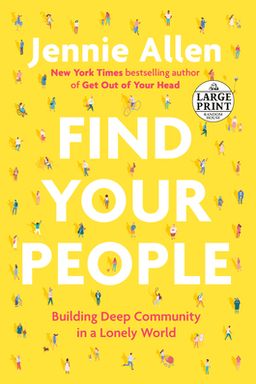
Building Deep Community in a Lonely World
Do you ever feel surrounded by people but still profoundly alone? Jennie Allen’s Find Your People begins with that universal ache—the sense that something essential is missing, even when our calendars are full and our phones are buzzing. Allen argues that modern life, for all its conveniences, has taught us to live in ways diametrically opposed to how God designed us. We were never meant to live isolated behind locked doors and glowing screens. God built humans for deep, daily, vulnerable connection—for actual community, not just acquaintanceship.
The book contends that our chronic loneliness is not simply a psychological or social crisis but a spiritual one. In Allen’s view, our disconnection stems from rejecting the communal blueprint woven into creation itself—first modeled by God in the Trinity. Because God exists in relational harmony as Father, Son, and Spirit, we too are created for interdependence. Loneliness thus isn’t just uncomfortable; it’s unnatural. Allen invites you to rebuild life around relationships of proximity, transparency, accountability, shared purpose, and consistency—five pillars she calls the rhythms of village life.
Why Modern Individualism Is Failing Us
Allen paints a stark picture of our cultural trajectory: where independence, efficiency, and self-sufficiency have become sacred values. She compares the modern world to a long experiment gone wrong—a society so obsessed with comfort and personal space that we’ve unknowingly traded belonging for convenience. Drawing from history, she notes that for most of human existence, people survived by depending on one another. They gathered around fires, farmed together, raised children together. Now our independence has become a kind of imprisonment, with loneliness statistics worse for health than obesity or smoking.
Allen’s argument unfolds across a mix of biblical reflection and vivid life stories—the panic attack on her closet floor, an empty move to Dallas with no friends, and watching Rwandan women laughing at the river as they washed clothes together. The contrast reveals what’s missing in Western life: we no longer live interdependently, not even by necessity. The modern substitution of independence has produced anxiety, depression, and spiritual hunger. The tragedy is that the very thing we need most—relationship—is the thing our culture least rewards.
From Isolation to “Village” Living
Allen redefines “finding your people” as returning to a rhythm of life that emulates how humans always lived before industrialized, digital age fragmentation. She uses terms like village or tribe not metaphorically, but to describe the network of about fifteen people who share daily life together. In anthropological studies (and research cited by Allen from Robin Dunbar and Jeffrey Hall), humans naturally manage about 150 meaningful relationships, but only five close ones where full belonging occurs. Her thesis: build a small, intentional circle—people who know your fears, sins, and dreams—and commit to intertwining your days, not just your weekends.
Throughout Find Your People, she blends this practical sociology with theology and personal confession. Allen admits she has failed deeply at friendship, lost close relationships for being guarded, and learned through pain that transparency is the soil of intimacy. Yet she insists, “It takes a village to raise adults, not just children.” True community involves letting others see your mess, walking through conflict, risking rejection, and continually choosing to stay. This is not a quaint idea—it’s spiritual warfare. According to Allen, if God created us for connection, then the enemy will fight hardest to destroy it.
The Road Map Ahead
In the chapters that follow, Allen offers a framework for reclaiming relationships based on five recurring patterns of village life: living near people (proximity); letting down walls (transparency); challenging each other toward growth (accountability); sharing work and purpose (shared mission); and committing to remain through conflict (consistency). Each practice corresponds to biblical examples—from Jesus living among His twelve disciples to Paul’s letters urging believers to “bear one another’s burdens” and “confess sins to one another.” These relationships are not peripheral but central to the gospel’s vision of life together.
Allen’s narrative voice is inviting yet uncompromising. She acknowledges friendship hurts but insists it’s worth the cost. Along the way, she integrates neuroscience (through references to her “neuro-buddy” Curt Thompson) and social psychology to show how we heal through being truly seen, soothed, and safe. The result is a manifesto for communal living that transcends trends, calling us to trade occasional bursts of connection for everyday belonging.
In short, Find Your People argues that spiritual maturity demands relational courage. Allen’s vision feels both ancient and revolutionary: fewer locked doors, more shared tables, deeper conversations around fire pits, laughter and prayer until midnight, forgiveness instead of quitting. Community, in her telling, is not optional—it’s the way back to wholeness, purpose, and joy in a world that has forgotten how to belong.