
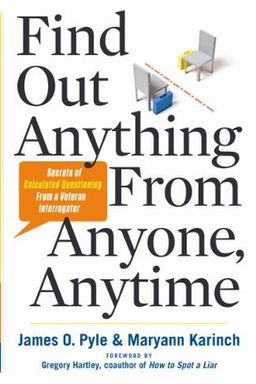
Find Out Anything From Anyone, Anytime cover

Find Out Anything From Anyone, Anytime

by James O Pyle and Maryann Karinch

Discover how to ask the right questions to get the answers you need, every time. Drawing from decades of interrogation experience, authors James O Pyle and Maryann Karinch unveil techniques that transform casual conversations into sources of valuable insights. Whether you’re a teacher, journalist, or just curious, this guide will enhance your questioning skills.

The Art of Asking Better Questions

When was the last time you asked a question that truly uncovered something unexpected about another person? In Find Out Anything From Anyone, Anytime, former U.S. Army interrogator James O. Pyle, joined by author Maryann Karinch, reveals that the real power in conversation lies not in what you say, but in what you ask—and how you listen. Drawing on his decades of teaching and practicing questioning in the military and beyond, Pyle argues that effective questioning is a form of disciplined curiosity. By mastering it, you can transform how you learn, negotiate, sell, interview, and connect with others.

Pyle contends that most of us think we already know how to ask questions—after all, we’ve been doing it since childhood. But as we grow up, our questions become cluttered with bias, assumption, and haste. The art of finding things out, he insists, requires us to return to the pure curiosity of a two-year-old—asking clear, direct, one-idea-at-a-time questions that invite genuine discovery. Whether you’re a journalist, salesperson, parent, manager, or simply someone seeking to improve everyday communication, the method Pyle shares can help you extract meaningful truth instead of shallow responses.

From Interrogation Rooms to Everyday Conversations

As an interrogator and intelligence instructor for the U.S. Army, Pyle learned that great questioning isn’t about coercion—it’s about understanding. Fort Huachuca, Arizona, where he trained soldiers in the art of “Human Intelligence Collection,” shaped his philosophy: information cannot be forced, only drawn out intelligently through rapport and structure. Over time, he replaced the rigid, memorized question lists used in interrogation school with a flexible, curiosity-driven approach—the same one he teaches readers now.

This method, Pyle explains, applies just as well to job interviews, negotiations, or family conversations. The difference lies in intention. Good questioning is not an interrogation; it’s an invitation. It demonstrates respect, engagement, and a genuine desire to discover rather than confirm what you already believe.

The Structure of Discovery

At the heart of the book is a simple equation: 2 + 6 over F × 4 = Good Questioning. It’s Pyle's formula for mastering the questioning mindset:

  • 2 – Adopt the curiosity of a two-year-old.
  • 6 – Use the six interrogatives: who, what, when, where, why, and how.
  • F – Follow-up questions that build depth (“What else?”).
  • 4 – Explore the four discovery areas: people, places, things, and events in time.

Together, these elements create what Pyle calls “discovery questioning”—a process that systematically uncovers precise and complete information. The goal isn’t merely to collect facts, but to engage others in a collaborative process of revealing what they know—even when they don’t realize they know it.

Why This Matters

In the book, Pyle argues that ineffective questioning costs us greatly—in misunderstandings at work, lost sales, and even personal conflict. Whether it’s journalists who ask “yes or no” questions to a president, customer service reps who fail to listen past scripts, or parents who ask, “Why did you do that?” instead of “What made you think that would help?”, each missed opportunity to inquire well limits our ability to connect and act wisely.

By contrast, good questions lead to richer communication, better decisions, and deeper trust. “Questioning is a handshake,” Pyle says, “not a poke in the ribs.” It’s both an investigative and relational art. When done right, the question–answer dynamic feels collaborative, not intrusive.

What You’ll Learn in This Summary

In the pages ahead, you’ll explore how to change your thinking to approach conversations with genuine curiosity; how to structure powerful, bias-free questions that invite narrative responses; and how to analyze the answers you receive, reading both content and body language. You’ll learn key listening and note-taking strategies that transform information into insight. Later chapters demonstrate how these principles apply to high-stakes contexts—education, medicine, customer service, law, and even crisis intervention—and how to use questioning to build rapport in personal life.

In essence, this is not a book about interrogation—it’s a book about curiosity as power. When you stop trying to sound smart and start asking better questions, you unlock what Pyle calls the “hidden engine” of human intelligence: the discovery of truth through open-ended curiosity.


Rediscovering Curiosity and Changing How You Think

In the opening chapters, Pyle challenges readers to fundamentally change the way they think about questioning. Most adults, he argues, have lost their innate curiosity. We replace discovery-driven inquiry with closed-ended, opinion-shaped exchanges. To reclaim mastery, you must see questioning not as probing, but as discovery—a demonstration of respect and wonder at another person’s experience.

Curiosity as Discovery

Pyle defines discovery as “open-minded curiosity without prejudice.” Drawing from his experience teaching interrogation at Fort Huachuca, he explains how novices begin with rote questioning but must evolve into intuitive explorers. In one exercise with a non-driver named Judith, Pyle used careful questioning to reconstruct driving directions she couldn’t consciously provide. By anchoring his questions in her sensory memories (“What do you see out the bus window?” “What’s next to the station?”), he teaches that the questioner’s job is to use the other person’s eyes to see.

He also recounts a conversation between Judith and himself about car racing, where her poor questioning—filled with yes/no questions and assumed answers—illustrated how quickly people derail discovery. It’s a humbling message: most of us are taught information delivery, not elicitation.

The “Santa Claus” and “Jeopardy” Tests

To rewire the brain, Pyle uses playful exercises. In the “Santa Claus” scenario, he invites trainees to channel their inner child—asking simple, direct “who,” “what,” “when,” and “why.” A child’s purity of curiosity eliminates bias and clutter, yielding better questions. In another exercise modeled on Jeopardy!, students must form every statement as a question. The lesson? Great questioners frame thoughts through inquiry, not declaration.

The Power of ‘What Else?’

Among Pyle’s favorite tools is the follow-up “What else?”—a deceptively simple probe that uncovers hidden layers of information. In his examples—from a child describing her lunch to a tech support call uncovering system errors—repeated “what else” questions prevent premature closure and reveal unknowns. As Socrates demonstrated millennia ago, truth surfaces through well-sequenced questioning, not authority.

Changing how you think about questioning begins with humility. The best questioners, Pyle notes, are not those who know everything, but those willing to admit, “I don’t know—tell me.”


The Architecture of a Great Question

Moving beyond philosophy, Pyle offers a precise blueprint for what he calls “the structure of a good question.” Form, tone, and length all matter. At its simplest, a good question begins with an interrogative—who, what, where, when, how, or why.

Using Interrogatives

Most people open with “Do you” or “Could you,” leading only to yes/no answers. Interrogatives, by contrast, invite narratives. Pyle compares two interviews—one full of vague “Did you” prompts, the other using “What” and “Where.” The difference: one yields chatter, the other rich detail. He holds up veteran journalist Mike Wallace as a model; his succinct interrogatives like “What is Randism?” or “Why are you so attackable?” provoked controlled yet revealing dialogues.

Curbing Bias and “Curiosity with Prejudice”

Bias, Pyle insists, is the enemy of discovery. By examining real interviews—Terry Gross vs. Gene Simmons, or Fox News’s Reza Aslan debacle—he shows how tone and judgment distort inquiry. Gross’s confrontation spiraled because she abandoned interrogatives for loaded “Are you trying to say” accusations. Yet when she reset with neutral “how” and “why” questions, Simmons relaxed and opened up. (Compare this to Chris Wallace’s even-handed “double-dip” questioning, which uses two linked interrogatives to draw complete stories.)

Keep It Short—Size Matters

A good question, Pyle quips, could fit on a Post-it note. Lengthy preambles often conceal ego or bias. He recalls a journalist who buried a question about Obama’s purple tie under a paragraph of commentary—undermining clarity. A better version stripped away context: “What are your insights on both leaders wearing purple ties?” Brevity shows confidence.

Framing Without Leading

Finally, Pyle distinguishes framing—context that helps a respondent answer—from leading, which suggests an answer. For instance, a young lawyer begins with “Estate planning means different things to different people, so let’s start with who is important to you.” The frame guides tone and focus, creating space without bias. Good frames open doors; bad ones tell people which hallway to walk down.


The Six Types of Questions—and the Bad Ones

Pyle divides questions into six “good” and four “bad” types, helping you use the right one for every purpose. Each type serves a role—from collecting data to verifying truth.

Good Question Types

  • Direct – Simple interrogatives (“Who are you?”) establishing facts. Eric Maddox’s direct questions in Iraq led to Saddam Hussein’s capture.
  • Control – Questions you already know the answer to, used to test honesty (“How did it go with Pamela today?”).
  • Repeat – Asking the same idea in different forms to check consistency.
  • Persistent – Repeating until all pieces surface (“What else?”).
  • Summary – Restating what you’ve heard to ensure understanding.
  • Non-pertinent – Off-topic questions that relax or reveal stress (“How long have you coached Little League?”).

The Four Bad Types

  • Leading – Suggests an answer (“You were upset, weren’t you?”).
  • Negative – Confusing double negatives (“Didn’t you not see him?”).
  • Vague – Overly broad or fuzzy (“How do you feel about politics?”).
  • Compound – Double-loaded (“Did you go to the show and like it?”).

In one vivid courtroom example, F. Lee Bailey used persistent and repeat questioning to destroy a witness’s credibility during the O.J. Simpson trial by weaving multiple versions of the same question about footprints. This shows how even persistence, when weaponized, can become powerful cross-examination—or, conversely, manipulative if done poorly.

Pyle’s message is practical: questions are tools, not weapons. Use them precisely and ethically to expose truth, not to win arguments.


Discovering Through People, Places, Things, and Time

Discovery, Pyle insists, has four universal dimensions: people, places, things, and events in time. Every conversation touches one or more. Learning to categorize what you’re asking separates noise from data.

People

Questions about people often fall into personal, professional, or relational buckets. For example, “What do you enjoy about your job?” opens professional discovery; “Who are your mentors?” reveals relationships. Pyle also identifies four respondent types—integrator, dictator, commentator, and evader—each requiring a tailored style. An integrator weighs options; a dictator asserts; a commentator overexplains; an evader sidesteps. Master questioners detect the pattern and adapt.

Places

Place questions orient context—asking for landmarks, directions, or surroundings. “When facing the rising sun, which direction are you facing?” may sound simple, but it extracts precision. Even without GPS, clarity emerges through guided structure.

Things

For “things,” Pyle walks students through his class exercise around a mystery black box, revealing each component through sequential questions. By staying curious and unbiased, they uncover that the object—his own invention, the Electronic Language Simulator—is a training device. His rule encapsulates the spirit: “You can find out everything about anything without knowing anything.”

Events in Time

Events demand chronological precision. To demonstrate, Pyle deconstructs the 9/11 attacks using only interrogatives—who, what, where, when, why—without emotional bias. The exercise reveals how factual framing yields truth even in emotionally charged contexts. Events, he reminds readers, have past, present, and future dimensions; exploring all three transforms snapshots into narratives.


Listening, Note-Taking, and the Science of Attention

Asking questions without listening is like fishing without a hook. Pyle and Karinch dedicate an entire chapter to the skills that anchor questioning: active listening and organized note-taking.

Listening Actively

Maryann’s story of asking “¿Qué hora es?” in Mexico and never hearing the answer underscores the epidemic of selective hearing. We often think about our next question rather than absorbing the current answer. Good listening requires focus on words, tone, and silence. Pyle urges adopting the “two ears, one mouth” ratio: listen twice as much as you speak. Techniques include making eye contact, leaning slightly forward, and eliminating distractions like smartphones.

Note-Taking as Discovery Mapping

Pyle’s note-taking system categorizes information under four headers—People, Places, Things, and Events in Time—allowing “lead notes” to cross-reference discoveries across categories. This prevents lost threads and builds structure. He even cites neuroscientist William Klemm’s research showing that writing by hand engages multiple brain regions, improving learning and recall. (In contrast, digital typing offers corrections but dulls cognitive engagement.)

The practical message: when you write, you think. When you type, you transcribe.

Listening in Business

In business, poor listening destroys service. Pyle cites Jeff Toister’s Service Failure, where a representative interrupts a customer mid-question—illustrating the human brain’s weakness for premature pattern recognition. Teaching yourself to stay curious instead of assuming meaning can repair most professional miscommunications.


Analyzing Answers and Detecting Truth

Collecting answers is only half the process. The next step is analysis—deciding whether the information is accurate, relevant, or deceptive. Pyle divides analysis into three dimensions: requirements, reliability, and intuition.

Requirements: Do You Have What You Need?

Every question serves a goal—what Pyle calls a “requirement.” For instance, if you need to know whom to approach for a grant, your questions target the decision chain, not personal opinions. Define your outcome first; then tailor discovery around it.

Reliability: Checking for Lies or Gaps

Reliability means separating “tellin’” (truthful recall) from “sellin’” (persuasion). Using FBI analyst Jack Schafer’s “text bridges”—phrases like “then,” “because,” or “in addition”—Pyle shows how people skip inconvenient facts. Meanwhile, Avinoam Sapir’s SCAN (Scientific Content Analysis) method reveals deception through language balance: perpetrators dwell on before and after, avoiding the moment of the act. Look for inconsistencies or deviations from a person’s verbal baseline.

Intuition and Body Language

Logic matters, but so does instinct. Humans perceive micro-tells even without training. A sudden drop in tone or a new barrier gesture (like crossing arms) can signal discomfort. Borrowing from Greg Hartley’s body-language framework, Pyle highlights illustrators, barriers, adaptors, and regulators as key cues—movements that amplify, shield, soothe, or control speech. The rule: notice deviations, not absolutes. Everyone’s baseline differs.

Finally, effective analysts ask follow-ups. Pyle recounts a student who uncovered a hidden insurgent leader simply by persistently asking “What else?” The moral: thorough questioning turns uncertainty into actionable intelligence.


Questioning Across Professions and Life

Good questioning transcends professions. Pyle devotes extensive chapters to how teachers, doctors, emergency responders, lawyers, salespeople, and negotiators can apply these methods practically.

Education

Teachers who ask “true questions,” writes Pyle, activate critical thinking. Drawing on researcher Dennie Palmer Wolf, he distinguishes questions that require recall (“Who wrote Hamlet?”) from those that foster reasoning (“Why does Hamlet delay revenge?”). Jamie McKenzie’s ten ‘question functions’—understand, decide, build, persuade, wonder, etc.—illustrate that intellectual discovery depends on curiosity, not memorization.

Medicine and Emergency Response

Doctors, says anesthesiologist Dr. David Sherer, use interrogatives like “Where is your pain?” then persist with “what else?” to reveal hidden symptoms. Emergency responders, however, must balance empathy with structure; 911 dispatchers rely on scripted questions because emotion can cloud logic. The difference between a life saved and lost may hinge on whether the caller is asked, “Are you suicidal?” instead of, “Why would you do that?”

Law, Sales, and Negotiation

In law, discovery questioning prevents courtroom surprises, though many attorneys still rely on leading questions that elicit only “Yes.” In sales, listening trumps talking; the best representatives (like those at Apple Stores) ask questions about customer needs before pitching. And in negotiation, strategic inquiry reframes conflict: “What do you need from me to give me a better price?” can shift leverage without confrontation. The universal rule: ask, don’t assume.


Bringing Questioning Home: Personal and Lifelong Mastery

In the final sections, Pyle brings questioning out of boardrooms and battlefields into daily life. His examples—from parenting and dating to self-reflection—show how curiosity fosters empathy and growth.

In Family and Parenting

Educational psychologist Dr. Haven Caylor demonstrates how “good parenting questions” boost a child’s learning. Instead of telling kids, he asks: “Who is your favorite Disney character?” then “Why?” Children learn reasoning through interrogatives. Even toddler “why” repetitions, Pyle notes, reflect cognitive development—curiosity strengthening language and logic.

In Social and Romantic Life

Conversation expert Susan RoAne advises applying the “Five-Minute Rule”: if someone hasn’t asked a question in five minutes, move on. For dating, curiosity indicates care, but probing turns creepy. Pyle suggests ten-minute patience—give nervous daters time before deciding if they’re disengaged or just shy. In both friendship and love, genuine listening beats interrogation.

Knowing Yourself Through Questions

Finally, Pyle invites readers to turn discovery inward. In creating lifelike characters for interrogation training, he asked himself “Who am I? Why am I here?” Developing personas for students revealed how self-questioning builds awareness. Keeping a “question journal”—recording daily questions that mattered, failed, or could be improved—turns introspection into a discipline. The key takeaway: the best questioners never stop learning, even from themselves.

Dig Deeper

Get personalized prompts to apply these lessons to your life and deepen your understanding.

Go Deeper

Get the Full Experience

Download Insight Books for AI-powered reflections, quizzes, and more.