
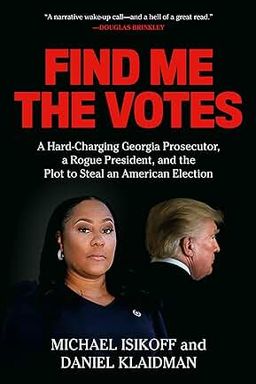
Find Me The Votes cover

Find Me The Votes

by Michael Isikoff And Daniel Klaidman

An account of former President Trump’s attempt to overturn the 2020 election and a Georgia prosecutor’s decision to indict him and his allies.

Georgia’s Fight Over Law, Power, and Narrative

How do you hold the line when political power, viral misinformation, and legal theater converge to overturn an election? In this book, the authors argue that Georgia becomes the crucible where those pressures collide—and where local institutions and a county prosecutor, Fani Willis, test whether state law can answer a national-level attempt to subvert democratic outcomes. The core claim is simple and bracing: the struggle over 2020 in Georgia is not just about votes; it’s about whether narrative dominance can outpace legal truth unless prosecutors, courts, and even intra-party dissent act decisively.

You follow three interacting engines. First is law: Georgia’s expansive RICO statute, special grand juries, and quietly courageous officials like Brad Raffensperger and Chris Carr who refuse to bend. Second is spectacle: a lawyer–PR machine—Giuliani, Powell, Eastman, Chesebro—wielding press conferences, edited videos, and novel theories to create political facts faster than courts can refute them. Third is intimidation: doxxing, threats, and racially charged harassment that punish election workers and pressure decision-makers, from Ruby Freeman and Shaye Moss to Raffensperger and, eventually, Willis herself.

Why Georgia becomes ground zero

Georgia is close, fast-growing, and newly competitive. It also has a distinctive legal environment: a broad state RICO law, energetic county prosecutors, and Republican officials who defy expectations by resisting pressure. When Trump calls Raffensperger on January 2, 2021, and says, “I just want to find 11,780 votes,” the call occurs in Fulton County—handing jurisdiction to Willis. That line condenses the book’s tension: a president’s demand colliding with an election official’s legal duty, now preserved on tape.

RICO as the lens on a sprawling scheme

You learn that Willis doesn’t see isolated misdeeds; she sees an enterprise. Georgia RICO, broader than its federal cousin, lets a prosecutor present a “whole story” of related acts: fake electors meeting in Room 216, false statements about “suitcases” in State Farm Arena, the pressure campaign on state officials, and the Coffee County data breach. John Floyd, Atlanta’s RICO sage, teaches Willis how to string disparate beads into one necklace—the same skill that made her infamous in the 2014 Atlanta school-cheating case (where altered test sheets counted as predicate acts).

The showmanship–lawfare nexus

On the other side, the book shows you a hybrid tactic: “trial by PR.” Giuliani and Powell narrate viral claims, from Dominion myths to “release the Kraken,” while Eastman and Chesebro draft theories that give the theatrics a veneer of legality. Kenneth Chesebro becomes the architect of the fake-electors plan—explicit paperwork, shared scripts, and whip operations led by Mike Roman. In Georgia, David Shafer and Robert Sinners assemble electors who sign documents with no contingency language, declaring themselves “duly elected,” even though no court or governor has certified them (a key legal vulnerability).

Threats, human costs, and racial undertones

Behind the headlines, ordinary people suffer. Ruby Freeman and Shaye Moss endure lies, doxxing, and death threats after their routine ballot processing is spun into “SuitcaseGate.” Brad and Tricia Raffensperger leave their home amid violent threats. Dominion employees and local election workers face waves of harassment. The book frames these as not collateral effects, but intended outcomes of a pressure ecosystem designed to break resistance where courts don’t.

Institutions push back

Georgia Republicans buck the caricature. Governor Brian Kemp, Lieutenant Governor Geoff Duncan, Secretary of State Brad Raffensperger, and Attorney General Chris Carr refuse to convene a special session or swap electors. In parallel, Willis builds a methodical case: she convenes a special grand jury, pulls in Jan. 6 Committee transcripts, upgrades security, and uses RICO’s leverage to harvest early pleas (Scott Hall, Sidney Powell, Kenneth Chesebro, Jenna Ellis). Judge Steven Jones keeps high-profile defendants like Mark Meadows in state court, reinforcing that the acts look political, not federal.

Key framing

“Georgia tells a national story through local law: if you can prove the pattern, you can protect the franchise.”

What this means for you

If you care about democratic resilience, Georgia shows you how it’s actually practiced: not by soaring speeches, but by statutes, phone records, venue fights, and citizens on grand juries like Emily Kohrs asking blunt questions. The book suggests you should watch state venues and local prosecutors as much as Washington. It also warns that legal truth doesn’t win by default; it wins when institutions move as quickly and cohesively as those who peddle spectacle.

(Note: Readers of Timothy Snyder or Anne Applebaum will hear echoes—authoritarians test boundaries through narrative and fear—but here you see something rarer: state-level actors and a county DA developing legal countermeasures that actually bite.)


Fani Willis: Roots, Risks, and Rise

You meet Fani Willis as a product of two worlds: civil-rights politics at home and courtroom theater at work. Raised by John C. Floyd III, a radical organizer who taught her that voting is sacred, Willis absorbs a moral frame: attacks on ballots are attacks on people. At Emory Law and the Fulton County DA’s Office under Paul Howard, she learns hard-charging litigation and a flair for props and narrative—bleach buckets, mannequins, and muscular cross-examinations that deter juries from getting lost in minutiae.

Formative prosecutions and the RICO habit

Two cases school her in enterprise thinking. In 2014, she helps prosecute the Atlanta public-school cheating scandal, using Georgia’s broad RICO to frame disparate erasures as an organized pattern tied to institutional pressure. Later, as DA, she applies RICO to gang indictments and even to a high-profile case involving rappers—using the statute to tell community-wide stories of harm. This repetition matters: when 2020’s chaos arrives, Willis already sees RICO as the narrative and leverage engine for complex wrongdoing.

A political insurgency in a city on edge

In 2020 Atlanta, protests, spikes in violence, and the Rayshard Brooks shooting change voter priorities. Armed encampments and the tragic killing of eight-year-old Secoriea Turner blunt simplistic narratives and shift parts of the Black electorate toward public-safety pragmatism. Willis breaks with her mentor Paul Howard, runs as a law-and-order insurgent, and wins in a landslide runoff. That victory positions her with a mandate to tackle violent crime—and later, to treat election subversion as a public-safety offense against the right to vote.

Seeing the Trump scheme through a voting-rights lens

When the Trump orbit turns Georgia into a pressure cooker—fake electors, the Jan. 2 “find 11,780 votes” call, State Farm smears—Willis doesn’t view it as political rough-and-tumble. She calls it a criminal assault on the franchise. Her upbringing shapes that frame: if you grew up hearing that ballots were won through blood and struggle, then a campaign to overturn them looks like organized civil-rights harm, not mere partisanship. That mindset underpins her choice to go big with RICO rather than nibble at misdemeanors.

Managing optics, allies, and adversaries

Ambition brings risk. She fractures with old office allies like Clint and Shaunya Rucker. A fundraiser appearance forces her recusal from certain lines of inquiry (e.g., then–state senator Burt Jones). She declines to rely on the Georgia Bureau of Investigation, wary of politics, and instead builds parallel investigative channels. She also hardens her office: bulletproof vests, panic buttons, body doubles, and security upgrades answer a torrent of threats naming her family.

Defining trait

“Underestimated” becomes a weapon—Willis leans into being dismissed, then outworks and out-argues opponents in court (and in the court of public opinion).

Why her story matters to you

Willis shows how local leadership can meet national stakes. You see a prosecutor who marries courtroom craft to moral clarity, then absorbs political heat to act. If you manage teams or navigate high-controversy environments, her approach offers a template: build narrative coherence, choose legal tools that fit the harm, and expect blowback. (Note: Readers of Preet Bharara’s “Doing Justice” will notice a shared ethic—cases must be trial-ready and proportionate—even as Willis deploys a broader statute and a more theatrical style.)

By the time indictments come, her arc explains her choices. A civil-rights formation tells her what matters. A RICO habit tells her how to tell it. A ferocious political apprenticeship tells her how to survive it.


RICO and the Enterprise Case

If you want to understand the Georgia prosecution, you have to understand the state’s RICO statute. It’s not just a legal cudgel; it’s a storytelling frame. Georgia RICO allows prosecutors to treat many acts by different people as part of a single enterprise if they share a common illegal objective. The statute’s breadth—covering predicate acts like false documents submitted to the state—makes it ideal for election-subversion conduct scattered across phone calls, Capitol meetings, and small-town offices.

How Georgia RICO works for complex plots

You don’t need a single smoking-gun conspiracy meeting. You need a pattern. Prosecutors can stitch together predicate acts—false statements at legislative hearings, forged elector certificates, illegal computer access in Coffee County—into an enterprise aimed at overturning the election. John Floyd, the architect of many Georgia RICO cases, tells Willis that RICO lets a jury “see the whole story,” meaning they can hear evidence that would otherwise be siloed in separate trials. That vista changes plea dynamics and jury comprehension.

From schools to elections: a proving ground

The 2014 school-cheating case previews the model. There, Willis used RICO to show educators altered test documents in an organized way tied to incentives and cover-ups. In the 2020 election, she applies the same logic: a broad cast—lawyers (Giuliani, Powell, Eastman, Chesebro), operatives (Mike Roman), party officials (David Shafer, Cathy Latham), and local administrators (Misty Hampton)—function as nodes of an enterprise. Their acts—drafting, signing, and sending fake certificates; staging “hearings” with edited videos; pressuring state officials; and copying software—converge on one illegal outcome.

Grand juries as engines of fact

Willis convenes a special-purpose grand jury—longer life, subpoena power, and the ability to take complex testimony. Jurors like foreperson Emily Kohrs start skeptical but change course as they hear from Cassidy Hutchinson, Jeffrey Rosen, and Georgia victims like Ruby Freeman. The panel unanimously concludes there was no widespread fraud and recommends dozens of indictments. A regular grand jury later returns a true bill against 19 defendants, including Trump, while early plea deals (Scott Hall, Sidney Powell, Kenneth Chesebro, Jenna Ellis) validate RICO’s leverage.

Staffing, sequencing, and discipline

Willis taps Nathan Wade as lead prosecutor and John Floyd as RICO adviser, emphasizes trial-ready indictments, and punishes sloppy work with what staff call “the Fani treatment.” She avoids potential interference by limiting reliance on the GBI and instead cultivates cooperation with the House Jan. 6 Committee, negotiating in-camera access to transcripts and exhibits. That national context helps tie Georgia acts to the broader push in Washington and other states.

Strategic payoff

RICO’s breadth creates leverage for cooperation and a narrative that jurors can follow—transforming scattered incidents into a single, comprehensible plan.

What to watch—and a caution

RICO is powerful and controversial. Critics warn it can sweep in peripheral actors who only brush against an enterprise. The book acknowledges that risk but argues the Georgia case is “the quintessential RICO”—a coordinated, multi-actor effort with shared intent and repeated acts. For you, the lesson is about tool–harm fit: when the harm is systemic, you need a statute that captures systems. (Note: Compared with Jack Smith’s narrower federal approach, Willis opts for maximum narrative scope, public transparency via state court, and plea leverage.)


Lawfare, Spectacle, and the Fake Electors

The book maps a machine that blends legal briefs with stagecraft. Giuliani, Sidney Powell, John Eastman, and Kenneth Chesebro build a simultaneous campaign in courts, legislatures, and media. Justin Clark, a Trump deputy, calls it “trial by PR”—allegations amplified regardless of courtroom viability. You see it at Georgia’s December 3 state Senate hearing, where edited clips of the State Farm Arena “suitcases” play like a courtroom drama without evidentiary rules, even as election officials later explain the footage shows routine ballot handling.

Manufacturing an “alternative” legal pathway

Kenneth Chesebro drafts memos arguing states can assemble alternate slates of electors, to be recognized later by courts, legislatures, or Congress. John Eastman supplies the constitutional frame—an expansive reading that invites the Vice President to choose between slates. Mike Roman runs the “Electors Whip Operation,” a logistics hub that corrals loyalists into state-capitol meetings. This practice, not theory, is what makes the scheme dangerous: the paperwork looks official enough to confuse the public and apply pressure on January 6.

Georgia’s Room 216 and the “duly elected” claim

On December 14, David Shafer and Robert Sinners shepherd a group into Room 216 at the Georgia Capitol. They sign documents proclaiming themselves “the duly elected and qualified Electors”—without contingency language. Chesebro circulates standardized forms and even emails “Pretty simple!” as instructions. The 1960 Hawaii precedent—two slates during an active recount later certified for Kennedy—is invoked, but Georgia has no such recount or certification. That gulf becomes a prosecutorial hinge: this looks like creating a false government record, not preserving a legitimate legal claim.

From legal claims to executive pressure

As courts and audits fail to validate fraud claims, the strategy shifts. On January 2, Trump calls Raffensperger with Mark Meadows, Cleta Mitchell, and others on the line. He repeats debunked allegations about dead voters and Ruby Freeman—citing internet claims—and then presses: “I just want to find 11,780 votes.” Raffensperger and counsel Ryan Germany calmly rebut numbers and refuse to release protected voter data. The call crystallizes a transition from legal argument to raw pressure on a state official to alter certified results.

Why narratives moved faster than law

Selective video, pseudolegal memos, and viral tropes—Dominion conspiracies, Smartmatic fantasies—outrun legal rebuttals. The spectacle fuels intimidation campaigns and persuades some legislators to entertain extraordinary remedies. Only when institutional actors—Kemp, Duncan, Carr—state their constitutional limits does the momentum slow. Even then, the manufactured electors’ documents head to the National Archives, creating a paper trail that prosecutors later use to show intent and coordination.

Bottom line

The fake-electors plan tries to wrap politics in legal clothing—an ensemble that unravels when you examine the missing facts, absent certifications, and the language of the documents themselves.

(Note: The book invites you to contrast the Georgia operation with proper legal “placeholders,” which keep options open during litigation but don’t falsely claim current authority. Here, the claim of being “duly elected” crosses that line.)


Pressure, Threats, and the Human Toll

Behind strategy memos and televised hearings lies a campaign of menace. You see it as allegations migrate from fringe forums to cable news to the president’s talking points—and then to the phones and doorsteps of election workers. The book catalogs a grim parade: doxxing on “enemiesofthepeople.com,” racist voicemails invoking lynching, and deepfakes and fake mugshots targeting Ruby Freeman. Dominion executives like John Poulos and Nicole Nollette face death threats; ordinary workers in Georgia change routines, move homes, or alter appearances.

How spectacle becomes operational threat

The pipeline is clear. Lawyers and influencers make aggressive claims—often unvetted. Viral accounts and 8kun figures like Ron Watkins amplify them. Local actors face the fallout: Brad and Tricia Raffensperger evacuate their house; Shaye Moss stops using her name. The ecosystem feeds on itself: each threat begets more coverage, which validates the grievance narrative for believers and escalates pressure on officials to “do something.”

The Raffensperger call as a case study

In the January 2 call, Trump mentions Ruby Freeman eighteen times, reflects the social-media mythology, and implies legal jeopardy if Georgia officials don’t act. Cleta Mitchell pushes for protected data like Social Security numbers; Raffensperger declines. Deputy secretary Gabriel Sterling had already warned publicly, “Someone’s going to get shot. Someone’s going to get killed,” capturing the stakes for frontline administrators. Jordan Fuchs, aware of the climate, records the call—creating a contemporaneous record that later becomes prosecutorial bedrock.

Racial history and modern tactics

The threats aren’t just numerous; they’re historically inflected. Racialized language and intimidation in Georgia echo long patterns of suppressing Black political participation. The book connects that past to present tactics—GPS coordinates posted online, coded calls to “patriots,” and survivalist messaging from figures like Lin Wood. For Willis, who grows up steeped in civil-rights memory, the continuity is moral fuel for treating election sabotage as a crime against community safety.

Security as part of prosecution

Willis’s office responds like a protective detail and a law firm at once—panic buttons, bulletproof vests, body doubles, and FBI coordination. That dual posture recognizes a hard truth: you can’t enforce voting rights if you can’t keep enforcers and witnesses safe. The result is a new prosecutorial normal where case design and threat management are inseparable, especially when proceedings are televised and nationally polarized.

Human center

The jurors’ empathy for Ruby Freeman and Shaye Moss isn’t incidental—it’s evidentiary glue that helps them see intent, harm, and the need for accountability.

(Note: For practitioners combating disinformation, the lesson is practical—pair rapid, public fact-correction with concrete security planning. Narrative fixes alone won’t blunt operational harassment.)


The Fringe Network and Coffee County

At the edge of the legal–PR machine sit actors who turn fantasy into operations. The book takes you to Tomotley, Lin Wood’s plantation, where QAnon tropes, ex-intelligence personas, and “cyber‑sleuths” mingle with Sidney Powell and Michael Flynn. They swap shredded paper theatrics and microwave phones; they hype a Venezuelan defector’s “holy grail” tape; they post survivalist checklists. It reads surreal until you follow the thread to a concrete breach in rural Georgia the day after the Capitol riot.

Coffee County: a modern Watergate

On January 7, 2021, an S2 (Sullivan/Strickler) team arrives in the Coffee County elections office with local help from GOP chair Cathy Latham and election supervisor Misty Hampton. Scott Hall, an Atlanta bail bondsman, coordinates and later boasts, “We scanned every freaking ballot.” For seven hours, they make forensic copies of Dominion software, ballot scanner code, thumb drives, and memory cards—then upload the data to a password-protected site for distribution across election-denial networks.

Illegal, insecure, and interconnected

Georgia’s elections director had explicitly prohibited copying proprietary software. Election systems are critical infrastructure; unauthorized access is a crime and a security risk. Yet the breach proceeds with pizza and “permission,” a fig leaf that doesn’t cure illegality. Financial records tie the job to Sidney Powell’s Defending the Republic ($26,200), and communications link Latham to Giuliani-world figures at the Willard war room. Data flows to activists like Conan Hayes and appears later at disinformation conferences (think Mike Lindell’s symposium).

From Antrim County myth to Georgia copycat

Antrim County, Michigan—a human error quickly corrected—becomes a distorted template: claim “vote flipping,” demand machine access, and publish “forensic reports.” Coffee County replicates the script, but instead of exposing fraud, it exposes Dominion’s proprietary code, creating a hacker roadmap. The operation fails to find systemic wrongdoing; it succeeds in creating disinformation fodder and criminal exposure for participants.

Why this matters to the RICO case

Coffee County anchors the enterprise’s operational wing. It shows the plot isn’t only about speeches and signatures; it includes physical and digital intrusion. For Willis, it ties local officials to national figures and adds predicate acts like computer trespass to the RICO matrix. It also humanizes risk for jurors: this isn’t abstract theory—it’s strangers copying election software in a county office with help from insiders.

Core lesson

Conspiracy ecosystems radicalize when ideas get logistics—planes booked, doors unlocked, servers accessed. That is where law must intervene.

(Note: Students of insurgency will recognize the pattern—ideology, propaganda, and operations in feedback. Coffee County is the operations node, and its unraveling supplies prosecutors with the connective tissue they often lack in disinformation cases.)


Guardrails, Venues, and Jurisdictional Battles

The Georgia story isn’t just about what conspirators tried; it’s about what institutions did. A surprising cast of Republicans—Kemp, Raffensperger, Duncan, Carr, and even the late Johnny Isakson—say no to pressure. Kemp declines to call a special session. Duncan refuses to reconvene the legislature to switch electors. Carr says he’d “resign before” defending a fake-elector swap. Their public statements, amplified with legal citations, reset the constitutional weather and shrink space for extraordinary remedies.

The removal fight and state-court strategy

Defendants like Mark Meadows and Jeff Clark try to move their cases to federal court under the removal statute, claiming they acted under color of federal office. Judge Steven Jones hears Meadows and rules the acts look like campaign conduct aimed at state procedures, not federal duties—keeping the case in Fulton County. That matters: Georgia state court allows cameras in the courtroom, giving the public a transparent record, and it empowers Willis to wield Georgia’s broader RICO tools.

Parallel federal action and contrasting scopes

Meanwhile, Attorney General Merrick Garland appoints Jack Smith as special counsel. Smith brings a narrower federal indictment centered on January 6 and the fake-electors scheme across multiple states. Willis’s indictment is wider in Georgia-specific detail—Coffee County, the Raffensperger call, and state-level false filings—presented as one enterprise. Running in parallel, the cases show two theories of accountability: federal precision versus state breadth and visibility.

Grand-jury dynamics and public legitimacy

The special-purpose grand jury, with citizens like Emily Kohrs, hears national-level testimony via Jan. 6 Committee transcripts and local victims in person. Jurors’ emotional reactions to Ruby Freeman and their skepticism turned certainty after hearing insiders like Cassidy Hutchinson shape what Willis ultimately brings. When plea deals roll in from Sidney Powell, Kenneth Chesebro, Jenna Ellis, and Scott Hall, they don’t just strengthen the case; they also reinforce public intuition that the enterprise existed and was coordinated.

Why venue is substance, not procedure

You might treat venue as technical, but the book shows it’s strategic. State court means jurors from the affected communities and proceedings the public can watch. It means applying a statute crafted for systemic harm to a systemic attempt to overturn an election. It also means speed and leverage: RICO predicates, mandatory minimums, and a televised docket that resists rumor by surfacing evidence.

Guardrail insight

Democracy’s defenses worked not because one hero acted, but because multiple institutions—executive officers, courts, and a county DA—each did their small part relentlessly.

(Note: If you follow election law, the Georgia saga is a case study in federalism’s virtue: state actors can shore up national outcomes when federal timelines, secrecy rules, or narrow charging theories leave gaps.)

Dig Deeper

Get personalized prompts to apply these lessons to your life and deepen your understanding.

Go Deeper

Get the Full Experience

Download Insight Books for AI-powered reflections, quizzes, and more.