
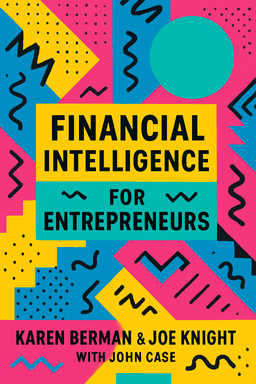
Financial Intelligence for Entrepreneurs cover

Financial Intelligence for Entrepreneurs

by Karen Berman & Joe Knight with John Case

Financial Intelligence for Entrepreneurs empowers business owners and managers to demystify financial concepts and harness the power of financial data. With practical insights and examples, the book guides nonfinancial professionals in mastering financial statements, recognizing revenue, and understanding business valuations for informed decision-making.

Mastering the Art and Science of Financial Intelligence

Have you ever wondered why some entrepreneurs seem to make consistently smart financial decisions while others constantly scramble to make payroll? In Financial Intelligence for Entrepreneurs, authors Karen Berman and Joe Knight argue that the difference comes down to one critical but teachable skill: financial intelligence. They believe that understanding the story behind the numbers—the art as well as the science of finance—is what separates entrepreneurs who run sustainable, growing companies from those who lose control of the business they built.

The authors contend that financial intelligence is more than just reading an income statement or tracking sales. It’s about understanding how financial statements tell a story about your business—and learning to interpret that story so you can make better decisions. They reveal that finance is not an exact science but an art shaped by assumptions, estimates, and interpretations. Recognizing this truth, they argue, allows entrepreneurs to keep control of their growth, cash, and profitability rather than being at the mercy of accountants, investors, or luck.

The Three Building Blocks of Financial Intelligence

Berman and Knight introduce three key skill sets: understanding the numbers, recognizing the art behind them, and practicing financial analysis. That means learning to read and interpret the three core financial statements—the income statement, balance sheet, and cash flow statement. They show how each document connects: profit feeds into equity, the balance sheet reflects accumulated performance, and cash flow reveals whether you can actually pay the bills on Friday.

But recognizing that finance is also art is crucial. Numbers are estimates, shaped by decisions about depreciation schedules, revenue recognition, or how to classify expenses. Two accountants can look at the same transaction and produce different profits—and both can be legitimate. Once you accept that there’s judgment in every number, you’re equipped to question assumptions and interpret reports critically.

Why Every Entrepreneur Must Learn the Language of Numbers

The book’s preface grounds this in relatable stories. Paul Saginaw and Ari Weinzweig founded Zingerman’s Deli with great passion but zero financial know-how. Sales soared, yet profits vanished. They were so busy working the counter that they didn’t realize their cash flow was collapsing. By contrast, Chip Conley of Joie de Vivre Hotels—who studied finance—used his financial literacy to scale his boutique hotel business intelligently, avoiding the blowups that sink many founders. These stories confirm the authors’ core message: you can’t manage what you don’t understand.

Berman and Knight remind entrepreneurs that there’s no exam to pass before starting a business—no one tested your grasp of accounting before you quit your job to launch your dream. Yet, without financial skills, entrepreneurs fly blind. They may be brilliant at sales, engineering, or product design, but if they don’t understand cash cycles, margins, and ROI, they risk building a bus they can’t afford to fuel.

The Art and Emotion of Numbers

What sets this book apart is its humanity. Berman, an organizational psychologist, and Knight, an MBA-turned-entrepreneur, bring empathy to a topic often wrapped in jargon. They debunk the myth that finance is for people who love math. In truth, most finance involves addition, subtraction, and an occasional division sign. What matters is learning the language—terms like gross profit, working capital, depreciation, and return on investment—and understanding what they mean for decisions about pricing, hiring, or expansion.

“Numbers should inform your decisions, not determine them.” —Karen Berman & Joe Knight

Numbers never tell the whole story; they must be read in context—the economy, competition, customer trends. Financial intelligence means seeing numbers as a flashlight, not a crystal ball. It helps you ask better questions: Why is profit different from cash? Why do my margins fluctuate? Is this investment really paying off? It replaces guesswork with insight.

From Confusion to Control: The Path Forward

Throughout the book, the authors build your competency step-by-step—from income statements and balance sheets, to understanding cash flow, ratios, ROI, and working capital. They show how each topic adds a layer of control over your business. Financially intelligent entrepreneurs know when profit is biased by accounting choices, how to use ratios to spot trends, and how to manage for cash, not just sales. They treat finance as a decision-making toolkit, not an afterthought.

Ultimately, Financial Intelligence for Entrepreneurs isn’t just about surviving financial reports—it’s about translating numbers into narratives that shape the destiny of your company. Whether you’re pitching investors, analyzing ROI, or navigating growth, the book’s message is clear: when you think financially, you lead strategically. Finance becomes not a constraint but a language of empowerment—one every entrepreneur can speak fluently.


The Art of Finance: Numbers as Interpretation

Berman and Knight emphasize a surprising truth: finance isn’t pure mathematics—it’s storytelling, grounded in assumptions and human judgment. This insight begins in their chapter “A Primer on the Art of Finance,” where they argue that understanding how numbers are created is as important as knowing how to read them. Every profit figure, depreciation schedule, or valuation is rooted in choice. The point isn’t to distrust numbers but to interpret them critically.

When Is a Sale Really a Sale?

Consider revenue recognition. A business might record a sale when a contract is signed, when goods are shipped, or when payment is received. According to GAAP, revenue is recognized once the product or service is delivered—but even that rule demands judgment. In the late 1990s, companies like Xerox infamously overstated $6 billion in sales by recognizing too much of their long-term maintenance contracts up front. Closer to home, a start-up juggling project milestones faces the same dilemma: do you book revenue when you send an invoice or only when a client accepts the work? Your choice shapes your profit and your bankers’ perception of your health.

Capital Expenditures vs. Operating Expenses

Another gray area is distinguishing between operating expenses and capital investments. An operating expense (like office supplies) hits your profit immediately; a capital expenditure (like machinery) spreads the cost over years through depreciation. This boundary, though, can be manipulated. Waste Management once inflated profits by simply depreciating its trucks over a longer lifespan, while WorldCom disguised billions in expenses as “investments.” On a smaller scale, labeling that new software system as a capital asset instead of an expense can make your business look more profitable—on paper.

Depreciation and the Illusion of Precision

Depreciation itself is a masterpiece of accounting art. It’s a method of allocating cost, not measuring value. If you buy a $36,000 truck and depreciate it over three years, you expense $12,000 per year. But what if you guess six years instead? Profit doubles instantly, even though the truck hasn’t changed. Airlines have adjusted plane lifespans to boost earnings, and entrepreneurs can mislead themselves by assuming overly long or short asset lives.

The key takeaway: numbers aren’t static truths. They reflect reasonable estimates made under uncertainty. Financial intelligence means identifying where those estimates live, understanding their bias, and adjusting your interpretation accordingly. Instead of asking “What’s the number?” smart entrepreneurs ask “How was this number created?”

Valuation: Putting a Price on a Dream

The same artistry extends to valuing entire companies. Public firms are priced by markets, but private businesses must rely on one of several methods: the price-to-earnings ratio, discounted cash flow, or asset-based valuation. Each tells a different story. A small restaurant might seem worth $500,000 on earnings multiples but only $200,000 by assets—because most of its value lies in customer loyalty and brand reputation, not equipment. The dot-com boom revealed how wild these interpretations can become, when companies with “no profits, no assets, and lots of eyeballs” fetched millions based on faith. Knowing how valuation methods work helps entrepreneurs see both opportunities and illusions.

Finance, the authors remind us, is not about perfect accuracy—it’s about crafting a reflection of reality that’s useful for decision-making.

The more you learn to see the art behind accounting, the less likely you are to be fooled—by others or by your own optimism. You’ll grasp, for instance, why two businesses can show identical profits but one runs out of cash and the other thrives. Financially intelligent entrepreneurs treat financials like a dashboard full of interpretive gauges, not gospel carved in stone.

Seen this way, financial intelligence becomes both protection and power. You’ll resist being dazzled by rosy spreadsheets, understand how your financial advisor “paints” the numbers, and learn to paint more honest pictures yourself. Numbers, in Berman and Knight’s view, are not ends in themselves—they’re tools for revealing the human choices and assumptions behind every business story.


Profit Is an Estimate, Not a Fact

One of the book’s most liberating insights is that profit—the holy grail of business success—isn’t as black-and-white as most people believe. Even on your income statement, profit is an estimate built on the matching principle, not a cash reality. The authors demystify this concept by explaining how accrual accounting tries to match revenues with the costs that produced them, creating a more accurate but less tangible picture of performance.

The Matching Principle in Action

Imagine you buy a truckload of printer cartridges in June to sell over six months. Under cash accounting, June looks terrible—you’d record a huge expense and no profit. Accrual accounting prevents this distortion by recording expenses only when revenue is realized. It treats costs and sales as dance partners: each expense belongs to the sale that generated it. The result is smoother, more readable statements—but also a step away from real cash in the bank.

Berman and Knight use a great example: a fast-growing business services firm that shows strong profits on paper but runs out of cash because clients pay sixty days late while payroll hits every two weeks. The lesson is clear: you can’t spend profit until it turns into cash.

Profit ≠ Cash: The Entrepreneur’s Trap

Many founders confuse profit with liquidity. You make sales, see a positive bottom line, and assume you can afford that new hire or equipment upgrade. But accrual-based profit is essentially a promise—it records value before money moves. This disconnect explains why businesses that look successful can collapse overnight. The authors liken profit to a mirage: attractive from afar, but dangerous if you chase it without checking your canteen.

Entrepreneurs need both profit and cash to survive. Profit tests your business model; cash proves your execution. Healthy companies generate both, turning paper profits into bank deposits through efficient collections, controlled spending, and wise reinvestment. Financial intelligence gives you the tools to track both simultaneously—via the income statement and cash flow statement—and to interpret the differences between them.

“You can be profitable and broke at the same time.” That paradox drives home why understanding the difference between accrual profit and cash reality is nonnegotiable for entrepreneurs.

When you realize that profit is an estimate—not a pile of cash—you start to make decisions differently. You’ll time purchases around collections, invest in working capital more carefully, and challenge assumptions in your financials. You’ll think like a seasoned CFO—even if you’re still signing paychecks from your kitchen table.


Cash Is King: The Reality of Business Survival

Berman and Knight popularize one of entrepreneurship’s golden rules: cash is reality; profit is theory. Quoting Warren Buffett—who measures companies by their cash flow rather than reported earnings—they drive home that cash flow is the lifeblood of a business. It’s what pays rent, vendors, and employees. Without it, even the most exciting startup collapses.

Understanding the Cash Flow Statement

The cash flow statement, often overlooked, reveals how money truly moves. It categorizes your cash into three streams: operating activities (day-to-day business), investing activities (buying or selling assets), and financing activities (loans, investor funds, dividends). A growing company should ideally generate positive cash from operations while investing in future assets and carefully managing loans or owner withdrawals.

The authors teach entrepreneurs to look at operating cash flow first—it shows whether your core business produces or consumes cash. A firm with high profits but negative operating cash is flashing a warning sign. Conversely, a company like Amazon can post slim profits yet thrive because it generates enormous operating cash by collecting payments before it pays suppliers.

Profit Without Cash: The Sweet Dreams Bakery

To illustrate, the authors introduce “Sweet Dreams Bakery,” a hypothetical small manufacturer that’s growing sales rapidly but fails to manage timing. Customers pay in sixty days, while suppliers demand payment in thirty. Each month sales rise, but so do receivables, and eventually the bakery runs out of money—it’s profitable but bankrupt. This vivid case shows how growing too fast can sink a company if cash doesn’t keep pace with expansion.

Cash Without Profit: The Fine Cigar Shop

Conversely, “Fine Cigar Shops” appears successful in the short term. It collects cash immediately from customers and pays suppliers slowly. Its bank account looks full even though it’s losing money every month. The illusion lasts only until unpaid bills come due. Cash-rich but unprofitable businesses die more slowly—but just as surely—as profit-rich, cash-poor ones.

Cash flow isn’t just a number—it’s the reality check that keeps optimism honest. A company’s survival depends more on its cash cycle than its income statement.

Ultimately, cash flow literacy lets you foresee crises before they strike. You’ll watch accounts receivable, control inventory, negotiate payment terms, and plan investments to avoid running dry. That’s why Buffett calls cash “hard to fudge” and why financially intelligent entrepreneurs track it like oxygen.


Ratios: Reading the Real Story Behind Numbers

Numbers by themselves rarely tell a complete story. Berman and Knight introduce financial ratios as the lenses that bring the financial picture into focus. By comparing line items from your statements—profit margins, debt levels, liquidity, efficiency—you can judge whether your business is healthy, sick, or improving.

Profitability Ratios: Measuring Return and Margin

Ratios like gross profit margin, operating margin, and net margin reveal how much of each sales dollar you keep after covering production, operating costs, and taxes. If your margins are shrinking, you may be discounting too heavily or spending too freely. Return on assets (ROA) and return on equity (ROE) show how well you’re using what you own—or owe—to generate profits. A sky-high ROA may actually signal underinvestment, while a low ROE may mean untapped potential.

Liquidity and Leverage Ratios: Balancing Risk and Responsibility

Liquidity ratios like the current ratio and quick (acid-test) ratio tell you if you can pay short-term bills without selling core assets. Leverage ratios such as debt-to-equity and interest coverage measure how much of your growth is funded through borrowing. Debt can amplify returns but magnify risk—a truth Ed Zimmer of ECCO summarized with humor: “If you’ve never put payroll on your Visa, you’re not a small business.”

Efficiency Ratios: Turning Inputs Into Cash

Efficiency ratios measure how swiftly assets turn into revenue or cash. Key metrics include inventory turnover (how fast your stock sells), days sales outstanding (how long customers take to pay), and total asset turnover (how effectively you use everything you own to generate sales). When Andrew Shore, a Paine Webber analyst, investigated Sunbeam, he noticed days sales outstanding soaring—proof that CEO “Chainsaw Al” Dunlap was inflating revenue with unsold goods. Ratios exposed the fraud long before auditors did.

Ratios turn raw data into insight—they ask “compared to what?” and force you to see the patterns shaping your company’s story.

The Power of Trends and Benchmarks

One ratio alone means little. Its power lies in comparison: against your past (trends), your plan (budget variance), or your peers (industry averages). A current ratio dropping below 1 is a red alert; a gross margin trailing competitors’ signals inefficiency. Entrepreneurs who learn to read these patterns can catch trouble early and steer proactively instead of reactively. As Berman and Knight put it, ratios are the entrepreneur’s X-rays—they diagnose what the surface numbers hide.

Once you master ratios, you stop managing from your gut and start managing from data. You’ll still use intuition—but informed intuition, grounded in a financial reality you can explain, share, and improve.


Return on Investment: Making Smart Big Decisions

Every strategic decision—from buying equipment to launching a product—comes down to one question: will this investment pay off? Berman and Knight walk readers through the essential toolkit for analyzing return on investment (ROI). They tie it to a foundational finance principle: the time value of money. A dollar today is worth more than a dollar tomorrow, because today’s dollar can be invested, earned, or lost.

Evaluating Investments: Three Core Methods

1. Payback Period: The simplest method—how long until the project recovers its cost. Quick but shallow, it ignores what happens after breakeven and doesn’t consider the time value of money. Use it as a first filter, not a final verdict.

2. Net Present Value (NPV): The favorite of finance pros. It discounts future cash flows back to today’s dollars using your hurdle rate—the minimum return required to justify the risk. A positive NPV means the project creates value; a negative one destroys it. NPV shows how much value in dollars an investment adds.

3. Internal Rate of Return (IRR): This finds the exact rate of return an investment yields. If it exceeds your hurdle rate, the project passes; if not, reject it. IRR shines when comparing projects of similar scale but can mislead when durations differ.

From Equations to Judgment

While the math matters, the authors stress that good ROI analysis rests on good assumptions. You must estimate how much cash a project will really generate and when—often the hardest, most artful step. Overly rosy projections have sunk countless businesses. A sensitivity analysis—testing what happens if returns shrink by 10–20%—helps you gauge risk before committing.

For instance, imagine deciding between three machines: one repays in a year but stops there, another yields smaller returns for three years, and the last produces steady profits longer. A naïve glance favors the fastest payoff; an NPV view reveals that longer, slower returns can create more value over time. Financial intelligence turns decisions from gut calls into calculated moves.

ROI isn’t just an equation—it’s a conversation about strategy, risk, and opportunity cost.

When you apply ROI thinking, you allocate capital not by emotion but by impact. You start to see your company’s money as a renewable resource that must earn more than it costs. In short, ROI transforms entrepreneurship from gambling into disciplined experimentation—a habit of mind that underpins every financially intelligent leader.


Working Capital Magic: Managing the Balance Sheet

If cash is your company’s oxygen, working capital is its circulatory system—the flow that keeps operations alive. Berman and Knight show how managing receivables, payables, and inventory can free trapped cash without touching sales or expenses. This is the entrepreneur’s hidden superpower.

Understanding Working Capital

Working capital equals current assets minus current liabilities. It measures how much operating cash is available after paying short-term obligations. Too little, and you risk insolvency; too much, and resources sit idle. The goal is balance—keeping your blood flowing, not pooling.

The Balance Sheet Levers

Three levers control working capital: accounts receivable, inventory, and accounts payable.

  • Receivables: Track days sales outstanding (DSO). Each day a customer delays payment ties up cash you could reinvest. Reducing DSO by even one day releases thousands of dollars. The cure: invoice promptly, clarify terms, and align sales incentives with collections, not just bookings.
  • Inventory: Treat stock as frozen cash. By applying lean principles—ordering smaller batches more often, simplifying product lines, improving production scheduling—you can cut days in inventory (DII) and free up liquidity.
  • Payables: Extending payment terms too far strains supplier relationships, but paying early burns cash needlessly. Smart firms balance financial efficiency with vendor trust, as Joe Knight’s Setpoint does—never letting invoices exceed thirty days to sustain goodwill.

Measuring Cash Conversion

The authors introduce the cash conversion cycle (CCC), a simple formula: DSO + DII – DPO. It measures how long dollars remain tied up after paying suppliers and before collecting from customers. Shorten that cycle, and you expand capacity without raising funds. Tyco once lost hundreds of millions when acquisitions bloated its inventory and stretched this cycle; smaller firms can face similar danger on a smaller scale.

Improving working capital is financial alchemy: you conjure cash out of efficiency, not debt or sales.

The beauty of working capital management is that it strengthens both cash flow and profitability without massive change. Entrepreneurs who grasp their balance sheet levers can self-finance growth, negotiate better with bankers, and sleep easier knowing exactly when cash will return to the till.


Building a Financially Intelligent Company

The final message of Berman and Knight’s book zooms out from individual skills to company culture. Financial intelligence, they argue, isn’t just for CEOs—it’s a collective mindset. Great businesses cultivate financial literacy and transparency at every level. When employees understand how their actions affect profit and cash, they make better decisions, trust leadership more, and work like owners.

Open-Book Management and Financial Literacy

Borrowing from pioneers like Jack Stack (The Great Game of Business), the authors advocate open-book management: sharing financials openly and teaching people what they mean. At ECCO, for instance, weekly “flash” reports display income statement line items with employee initials next to them—who owns which number. When profits dip, the discussion isn’t finger-pointing; it’s problem-solving.

The result is what Joe Knight calls “psychic ownership.” Even where employees have no stock, they think and act like shareholders because they understand the connection between their performance and company results. Research cited by the authors confirms that organizations sharing financial data and teaching basic business literacy outperform those that keep employees in the dark.

How to Teach the Numbers

  • Run short, recurring training sessions on topics like margins, cash flow, and costs—simple, visual, and story-driven.
  • Hold weekly numbers meetings to review two or three key metrics (sales, shipping, costs) and discuss trends.
  • Post scoreboards—public dashboards tracking progress and forecasts—and celebrate when teams hit their targets.

These routines turn abstract numbers into shared goals. At one company, renaming employees “business partners” revolutionized culture; conversations about costs became conversations about opportunity. Transparency breeds trust, reduces destructive politics, and encourages informed risk-taking.

Beyond Compliance: From Sarbanes-Oxley to Ownership

While large corporations grapple with regulations like the Sarbanes-Oxley Act, small businesses can adopt its spirit without the bureaucracy: ethical reporting, accurate data, and clear accountability. An open approach aligns everyone—from line workers to executives—behind the same scoreboard of financial truth. It also prepares companies for growth, investment, or even going public.

Financial literacy turns employees into strategists. Transparency turns businesses into communities.

In the end, a financially intelligent company is one where everyone speaks the language of numbers fluently—not to impress investors but to make smarter collective choices. The result is resilience, trust, and sustainable performance—a business that thrives because its people understand how it truly works.

Dig Deeper

Get personalized prompts to apply these lessons to your life and deepen your understanding.

Go Deeper

Get the Full Experience

Download Insight Books for AI-powered reflections, quizzes, and more.