
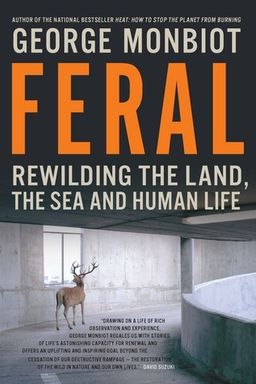
Feral cover

Feral

by George Monbiot

Feral by George Monbiot is a compelling call to embrace nature''s wildness, arguing for the rewilding of land and sea to rejuvenate ecosystems and human life. Through personal adventures and insightful analysis, Monbiot reveals how reconnecting with true wilderness can enhance well-being and inspire a profound ecological renewal.

Rewilding: Restoring Processes and Possibility

What does it mean to make the world wild again—and why should you care? In Feral, George Monbiot argues that rewilding is not nostalgia or a blueprint for the past but a restoration of process: letting ecosystems and people regain the freedom to reorganize themselves. He asks you to let go of control—to remove barriers, reintroduce lost links, and give nature and human experience room to unfold. The book's theme is both ecological and existential: to rewild the land and the self.

Two meanings, one force

Monbiot defines two linked senses of rewilding. The first is ecological—reintroducing or protecting missing species and functions until ecosystems become self-willed. The second is personal—rewilding human life by regaining adventure, sensory range, and contact with non-human reality. These ideas intertwine. You cannot understand wild landscapes without confronting your own confinement within modern routine.

Rewilding resists control: rather than manicuring nature into gardens or following historic maps, it dissolves fences, undoes drainage, and allows succession. In Wales and Scotland, Monbiot watches birch and willow reclaim bracken-covered slopes once sprayed and grazed. At Dundreggan, Trees for Life protects suckers and seedlings to let the Caledonian forest return. At sea, he calls for no-take zones where depleted food webs can heal themselves. You learn that rewilding is permissive, not prescriptive—a plural path, not a single utopia.

Wild processes over static snapshots

Monbiot’s key claim is that systems thrive when left flexible. He contrasts living processes with the conservation prison, where reserves like Glaslyn are kept treeless and grazed to satisfy outdated designations. He invites you to trade the illusion of stability for the confidence of dynamic recovery. Rewilding asks that you restore missing players—predators, beavers, large herbivores, even soil engineers—so the system can rearrange itself. Yellowstone’s wolves, beavers in Knapdale, and lynx in the Carpathians provide proofs of concept. He draws a parallel with personal experience: you, too, flourish when freed from the management of comfort and monotony.

Deep time and moral compass

Understanding wildness requires deep historical context. Palaeoecology—mud, pollen, and bones—shows that Britain’s bare uplands were once rich forests, shaped even by elephants that may have molded tree traits. The idea challenges modern baselines and reminds you how shallow your concept of ‘natural’ is. Monbiot connects this to Daniel Pauly’s Shifting Baseline Syndrome: every generation mistakes its diminished childhood world for health. Once you grasp deep time, you see that restoration means reviving lost processes, not decorating a museum landscape.

Rewilding people and ethics

Monbiot’s argument extends beyond ecology: modern humans are domesticated by culture and economy. You feel ecological boredom—a craving for unpredictability, risk, and contact. He recounts his own transformations in Roraima and Cardigan Bay and interprets cultural myths, from British big-cat sightings to the fascination with figures like Raoul Moat or Johnny Byron, as distorted expressions of that yearning for feral vitality. Rewilding yourself means rediscovering capacity for wonder, not chaos.

Politics, power and consent

Rewilding collides with economics and identity. Monbiot unpacks how sheep grazing—heavily subsidised and culturally entrenched—has stripped Britain’s uplands bare. The Common Agricultural Policy, with its perverse ‘fifty trees’ rule, rewards land kept barren while punishing natural regeneration. Undoing this requires legislative reform and new incentives: paying for restoration, capping entitlements, and letting land revert when communities choose. Through encounters with farmers like Dafydd and Delyth, Monbiot insists that rewilding must never erase human stories. Consent, heritage, and justice are non‑negotiable. You can design policies that free ecosystems while keeping living rural cultures intact.

A continental and moral horizon

Across Europe, accidental rewilding—from Slovenia’s forests to abandoned Romanian farms—shows nature’s resilience once exploitation stops. But history warns of darker versions: Nazi forest romanticism, coerced evictions, and conservation as colonial power. Monbiot ends with guardrails—ethical rules for freedom without dispossession. Rewilding must remain plural, democratic, and restorative. It can heal earth and psyche only when driven by humility and shared choice, not ideology.

If you take away one insight, it is this: rewilding is less about returning to a lost Eden and more about releasing agency—of rivers, wolves, soil, and people—from the systems that have fenced them in. It is both ecological science and an invitation to recover your own wild sense of life.


Trophic Webs and Keystone Forces

If you restore the wild, you must understand the mechanics that make it function. Monbiot grounds rewilding in the science of trophic cascades—the ripple effects caused when top predators and engineers return. The Yellowstone experiment encapsulates this: wolves changed not only numbers but behaviour. Elk avoided valleys, allowing willows and aspens to regrow, cooling rivers, inviting beavers, and triggering a chain of hydrological and biological renewal.

Predators, engineers and chemistry

Beavers, as ecosystem engineers, create ponds that trap sediment, support amphibians and birds, and reduce flooding. Arctic fox introductions that altered soil phosphate in the Aleutians and India’s vulture decline leading to rabies epidemics demonstrate how missing species can reshape chemistry, disease, and even human health. You see that every ecosystem is a web of function, not a list of names. Restoration requires reinstating these functional groups rather than planting symbolic species.

Designing rewilding projects

For your own decisions, Monbiot advises thinking in cascades, not counts. Ask how a species changes behaviour, structure and nutrient flow, not merely how many hectares it occupies. Predators like lynx or boar reshape fear and forage; herbivores restore cycling and carbon balance. Sergey Zimov’s Pleistocene Park shows the complexity: grazing can slow permafrost thaw but also shift vegetation and albedo. Each place demands local monitoring and adaptation.

Core principle

A small number of species can have disproportionately large effects. Rewilding looks for function before form: restore relationships, not snapshots.

Once you grasp this logic, rewilding stops being sentimental and becomes science—a method for rebuilding living systems through feedback and freedom.


Deep Time and Shifting Baselines

To see what restoring nature means, you must first unlearn what ‘natural’ looks like. Monbiot invites you into the archaeological mud of Goldcliff, where Mesolithic footprints of people, cranes and aurochs remind us that wild landscapes once supported vibrant human life. Those traces undermine modern nostalgia for treeless heaths and barren moors.

The elephant-adapted forest

With Adam Thorogood he proposes that many European trees—coppicing and bark traits—are legacies of ancient elephants. Straight-tusked elephants vanished forty thousand years ago, yet their browsing shaped species still present. It means our temperate forests evolved with giants; their absence distorted ecological structure. Recognizing this helps you understand which missing roles might ethically be reinstated today—large herbivores or natural predators.

How baselines erode

Daniel Pauly’s concept of Shifting Baseline Syndrome shows that people mistake their childhood landscapes for health. Pollen cores from Welsh uplands reveal that heather moor once held oak and mixed forest. By confining conservation to recent memory, policy enshrines degraded states. Rewilding, informed by palaeoecology, replaces nostalgia with informed imagination.

Practical guidance

Use deep time as a reference, not a map. It tells you what diversity and interactions were once possible, guiding adaptive experiments like beaver or boar reintroductions. By comparing past pollen and bones to present constraints, you can design restoration that amplifies complexity instead of replicating static pasts.

The lesson: the past is not sacred but instructive. It broadens your imagination for the futures wildness can still invent.


Politics, Economy and the Sheep Barrier

Wild recovery collides with entrenched economics. Monbiot exposes how the Common Agricultural Policy subsidizes ecological decline. Hill farming, especially sheep grazing, turns thousands of hectares into biologically sterile grass, yet taxpayers pay billions a year to maintain it. In Wales, farm viability depends entirely on subsidies that punish reforestation.

How rules enforce degradation

The CAP’s Good Agricultural and Environmental Condition standards require ‘maintenance’ of pasture. More than fifty trees per hectare disqualify land from payment—so woods are cut and scrub burned. The result is erosion, flooding and biodiversity collapse. Monbiot shows farmers clearing woody debris from river catchments, accelerating runoff and increasing insurance costs downstream. You, the taxpayer, fund ecological simplification and flood damage simultaneously.

Reform and fairness

His fix is deceptively simple: stop criminalizing natural succession. Let landowners choose whether to farm or let trees grow. Cap entitlements (for example at 100 hectares) to reduce rent-seeking by wealthy absentee landlords who control 69% of British land. Redirect funds into voluntary restoration, community woodland schemes and transition income supports. Over time, the land would self-sort: cultural farmers would stay, others would rewild.

Policy insight

Pay for public goods—carbon storage, flood prevention, biodiversity—not empty fields. Economic freedom can become ecological freedom.

Here rewilding proves political: redesigning incentives transforms landscapes without coercion, combining justice and restoration.


Human Communities and Consent

Monbiot’s narrative comes alive in the Cambrian Mountains with Dafydd and Delyth, whose family roots reach back to 1885. Through them you confront why restoration often feels like erasure. They see proposals for tree return as threats to heritage—the same logic that once exiled families when conifer plantations swallowed homes. Their fear is historically justified.

Balancing justice and ecology

The moral heart of rewilding is consent. Monbiot refuses forced eviction. Instead, he builds a participatory model: remove perverse subsidies and let choice decide. When payments no longer reward ecological harm, communities that cherish their farming will endure. Others can diversify—offering guiding, small lodgings, crafts and wildlife tourism. In Wales, nature-based activity already yields around £1.9 billion annually against farming’s £400 million, signalling the potential for livelihood without loss.

Designing coexistence

Respect is key. Monbiot calls for voluntary transitions, shared decision-making, and capped entitlements so small farmers survive. Rewilding can then serve culture and ecology together—a living countryside where language, song and biodiversity thrive side by side.

You learn that wildness and human belonging are not enemies. With freedom and consent, both can grow from the same soil.


The Sea’s Forgotten Wilderness

Monbiot turns from land to ocean to show a deeper crisis. The sea is often more impoverished, stripped by industrial fishing. Rewilding the sea means creating large, enforced no‑take zones that let food webs rebuild. You begin with the whale pump: whales dive and defecate, fertilizing plankton blooms that support krill, fish and carbon sequestration. Remove whales and sharks, and nutrient circulation collapses.

Collapse and illusion

Historical accounts reveal that European seas teemed with giant cod, herring, and bluefin tuna—yet biomass fell by 94% since 1889. This decline hides behind shifting baselines: we compare today’s scraps to mid‑century abundance, not to the former glory. Monbiot chronicles how predator removal caused jellyfish and ray explosions, destroying scallop beds and creating dead zones.

Recovery through protection

No‑take reserves work. Around Lundy, lobsters tripled in months; on Georges Bank scallops rose fourteenfold in five years. Biomass, size and diversity surge within two to five years of closure, then spill over to fisheries outside. Despite this evidence, only 0.01% of Britain’s seas enjoy strict protection; vested interests keep trawlers in conservation zones like Cardigan Bay.

Lesson from the deep

When you give the sea rest, it roars back to life. Protection—not micromanagement—is the route to both abundance and resilience.

Rewilding the sea mirrors the land: freedom of process returns productivity, biodiversity and hope within years.


Culture, Yearning and the Inner Wild

Underneath the ecological analyses runs a psychological current. Monbiot describes ecological boredom—a symptom of domestication. Modern life, fenced and comforted, dulls our instincts for challenge and discovery. His adventures among the Maasai and in Roraima reignited the wild sense that modernity suppresses. Rewilding humans means reopening that vein safely.

Myths of beasts and freedom

The British fascination with phantom big cats reflects that void: people invent predators to fill it. Cultural heroes like Raoul Moat or Johnny Byron become feral symbols—violent, autonomous figures idolized because they break invisible cages. Monbiot’s interpretation is compassionate: these myths show our hunger for intensity and risk.

Channeling wildness ethically

He urges advocates to meet this longing, not dismiss it. Redirect people toward legal, restorative wildness—volunteering, fishing, camping, exploring—with evidence-based reassurance. Rewilding satisfies the need for awe and danger without abolishing safety.

If you understand the psychological side, you can communicate rewilding as liberation rather than threat—an invitation to feel alive again instead of fearing predators or change.


Children and the Lost Commons

A society that fences off wildness fences off childhood itself. Since the 1970s children’s roaming radius in Britain has shrunk by ninety percent. Monbiot links this to enclosure—the same process that privatized land and diminished ecological freedom. Without woods and rivers to learn from, children lose health, resilience and curiosity.

Health and learning

Studies show outdoor play among trees reduces ADHD symptoms, obesity and myopia, while boosting reasoning and empathy. Richard Louv’s research corroborates: nature contact is cognitive nourishment. Rewilding children is cheap public health.

Restoring commons

Monbiot proposes accessible reforms: require schools to allocate weekly wild play time; design housing with self‑willed land for exploration; reforest edges of towns for local woods. Treat child access to wildness as infrastructure, not leisure.

Social insight

Restoring wild land restores human capacity. Every woodland regained becomes a classroom for wonder.

Rewilding the landscape thus also rewilds culture—beginning with the young who must inherit it.


Guardrails and Ethical Limits

Wildness without ethics can turn monstrous. Monbiot closes by warning of times when nature’s ideals were co‑opted by ideology. Nazi conservation fused forest worship with racial mythology; the Heck brothers bred a pseudo‑aurochs to glorify purity. Colonial park evictions in Africa and royal hunting reserves in Europe followed similar logic: nature revered, people erased.

Learning from history

These abuses reveal how quickly rewilding can become authoritarian spectacle. Monbiot cites Göring’s seizure of Białowieża and the cults around large predators built by characters like John Aspinall as cautionary tales. The cure is inclusion and transparency. If rewilding expels, it repeats the old violence.

Ethical rules

  • Never dispossess or erase cultures in the name of wilderness.
  • Ensure consent and fair compensation for any land-use change.
  • Base decisions on ecological evidence, not mythic purity.
  • Govern projects democratically, with local voices at their core.

Rewilding is liberation only if it extends freedom to all living beings—human and non‑human alike.

Dig Deeper

Get personalized prompts to apply these lessons to your life and deepen your understanding.

Go Deeper

Get the Full Experience

Download Insight Books for AI-powered reflections, quizzes, and more.