
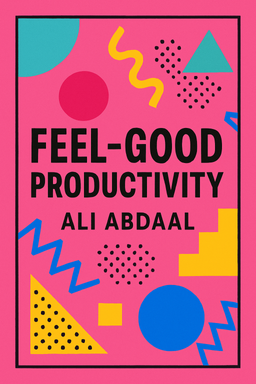
Feel-Good Productivity cover

Feel-Good Productivity

by Ali Abdaal

Feel-Good Productivity by Ali Abdaal redefines productivity by focusing on enjoyment and well-being. Discover science-backed strategies and fun experiments to overcome low energy, procrastination, and burnout, ensuring a fulfilling path to success.

Feel-Good Productivity: The Science of Doing What Feels Right

Have you ever felt like you’re working harder than ever, yet accomplishing less and enjoying none of it? In Feel-Good Productivity, Ali Abdaal invites you to rethink everything you’ve been told about success, motivation, and high performance. Instead of glorifying relentless hustle and discipline, Abdaal argues that true productivity comes not from suffering but from feeling good. When you cultivate positive emotions, you energize yourself, overcome procrastination, and sustain meaningful work.

Abdaal’s core claim is simple but radical: your mood is not a side effect of productivity—it’s the source of it. Drawing from psychology, neuroscience, and lessons learned during his grueling days as a young doctor, he shows that we work better when our emotions pull us forward rather than pressure or guilt. Feel-good productivity means using what brings you joy, connection, and autonomy to fuel performance. Rather than pushing harder, you focus on energizing yourself first, unblocking emotional obstacles second, and sustaining the process third.

The Journey from Burnout to Flourishing

The book begins with a vivid story from Abdaal’s time as a newly qualified doctor. On Christmas Day, overwhelmed and exhausted, he realized that endless discipline had brought him neither happiness nor success. His revelation—that success was not about hustling harder but about working better through well-being—became the birth of feel-good productivity. He soon found research to validate this intuition, citing psychologists like Alice Isen and Barbara Fredrickson. Their studies revealed that positive emotions don’t just feel nice; they expand creativity, improve problem-solving, and build long-term cognitive resources for resilience. Fredrickson’s “broaden-and-build” theory shows that when you feel good, your mind broadens its awareness, builds connections, and sets off an upward spiral of performance.

Three Phases of Feel-Good Productivity

The book unfolds across three main parts: Energise, Unblock, and Sustain. In Part 1, you learn how to generate energy by embracing the energisers—Play, Power, and People. Play helps you rediscover curiosity and enjoyment in your work (think Richard Feynman’s delight in wobbling plates that led to Nobel-winning physics). Power is the sense of personal agency and confidence that keeps you motivated without coercion. People, finally, are the source of relational energy—the joy and creativity we get from genuine connection.

In Part 2, Abdaal examines why we procrastinate, introducing his three emotional blockers—Uncertainty, Fear, and Inertia. Instead of blaming laziness or lack of discipline, he shows that procrastination usually stems from feeling bad. When work feels overwhelming or dangerous, we freeze like an “amygdala hijack.” The solution is to feel better first—seeking clarity, finding courage, and simply getting started with small, frictionless actions.

Sustaining Without Burnout

In Part 3, Abdaal reveals the secret to staying productive for years, not weeks: sustainability. He dissects burnout into three forms—overexertion, depletion, and misalignment. Overexertion comes from overcommitment; fixation on constant performance. Depletion arises when your rest doesn’t actually recharge you. Misalignment results from pursuing goals that don’t match your values. Abdaal’s corresponding ‘sustainers’—Conserve, Recharge, and Align—show how to work less and achieve more, rest properly, and reconnect with your deeper purpose.

Why This Matters

These ideas matter because many people feel submerged beneath their responsibilities. From students to professionals, the modern work culture glorifies exhaustion and guilt. Abdaal’s message offers liberation: productivity and happiness aren’t enemies—they’re partners. Making work feel good doesn’t just prevent burnout; it actually increases motivation and longevity. As psychologist Barbara Fredrickson writes, “Positive emotions are the fuel that drives the engine of human flourishing.” If you’ve ever wondered how to achieve more while enjoying life instead of surviving it, Abdaal shows that the answer begins with joy itself.

Core Message

Productivity is not about discipline alone. It’s about emotional health. When you feel good, your mind expands, your motivation strengthens, and your actions align organically with purpose. Feel-good productivity is not just a technique—it’s a new philosophy for flourishing at work and in life.


Play: Rediscovering Joy at Work

Ali Abdaal begins the Energise section with the concept of Play—an energiser that brings delight, curiosity, and adventure back into your professional life. He tells the iconic story of Nobel Prize-winning physicist Richard Feynman, who regained his passion for physics after treating work as play. Feynman was burned out after years of serious research, until curiosity about a wobbling plate in a cafeteria reawakened his childlike wonder. That lighthearted observation led to groundbreaking discoveries in quantum electrodynamics. The moral? Fun breeds innovation.

Adventure and Curiosity

Play begins with adventure—the willingness to approach daily life as an exploration rather than a checklist. Abdaal cites a study showing that people who visit new places or vary routine routes report higher happiness and excitement. He encourages you to cultivate this sense of playful adventure through small changes: choose a different coffee shop, try a new app, or set “side quests” for your day as if life were a game. Curiosity also plays a vital role. Neuroscience shows that curiosity triggers dopamine, improving memory and engagement. When you treat learning as an adventure rather than an obligation, focus becomes effortless.

Find the Fun

To bring fun into mundane tasks, Abdaal draws inspiration from Mary Poppins’ cheerful maxim: “In every job that must be done, there is an element of fun.” His favorite experiment—the Magic Post-it Note—asks one question: “What would this look like if it were fun?” By transforming dreary study sessions with the Lord of the Rings soundtrack or playful setups, Abdaal learned that a tiny shift in mindset can make labor enjoyable. Treat dull chores as creative challenges—add music, humor, or friendly competition. As psychologist Jaak Panksepp demonstrated with laughing rats, play releases dopamine, creating a biologically real state of joy.

Lower the Stakes

Play also requires freedom from fear. Stress suppresses creativity; even lab rats stop playing when restrained. Abdaal asks us to lower the stakes through reframing failure. Citing engineer Mark Rober’s NASA experiment, he shows that people perform better when failure has harmless consequences. If you treat life like an experiment, mistakes become data points, not disasters. He recommends turning failures into lessons and celebrating “data collection,” not embarrassment. This mindset fosters courage to explore, iterate, and laugh through setbacks.

Be Sincere, Not Serious

Abdaal closes with philosopher Alan Watts’ advice: “Don’t be serious. Be sincere.” Being serious drains enthusiasm, while sincerity invites full engagement without fear. Treat your work like Monopoly with friends—strive to win but enjoy the game. This shift from gravity to lightness encourages playfulness even in demanding environments. When Grey’s Anatomy’s Dr. Shepherd says, “It’s a beautiful day to save lives. Let’s have some fun,” he models that spirit perfectly.

Key Takeaway

Treat work as play, not punishment. Add adventure, curiosity, and fun, and reduce stress by treating failure as learning. Approach your efforts with sincerity—because joy doesn’t just make life better; it fuels creative excellence and lasting productivity.


Power: Building Confidence and Control

The second energiser—Power—is all about reclaiming a sense of agency. Abdaal defines power not as dominance over others, but as inner empowerment: feeling capable, confident, and free to direct your life. He illustrates this through Netflix’s culture revolution, where executives replaced rigid policies with freedom and responsibility. Employees gained autonomy—and Netflix grew into a $300-billion company. Power is fuelled by confidence, mastery, and ownership.

Boosting Confidence

Confidence is not innate—it’s learned. Ali cites psychologist Albert Bandura’s theory of self-efficacy, showing that belief in your ability predicts actual performance. Experiments reveal that people told they’re fit enjoy exercise more and perform better. To build confidence, Abdaal suggests flipping the “confidence switch”: act as if you already feel self-assured. Behavioral mimicry drives emotional reality. During university parties, he conquered stage fright as a walkaround magician by pretending he was one—until belief caught up.

Level Up Your Skills

Competence amplifies confidence. Drawing on Bandura’s idea of enactive mastery, Abdaal urges you to learn by doing. He adopts Zen Buddhists’ shoshin—the beginner’s mind—to stay open and curious. Phil Jackson’s legendary Chicago Bulls found success by approaching each game not as experts but as learners. Similarly, teaching others accelerates learning through the protégé effect (students who teach peers learn better themselves). Every skill is a quest, and mastery builds power organically.

Owning Your Work

The final component of power is ownership. Abdaal references Edward Deci and Richard Ryan’s self-determination theory: lasting motivation derives from autonomy, not external reward. He recounts the story of FiletOfFish1066, a programmer who automated his own boring job, showcasing ingenuity and control even in a rigid system. To foster ownership, Abdaal suggests mastering two mindsets. First, own the process, even if you can’t control the situation. Customize tasks to suit your style. Second, own your mindset. Replace “I have to” with “I choose to.” Viktor Frankl’s reminder from the concentration camps—“The last of the human freedoms is to choose one’s attitude”—serves as this chapter’s soul.

Key Takeaway

Confidence, competence, and autonomy are the three pillars of power. When you believe in yourself, master your craft, and own your actions, you become unstoppable—not through force but through freedom.


People: The Energy of Human Connection

The third energiser is People, the social battery that recharges everything else. Abdaal reminds us that relationships can either energize or drain. His friend calls the latter ‘energy vampires’—those interactions that leave you deflated. Psychologists Rob Cross and Andrew Parker coined the term relational energy: the boost we get from uplifting connections. When we harness positive relationships intentionally, we don’t just feel better—we work better.

From Competitors to Comrades

Abdaal introduces the concept of scenius (Brian Eno’s term for collective genius), showing how collaboration fuels creativity. He contrasts toxic competition in medical school with teamwork that uplifts everyone. Stanford’s Gregory Walton demonstrated that merely believing you’re working together with others increases motivation and effort. Develop the comrade mindset: replace “you win, I lose” with “we rise together.”

Helping Others and Asking for Help

Human interaction fuels productivity through giving and receiving support. Abdaal cites Allan Luks’ study of volunteers who experienced a “helper’s high”—a rush of oxytocin after acts of kindness. Even small gestures, like making tea for a nurse, can lift morale. Likewise, asking for help generates goodwill thanks to Benjamin Franklin’s paradox: people like you more after helping you. Ask authentically, not apologetically. People enjoy generosity—it makes both sides feel good.

Communicate More Than You Think

Relationships thrive on communication. Abdaal advises overcommunication—both of the good and the bad. Share successes actively and react positively when others succeed; psychologists Shelly Gable and Harry Reis found that enthusiastic responses strengthen bonds. When giving tough feedback, replace brutal honesty with radical candor (Kim Scott): care personally while challenging directly. Candidness builds trust without cruelty.

Key Takeaway

Surround yourself with energisers, not drainers. Be generous, ask for help, and communicate frequently. Teams succeed through emotional resonance—because productivity thrives wherever people feel connected.


Unblock: Overcoming Emotional Barriers

Even the most energised person can stall when emotions block progress. In Unblock, Abdaal examines uncertainty, fear, and inertia as the three internal obstacles that sabotage our efforts. He proposes the unblock method—understanding why we feel bad and then fixing it. Where most productivity advice demands discipline, this method calls for diagnosis.

Clarity: Dissolving Uncertainty

Uncertainty paralyzes action because it clouds our purpose. Abdaal borrows “commander’s intent” from the U.S. Army—define the mission’s purpose and desired end-state so everyone knows why they act. Ask “What’s the ultimate purpose?” before planning anything. Then apply Sakichi Toyoda’s “Five Whys” to uncover the true reason for every task. Next, refine the what with NICE goals (Near-term, Input-based, Controllable, Energising) instead of rigid SMART ones. Finally, identify the when with tools like implementation intentions (“If it’s lunchtime, I’ll do X”) and time-blocking your calendar. Structured clarity dissolves paralysis.

Courage: Defusing Fear

Fear is the amygdala’s hijack—mistaking challenge for danger. Abdaal introduces affective labelling (naming your fear: “I feel anxious about failing”). Doing so calms neural circuits. Identity labelling reframes who you are: instead of “I’m a chronic procrastinator,” say “I’m a lifelong learner.” These shifts let you face fear rationally. Then apply cognitive reappraisal—his 10/10/10 rule: will this matter in 10 minutes, 10 weeks, or 10 years? Most anxiety evaporates under that lens. Finally, create confidence through the Batman effect: adopt a fearless alter ego when performing. Channel your inner Sasha Fierce—Adele’s stage persona—to act beyond fear.

Action: Escaping Inertia

Inertia thrives on friction. To move, remove barriers. Make good habits easy—place your guitar in sight if you want to play more. Then overcome emotional friction with the five-minute rule: commit to a task for only five minutes; once started, momentum carries you forward. Use Tim Pychyl’s question—“What’s the next action step?”—to convert abstract goals into visible movement. Track small progress to maintain momentum, find an accountability buddy, and forgive yourself when you slip. Productivity, Abdaal insists, is not about perfection—it’s about gentle persistence.

Key Takeaway

Procrastination isn’t laziness—it’s emotion. Clear your purpose, calm your fear, and take one small step. Unblock feelings first, and breakthroughs will follow.


Sustain: The Art of Lasting Energy

After energising and unblocking, sustainability becomes the final frontier. Abdaal explores three kinds of burnout—overexertion, depletion, and misalignment—and three antidotes—conserve, recharge, align. Productivity isn’t measured in days of high performance but in years of meaningful focus. Sustainability means managing energy like LeBron James on the basketball court: sprint only when necessary, walk the rest.

Conserve: Doing Less to Achieve More

Overexertion burnout comes from saying yes too often. Abdaal borrows Steve Jobs’ mantra—focus means saying no. Create an energy investment portfolio: one list for dreams and one for active commitments. Limit active projects to what you can truly sustain. Derek Sivers’ rule (“If it’s not a hell yes, it’s a no”) helps here. Avoid the six-week trap—if you wouldn’t do it tomorrow, don’t commit for next month. To combat distraction, add friction—delete social media apps or use slow-loading blockers. And when you slip, don’t abandon ship. Correct course, begin again.

Recharge: Rest That Refuels

Depletion burnout stems from poor rest. Scrolling and passive entertainment feel restful but aren’t. Instead, Abdaal introduces CALM rest—activities that make you feel Competent, Autonomous, Liberated, and Mellow. He suggests hobbies like painting, music, or crafts; projects with clear endpoints but low stakes; and micro-nature breaks—just 40 seconds of greenery improves focus. Mindless rest has a place too: zoning out activates the brain’s default mode network. Abdaal recommends embracing the Reitoff principle—write off bad days without guilt. Rest deliberately, not obsessively.

Align: Living Authentically with Your Values

Misalignment burnout happens when you work toward goals that contradict your values. Drawing on Kennon Sheldon’s Pacific Crest Trail study, Abdaal explains that identified motivation—doing things because they align with who you are—produces happiness and persistence. To find alignment, try three time horizons: the eulogy method (what would you want said at your funeral?), the 12-month celebration (how would you celebrate progress a year from now?), and the daily alignment quests (three small actions today that reflect your values). Treat life like a set of ongoing experiments—keep testing what feels authentic.

Key Takeaway

Productivity that lasts is about balance. Conserve energy, recharge deeply, and align your goals with your values. Sustainable success isn’t about doing everything—it’s about feeling good enough to keep going.


Think Like a Productivity Scientist

Ali Abdaal closes with a reflection from his hospital days, reminding us that his greatest mistake wasn’t working too hard—it was thinking too narrowly. Productivity isn’t a checklist; it’s a science of experimentation. The productivity scientist mindset means treating life as a lab: test, measure, iterate. You become both researcher and subject in the pursuit of better living.

Experiment, Don’t Enforce

Abdaal contrasts hustle culture with curiosity culture. Instead of forcing yourself to adopt rigid systems, conduct experiments. If a method makes you feel good and gets results, keep it. If not, discard it. Each chapter in this book becomes a toolkit of potential experiments—from the five-minute rule to alignment quests—that you can adapt to your personality. Productivity, like medicine, requires diagnosis and iteration.

Measure What Matters

True productivity metrics are emotional, not numerical. Track your energy, mood, and engagement. Ask daily: “How does this make me feel?” Emotional data provides richer insight than hours logged. Productivity science is about feedback loops: test strategies, evaluate feelings, adjust inputs. It’s not perfection—it’s progress through experimentation.

A Life of Joyful Inquiry

Ultimately, being a productivity scientist transforms your life philosophy. You replace guilt with curiosity, rigidity with play, and burnout with balance. Abdaal’s message mirrors that of thinkers like Cal Newport and James Clear—sustainable habits come from systems, not willpower. But his twist is emotional: success starts with feeling good. As he muses while watching London doctors rush by, the real goal isn’t to maximize efficiency—it’s to learn how to flourish.

Key Takeaway

Think like a scientist. Try, observe, and adapt. There is no one-size system—only experiments that make your work and life feel better. Productivity begins when curiosity replaces pressure.

Dig Deeper

Get personalized prompts to apply these lessons to your life and deepen your understanding.

Go Deeper

Get the Full Experience

Download Insight Books for AI-powered reflections, quizzes, and more.