
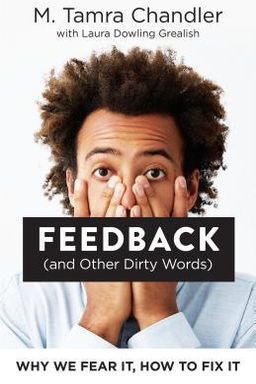
Feedback (and Other Dirty Words) cover

Feedback (and Other Dirty Words)

by M Tamra Chandler and Laura Dowling Grealish

Feedback (and Other Dirty Words) demystifies the art of giving and receiving feedback, offering actionable strategies to overcome fear and build a culture that thrives on constructive communication. Elevate your interpersonal skills and drive personal and professional growth with this insightful guide.

Turning Feedback from Fear into Fuel

When was the last time the mere phrase “I have feedback for you” made your stomach turn? In Feedback (and Other Dirty Words), M. Tamra Chandler and Laura Dowling Grealish ask what would happen if we stopped bracing for impact every time feedback arrives—and started viewing it as a vital tool for growth, collaboration, and connection. Their central argument is that feedback, far from being a dreaded annual ordeal, should be a continuous, human-centered exchange that empowers learning and improvement for everyone at work.

Chandler and Grealish contend that the way feedback has been practiced for centuries—top-down, evaluative, fear-based—has warped its reputation into something almost toxic. In workplaces around the world, employees equate feedback with punishment, manipulation, or shame. Managers fear being disliked. Receivers prepare defensive reactions. As a result, we’ve created a culture of silence where honesty feels risky and learning stalls. The authors’ mission is to reclaim feedback’s true purpose: an act of helping, insight-sharing, and mutual growth.

From Performance Review to Performance Culture

Chandler’s first book, How Performance Management Is Killing Performance, exposed how traditional review systems demoralize employees. This follow-up builds on that insight: if feedback is broken, then fixing performance begins with fixing feedback. Their solution is not a new HR process—it’s a movement. A movement to redefine feedback so that it functions as an ongoing dialogue rather than a managerial monologue, grounded in curiosity, trust, and fairness. They call for a seismic philosophical shift in how organizations talk about performance and potential.

They define feedback simply as: “Clear and specific information that’s sought or extended with the sole intention of helping individuals or groups improve, grow, or advance.” This redefinition strips away judgment and hierarchy. It emphasizes both asking and offering, signaling that feedback should flow in all directions—up, down, and across teams. Critically, it separates improvement feedback (how to fix problems) from growth feedback (how to develop and expand strengths), recognizing that both matter in learning cultures.

Why We Fear Feedback

Understanding feedback’s failure requires going deep into our biology. When someone says, “Can I give you feedback?”, our brains trigger an ancient survival alarm. The amygdala interprets this as danger, initiating the classic “fight, flight, or freeze” (and occasionally “appease”) response. Chandler illustrates this through Steven and Mira, a manager-employee pair whose feedback session devolves into mutual anxiety rather than understanding. Feedback, she explains, feels like threat not because of words, but because our wiring equates social rejection with survival risk. We fear feedback because we fear losing belonging and identity.

The authors draw on research from neuroscience, psychology, and organizational behavior to show that fear shuts down learning. When cortisol floods the system, rational thinking and empathy vanish. The fix? Retrain the brain through awareness and practice. Ground yourself physically—“feel your feet,” breathe deeply, and engage sensory awareness—to pull attention from the primitive brain to the “wise brain,” or prefrontal cortex. Over time, this rewiring (known as neuroplasticity) allows us to respond to feedback calmly and constructively rather than defensively.

Mindset, Bias, and the Human Condition

Science also explains another culprit: negativity bias. Humans notice and remember threats more vividly than praise. That’s why one criticism in a performance review can outweigh ten compliments. Chandler calls this the “Velcro/Teflon phenomenon”—bad sticks, good slides off. To combat it, she leans on Martin Seligman’s “learned optimism” and Carol Dweck’s growth mindset. People who view abilities as improvable, not fixed, turn feedback into fuel instead of fire. Shifting from “prove” (“I have to show I’m right”) to “improve” (“I can learn from this”) reframes every tough conversation as an opportunity for development.

Bias also distorts fairness in feedback. Confirmation bias leads us to notice only what supports our assumptions; recency bias exaggerates recent events. The authors argue that true fairness requires awareness of our mental shortcuts and a shared approach to observing without judging—what they term the Fine Art of Noticing. Learning to notice rather than evaluate creates a foundation for the three essential pillars of healthy feedback: Fairness, Focus, and Frequency.

Building a Feedback Movement

This book goes beyond theory. Chandler and Grealish offer practical tools to remake feedback culture, beginning with roles we all play. Everyone alternates among three identities: Seekers, who proactively ask for feedback to learn; Receivers, who interpret and decide what to apply; and Extenders, who share observations and insights to help others. Skillful feedback cultures require training everyone in these roles so that asking, giving, and receiving become routine, not rare.

Research cited from i4cp and the Center for Effective Organizations confirms that companies with strong Performance Feedback Cultures outperform peers on profit, engagement, and retention. Positive feedback, the authors emphasize, isn’t fluff—it’s a proven performance driver. By doubling down on constructive recognition, leaders boost commitment, health, and innovation. The “magic ratio” of 5:1 positive to corrective interactions—borrowed from John Gottman’s relationship research—applies as much to teams as to marriages.

Ultimately, the book is a manifesto for leaders and coworkers to lead with curiosity, humility, and courage. It calls on you to reshape the very texture of conversation at work—to make feedback light, frequent, and forward-moving. In doing so, you not only improve performance but also humanize the workplace. Feedback, stripped of fear and judgment, becomes a shared act of care. The authors close by asking readers to imagine workplaces where feedback flows across hierarchies, where gratitude is common language, and where “helping each other grow” replaces “telling each other what’s wrong.” That vision, they argue, isn’t a fantasy—it’s achievable, one conversation at a time.


How Feedback Lost Its Way

Chandler opens with a painful truth: feedback’s reputation is terrible. The word itself conjures memories of bosses wielding criticism like a weapon. This is feedback’s branding problem—a PR disaster created by centuries of misuse. The authors trace this history to early hierarchies, authoritarian workplaces, and the dreaded annual review, where feedback became synonymous with evaluation, control, and shame. Most of us, they argue, were taught feedback as something to fear, not seek.

Conditioned by Early Experiences

As children, we learned what feedback felt like when authority figures scolded us. Parents’ sharp words, teachers’ red pens, coaches’ critiques—all rooted in judgment. When those patterns continue into adulthood, our nervous systems associate feedback with failure. We’re wired to recoil. “We learn habits early,” Chandler notes, “and despite our best intentions, we repeat them.” The result is a feedback culture built on anxiety and avoidance. Even positive comments are often dismissed, because we expect the “but…” that follows.

The Annual Performance Review Trap

Take the annual review—a ritual so dreaded it borders on farce. Chandler calls it the embodiment of everything broken: “nothing, nothing, and then boom!” Feedback stored up for a year lands in a single meeting, when the stakes are highest. It’s often one-directional, biased by recency (what happened last month) and filtered through the manager’s subjective lens. Employees walk out replaying a single criticism, forgetting the praise entirely. Worse, such reviews rarely change behavior because they’re too late, too formal, and too fear-filled.

The authors’ prescription is radical in its simplicity: end feedback as event; start feedback as conversation. Replace yearly paperwork with continuous, human dialogue that’s light, timely, and authentic. Feedback should be fluid, not stored ammunition.

The Feedback Paradox

Strangely, while people hate feedback, they also crave it. Research from OfficeVibe found that 83% of employees appreciate feedback and 62% want more from peers. Chandler calls this the feedback paradox: we fear the thing we need most. We complain about its absence yet resist its presence. That contradiction, the authors argue, means the real problem isn’t feedback itself—it’s bad feedback. Fix the experience and the demand returns naturally.

To fix the experience, leaders must unlearn the myths of “tough love” and “constructive criticism” that glorify harshness. Compassionate candor outperforms brutal honesty. The same courage it takes to give feedback well is the courage to listen well—and both can be learned.


The Science of Fear and Feedback

Why does your heart race when your boss says, “Can we talk”? Chandler dives into neuroscience to show that fear of feedback is neither weakness nor personality flaw—it’s evolutionary inheritance. Our ancestors needed acute danger responses to survive threats. Today, that same neural mechanism misfires in modern settings. So when feedback triggers your amygdala, you aren’t overreacting—you’re being human.

Your Brain on Feedback

When Mira tells her employee Steven she has feedback, his body floods with stress hormones. His pulse quickens, palms sweat, and his mind imagines catastrophe. Though Mira intends to help, Steven’s amygdala interprets danger. Chandler explains how the body’s fight-flight-freeze (and appease) mechanisms hijack rational thought. Evolution never anticipated HR meetings; it can’t tell the difference between a manager’s critique and a saber-toothed tiger.

She introduces an additional coping reaction—appeasement, a “Northwest Nice” strategy where people nod and agree just to escape emotional discomfort. The result: false compliance and no real learning. Without emotional safety, feedback becomes mistrust in disguise.

The Role of Identity and Connection

At the core of feedback fear lies vulnerability. We fear not information but exclusion—losing belonging or value within the tribe. Because identity and connection are vital human needs, critical feedback feels like social rejection. That’s why even mild correction can feel like deep threat.

Chandler illustrates this with Mira’s side of the story: the manager also feels fear. She avoids telling Steven the truth because she doesn’t want to damage the relationship. Avoidance feels safer than honesty. But double avoidance creates mistrust and performance failure. The antidote is mutual courage: choosing authenticity and curiosity over control.

Negativity Bias and Velcro vs. Teflon

Citing research by Roy Baumeister and others, Chandler notes that the brain processes negative inputs faster and more intensely than positive ones. We remembering losses longer than equivalent gains. This negativity bias means your one bad comment sticks like Velcro, while ten good ones slide off like Teflon. Socially, we evolved to prioritize threat detection; professionally, this skew distorts our perception of fairness. Awareness is step one: realizing that your mind may amplify negative feedback beyond proportion.

Managing the Fear Response

Fortunately, science also offers tools. The authors recommend moment-to-moment grounding—what Stanford’s Shirzad Chamine calls “PQ reps.” Simple acts like “feeling your feet,” listening to nearby sounds, or breathing 4-7-8 (inhale 4 seconds, hold 7, exhale 8) can interrupt panic signals and engage your rational brain. Repetition builds neural resilience. Each calm conversation creates new “safe feedback” circuits, weakening old fear pathways. Over time, the brain learns that feedback equals growth, not danger—a rewiring achieved through consistent practice.

(In Difficult Conversations, Douglas Stone and colleagues echo this insight—changing one’s physical reaction precedes emotional mastery.) Chandler’s approach merges mindfulness, positive psychology, and organizational science to transform fear into fuel. As she writes, “We can use our minds to change our brains,” one feedback moment at a time.


The Power of Trust, Fairness, and Frequency

At the heart of Chandler and Grealish’s model sits one critical truth: feedback only works when trust exists. Without trust, even well-intentioned input feels like attack. To rebuild that foundation, they outline three pillars—Fairness, Focus, and Frequency—simple principles that, when practiced, turn feedback into an everyday act of care rather than correction.

Building Trust

Trust grows, the authors explain, through small consistent actions: keeping promises, being human, and demonstrating kindness. They advise admitting mistakes, showing emotion, and being authentically imperfect. When colleagues see humanity instead of hierarchy, fear recedes. Research from John Gottman’s 5:1 ratio adds evidence—relationships thrive when positive interactions outnumber negative ones five to one. Applied at work, this means every critique should be balanced by five genuine acknowledgments or connections. Without that balance, trust erodes.

Fairness and Bias Awareness

Fairness is feedback’s moral compass. Chandler defines it as sharing observations untainted by bias, rumor, or hidden agenda. It’s describing rather than judging. Unfortunately, fairness collides with human bias: confirmation, recency, and halo effects shape what we see. Awareness is the first step. She encourages leaders to “notice without labeling” and verifies fairness through multiple perspectives. Inclusive feedback—seeking diverse voices—reduces distortion and fosters belonging.

Focus: Keep It Bite-Size

Focus ensures feedback is clear and actionable. “Snack-sized, not supersized,” Chandler quips. Rather than dumping a dozen critiques, pick one concrete behavior to reinforce or adjust. Focused feedback respects cognitive limits and prevents overwhelm. It transforms learning from punishment into progress. Short, specific insights delivered often beat long, vague reviews delivered rarely.

Frequency: Light and Continuous

The authors liken frequency to metabolism—the more regularly feedback circulates, the healthier the system. Informal touchpoints (“How’s that project feeling?”) carry more impact than sporadic deep dives. Frequent dialogue keeps relationships in motion, normalizing feedback and lowering anxiety. Studies cited show performance jumps 30–40 percent when managers check in biweekly instead of annually. Frequency transforms feedback from occasional anxiety into habitual clarity.

The Fine Art of Noticing

Perhaps Chandler’s most elegant concept, the Fine Art of Noticing (FAN), means observing with attentiveness but without judgment. It’s a discipline of curiosity: “What did I see?” rather than “What do I think?” FAN replaces hierarchical evaluation with human observation, creating psychological safety. It also eliminates gossip and triangulation—the destructive habit of talking about someone instead of to them. Practiced regularly, FAN makes fairness, focus, and frequency natural behaviors, transforming organizations into learning communities rather than blame systems.

Through trust, fairness, and noticing, feedback becomes conversation, not confrontation—a loop of connection that feeds both performance and well-being.


Becoming a Seeker: Taking Control of Growth

In the world Chandler envisions, the bravest act isn’t giving feedback—it’s asking for it. Seekers, she argues, are the true drivers of change. When you ask for input, you model humility, invite trust, and gain control of your learning. Leaders, especially, must “go first.”

Why Seeking Matters

Research by Jack Zenger and Joe Folkman shows leaders who frequently ask for feedback rank 86th percentile in effectiveness. Seeking signals strength, not weakness—it shows security and curiosity. Employees who see their bosses model it follow suit, turning feedback into a shared pursuit rather than a hierarchy of judgment. The authors encourage asking not “How am I doing?” but specific questions: “What’s one thing I could do to make my presentations more engaging?” This narrows focus and calms potential anxiety in those giving feedback.

Practical Tools for Seekers

Seekers should prepare a personal “Feedback Guide”—a map of their comfort zones, triggers, and growth goals—to share with Extenders. It sets expectations and establishes safety. They should also diversify their sources: peers, subordinates, even clients. Peer feedback, the authors note, is particularly powerful because colleagues witness your behavior daily. Moreover, diversity reduces bias; hearing from multiple perspectives paints a truer picture.

Seeking also teaches emotional regulation. When you invite feedback, you rehearse managing defensiveness before it arises. You take control of timing and context, ensuring you’re ready to listen. Over time, this proactive stance rewires your self-concept away from fear and toward agency.

Embrace the Good and the Blind Spots

Chandler urges Seekers to pursue not only improvement feedback but also reinforcement of strengths. Ask, “What am I doing well that you hope I keep doing?” Strengths are fuel for engagement and happiness. Drawing on Marcus Buckingham’s research, she reminds us: growth occurs fastest in areas of talent, not weakness. Learning from what energizes you leads to more sustainable progress.

But seekers must also brave their blind spots—the unseen patterns that sabotage effectiveness. She proposes an exercise: ask one new person every day for a week, “What’s something you notice that I don’t?” Comparing answers reveals hidden themes. As one grandmother in her story realized, if someone had told her earlier that her constant complaining alienated family, she could have changed decades of relationships. Seekers shorten that painful timeline.

Ultimately, seeking is the ultimate act of ownership. It replaces fear with curiosity and teaches you to build growth into daily practice rather than annual confession.


Receiving Feedback with Grace and Grit

Receiving feedback, Chandler admits, is where most of us lose composure. Our palms sweat, thoughts race, and egos flare. Yet in her redefined framework, receiving isn’t passive endurance—it’s active sense-making. The goal is to listen openly, reflect deeply, and decide deliberately.

Listening Without Losing Yourself

When your body reacts, start by grounding. Feel your feet on the floor and breathe. Your duty as Receiver is not to agree or obey but to consider. Leaders especially must model graceful receiving. Chandler lays out five leadership practices: Be the change; recognize receiving as strength; make it safe for others to speak; listen with gratitude; and show fearless authenticity. Vulnerability, she notes, boosts trust far more than polished perfection ever could.

Know Your Feedback Self

Your sensitivity to feedback often mirrors your identity values. If you pride yourself on creativity, any critique of your originality cuts deep. Understanding these core self-beliefs helps you manage triggers. Chandler’s own story—when told her collaborative style might limit her career—shows that filtering feedback through values allows discernment. She rejected that advice because collaboration, she realized, was her non-negotiable value. You can say “thanks, but no thanks” to feedback that misaligns with who you are.

Processing and Progress

When you receive feedback badly, recovery matters more than reaction. Apologize if you overreact, but don’t over-apologize. Loop back later to show growth. Likewise, when feedback feels vague (“Just act more like Candice”), ask for clarification: specifics, context, and impact. Use inquiry phrases like “Can you give an example?” or “What effect did you notice?”

Chandler advises “feedback short, reflection long.” Small comments can yield major change—if you give them time to marinate. She recounts a colleague’s casual line (“I haven’t seen you this excited in years”) that ultimately inspired her to start her own firm. Bite-size input, digested fully, can shift careers.

From Prove to Improve

When feedback stings, our instinct is to defend—to prove we’re right. Chandler urges the mental switch from prove to improve. Ask: “What truth might live inside this, and how could it help my future self?” Focus on progress, not punishment. She even provides reflection prompts: What scares me? What’s true here? What’s my next step? Grace, she reminds, doesn’t mean submissiveness; it means composure under growth.

Receiving, when done well, transforms potential pain into self-knowledge. It’s feedback alchemy—turning lead into gold.


Extending Feedback as a Gift

After learning to seek and receive, the final skill is extending—sharing feedback that helps others thrive. Chandler reframes this from an evaluative duty to a generous offering: feedback as gift, not verdict. And giving it well, she insists, requires mindset alignment, empathy, and timing.

Creating Connection First

Successful feedback flows through relationship channels. Before offering insight, reconnect. Be inquisitive, help, laugh, or show gratitude. Trust acts as social lubricant. Chandler highlights the 5:1 ratio again—five positive moments for every challenging one. Even a simple “Thank you for your work on this project” before critique opens ears and hearts.

Know Your Intent

Before speaking, check: “Am I trying to help them improve or prove myself right?” Feedback given to display superiority breeds resentment; feedback shared to enable growth builds partnership. Ask permission before offering—“Would now be a good time for some input?”—a small courtesy with huge impact.

Drop the “Sh*t Sandwich”

One of the most vivid metaphors in the book is Chandler’s takedown of the “sh*t sandwich”—the bad habit of hiding criticism between two compliments. Receivers see through it instantly, and genuine praise loses credibility. Instead, separate positive and improvement feedback. Share good freely and for its own sake. When addressing challenges, be direct, factual, and kind. Honesty delivered with empathy lands softer than flattery wrapped around shame.

Just the Facts, No G.R.I.T.

Chandler introduces a clever acronym for what to avoid: Gossip, Rumor, Innuendo, and Triangulation. Always speak from direct experience, not hearsay. Ground your message in specific behavior and its impact—“In yesterday’s meeting, when you cut off Sarah, it shut down discussion”—not judgments like “You’re rude.” Describe effects and ask exploration questions (“How did that feel to others?”). Extending feedback this way creates accountability without humiliation.

Bite-Size and Future-Focused

Feedback should be digestible. Chandler cites research showing that when people receive too much at once, learning collapses. Limit input to one or two insights and anchor moves toward the future: “Next meeting, try asking one more question before adding your point.” Encourage reflection rather than dictate correction. Extenders become coaches, not critics. As psychologist Amy Edmondson emphasizes, psychological safety fuels learning—exactly what this approach nurtures.

In sum, extending feedback means caring enough to be clear, courageous enough to be honest, and wise enough to be kind.


Imagining a Feedback Culture that Works

The book ends with vision and practice. Chandler and Grealish ask readers to “imagine” a new world of work where feedback feels natural, continuous, and fearless. This isn’t utopian—it’s the logical result of everyday rituals done differently.

Embedding New Habits

Sustained culture change requires habit, not hype. The authors propose small, repeatable team rituals: ending meetings with reflection (“benefits and concerns” or “liked it, learned it, lacked it”), dedicating “Feedback Fridays” for peer recognition, or co-creating goals in performance reviews (“Nothing about me without me”). Such structures normalize feedback until it’s as routine as coffee breaks. It becomes the water cooler of growth.

Collective Stewardship

The movement to fix feedback isn’t the job of HR—it’s collective stewardship. Each Seeker, Receiver, and Extender carries responsibility for tone and intent. Leaders ignite it by modeling vulnerability; peers sustain it through curiosity and kindness. Over time, the authors envision cultures where feedback “flows across teams and people in a manner that is easy, genuine, and informal.”

Future-Focused Optimism

They end on optimism: the same human impulses that made feedback painful—connection, validation, identity—can make it powerful when harnessed correctly. By focusing every feedback act on the future, we pivot from blame to possibility. As Chandler writes, feedback is “clear and specific information shared with the sole intention of helping.” When that intention becomes habit, organizations become communities—and fear finally gives way to flourishing.

In that imagined world, feedback isn’t a dirty word. It’s the language of learning, spoken often, heard kindly, and used well.

Dig Deeper

Get personalized prompts to apply these lessons to your life and deepen your understanding.

Go Deeper

Get the Full Experience

Download Insight Books for AI-powered reflections, quizzes, and more.