
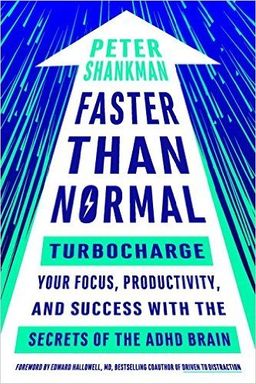
Faster Than Normal cover

Faster Than Normal

by Peter Shankman

Faster Than Normal redefines ADHD, not as a limitation but as a unique strength that, when understood and managed, can lead to extraordinary achievements. Peter Shankman shares actionable insights and strategies for unlocking the hidden potential of the ADHD brain.

ADHD as a Superpower, Not a Disorder

Have you ever felt that your restless energy or constant stream of ideas is something to be fixed rather than celebrated? In Faster Than Normal, entrepreneur, skydiver, and Ironman triathlete Peter Shankman argues that Attention Deficit Hyperactivity Disorder (ADHD) is not a curse or a defect—it’s a competitive advantage in disguise. Instead of framing ADHD as a barrier to productivity or relationships, Shankman reframes it as a high-performance brain that simply runs faster than others. The key, he insists, is learning to manage it wisely, channeling that speed into focus, creativity, and success.

Shankman’s mission is both personal and cultural: he wants to normalize a new narrative about ADHD. Where medicine and education often aim to quiet or correct those with fast minds, he offers a blueprint for embracing the energy, drive, and intensity that come with them. As a businessman and father who turned his own ADHD into a multimillion-dollar career—and later, a movement—Shankman’s story is proof that thriving “faster than normal” is possible when we understand how our brains work.

From Disorder to High-Performance Difference

The book begins with a radical claim: ADHD isn’t a deficit but a different operating system. Shankman recalls school days filled with reprimands, awkward social stumbles, and disciplinary notes that always began with “If he only applied himself.” But the very traits that once seemed disruptive—hyperfocus, risk-taking, irrepressible curiosity—became his greatest business assets. These faster neural circuits, when directed correctly, produce astonishing creativity, stamina, and intuition. “ADHD isn’t a diagnosis,” he writes, “it’s a gift.”

His message echoes experts like Dr. Edward Hallowell (author of Driven to Distraction), who urges people to view ADHD as a trait of vitality and invention, not illness. Shankman argues that many visionaries—Einstein, Edison, Walt Disney, Richard Branson—displayed ADHD-like traits long before the term existed. Their restless drive for novelty and their ability to hyperfocus on passion projects changed the world. We’ve labeled these traits “disorders,” he notes, only because modern industrial life favors conformity and routine over creativity and speed.

Why Harnessing ADHD Matters

Shankman insists that now, more than ever, these traits are assets. In a digital, hyperconnected world fueled by speed, ideation, and adaptability, those with ADHD are naturally wired for the future. The problem isn’t the brain—it’s the lack of structure to guide it. Without systems, the ADHD brain operates like a fire hose flailing at full force, flooding instead of watering the field. But with the right framework—rituals, exercise, nutrition, tech tools, and rules of self-command—it becomes a laser beam of creativity and execution.

That’s the purpose of this book: to teach you how to build that framework. Shankman distills decades of personal experimentation into practical “life hacks” that anyone with a fast brain can use. His chapters read like an energetic conversation rather than a diagnosis manual—from how to turn negative triggers into fuel, to how to design rituals that keep you on track without crushing your spontaneity. Every story—from his skydiving revelations to his ritual of wearing gym clothes to bed—illustrates one principle: structure creates freedom.

A Blueprint for Living Faster, Not Frantic

The book travels through several key themes. It begins with mindset transformation—turning the shame of “disorder” into pride over a unique genius. Then come the core lifestyle systems: his “Undeniable Life Rules” (eat well, sleep well, exercise, and remove needless choice) that form the foundation of ADHD success. Later chapters tackle triggers, time management, and tools—from digital apps to mental disciplines—that help transform chaos into focus. He also addresses relationships and parenting, showing both ADHD individuals and their loved ones how to communicate and thrive together.

Shankman’s energetic voice makes the science relatable. His anecdote about climbing into an airplane just to get 30 uninterrupted hours of focus on a book draft epitomizes the ADHD paradox: distraction-prone yet capable of extreme productivity when conditions align. ADHD life, he argues, isn’t about slowing down—it’s about designing an environment fast enough to match your brain.

Why This Matters Beyond ADHD

Though written for ADHD audiences, Shankman insists that these methods apply to everyone seeking better focus in a distracted age. His hacks—ritualized mornings, tech-assisted accountability, exercise-driven clarity, minimalist environments—extend far beyond a clinical condition. We all drown in stimuli; we all crave momentum. If you can thrive with an ADHD brain, he suggests, imagine what you could accomplish with a calmer one.

Ultimately, Faster Than Normal is less about coping and more about thriving intentionally. It’s a manifesto for managing energy, not time—for seeing difference as power, and designing your life around your brain’s strengths rather than fighting its tendencies. Shankman’s central promise is both hopeful and practical: when you align your habits with your brain’s natural velocity, you’ll stop chasing normal—and start outrunning it.


Turning Difference into Power

Peter Shankman invites you to stop apologizing for being different. In his view, ADHD isn’t about being broken—it’s about running on a faster operating system. The sooner you accept that your brain moves quickly and demands a stimulating environment, the sooner you can redirect that power toward growth. The book’s first major lesson is identity reframing: swapping the mindset of disorder for one of power, creativity, and elite performance.

From Shame to Superpower

Shankman’s life plays out like an accelerated case study. Once scolded for blurting out jokes and derailing class discussions, he later built multimillion-dollar businesses from spontaneous ideas—including his best-known venture, Help a Reporter Out (HARO). The same impulses that earned childhood detentions—curiosity, risk-taking, relentless energy—became gold in entrepreneurship and media. The trick wasn’t changing who he was; it was learning to channel his impulses with structure and purpose.

He describes his revelation while reading Delivered from Distraction by Dr. Ned Hallowell. The book’s description of paradox—people who can hyperfocus yet be spacey, perform brilliantly yet feel incompetent—felt like reading his mind. From that moment, Shankman decided to stop viewing ADHD as a diagnosis and start calling it what it was for him: his gift. This act of self-definition liberated him from shame and became his rallying cry to others.

The Firehose Brain and the Learning Curve

To explain ADHD’s dual nature, Shankman uses the metaphor of a firehose. Unmanaged, it whips chaotically, spraying water everywhere. But once held steady with deliberate control, it becomes a precise tool capable of immense productivity. The lesson is clear: understanding how your brain’s “firehose” works allows you to turn chaos into clarity. This transformation runs through every story—from his need for adrenaline-fueled focus during skydiving to the strategies that keep his impulsive tendencies from derailing his success.

Normal Isn’t the Goal

Perhaps Shankman’s most impactful idea is that “normal” is a myth not worth chasing. He celebrates the innovators who were likely “faster than normal” themselves—Da Vinci, Tesla, and Galileo—using them as proof that rule-breakers and nonconformists have always driven human progress. In his words, ADHD isn’t a limitation but “like driving a Lamborghini of a brain while others pedal a tricycle.” The challenge is simply learning to steer. Once you accept that, your difference becomes the engine for meaningful innovation rather than an obstacle to overcome.


Rituals: The Architecture of Focus

If ADHD is a high-performance engine, rituals are the steering wheel. Shankman insists that rituals—not resolutions—create consistency. Where most people rely on motivation, those with fast brains need structure built directly into their routines. Without rituals, chaos wins; with them, even the most impulsive person can create predictable excellence.

Why Resolutions Fail, Rituals Succeed

Resolutions rely on willpower, which quickly evaporates in the face of distraction. Rituals replace decision-making with automation. Shankman compares resolutions to weak shacks—easily knocked down by breeze—while rituals are skyscrapers anchored in deep foundations. He shares his own ritual: waking at 3:30 or 4:00 a.m. daily to work out, because he knows mornings fuel his dopamine. Over time, this became automatic—no need to negotiate with himself at sunrise.

Building a Ritual Step by Step

Creating a ritual, he explains, starts with chasing a positive feeling rather than avoiding a negative behavior. For example, instead of thinking, “I need to wake up early,” he thinks, “I want that high of finishing my day proud.” This forward-looking mindset, paired with fail-safes like automatic lights turning on before his alarm, transforms habits into daily setups for success. Visualizing the reward and building safety nets around potential weak spots helps turn discipline into autopilot.

Rituals for Everyday Life

Shankman offers numerous rituals beyond mornings: cleaning clutter before work to eliminate distractions, scheduling movement breaks throughout the day, and simplifying wardrobe decisions to reduce cognitive load. The key, he emphasizes, is repetition until habit becomes second nature. “When the ritual is set,” he writes, “your brain has less chance to wander away from what matters.” In essence, rituals are the external scaffolding that stabilizes an internal whirlwind, turning scattered effort into consistent creative momentum.


The Four Undeniable Life Rules

At the heart of Faster Than Normal lies a simple system: four daily non-negotiables that keep Shankman’s ADHD brain running smoothly. These are his Undeniable Life Rules: Eliminate choice, eat well, sleep well, and exercise regularly. Each one is a safeguard against burnout, distraction, and poor decision-making.

Rule #1: Eliminate Choice

For someone with ADHD, too many options equal paralysis. Shankman simplifies everything from his clothing (jeans and T-shirts only) to his diet. By reducing decisions, he saves precious mental energy for creative work. Even his speaking contracts include clauses that limit his time in temptation-heavy cities like Las Vegas—self-designed guardrails against impulsivity.

Rule #2: Eat Well

Shankman doesn’t advocate for a particular diet; he promotes “eating clean.” That means real food—things your grandmother would recognize as food—and minimal processed junk. The famous “apple test” epitomizes this idea: if you’re not hungry enough to eat an apple, you’re not truly hungry; your brain just wants dopamine. It’s an elegant way to separate emotional impulse from real need, and it keeps energy steady throughout the day.

Rule #3: Sleep Well

Once a self-proclaimed caffeine addict, Shankman learned the hard way that sleep deprivation magnifies ADHD’s worst symptoms: impulsivity, irritability, and poor focus. Now he treats sleep like medicine. His meticulous nighttime rituals (lights dimmed, technology off, blackout curtains) ensure deep rest, proving that mental speed requires recovery. Quality sleep, he insists, is a non-negotiable fuel for performance.

Rule #4: Exercise—Preferably Outdoors

Physical movement, he says, is “the best medication on the planet.” Whether skydiving or running marathons, Shankman experiences the ADHD brain’s natural high when dopamine floods the system. Exercising outside multiplies this effect—combating “nature deficit disorder” and restoring clarity. These life rules, simple yet powerful, translate to anyone seeking a more focused, controlled, and joyful life, whether they have ADHD or not.


Defusing Triggers Before They Derail You

One of Shankman’s most practical chapters centers on identifying and neutralizing triggers—those moments, people, or situations that send your ADHD brain spiraling off-course. Whether it’s a stressful coworker, a cluttered desk, or an unplanned drink, triggers can hijack your focus in seconds. The secret, he says, is learning to spot the potholes before you hit them.

Recognize Your Potholes

He divides triggers into categories—professional, personal, environmental, and chemical—and approaches each with humor and honesty. In the workplace, for instance, feeling unproductive or micromanaged can lead to anxiety spirals. His fix? Limit meetings to one day a week and let an assistant control his calendar. Fewer interruptions mean fewer detours into frustration. The same principle applies personally: if lateness causes fights, communicate clearly in advance instead of stewing in resentment.

Replace Reactivity with Preparedness

Preparation is Shankman’s antidote to chaos. He compares it to an ER “intake evaluation”: when symptoms flare, quickly assess what’s really wrong. Triggers, he emphasizes, often arise from lack of sleep, hunger, or clutter—issues your brain interprets as emergencies. Recognizing and addressing these early prevents bigger meltdowns later. For example, by insisting on showing up 30 minutes early to everything, he eliminates rushing-induced stress and primes his focus before events.

When Avoidance Is the Smart Move

Finally, Shankman normalizes the idea that avoiding certain environments isn’t weakness—it’s wisdom. Knowing he can’t handle idle nights in Las Vegas or “one harmless drink,” he structures life to remove temptation altogether. As he writes, “The only winning move is not to play.” His playful “NASA the cat” story—about a feline calmly walking away from a toddler’s chaos—inspires readers to do the same when faced with emotional stress. Walk away, reset, and return later stronger.


Tools for Productivity and the Fast Brain

Technology, when used deliberately, can turn the ADHD brain’s chaos into clarity. Shankman’s section on tools reads like a modern survival kit for focus junkies—part tech manifesto, part lifestyle guide. His goal isn’t to make you dependent on gadgets, but to show how automation and simplification can dramatically boost consistency.

Life Tools That Build Order

Before diving into apps, Shankman emphasizes a clean environment as the foundation. A cluttered space equals a cluttered mind. He even outsources housecleaning, arguing that spending money on cleanliness pays twice its cost in focus. For those with smaller budgets, he suggests bartering cleaning sessions with friends or setting a “client hour” to declutter weekly—a clever fusion of accountability and self-care.

Automation, Backup, and the Cloud

Shankman is fanatical about redundancy: cloud backups, password managers, and synced calendars. He lives by mantras like “Always be backing up” and “Eliminate the need to remember.” Apps like Google Calendar, TripIt, and Wunderlist replace willpower with automation. Delegating scheduling to his assistant ensures his energy is spent performing, not planning. The principle—outsource small decisions so your brain can focus on creativity—connects his ADHD strategy to business management classics like Tim Ferriss’s 4-Hour Workweek.

Compartmentalizing and Maximizing Downtime

Because transitions drain focus, he “compartmentalizes” time into blocks—creative mornings, meeting afternoons, exercise hours. Long flights become productivity marathons (“thirty hours, two books written”), while short waits are repurposed for quick wins: replying to texts, deleting emails, or drop-and-squat dopamine boosts. Every interval becomes intentional—a masterclass in turning ADHD’s notorious impatience into a time advantage.

Tech as Ally, Not Addiction

Ultimately, Shankman preaches mindful use: turn off all app notifications, keep only one visible screen of icons, and use tech as a stabilizer, not a stimulant. His connected home—the lights that anticipate his arrival, the smart assistants that manage routines—shows what’s possible when technology’s speed complements, not competes with, a fast brain. It’s attentional aikido: redirecting the world’s noise into streamlined flow.


Relationships, Empathy, and Building Understanding

No system is complete without addressing the emotional side of ADHD. Shankman dedicates some of his most moving chapters to helping both ADHD individuals and their loved ones understand each other. The theme: fast brains need compassion and communication as much as strategy.

For Parents and Teachers

Partnering with psychologist Dr. Jennifer Hartstein, Shankman provides parents of ADHD children with reassurance: this diagnosis is not the end of the world. It means parenting differently—not “harder,” but smarter. Focus on strengths, establish clear routines, and explain to children how their brains work. The message mirrors Hallowell’s “strength-based” school of thought: nurture what children do well rather than punishing what they lack.

For Partners and Loved Ones

Shankman confesses the challenges his ADHD brought to relationships—missed details, impulsive messages, moments of “WHAT IS WRONG WITH YOU?”—but uses these as teachable moments. His advice to partners is empathetic and blunt: don’t mistake forgetfulness for malice; avoid interrupting our “zones of focus.” In return, ADHD partners must build checks against reactivity: pause before speaking, breathe before entering the room, and ask questions to stay connected. Together, these micro-skills turn conflict into connection.

When Fast Meets Slow

The relationship counsel boils down to pace awareness. Faster brains must learn patience; slower ones must learn flexibility. Shankman’s examples—from coaching colleagues to reading bedtime stories calmly to his daughter—illustrate that thriving relationships are possible when difference is reframed as dynamic balance. Love, like ADHD management itself, is an active design project, not a default state.


The Mindset of Continuous Reinvention

Peter Shankman closes his book with optimism that matches his energy. Thriving with a faster brain isn’t about fixing yourself but about constant reinvention. ADHD success, he says, is iterative experimentation—tweaking habits, trying new systems, and forgiving inevitable slipups.

Experiment Like a Scientist

Shankman treats ADHD management as a lifelong lab project. You measure data, test variables, and adjust. Whether tracking sleep cycles with wearables or observing which foods boost focus, data replaces guesswork. This “scientist mindset” demystifies self-control: instead of blaming willpower failures, you diagnose and improve your systems. His collaboration with Harvard scientist Rachel Cotton, who calls her ADHD a research superpower, reinforces this empirical approach.

Embrace Progress, Not Perfection

Failure, Shankman insists, is feedback, not evidence of brokenness. He recalls his infamous mix-up booking a flight to Shanghai instead of Singapore—an expensive mistake that taught him to delegate travel forever. Each misstep becomes another data point in refining his life architecture. “You only really fail,” he quips, “if you stop learning from what distracted you.”

Legacy of the Faster Mind

In his closing stories—from leading a minyan on a train at age twelve to his adult mantra for sending “the elevator back down”—Shankman frames ADHD as both personal engine and social responsibility. Having learned to manage his extraordinary speed, he now uses it to help others master theirs. The final takeaway: by embracing difference, designing systems, and leading with curiosity, you don’t just go faster—you lift others with you. That, he says, is the real power of being faster than normal.

Dig Deeper

Get personalized prompts to apply these lessons to your life and deepen your understanding.

Go Deeper

Get the Full Experience

Download Insight Books for AI-powered reflections, quizzes, and more.