
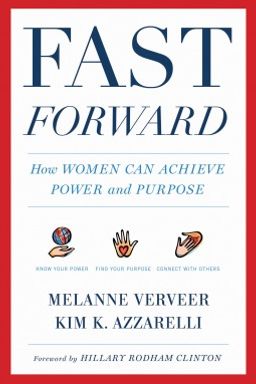
Fast Forward cover

Fast Forward

by Melanne Verveer and Kim K Azzarelli

Fast Forward explores the untapped potential of women as catalysts for change and economic growth. By addressing gender inequality and championing female empowerment, this book provides a roadmap for leveraging women''s contributions to achieve global progress and prosperity.

From Power to Purpose: The Blueprint for Women's Leadership

How can you turn conviction into measurable impact? In From Power to Purpose (Melanne Verveer and Kim K. Azzarelli), the core argument is that women possess untapped power to transform economies, cultures, and institutions—but only if they learn to use it deliberately. The authors contend that meaningful change comes through a disciplined, repeatable process: knowing your power, finding your purpose, connecting with others, and making the case with data and partnerships.

Across interviews, case studies, and decades of global advocacy, the book maps how women leaders—from Christine Lagarde at the IMF to Mukhtar Mai in Pakistan—turned moral conviction into systems change. You see power reframed not as hierarchy but as influence: every individual, regardless of title, controls assets that can spark progress.

Know Your Power

You begin by auditing your influence. Laura Gentile didn’t wait for a CEO title—she used ESPN’s audience data to reveal a market of women athletes and built espnW. Beth Brooke‑Marciniak at EY leveraged internal research to publish the Groundbreakers report, making gender equality a boardroom issue. Power, the authors insist, lies not in authority but in how you mobilize networks, knowledge, and credibility. Mapping these assets clarifies what you can change right now.

Find Your Purpose

Purpose sustains progress through doubt and fatigue. Pam Seagle’s brush with mortality on Flight 1549 led her to build Bank of America’s Global Ambassadors program. Melanne Verveer’s decades of diplomatic work trace back to a singular aim: elevating women worldwide through Vital Voices. When you define the 'why,' you align passion with persistence—a lesson echoed by many entrepreneurs and diplomats featured in the text.

Connect with Others

Change rarely happens alone. Whether in the Avon Global Center for Women and Justice or Coca‑Cola’s 5by20 initiative, collaboration multiplies impact. Justice Sandra Day O’Connor connected courts with advocates; Ebby Elahi’s medical mission in Cambodia became part of a transnational legal response. The book treats connection as infrastructure, not sentiment: it builds continuity across leadership changes and scales local innovation globally.

Make the Case with Evidence

Data transforms advocacy into strategy. Christine Lagarde called women “macro critical,” linking gender parity to GDP growth; Catalyst and Credit Suisse quantified corporate returns from diverse leadership. When numbers replace moral appeals, decision‑makers listen in their language—be it dollars, productivity, or competitiveness. You learn that statistics are persuasion tools, not mere academic citations.

The Broader Message

Ultimately, the book argues that women’s advancement is not just a fairness goal—it is an economic and moral imperative. Empowering half the population lifts entire societies. From classrooms to boardrooms to judicial benches, Verveer and Azzarelli chart a continuum: local courage translates into institutional reform when guided by purpose, partnership, and evidence. Every chapter reframes social good as a strategic opportunity for leaders in all sectors.

Core takeaway

Know your power. Find your purpose. Connect with others. Make the case with data. This four‑step cycle can reshape organizations, public policy, and your own life’s work.

By weaving microstories of courage with macro‑level evidence, From Power to Purpose offers a toolkit for anyone seeking change—from entrepreneurs scaling marketplace access to policymakers closing gender gaps in education, pay, and peacebuilding. The journey begins by recognizing that the power to create change already sits within you.


Building Evidence for Equality

You learn that numbers can rewrite narratives and budgets. When the authors describe Christine Lagarde declaring women “macro critical,” they prove that measurable evidence—not just empathy—moves governments and CEOs. Beth Brooke‑Marciniak’s Groundbreakers report transformed gender equality into a board‑level metric. Muhtar Kent at Coca‑Cola used consumer data to justify 5by20, a program linking supplier empowerment to revenue growth.

Across examples—from Kathy Matsui’s womenomics reforms in Japan to Laura Gentile’s use of ESPN audience metrics—you see evidence turn belief into policy. Catalyst studies correlating women on boards with higher returns made gender diversity mainstream in Fortune 500 rooms. Each dataset functions as social proof that inclusion pays dividends.

How You Use Evidence

You can apply data even without a research department. Pilot measurable experiments—like Ann Moore’s 'minivan test' at People Magazine—to validate intuition. Translate results into metrics that matter to your audience (ROI, GDP, retention). Partnerships with credible institutions amplify impact; the UN Foundation and ExxonMobil commissioned rigorous studies before scaling interventions. Evidence converts goodwill into durable organizational commitments.

Insight

When you speak the language of data, moral intent becomes actionable strategy. Decision‑makers listen when equality aligns with measurable growth.

By reframing fairness as a business and national advantage, you move inclusion from the margins to the core of development and corporate planning. Evidence is not just persuasive—it is transformative.


Leadership at Every Level

Leadership, the authors stress, isn’t limited to corner offices. Sustainable change requires coordination across three levels: top, middle, and base. Each performs a distinct function but relies on the others for momentum.

Top: Setting Norms and Visibility

At the top, figures like Christine Lagarde, Hillary Clinton, and Helena Morrissey turn gender equality into systemic policy and public expectation. Their visibility normalizes parity and allocates resources. A speech—like Clinton’s declaration that “women’s rights are human rights”—can shift diplomatic agendas worldwide.

Middle: Executing Strategy

Middle managers bridge vision and practice. Amanda Ellis at the World Bank produced data‑rich gender and growth analyses that informed national policy. Jane Randel at Liz Claiborne transformed domestic violence prevention into corporate culture thanks to executive allies. You, too, can be a translator between aspiration and application—using small pilots and metrics to convince higher‑ups that inclusion improves performance.

Base: Networks and Grassroots Empowerment

Grassroots entrepreneurs and workers drive the foundation. Programs like Grameen Bank, SEWA, and Coca‑Cola’s 5by20 show how empowering women at the community level raises family income and stability. Kate Spade’s Rwanda co‑op illustrates how global companies can integrate local producers ethically and profitably.

Practical lesson

Change falters when any layer acts alone—policy without grassroots input fails, and community projects without institutional support remain local. Coordinate upward and downward.

Map your role, identify one ally at each adjacent level, and design projects that build bridges. Leadership is a chain reaction, not a hierarchy.


Partnering for Purpose

The book proves that cross‑sector partnerships turn vision into scale. Complex problems—violence, exclusion, health inequity—demand shared resources. The Avon Global Center at Cornell began when corporate, judicial, and academic leaders met to design legal training for judges, blending authority, budgets, and expertise. The Cambodian acid attack case joined medical missions, business leadership, and legal reform through coordinated action.

Designing Coalitions

Effective partnerships rest on complementary assets: corporations offer reach, universities offer data, NGOs bring local insight, and governments provide regulation. Coca‑Cola worked with TechnoServe and the Gates Foundation; Kate Spade built supplier cooperatives instead of charities. You can design similar alliances—align incentives, set measurable goals, and keep timelines short to maintain momentum.

Networks as Multipliers

Events like Women in the World and Vital Voices amplify stories into global movements. Visibility attracts partners and investors. Collaboration reframes philanthropy as shared value creation.

Key idea

Partnerships built around mutual benefit and reliable data survive beyond founder charisma—they become institutions of purpose.

When you design alliances with accountability and shared metrics, your impact endures leadership transitions and scales across geographies.


Entrepreneurship and Economic Inclusion

Women entrepreneurs constitute an economic engine, yet face financing and market‑access barriers. The authors detail how leaders such as Sheila Marcelo (Care.com) and Tory Burch created businesses around women’s needs while launching foundations to close capital gaps. Goldman Sachs’ 10,000 Women program and IFC’s women’s bonds paired funding with training, generating thousands of jobs and measurable revenue growth.

Financing Innovation

Initiatives like Golden Seeds and Belle Capital demonstrate how targeted venture capital and mentoring increase success rates. Microfinance models such as Grameen America adapt community credit for developed economies. Still, global data show a multi‑hundred‑billion‑dollar shortfall in funding for women‑owned enterprises—an opportunity for governments and investors.

Market Access

Certification programs (WEConnect, WBENC) integrate women suppliers into corporate value chains. Walmart’s “Women Owned” label and procurement pledges exemplify how market recognition reinforces supplier development. Long‑term relationships replace one‑off charity purchases.

Business lesson

Capital and customers form a loop: financing without buyers stalls, buyers without trained suppliers disappoint. Sustainable markets combine both.

Empowering women entrepreneurs drives community growth, breaks dependence cycles, and expands national GDP. The principle is universal: investment plus inclusion equals scale.


Education, Technology, and the Culture of Possibility

Education and technology emerge as interdependent levers for empowerment. Girls’ schooling raises incomes, reduces early marriage, and improves health; technology provides access, safety, and employment. Kakenya Ntaiya’s boarding school model in Kenya, where parents pledge to spare daughters from FGM, exemplifies how education transforms cultural expectations. (Compare this to Malala Yousafzai’s advocacy—both link education to autonomy and peace.)

Digital Inclusion

Intel’s She Will Connect and mobile banking innovations like mPesa demonstrate how access to digital tools increases safety and financial independence. Studies show women owning phones feel more secure and achieve higher earnings. Closing this digital gender gap could add tens of billions to developing‑country GDP.

STEM and Representation

Programs like Girls Who Code, NCWIT, and Harvey Mudd College reveal how early encouragement and institutional design boost women’s participation in science and tech. Reimagined introductory courses and mentoring networks help girls persist, countering stereotypes and cultural resistance. The historical re‑framing—from Ada Lovelace to the ENIAC programmers—reminds you that women built computing before being written out of its story.

Long‑term insight

Educate a girl, connect her digitally, and you expand possibility—not just for her, but for national prosperity. Knowledge and connectivity form the twin engines of equality.

Invest simultaneously in schooling and access; the social and economic returns compound for generations.


Ending Violence and Changing Culture

Gender‑based violence and harmful traditions represent the deepest structural barriers discussed. The authors combine global data with survivor stories to show how law, culture, and economics intersect. One in three women worldwide faces violence—costing billions in lost productivity and health. U.S. policy under the Violence Against Women Act cut intimate partner violence by over 60%, demonstrating that design and enforcement change outcomes.

Laws and Justice Systems

Judicial training through the Avon Global Center and International Association of Women Judges brought legal reforms to dozens of countries. Justice Highton de Nolasco’s 24/7 domestic‑violence office in Argentina and Judge Ann Claire Williams’ cross‑border education for African judges illustrate institutional leadership. Laws matter—but enforcement and normalization are the true tests.

Changing Cultures from Within

Community‑led programs like Tostan in Senegal and the Nike Foundation pilot in Ethiopia prove norms shift when locals lead. Economic incentives—a goat for schooling or dialogue with religious leaders—produced sharp declines in child marriage and FGM. Dr. Hawa Abdi’s Somali hospital and Mukhtar Mai’s school show survivor leadership turning trauma into transformation.

Cultural truth

Lasting change arises when communities enforce dignity themselves—information and choice matter more than top‑down mandates.

Policy, justice, and local ownership must converge to end violence and restore women’s agency. When society values women’s lives equally, prosperity follows.


Women, Peace, and Media Power

Conflict and communication share one moral frontier: both test society’s respect for the female voice. The Women, Peace, and Security agenda demonstrates that including women in peace processes increases stability, yet remains rare—just under 10% representation globally. Leymah Gbowee’s organizing ended Liberia’s war; Zainab Bangura’s leadership at the UN combats wartime sexual violence through coordinated international policy. Resolution 1325 and subsequent Security Council actions established a lasting framework for female inclusion in security.

Media as Cultural Leverage

Media representation, covered in the book’s closing chapters, shapes what peace and leadership look like. The Geena Davis Institute documents gender imbalance—only about 30% of speaking roles in family films go to women. Yet entertainment offers rapid leverage: casting decisions shift culture faster than legislation. Productions like Girl Rising, Saving Face, and Women, War, and Peace brought global gender issues into living rooms, proving that narrative builds empathy and activism.

Essential lesson

Peace tables, classrooms, and screens all require women’s voices. Representation—political or cultural—is not cosmetic; it is structural security.

Supporting organizations that train female mediators, journalists, and filmmakers amplifies inclusion. When women lead both dialogue and storytelling, societies stabilize and imaginations expand.


Unfinished Business and the Path Ahead

Despite progress, the authors highlight persistent structural gaps—care, pay, and workplace design. Millions of women still step back from careers because child or elder care lacks systemic support. The United States, unlike many OECD countries, offers no national paid parental leave. Employers such as Deloitte, Vodafone, and Orrick are testing returnship and flexible work models, proving retention improves when care is recognized as infrastructure.

The Pay Equation

Pay inequality compounds over a lifetime—78 cents on the dollar translates into pension and wealth deficits. Iceland’s 2010 walkout dramatized inequity vividly when women left their jobs at 2:25 p.m., symbolizing the portion of unpaid labor due. You can address disparity directly: conduct pay audits, publish salary bands, and link manager evaluation to equity outcomes.

Caregiving as Economic Policy

Policy innovations like caregiver pension crediting or affordable childcare convert domestic balance into macroeconomic gain. The authors urge applying their three‑step framework again—map power, define shared purpose, and connect partners—to close remaining gender gaps.

Forward insight

Gender equality work is never abstract—it touches every paycheck, promotion, and policy. Solving care and pay issues transforms economies just as much as board quotas or entrepreneurship programs.

Finish the unfinished business by treating equality not as a sidebar to growth but as its foundation. When families thrive, markets follow.

Dig Deeper

Get personalized prompts to apply these lessons to your life and deepen your understanding.

Go Deeper

Get the Full Experience

Download Insight Books for AI-powered reflections, quizzes, and more.