
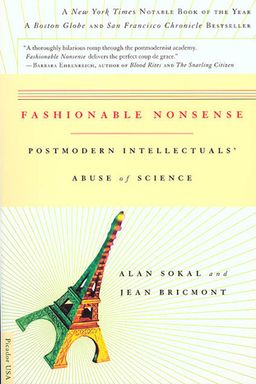
Fashionable Nonsense cover

Fashionable Nonsense

by Alan Sokal and Jean Bricmont

Fashionable Nonsense delves into the problematic realm of postmodernism, revealing how its complex language can obscure shallow ideas and misuse scientific concepts. Discover the impact on academia and society, and learn the importance of maintaining clarity in intellectual discourse.

Unmasking Intellectual Impostures

Why do some writers use the language of science to sound profound while saying nothing precise? In Intellectual Impostures (also published as Fashionable Nonsense), physicist Alan Sokal and philosopher Jean Bricmont mount a provocative response to this question. The book grows directly out of the infamous Sokal Hoax—a parody paper full of pseudo‑scientific jargon that Sokal submitted to the cultural‑studies journal Social Text in 1996. When the journal published it, unaware it was a spoof, the incident became a watershed in what came to be called the 'science wars.’

The authors' central aim is modest but urgent: to defend intellectual honesty and conceptual clarity. They do not attack the humanities as such; instead, they expose a pattern of disciplinary pretension in which celebrated theorists misuse mathematical and scientific language to create illusory depth. Through detailed examples, they show how opaque prose and technical terminology can gain cultural prestige even when it conceals confusion.

From hoax to diagnosis

You first encounter Sokal's spoof article, titled 'Transgressing the Boundaries: Toward a Transformative Hermeneutics of Quantum Gravity.' Written in the densely self‑referential idiom of postmodern theory, it offered ludicrous claims—that physical reality is a social construction, that quantum field theory supports feminist epistemology, that gravity has moral dimensions. When Social Text printed it, Sokal exposed the hoax and ignited debate between scientists and humanists about standards of rigor. This book provides the detailed analysis that the short explanation in the press could not: it catalogues real cases where prominent thinkers commit the same category mistakes the parody exaggerated.

The problem the hoax reveals

The authors argue that the hoax was not about humiliation but education. It revealed how certain forms of writing, immunized by prestige and opacity, could pass peer review without coherent argumentation. According to Sokal and Bricmont, this is dangerous for two reasons. First, it erodes the credibility of serious interdisciplinary work. Second, it feeds a larger philosophical trend—epistemic relativism—that denies the distinction between empirical knowledge and cultural narrative. The hoax thus dramatized both the micro‑level problem of misuse and the macro‑level threat to rational discourse.

Critique with boundaries

They stress that their critique is narrow. They target four recurring misuses: (1) pronouncing on scientific topics without understanding; (2) importing technical vocabulary across disciplines without justification; (3) flaunting pseudo‑erudition to intimidate readers; and (4) producing strings of meaningless, yet authoritative, sentences. Their goal is not to strip culture of metaphor but to insist that metaphors be transparent and labeled as such. If you claim scientific rigor, you must honor scientific precision.

Science, reason, and the left

Underlying the criticism is a political anxiety. Sokal and Bricmont both identify with the political left, yet they believe strands of postmodernism have undermined progressive politics by eroding the notion of objective truth. When 'science is just another narrative,' evidence loses its force, and demagogues or ideologues of any camp can claim equal validity. They urge you not to confuse social critique of science (which is valuable) with epistemic relativism (which is self‑defeating). The book therefore defends Enlightenment rationality not as dogma but as a shared foundation for constructive disagreement.

How to read charitably

Although the authors’ tone can be caustic, they explicitly invite readers to check the evidence and interpret charitably. They acknowledge that literary theorists may use analogy legitimately and that metaphoric thinking has a place in art, philosophy, and rhetoric. Their complaint is against pseudo‑rigor—when writers present metaphors as if they were deductions. In that sense, the book becomes not just a polemic but a manual in intellectual hygiene: it teaches you how to ask, 'Does this sentence make sense? Are these concepts connected by logic or merely by rhythm?'

Key message

Intellectual integrity depends on knowing what you mean. When disciplines borrow ideas, they must carry the discipline’s discipline with them.

By the book’s end, you see how a single episode—the Sokal hoax—expands into a broader plea for rational clarity across academia, philosophy, and politics. The authors do not insist on scientism or narrow empiricism; rather, they call for a bilingual intelligence able to translate ideas faithfully between science and the humanities. Against fashionable nonsense, they propose a simple ethos: clarity first, evidence always, humility everywhere.


Patterns of Misused Science

Sokal and Bricmont’s forensic investigation uncovers repeating habits among theorists who appropriate scientific language. Four tactics appear again and again in works by Lacan, Kristeva, Baudrillard, Irigaray, Virilio, Deleuze, and Guattari. Recognizing these patterns helps you separate legitimate interdisciplinary ambition from empty display.

1. Speaking without understanding

Lacan discusses topology in psychoanalysis but gets the mathematics wrong: the 'torus of the neurotic' or the 'compact space of jouissance' are presented not as analogies but as literal correspondences. Sokal and Bricmont show that his definitions of compactness or open sets collapse into nonsense when read literally. The point isn’t to mock Lacan’s creativity—it’s to demonstrate the danger when rhetorical confidence replaces conceptual mastery.

2. Importing concepts without bridges

Kristeva’s invocation of Cantorian set theory, the axiom of choice, and Gödel’s incompleteness theorems illustrates the second pattern. She uses the technical aura of mathematics to describe poetic transgression but never explains how these abstract ideas map onto language or subjectivity. Some of her analogies could work metaphorically, yet she introduces formal symbols as if they yielded empirical or logical demonstration.

3. Intimidating through jargon

Other authors rely on verbal fireworks. Baudrillard speaks of 'non‑Euclidean wars' or 'hyperspace of communication' and Virilio transforms the speed of light into political metaphysics. These phrases sound profound, especially to readers untrained in physics, but they lack definable meaning within any scientific system.

4. Producing meaningless sentences

When terms like 'compact,' 'continuous,' or 'nonlinear' are strung together without syntactic logic, you arrive at technically meaningless statements. The authors propose a simple test: replace the scientific term with an unrelated one; if the prose still sounds solemn, you are reading word magic rather than analysis.

Practical takeaway

To read critically, ask: what does this term contribute? If the concept adds no predictive or explanatory power, it’s ornamental, not analytical.

These patterns persist because technical vocabulary carries prestige. Non‑specialists may associate complexity with insight. The authors do not oppose metaphor but demand accountability: interdisciplinary borrowing is fruitful only when translation, not mystification, governs the exchange.


Relativism and the Nature of Knowledge

Beyond textual misuses lies a deeper issue: the temptation to treat truth as purely local or constructed. Sokal and Bricmont dedicate several chapters to analyzing this intellectual mood—variously called epistemic relativism, social constructivism, or the 'strong programme’ in sociology of knowledge.

Where relativism comes from

They trace its origins to mid‑20th‑century philosophy of science: Thomas Kuhn’s paradigms, Feyerabend’s methodological anarchism, and sociological readings from Bloor and Barnes. Each began as a legitimate insight—science is historical, fallible, and socially embedded—but some disciples stretched these insights into the claim that scientific truth is no different from myth. Sokal and Bricmont reconstruct what these philosophers actually meant to show how the radical reading overshoots the evidence.

The crucial distinctions

You must separate the sociology of belief (how people come to hold a view) from epistemology (whether the view corresponds to reality). Describing why physicists accepted relativity in 1919 differs from proving relativity’s equations correct. Ignoring that separation converts rational debate into relativist standoffs. The authors concede that all observation is theory‑laden but argue that Nature still constrains belief: reproducible experiments count because the world pushes back.

Why it matters politically

Relativism’s appeal is often moral or political—it seems to protect pluralism against imperial scientism—but carried too far it undermines justice itself. If all versions of the past are 'equally valid,' denial of atrocities becomes as legitimate as documentation. Examples like the archaeology of Native American origins illustrate this danger: respecting cultural narratives does not require labeling them factually equivalent to geological or genetic evidence. The authors argue that affirming cultural dignity and maintaining empirical distinction are compatible, indeed necessary, aims.

Their conclusion is neither positivist nor nihilist. Knowledge remains provisional and revisable, yet not arbitrary. You can study how social forces shape science while also accepting that some theories—like atomic structure or evolution—are better supported than others. The integrity of reason lies in this middle ground between arrogance and irony.


Case Studies in Intellectual Overreach

Concrete examples occupy the center of the book. Through close reading, the authors dissect how specific figures—Lacan, Kristeva, Deleuze, Guattari, Irigaray, Virilio, Baudrillard, and Latour—transform scientific concepts into prose divorced from their technical context.

Lacan and topology

Lacan’s fascination with topology leads him to literal claims: the torus 'is the structure of the neurotic.’ When he defines 'compact space' or manipulates imaginary numbers as psychic operators, the mathematics dissolves into gibberish. Sokal and Bricmont refrain from psychoanalytic evaluation; their verdict is strictly formal—his math does not mean what he thinks it means.

Kristeva and set theory

Kristeva’s early essays equate poetic creation with transfinite arithmetic: she misuses the axiom of choice, confuses continuum cardinalities, and misstates Gödel’s theorems. Later she admitted metaphorical intent, but readers had long interpreted these moves as literal theory. The lesson: mathematical language gives an illusion of necessity without argument.

Deleuze, Guattari, and calculus

Deleuze and Guattari treat differential calculus as philosophy of becoming, yet they distort its meaning. 'Function’ and 'derivative’ turn mystical—the 'functive’ is their neologism—but such usage ignores calculus’s logical structure. Their exuberance produces poetry, not mathematics, which is fine—if only they acknowledged it as such.

Virilio, Baudrillard, and physics metaphors

Virilio confuses speed and acceleration and turns the limit of light velocity into political allegory. Baudrillard invokes 'non‑Euclidean war’ or chaos to dramatize media saturation. The authors find these misfires symptomatic of intellectual culture where dazzling metaphor replaces disciplined analogy.

These case studies are not about belittling creativity but about restoring proportion. You can appreciate their imaginative ambition while recognizing that naming equations or topologies does not deepen understanding unless the logical relations still hold. The book offers a model of informed reading: enjoy metaphor but know when it stops explaining and starts merely performing.


Relativity, Chaos, and the Limits of Metaphor

In later chapters, Sokal and Bricmont clarify what major scientific theories actually claim before examining how cultural theorists distort them. They focus on relativity, quantum mechanics, and chaos—fields often invoked to justify epistemic uncertainty.

Latour and relativity

Latour’s sociological reading of Einstein mistakes frames of reference for narrative voices. He imagines an 'enunciator’ necessary to compare train and platform observers, as if Einstein’s pedagogical narrator were a physical element. The authors patiently explain that the Lorentz transformations relate frames directly; no third observer intervenes. The confusion arises from treating linguistic relativity as physical relativity, collapsing physics into discourse analysis.

Quantum mechanics and uncertainty

Against New Age misreadings, they insist that quantum theory does not show 'everything is relative to the observer.’ Non‑commuting operators obey precise mathematical laws; uncertainty is quantitative, not mystical. Collapse of the wavefunction is no license for solipsism. Understanding this helps you see why claims of 'quantum healing’ or 'quantum morality’ rest on wordplay, not experiment.

Chaos and postmodernism

Chaos theory, too, suffers rhetorical abuse. Lyotard and others declared it proof that modern science embraces discontinuity and unknowability. Yet chaos, they remind you, describes deterministic systems—like weather—whose sensitivity to initial conditions limits prediction but not causality. Confusing 'nonlinear' with 'irrational' mistakes mathematics for metaphor.

Guiding principle

A metaphor drawn from science is legitimate only when you know the science well enough to respect its limits.

By clarifying what relativity, quantum mechanics, and chaos actually entail, Sokal and Bricmont both defend science from caricature and arm readers for nuanced cross‑disciplinary exchange.


Science, Society, and the 'Science Wars'

The so‑called 'science wars' form the book’s backdrop: disputes between natural scientists defending objectivity and cultural theorists emphasizing social construction. The authors navigate a middle path, distinguishing at least four meanings of ‘science’ to keep debates precise.

Four senses of science

  • Science as the method of rational inquiry requiring empirical test.
  • Science as the current body of established results (theories, data).
  • Science as a social institution with hierarchies and funding structures.
  • Applied science and technology with political and economic consequences.

Confusing these levels fuels polemics: critics attack institutional bias and infer that the findings themselves are false. Sokal and Bricmont affirm that social critique (levels three and four) is vital but doesn’t invalidate science’s epistemic core (levels one and two).

A political dimension

They warn that when left intellectuals abandon objectivity, they weaken their claim to speak truth to power. Evidence‑based reasoning underlies progressive causes like environmentalism or public health. Relativism may sound radical, but it disarms critique by leveling all assertions into rhetoric. (Chomsky’s critique of 'Parisian linguistic fog' captures this worry.)

Practical lesson

Question institutions passionately but preserve evidence as a common standard—without it, no argument can persuade beyond its believers.

By reframing the science wars as a misunderstanding of categories rather than an inevitable clash of cultures, the book seeks reconciliation: rigorous science and critical theory need not be enemies if each respects the other’s methods and limits.


The Postmodern Left and Cultural Costs

In later chapters, Sokal and Bricmont ask why many left‑wing intellectuals turned toward postmodernism and how that shift backfired. They identify three broad causes—political frustration, moral fatigue, and symbolic rebellion against power.

From movements to relativism

The New Left, feminism, and postcolonial thought sought to challenge Eurocentric rationalism. But dissatisfaction with reductionist Marxism sometimes slid into distrust of reason itself. Adopting relativist epistemologies felt liberatory: no single truth would dominate. The authors sympathize with the motive but consider the philosophical conclusion disastrous—justice still requires facts.

When despair breeds fashion

After political defeats and neoliberal ascendancy, some scholars turned inward, transforming critique into style. Academic success began to depend on opaque novelty rather than empirical argument. The Sokal hoax exposed this cultural vulnerability: a parody of theory could pass as theory because the simulation was indistinguishable from the real article.

Pedagogical and political fallout

In classrooms, students memorized jargon instead of learning to reason. In politics, the erosion of fact empowered cynicism. You cannot fight climate denial or revisionist history with language games. For the authors, reclaiming clarity is not elitist—it is democratic.

Hopeful ending

They envision a future intellectual culture neither dogmatic nor nihilist: precise in method, open in dialogue, egalitarian in access, and humble before evidence.

Their closing counsel is simple: if you care about justice, value clarity. Intellectual mystification may feel radical, but it is politically sterile. Only disciplined reason lets you unite persuasion with truth.

Dig Deeper

Get personalized prompts to apply these lessons to your life and deepen your understanding.

Go Deeper

Get the Full Experience

Download Insight Books for AI-powered reflections, quizzes, and more.