
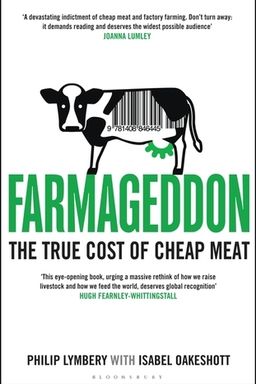
Farmageddon cover

Farmageddon

by Philip Lymbery with Isabel Oakeshott

Farmageddon exposes the hidden costs of cheap meat, revealing how industrial farming harms the environment and human health. Through eye-opening insights, it empowers readers to make informed choices that support sustainable, ethical food production.

The Hidden Costs of Industrial Food

When you are told that modern agriculture feeds the world, you probably imagine a success story of efficiency and progress. This book turns that image inside out. It argues that the industrial food system—once promoted as a triumph of science—has become a system of hidden costs: ecological collapse, animal suffering, sick communities, and global inequality. Every cheap meal, it shows, carries invisible debts in pollution, public health, and the depletion of soil, oil, and water.

From Wartime Chemistry to Factory Farms

The industrial model grew rapidly after World War II. Technologies like the Haber-Bosch process for fertiliser and organophosphates for pesticides emerged from wartime chemistry. Governments rewarded output through policies such as the US Farm Bill and Europe’s Common Agricultural Policy, turning farming into an arm of industrial production. Medicines and mechanisation completed the shift—antibiotics keep crowded animals alive, while genetic selection bred fast-growing birds and pigs raised for throughput, not health. As Ruth Harrison and Rachel Carson warned, this apparent prosperity substituted quantity for quality.

The System Revealed Across the World

The book pulls you through real landscapes that demonstrate how this logic plays out. In California’s Central Valley, mega-dairies produce milk for global markets but leave behind smog, polluted water, and children with triple the national asthma rate. In Argentina, endless GM soya monocultures feed animals in Europe and Asia while local villages face cancer clusters from pesticide drift. In China, pig lagoons poison rivers and lakes under the banner of economic success. Each example shows how ‘cheap’ food exports costs onto people and ecosystems elsewhere.

Biodiversity, Health, and the Web of Life

Intensified farming systems hollow out biodiversity. Birds, bees, and butterflies vanish where monocultures and pesticides dominate—threatening pollination, soil resilience, and the very foundation of agriculture. Similar processes unfold underwater through overfishing for fishmeal and pollution from aquaculture. The pattern is clear: whether soil, sea, or sky, extraction and concentration replace ecological balance with fragility. Public health bears the cost too. Antibiotic resistance, zoonotic outbreaks such as H1N1, and toxic waste from lagoons and factories echo one warning—an ecological crisis inevitably becomes a human crisis.

Power, Control, and Inequality

Beneath the ecological story runs a political one. Seed patents, land grabs, and genetic modification concentrate power in corporate and financial hands. Farmers lose autonomy as multinational firms—from soy traders to biotech giants—capture inputs and dictate methods. In villages from Ethiopia to India, farmers face debt, displacement, and despair. The book situates this not as a failure of globalisation but as its predictable by-product: a system optimised for volume and profit, not fairness or resilience.

Finding a Way Back to Balance

Yet the narrative is not only bleak. You meet the people who fight back—Ruth Harrison’s advocacy, Maria Foronda’s pollution monitoring, Tom Frantz’s local lawsuits, or Will Harris’s regenerative grazing. Their actions signal a way forward: reconnect animals to land, make waste and resource cycles closed, and let policy reward stewardship over output. Technological innovation, from seaweed protein to lab-grown meat, can support that transition, but ethics and politics must lead. The book closes by urging consumers and governments to realign incentives—to pay the real price of food and to reclaim agriculture as part of the living world, not its opposite.

Central Message

Industrial farming feeds markets, not people. True sustainability demands economic honesty: accounting for what is lost in soil, rivers, climate, and community when food is made to seem cheap.


Origins of the Factory Farm

Industrial farming’s roots lie in mid-twentieth-century optimism. Science promised endless production through chemistry, breeding, and policy engineering. The result was the factory farm, where animals and crops became mechanised systems.

Technological Drivers

The innovations that enabled this revolution had unintended consequences. The Haber-Bosch process replaced natural fertility cycles with fertilisers that allowed monocultures to expand endlessly. Wartime chemicals were recast as pesticides, saturating farmland. Antibiotics—first medical miracles—became growth promoters for livestock. Machines replaced manure handling and pasture management with industrial logistics. These steps created an illusion of efficiency while masking hidden ecological debt.

Policy as Accelerator

Governments turbocharged intensification. The US Farm Bill guaranteed prices and subsidised corn, Soya, and meat; Britain’s 1947 Agriculture Act prioritised output; Europe’s CAP poured nearly half its budget into production bonuses. Those subsidies aligned perfectly with new industrial tools—yield became the only metric that mattered. 'Quality replaced by quantity' describes not just food but rural life as entire landscapes reorganised around scale.

Social Resistance

Voices of dissent appeared early. Ruth Harrison’s Animal Machines and Peter Roberts’s Compassion in World Farming challenged the moral and ecological absurdity of treating animals as units of conversion. They foresaw climate change, biodiversity loss, and antibiotic resistance decades before these became mainstream concerns. (Note: their advocacy parallels Rachel Carson’s critique in Silent Spring—each revealed how chemical and policy modernisation had moral blind spots.) Factory farming’s birth story, then, is not only scientific; it’s ethical, showing how technological optimism divorced from ecology lays foundations for crisis.


Land, Feed and Displaced Costs

Behind every intensive livestock unit stretches a shadow empire of land used to grow its feed. These 'ghost acres'—a concept developed by Georg Borgström—represent the hidden geography that makes cheap meat possible. The book illustrates how Europe’s meat industry relies on Brazil, Argentina, and Paraguay’s transformed ecosystems, and how this pattern transfers costs across continents.

Soya and the New Colonialism

Argentina’s Pampas once hosted mixed farms; now GM soya monocultures dominate. Companies like Gustavo Grobocopatel’s manage hundreds of thousands of hectares, displacing smallholders and indigenous Qom communities such as Abel Paredes and Domingo Lassaro. The grain flows to feed pigs and poultry thousands of miles away. Each shipment exports soil nutrients, water, and social equity—the costs of which remain invisible to meat consumers abroad.

Chemical Dependency and Public Health

The GM revolution promised fewer sprays but delivered more. In Argentina, herbicide use jumped from 35 million to 300 million litres a year. Farmers like Viviana Peralta, whose child suffered pesticide poisoning, forced limited local bans through courts. In Rosario, doctors recorded cancer clusters and respiratory disease. The lesson: when the farm economy prioritises feed exports, it can cannibalise local health and autonomy. Agrochemical companies profit, but communities pay the epidemiological price.

Land Grabs and Global Inequality

Africa’s experience mirrors South America’s. The Karuturi deal in Ethiopia—a 311,000-hectare lease—symbolises a new colonial economy where fertile land feeds foreign livestock. The book links this to policies from the World Bank and IFC that normalise massive land transfers. These ghost acres confirm a core truth: the global meat economy depends on visible efficiency and invisible appropriation. (Parenthetical note: this argument parallels Vandana Shiva’s critiques in Stolen Harvest.)


Waste, Pollution and the Ecological Bill

Once animals were removed from pastures, their manure became not an asset but a liability. This section tracks the journey of waste—from pig lagoons in Brittany and North Carolina to fishmeal sludge in Peru—to show how industrial food production externalises its ecological bill onto air, water, and communities.

Waterways and Coastal Death Zones

In Brittany, excessive pig slurry runoff fuels algal blooms. The decomposing algae emit hydrogen sulfide gas, killing livestock and workers like Thierry Morfoisse. Across the Atlantic, North Carolina’s lagoon failures released millions of litres of manure, triggering fish kills and Pfiesteria outbreaks that harmed fishermen. The pattern is predictable: concentration breeds pollution, and dilution is not a solution. Locals such as Rick Dove use aerial photography and lawsuits as tools of resistance, echoing Tom Frantz’s activism in California.

Air and Community Health

Mega-dairies in California's Central Valley reveal the human cost of industrial scale. Ammonia and dust aggravate asthma; water wells are tainted with nitrates. Social impacts include psychological strain, as indebted farmers succumb to economic and emotional stress. Environmental injustice arises when entire communities—often poorer or migrant—bear the consequences of others’ cheap food habits.

Fishmeal Waste and Global Feedback

Peru’s Chimbote illustrates industrial waste at sea. Anchoveta processed into fishmeal for salmon farms leaves behind toxic sludge and dead bays. Local activist Maria Foronda connects those export profits to local malnutrition. The takeaway: divorced from land or sea cycles, waste doesn’t disappear—it migrates into new crises, from eutrophication to methane emissions.


Health, Antibiotics and Global Risk

When you medicate whole herds to maintain productivity, you turn farms into laboratories for resistance. This key idea examines the medical dimension of industrial farming—antibiotics, disease emergence, and the professional dilemmas of veterinarians who straddle production and health.

Antibiotic Overuse and Resistance

Since the 1950s, 'penicillin for pigs' symbolised a quiet revolution—antibiotics became routine feed additives. Despite the Swann Report’s 1968 warnings, preventive use persisted. Today roughly half of all antibiotics worldwide are consumed by livestock. Bacteria such as MRSA ST398 spread from pigs to farmworkers. Real tragedies, like toddler Simon’s death from resistant infection in the US, show these are not abstract data points—they're public-health failures brewed in agricultural sheds.

Pandemics and Crowded Systems

Viruses exploit density. The 2009 H1N1 outbreak in Mexico’s La Gloria town and recurrent bird flu episodes highlight how concentrated animal populations become mixing vessels for flu strains. Even if causality is hard to prove, the pattern—high density, global transport, minimal genetic diversity—creates ideal conditions for contagion. (Note: parallels can be drawn with COVID-19’s zoonotic lessons about industrial food supply chains.)

Veterinary Ethics and Structural Pressure

Vets working in abattoirs or mega-farms face moral constraints: shutting down production can cost them jobs, so hygiene lapses persist. Figures like Jean-Claude Latife describe being threatened for enforcing standards. The ethical cost of cheap meat thus extends into professional life, making animal medicine an uncomfortable accomplice of industrial economics. Reforming antibiotic regulation and veterinary education is essential to restoring animal welfare and human health alike.


Biodiversity Loss and the Fragile Web

The ecological impact of intensive farming extends beyond visible pollution: it reshapes life itself. Fields once filled with birds, bees, and butterflies now fall silent. The book connects those silences to your own food security.

Birds as Barometers

In Britain, 97 percent of tree sparrows and 90 percent of grey partridges vanished within decades. Hedgerow removal and pesticides destroyed their habitats. These declines signpost broader ecological collapse: when birds disappear, it often means the insects and seeds that sustain them—and us—are gone too.

Pollinators and Agriculture’s Paradox

Almond farmers in California hire billions of bees trucked in each spring. In India and China, people hand-pollinate crops because wild bees have vanished. The irony is stunning: industrial farms designed for efficiency now depend on artificial pollination because their chemicals erase the natural workforce. The EU’s neonicotinoid bans reveal tension between precaution and corporate interest, mirroring debates Rachel Carson ignited decades ago.

Butterflies and the Wider Signal

Monarch butterflies, tracked by Dr. Chip Taylor, declined from 21.6 to under two hectares of wintering colonies in Mexico—collateral damage from herbicide-tolerant GM crops that eliminated milkweed. Each disappearing species marks a weakening of resilience: ecosystems simplified for yield are brittle, not robust. (Parenthetical note: this aligns with E.O. Wilson’s biophilia hypothesis—human prosperity depends on life’s diversity, not its reduction.)


Economic Myths and Global Inequality

Global hunger persists not because food is scarce but because resources are misallocated. Industrial livestock turns edible crops into animal feed and inflates grain prices. This section examines how 'cheap' protein undermines human food security and political stability.

Feed Grains and Human Hunger

Around one-third of global cereals and most soya in rich nations feed livestock. Redirecting those calories could feed up to three billion people. During 2008’s food-price shocks, an additional hundred million fell into poverty. The outcome exposes an economic contradiction: efficiency in one metric—cheap meat—creates inefficiency in another—human nutrition.

Social Consequences and Political Fallout

Food inflation contributed to unrest in Egypt and Tunisia. Bread riots erupted where staple foods became unaffordable. The book links these events to grain diversion for meat and biofuels. In India, the suicide epidemic among indebted farmers—over a quarter-million deaths—speaks to the darker costs of adopting industrial models into unsuitable economies. The promise of prosperity through GM and intensive methods often hides dependence and debt.

The False Economy of Cheap Food

Chandran Nair’s 'hundred-dollar hamburger' metaphor sums up the illusion: low retail prices offset by environmental damage and social dislocation. Once those externalities are counted, cheap meat is revealed as extraordinarily expensive. Real efficiency, the book argues, lies in fairness and ecological integrity, not subsidy-driven abundance.


Paths to Regeneration

After examining the problems, the book turns to solutions that can rebuild balance. Restoring land-based, closed-loop agriculture is both technically possible and socially transformative. The principles are straightforward: eat lower on the food chain, integrate animals with crops, recycle nutrients, and align incentives with nature rather than against it.

Reuniting Animals and Land

Pasture-fed systems convert grass into protein without competing with staple grains. Grazing rotations, such as those at Will Harris’s White Oak Pastures, rebuild soil fertility and biodiversity. Ruminants kept on grass produce fewer net emissions when managed regeneratively. Half the cereals now fed to livestock could feed people directly if farming refocused on ecological cycles rather than yield.

Cut Waste, Feed Smart

Roughly a third of food is wasted worldwide. Processing safe leftovers into animal feed, as practised in Japan and Korea, could replace vast imports of maize and soya. Such loops turn waste into resource. Initiatives like Tristram Stuart’s campaigns show how citizens and companies can cooperate to reduce loss along the chain.

Innovation and Alternatives

New technologies also play a part. Researchers at Wageningen explore algae and seaweed as alternative proteins; Mark Post’s cultured meat experiment demonstrates feasibility of lab-grown protein. Yet these are complements, not substitutes, for system redesign. The ultimate solution remains ecological literacy—knowing that soil, water, and climate tolerance set real boundaries for production.

Core Principle

Redesigning agriculture is not about nostalgia but necessity: a circular system that feeds people first, respects planetary limits, and rewards regeneration instead of depletion.


People, Policy and the Power of Choice

The closing argument invites you to act. The power to reshape food systems lies with consumers, corporations, and policymakers working together. Every purchase is a policy vote; every supermarket sourcing decision shifts markets faster than most governments manage.

Consumer Leverage

You influence outcomes through purchases and waste reduction. Retail shifts like McDonald’s and Sainsbury’s cage-free egg commitments prove pressure works. Choosing pasture-raised or organic options and cutting food waste act as daily forms of political action. Campaigns such as 'Labelling Matters' reveal that transparency encourages better production.

Corporate and Policy Change

Governments can re-channel subsidies toward regenerative farms and enforce mandatory labelling on production methods. CAP and Farm Bill reform, green public procurement for schools and hospitals, and stronger antibiotic laws would magnify consumer intent. (Parenthetical note: this unified triad—demand, supply, and policy—parallels systemic approaches proposed in Kate Raworth’s 'Doughnut Economics'.)

The Moral Economy of Food

Ultimately, the book reframes consumption as citizenship. Eating becomes an ethical act linking you to farmers, animals, and ecosystems. In choosing differently, you help re-price the true value of food and signal that sustainability is not a luxury but a shared responsibility.

Dig Deeper

Get personalized prompts to apply these lessons to your life and deepen your understanding.

Go Deeper

Get the Full Experience

Download Insight Books for AI-powered reflections, quizzes, and more.