
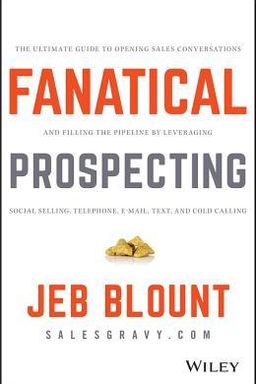
Fanatical Prospecting cover

Fanatical Prospecting

by Jeb Blount

Fanatical Prospecting by Jeb Blount is a no-nonsense guide for sales professionals looking to excel through effective prospecting. Packed with practical tips, it demonstrates how relentless effort and strategic use of all communication channels can fill your sales pipeline and boost your closing rates.

Fanatical Prospecting: The Relentless Art of Filling Your Sales Pipeline

When was the last time you looked at your sales pipeline and felt absolute certainty about the future? In Fanatical Prospecting, Jeb Blount insists that this level of confidence doesn’t come from sheer talent, luck, or clever marketing—it comes from discipline. Blount’s central argument is simple but transformative: fanatical prospecting is the single most important activity in sales. It’s the habit that separates top performers—the 20% who make 80% of the money—from everyone else.

Blount’s book is both a manifesto and a manual for anyone whose success depends on generating new business. He exposes one of the great delusions in modern sales culture: the belief that technology, marketing funnels, and ‘social selling’ can replace the grind of actively creating new opportunities. Instead, he shows that all sustainable success in business rests on a single foundation—consistent, disciplined, and energetic prospecting across multiple channels.

Through powerful anecdotes, laws, and real-world tools, Blount builds a case for adopting a lifestyle of prospecting that never takes a day off. Every chapter reinforces variations of his mantra: nothing happens until you move. Whether you’re a sales veteran, entrepreneur, or freelancer, his insight reminds you that success is not about waiting for inbound leads but about owning your pipeline—and your future.

The Brutal Truth About Sales Success

Blount begins by dismantling common myths. He observes that many salespeople chase fads—‘social selling,’ ‘automation,’ or ‘marketing alignment’—in search of an easy fix. But the so-called Easy Button doesn’t exist. Citing personal experience and decades of sales leadership, he argues that the downfall of most professionals comes not from lack of skill or intelligence but from what he calls the failure to prospect. The number one cause of failed sales careers isn’t poor closing or bad product—it’s an empty pipeline.

He introduces the Paradox of Basics: success in sales isn’t about adopting new tricks—it’s about revisiting basic habits with mastery. Superstar salespeople prospect even when they don’t feel like it, even when they’re tired, even when business is good. They fill their day with disciplined outreach that compounds over time. These pros accept that prospecting is not glamorous or fun—but they understand it’s the toll you pay to reach and maintain high performance.

Why Fanatical Prospecting Matters Today

Blount warns that in our digital, distracted age, it’s easier than ever for salespeople to hide from hard work behind screens. He compares modern sellers to dieters buying miracle pills instead of exercising—they crave quick results without discomfort. To counter this mindset, he teaches that sales isn’t about being owed opportunities; it’s about generating them through relentless initiative. You can control only three things, he notes: your actions, your reactions, and your mindset. Everything else is noise.

The book’s deeper promise is psychological: learning to confront rejection and viewing it not as a personal wound but as part of the process. Through this lens, each ‘no’ brings you closer to your next ‘yes.’ Fanatical prospectors don’t expect ease—they expect resistance, and they push through it anyway. This theme parallels teachings from authors like Angela Duckworth (Grit) and Ryan Holiday (The Obstacle Is the Way): perseverance and mindset matter more than any tool or tactic.

How This Book Is Structured

Blount layers his argument through a logical progression of ideas. First, he makes the case for prospecting as the foundation of success. Then he outlines the seven mindsets of fanatical prospectors, explaining who they are and how they think. Next, he dispels myths around cold calling and introduces a balanced prospecting methodology—a mix of phone, email, social, text, and in-person contact. He then reveals the laws of prospecting—such as the 30-Day Rule and the Law of Replacement—that govern your pipeline’s health. Later chapters focus on time management, crafting powerful messages, handling rejection, and developing the mental toughness needed to persist when others quit.

Throughout the book, Blount’s tone is candid and motivational, often tough-love in style. He calls out excuses, demolishes myths, and blends inspiration with practical guidance. Each story—from agents too afraid to call clients to reps rescued by daily prospecting—underscores his universal truth: activity drives success. You don’t need to love prospecting—you just need to do it relentlessly.

Why It Resonates

More than a sales manual, Fanatical Prospecting is an appeal to personal accountability in any profession where initiative matters. It teaches you that control comes from movement—every call, text, or email builds momentum. Blount’s voice is seasoned, sometimes brash, but always empathetic. He’s been the rep staring at a silent phone and the executive watching a team sink into mediocrity. His core conviction is motivational at its heart: when you choose to prospect, you choose success. The rest of your career follows from that decision.

By the end of this summary, you’ll see how Blount’s simple but demanding philosophy can transform not only your sales numbers but your discipline, mindset, and entire approach to achievement. It’s not magic—just mastery of motion. As he puts it, “The more you prospect, the luckier you get.”


The Seven Mindsets of Fanatical Prospectors

What makes some salespeople unstoppable while others stagnate? Blount’s research across industries distills the difference into seven mental habits he calls the Mindsets of Fanatical Prospectors. These aren’t tactics—they’re attitudes that govern behavior. If you cultivate them, you build resilience, urgency, and optimism into your daily rhythm.

1. Optimistic and Enthusiastic

Top producers attack every day believing something good will happen. This isn’t naïveté—it’s mental armor. When you expect opportunity, you notice it. Blount notes that bitterness or cynicism kills sales faster than lack of skill. The best prospectors start energized, even when they’ve been rejected all morning. They find the next dial refreshing rather than draining. (This echoes Shawn Achor’s The Happiness Advantage, which links optimism to performance.)

2. Competitive

In sales, apathy is death. Fanatical prospectors approach every outreach like an athlete entering a game—they’re hardwired to win. They measure success not just in commission checks but in small daily victories: more calls, faster follow-ups, cleaner CRM entries. Their competition isn’t only external—it’s internal. They’re constantly trying to beat yesterday’s version of themselves.

3. Confident

Confidence is magnetic. When you believe in your value, others do too. Blount explains that confidence stems from preparation and repetition, not personality. Whether on the phone or in person, confident sellers project calm control—no begging, no nervous filler words. They’ve trained themselves to manage fear’s physical effects (like shaky voice or hesitant language). As Harvard’s Amy Cuddy teaches through her “power poses,” body language literally reinforces inner belief.

4. Relentless

Persistence is Blount’s favorite virtue. Fanatical prospectors simply don’t quit. Rejection fuels them rather than deflates them. They understand laws like the “30-Day Rule”: what you prospect today will pay dividends 90 days from now. So even after a big deal, they keep prospecting—because complacency today becomes panic tomorrow.

5. Thirsty for Knowledge

The best prospectors are lifelong learners. They read books, attend training, and seek coaching. They don’t assume mastery—they assume there’s always another edge to sharpen. Blount, like Napoleon Hill or Carol Dweck, connects this to the “growth mindset”—the belief that improvement is infinite when you choose to learn.

6. Systematic and Efficient

Sales superstardom isn’t random. These reps treat their days like athletes treat practice sessions. They guard their “Golden Hours” (the blocks of time when customers are reachable), shut out distractions, and strike a balance among channels—phone, email, social, referrals. Their results compound because they manage process as seriously as performance.

7. Adaptive and Flexible

Change doesn’t scare fanatical prospectors—it excites them. When technology, territories, or buyer behaviors shift, they ‘adopt, adapt, adept.’ Blount’s phrase means they borrow new ideas, personalize them, and master execution. That’s why they tend to be early adopters of innovations like LinkedIn voice messages or CRM automation—but only when those tools support activity, not replace it.

Together, these mindsets create a self-reinforcing loop. Enthusiasm powers persistence; systems protect consistency; learning fuels adaptability. You can’t fake this blend—but you can build it deliberately. Each choice—to learn, to call, to try again—rewires your professional DNA. That’s what turns an average salesperson into a superstar.


The Laws of Prospecting: How Consistency Creates Luck

Blount reveals that prospecting isn’t a guessing game—it’s governed by what he calls the Universal Laws of Prospecting. These laws determine whether your pipeline flows steadily or dries up. Understanding and obeying them is non-negotiable.

The Universal Law of Need

When your pipeline empties, your desperation becomes obvious. Blount calls this the cruelest law in sales: “The more you need something, the less likely you are to get it.” Prospects sense desperation instantly—through tone, body language, and over-eager follow-ups. The solution? Maintain abundance. Keep prospecting even when you don’t need immediate deals, so you can operate from confidence, not panic.

The 30-Day Rule

Every action you take this month affects your results three months later. That’s the 30-Day Rule. Stop prospecting for a month, and 90 days later, your income collapses. The story of “Greg,” a salesperson who slacked off over the holidays, demonstrates this vividly: when March came, he faced an empty pipeline and thought he had a closing problem—when he really had a prospecting problem. (This principle mirrors Darren Hardy’s The Compound Effect—small daily actions create exponential returns.)

The Law of Replacement

To keep the pipeline healthy, every sale must be replaced by fresh opportunities. For instance, if Becky closes one deal out of ten prospects, she must add ten more to replace the ones that fell out. Most sellers forget this, leading to boom-bust cycles. Prospecting isn’t sporadic—it’s continuous maintenance, like feeding a furnace. Ignore it too long, and the fire dies.

Escaping the Sales Slump

When sales dry up, panic sets in—but Blount diagnoses most slumps as self-inflicted. They follow a pattern: stop prospecting → pipeline dies → fear rises → productivity falls → confidence collapses. The way out? Return to basics. Make the calls, every day, no matter your mood. It takes about 30 days of steady prospecting to recover momentum. As Blount quotes Arnold Palmer, “The more I practice, the luckier I get.” The same goes for prospecting: luck favors the busy.

These laws aren’t motivational slogans—they’re economic principles of effort and probability. Activity creates predictability. By respecting these laws, you build a pipeline so strong that downturns, bad leads, or market dips barely faze you. Consistency is your insurance policy against chaos.


Time: The Great Equalizer of Sales

Every salesperson has 24 hours, but not everyone treats them equally. Blount devotes considerable time (pun intended) to showing how time management defines earning potential. You can’t control the market or your manager—but you can control your calendar. The question becomes: do you own your time, or does it own you?

The CEO Mindset

Blount urges you to think like the CEO of “You, Inc.” Just as CEOs allocate resources for maximum return, your scarcest resource is time. fanatical prospectors guard it ruthlessly. They schedule prospecting blocks as sacred appointments and treat them with the same respect as client meetings. If someone tries to steal your time with non-sales tasks, say no. As Blount warns, “You cannot be delusional and successful at the same time.”

Golden Hours vs. Platinum Hours

Golden Hours are when clients are reachable—weekday mornings and afternoons. During these blocks, you should be selling, not drafting proposals or checking email. Administrative work belongs to the “Platinum Hours”—before or after these prime periods. This distinction alone can double productivity. (It echoes Cal Newport’s Deep Work—protecting blocks of uninterrupted focus.)

The Power of Time Blocking

Most salespeople let work expand to fill the day (Parkinson’s Law). The remedy: schedule short, intense “Power Hours.” Blount’s experiments show that reps who make 25 dials in 30 minutes achieved more in a morning than most did in a full day. The secret, he adds, is concentration of power—focus exclusively on one task. No multitasking, no checking messages, no “ding” from your phone stealing attention.

Measure Your Worth

An anecdote about Blount’s millionaire mentor drives this home. When young Jeb bragged about fixing plumbing at home to save $150, his boss asked: “What’s your hourly worth?” When calculated, his time sold for $50 an hour—meaning he’d actually lost $600 doing low-value work. Your hours have value; spend them where they yield maximum ROI—talking to prospects, not tinkering with admin tasks.

Time management isn’t about tools—it’s about choices. The best salespeople sacrifice comfort to protect selling time. They get up early, work late, and track every hour invested. In an age when distractions multiply, Blount’s message is stark and liberating: master your time, and you master your income.


The Balanced Prospecting Methodology

One of the book’s most practical sections dismantles the idea of a single perfect technique. Whether it’s cold calling, social selling, or inbound marketing, Blount warns against putting all your eggs in one basket. A balanced prospecting methodology—diversifying across multiple channels—is the only rational strategy for sustainable results.

The Fallacy of the One-Channel Wonder

Blount likens one-trick prospectors to investors buying a single stock. Relying solely on email, social media, or referrals is “career suicide.” For instance, social media is powerful for familiarity building, but unrealistic for seeding immediate appointments. Likewise, phone-only prospectors miss inbound leads and networking opportunities. You need a mix suited to your product, industry, and tenure.

Building the Mix

The right balance depends on your context. Enterprise reps might lean on referrals and social branding; inside sales may prioritize calls and emails. Startups, with no database, must cold call aggressively to build volume. Veterans can shift toward nurturing. The principle: blend methods to create redundant opportunity streams—so one drying up doesn’t sink you.

The Prospecting Pyramid

Blount’s “Prospecting Pyramid” illustrates efficiency hierarchy. At the top are highly qualified, imminent buyers deserving personal outreach. Mid-pyramid prospects need nurturing and qualification. The base contains unverified or cold contacts. Daily activity should start at the top where probability of success is highest, then descend to data gathering. This structured approach prevents random calling and ensures continuous pipeline replenishment.

Balance isn’t static—it evolves. As you grow your territory and technology changes, your perfect blend shifts. The key is awareness and flexibility: audit your mix regularly and follow the data. Mastering multiple channels makes you antifragile—able to sell effectively no matter how the market changes.


Message Matters: Communicating for Conversion

Prospecting fails most often not because of what you do—but because of what you say. In the chapter Message Matters, Blount stresses that words are your weapon, and every contact—via call, text, email, or in person—must answer the prospect’s fundamental question: What’s in it for me? (the WIIFM principle).

Crafting Powerful Bridges

Blount introduces the idea of the “Because Bridge.” People comply more often when given a reason. Even simple logic (“because I wanted to learn more about your process”) doubles success. Every outreach should connect your reason (“because”) to the prospect’s world. The message must be quick, direct, and relevant—typically delivered in ten seconds or less on phone calls.

Emotion Over Logic

Humans decide emotionally first, justify logically later. Leading with data or features builds resistance. Leading with empathy—“I can understand how frustrating it is when your reps take too long to ramp up”—builds rapport. This mirrors Daniel Pink’s assertion in To Sell Is Human that attunement and empathy outperform slick persuasion.

The Five-Step Telephone Framework

Blount provides a repeatable call structure: 1) Get attention (“Hi, Julie”), 2) Identify yourself, 3) Say why you’re calling, 4) Give a “because” bridge tied to value, 5) Ask for what you want—and shut up. No small talk (“How are you today?”), no rambling. This brevity respects time and signals professionalism. The secret ingredient is silence: once you’ve asked, wait. Confidence lives in the pause.

The Law of Asking

If there’s a golden rule of sales communication, it’s this: ask for what you want. Fear of rejection makes many reps dance around the ask. Blount prescribes boldness: be assumptive (“Let’s schedule Thursday at 3 p.m.”) rather than passive (“Would you maybe have some time?”). Assertiveness doubles success rates. Follow Jeffrey Gitomer’s advice: assume the yes.

In all channels, your goal is clarity plus value. Every word should move the conversation toward a meeting, qualification, or sale. Never forget that enthusiasm and confidence communicate louder than any script. As Zig Ziglar said, “For every sale you lose because you’re too enthusiastic, you’ll lose a hundred because you’re not enthusiastic enough.”


Developing Mental Toughness and Grit

Prospecting is a high-rejection, emotionally demanding sport. That’s why Blount closes his book with what he sees as the ultimate differentiator: mental toughness. Without it, no technique survives adversity. With it, even average skills produce extraordinary results.

The Nature of Grit

Top performers are not gifted—they’re gritty. Drawing from psychologists Angela Duckworth and James Loehr, Blount identifies grit as perseverance plus passion over the long term. Salespeople face more rejection before 9 a.m. than most people do in a year. Only those with emotional resilience—who can recover from a ‘no’ instantly—survive and thrive. Grit means staying in motion long after motivation fades.

The Four Pillars of Mental Toughness

  • Desire: You need a goal that burns hotter than temporary discomfort. Blount quotes Napoleon Hill—“Desire is the starting point of all achievement.” Write down what you want and why it matters.
  • Mental Resilience: Life will knock you down; sharpen yourself through constant learning (“sharpen the saw,” as Stephen Covey says). Invest time in skills, books, and mentors to recover faster.
  • Physical Resilience: Your brain’s energy depends on your body. Exercise, sleep, and diet aren’t luxuries but sales weapons. A fit mind in a fit body handles rejection better.
  • Attitude: Feed your mind positivity. Surround yourself with achievers, not complainers. As Blount warns, misery loves company, and it’s contagious.

When You’re Winning, Attack Yourself

The scariest moment isn’t when you’re losing—it’s when you’re winning. Complacency kills momentum. Blount tells readers to practice “self-attack”: after every victory, critique yourself ruthlessly and reset higher goals. Winners don’t celebrate too long; they prospect the next morning. The 30-Day Rule still applies, even to champions.

Mental toughness turns effort into endurance. It’s the gym for your willpower—the habit of acting despite fear. Whether facing rejection, fatigue, or success itself, grit ensures consistency. That’s why Blount ends with one challenge: When it’s time to go home, make one more call. That single decision—to persist when others stop—is what defines fanatical prospectors—and lasting greatness.

Dig Deeper

Get personalized prompts to apply these lessons to your life and deepen your understanding.

Go Deeper

Get the Full Experience

Download Insight Books for AI-powered reflections, quizzes, and more.