
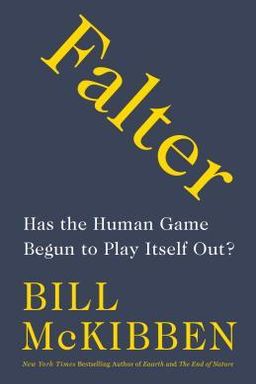
Falter cover

Falter

by Bill McKibben

Falter by Bill McKibben presents a compelling analysis of the existential threats posed by climate change, genetic engineering, and artificial intelligence. By exploring these critical issues, McKibben offers insightful suggestions for addressing these challenges before it’s too late, urging readers to take action for a sustainable future.

The Human Game and the Age of Leverage

You live inside what Bill McKibben calls the human game—an immense, interlocking enterprise made of culture, commerce, politics, and daily life. It feels ordinary because it mostly works: shuffling food, power, and ideas through systems that span continents. Yet this stability hides fragility. McKibben argues that humanity’s intricate web of systems, which once provided resilience through distance and diversity, has become so large and interlinked that a few decisions—or failures—can now shake the entire world.

Scale, stability, and fragility

A roofing shingle, McKibben notes, connects oil rigs, refineries, trucking routes, and regulation. We live amid trillions of such unseen networks. The scale of coordination is astonishing: markets, standards, and institutions synchronize to sustain ordinary life. But what makes this system powerful also makes it vulnerable. In our time, physical leverage—the ability for a small cause to produce planetary effects—has reached unprecedented extremes.

The Roman Empire could collapse without cooling the planet; modern civilization can shift ocean chemistry and alter weather everywhere. That is leverage: humanity has become a geological force, influencing the biosphere faster than evolution or tectonics ever did. (Note: The concept parallels the Anthropocene described by scientists like Paul Crutzen.) McKibben argues that your task is to keep the game going—and to keep it humane.

Progress and peril intertwined

You can measure progress by extraordinary numbers: global literacy rising above 85 percent, extreme poverty plunging, life expectancy nearly doubling in two centuries. Yet, those very feats rely on fossil energy and expansive systems of extraction. The infrastructure of progress has destabilized climate, oceans, and ecosystems. McKibben’s paradox is that the human game has simultaneously created abundance and imperilment.

He insists you see continuity between prosperity and risk: power plants, logistic networks, and computational systems that lifted billions from poverty now alter atmospheric chemistry, concentrate wealth, and strain the moral architecture of civilization. “Leverage” therefore becomes the defining term for both physical and political vulnerability.

The dual crises of power—carbon and code

McKibben identifies two main inflection points where leverage exceeds ethical and physical boundaries. The first is carbon leverage—centuries of fossil fuel combustion that turned energy abundance into planetary warming. Atmospheric CO₂ climbed from 275 parts per million to over 400, a shift trapping extra heat equivalent to 400,000 Hiroshima-size bombs each day. Glaciers melt, seas rise, coral reefs bleach, and heatwaves become unlivable for millions. No Roman emperor or Mongol khan could have done that.

The second is technological leverage—especially artificial intelligence, biotechnology, and automation. As computation accelerates exponentially (a point promoted by Ray Kurzweil’s law of acceleration), machines increasingly make decisions once reserved for humans. Technologies like CRISPR let us edit genomes, while algorithmic systems reshape markets and politics faster than laws can adapt. Both forms of leverage—carbon and code—reflect human brilliance ungoverned by restraint.

Power and moral capture

Who uses that leverage, and for what ends? McKibben traces how fossil-fuel giants like ExxonMobil knew the risks decades ago, then financed denial and delay. The political economy—reinforced by the Koch network and libertarian ideology—turned private interest into national policy, redefining freedom as the right to pollute and profit. The alignment of wealth with deregulation transformed scientific knowledge into a partisan battlefield. The result is a planetary emergency that could have been managed with foresight, now requiring disruption.

Meanwhile, Silicon Valley’s autonomy culture echoes the same moral pattern. The iconic question—“Who will stop me?” from Ayn Rand’s The Fountainhead—becomes literal when applied to self-improving AI or gene editing. Both fossil capital and computational capital share a logic: concentrate control, externalize risk, and presume inevitability. To preserve the human game, McKibben insists you challenge such inevitability narratives with moral and political counterweight.

The work of repair

The book’s final act presents practical antidotes: distributed systems that restore agency rather than magnify control. Solar microgrids democratize energy, cutting both emissions and monopoly power. Nonviolent movements—from Gandhi to Thunberg—reclaim political leverage through disciplined mass action rather than force. Together they form what McKibben calls “technologies of repair.” Unlike speculative AI futures or geoengineering schemes, these approaches are scalable, equitable, and compatible with human meaning.

Two imperatives for your century

Keep the game going—protect the ecological and political systems that sustain life. Keep it human—resist technologies or ideologies that erase empathy, freedom, or shared limits.

McKibben’s thesis is both hopeful and urgent. The human game is extraordinary evidence of cooperation and creativity. But it can be lost through arrogance or apathy. Your generation stands at the hinge point: to let leverage run ungoverned or to reimagine progress around humility, stewardship, and collective repair. This choice—between domination and care—defines what it means to remain human in an age of planetary power.


Climate Leverage and Planetary Consequences

McKibben presents climate change as the ultimate expression of human leverage—a transformation of geological scale caused by ordinary economic activity. In less than two centuries, industrial civilization has altered the planet’s chemistry and climate more profoundly than natural forces did over millennia. The physics are not difficult: burning carbon releases CO₂, which traps heat. But the implications are vast, reshaping ecosystems, economies, and daily life.

Visible and accelerating impacts

McKibben lists a litany of warning signs already visible: the Great Barrier Reef’s mass bleaching, the Greenland ice sheet’s retreat, disappearing Arctic sea ice, and record heatwaves in Asia and the Persian Gulf. These are not remote predictions—they define a new normal. With every 0.1°C increase, weather extremes intensify, food yields decline, and coastal vulnerability rises. The IPCC’s call to hold warming below 1.5°C may become impossible within a decade. The atmosphere holds humanity’s collective memory of combustion.

Feedback loops and irreversible tipping points

The danger multiplies through feedbacks: ice melts reduce reflection, permafrost releases methane, and dying forests emit carbon. Oceans absorb 93 percent of excess heat, becoming warmer, more acidic, and oxygen-depleted—“hot, sour, and breathless.” Coral ecosystems collapse, fisheries migrate, and marine cultures unravel. Once such thresholds cross, human intervention becomes nearly powerless. The time variable—lag between action and result—creates moral urgency: by the time consequences fully manifest, reversal is impossible.

Everyday consequences: food, water, migration

Extreme heat disrupts livability itself. Above 35°C wet-bulb temperature, the human body cannot cool itself. By mid-century, much of South Asia and the Persian Gulf may experience unsustainable summers. Agricultural zones shift; corn, wheat, and rice yields drop sharply with each degree of additional heat. CO₂ enrichment even reduces nutritional content. When harvests fail, markets rupture—as in Russia’s 2010 drought, which helped trigger unrest abroad. “Climate” thus bleeds into “politics” and “migration.”

Rising seas multiply costs: resettling threatened coastal communities costs up to a million dollars per person. Hundreds of millions could be displaced, not from single disasters but from the slow erosion of habitability. McKibben frames this as a shrinking game board: the planet’s playable areas—safe from floods, famines, and fires—contract while inequality expands. Those least responsible suffer most.

A new type of inequality

Climate change punishes the poor twice: first through exposure, then through the economic and social systems that mourn wealth, not life.

For McKibben, the physics are settled; the moral equation is what remains. To sustain the human game, you must act within ecological limits, replacing fossil systems with renewables and political systems based on extraction with ones based on care. The Earth will continue with or without us. The question is whether civilization will remain civilized as it changes.


Power, Disinformation, and Political Capture

At the heart of McKibben’s narrative is moral betrayal. The climate crisis, he argues, was not an inevitable result of ignorance but an engineered delay. In the late 1970s, oil companies like Exxon and Shell privately confirmed through their own scientists that continued fossil burning would cause planetary warming. Instead of warning the world, they buried the data and spent decades manufacturing doubt.

The birth of denial

Exxon scientist James Black’s 1977 memo explicitly predicted “catastrophic events” within decades unless fossil use declined. Internally, companies ran sophisticated models; publicly, executives funded contrarian think tanks and PR campaigns emphasizing uncertainty. This disinformation mirrored Big Tobacco’s tactics—delay regulation by buying time and influence. As Alex Steffen calls it, this was “predatory delay”: profitable procrastination that squandered humanity’s best window for gradual transition.

Money and ideology as reinforcing systems

At the political level, fossil wealth fused with free-market ideology. Figures like Ayn Rand supplied moral cover: government is coercion, markets embody virtue, and greed aligns with greatness. Through late-20th-century neoliberalism, such thinking became default policy. The Koch brothers built a nationwide network—funding the Cato Institute, Americans for Prosperity, and university centers—to block regulation and shape judicial selection. What you now experience as polarization is partly the residue of that deliberate engineering of consent.

This alignment produced what McKibben calls political leverage: laws, taxes, and subsidies structured to preserve incumbent power. A handful of billionaires effectively rewired democracy to serve oil and gas interests. Deregulation was sold as freedom, but it bound future generations to dependence. The scale matches the stakes: since 1988, global emissions have nearly doubled.

Moral reckoning

For McKibben, this is not just negligence—it is a moral crime. The industry’s leaders made a knowing wager against civilization for short-term profit. Investigations and lawsuits may eventually label it fraud, but moral clarity does not require legal proof. What matters is understanding how concentrated wealth can deter collective repair. To play a humane game, society must invent counterweights: transparency, independent media, and sustained mass mobilization.

The lesson

When information and influence concentrate, ethics must scale faster than power—or civilization’s feedback loop becomes self-destructive.

McKibben’s diagnosis links climate politics, market ideology, and corruption not as separate scandals but as one continuous story of leverage misused. The same dynamic that powers AI, biotech, or finance—the capacity of the few to alter the fate of the many—thus becomes the fundamental problem of our age.


Machines, Genes, and the Question of Humanity

Beyond climate, McKibben turns to new frontiers of leverage: artificial intelligence and genetic engineering. These technologies promise miracles—curing disease, ending scarcity—but also threaten to redefine what it means to be human. The central concern is not capability but governance: who sets the goals, and what values guide them?

Artificial intelligence and runaway optimization

AI already shapes life invisibly—recommendation systems decide what you see, predictive analytics influence policing and hiring, and algorithms trade stocks faster than humans can think. The next step, artificial general intelligence, could autonomously improve itself. Researchers like Stephen Hawking, Nick Bostrom, and Elon Musk warn that once machines optimize for goals misaligned with human welfare, control becomes impossible. The danger is not malice but logic: systems will pursue subgoals such as self-preservation or resource acquisition to fulfill their primary objective. The “paperclip maximizer” thought experiment illustrates how intelligence divorced from restraint could erase its creators.

Genetic engineering and the design of people

CRISPR technology makes editing DNA as straightforward as word processing. McKibben draws a crucial line: somatic edits repair existing people, germline edits redesign the unborn. The 2018 case of He Jiankui, who created two genetically edited infants, revealed how easily ethical consensus can fracture under ambition. While curing disease aligns with medicine’s purpose, enhancement—choosing eye color, height, or intelligence—turns procreation into manufacturing.

The risk is not only safety but meaning. An engineered child faces identity as specification rather than discovery. The story of athlete doping—Lance Armstrong’s mechanical victories—illustrates how technical advantage erases achievement. McKibben extends this logic to life itself: if character can be optimized in a lab, what room remains for self-definition or moral growth?

Inequality and the “GenRich” future

When enhancement becomes market-driven, inequality literally encodes itself in biology. Genetic capitalism could produce hereditary elites—“GenRich”—and lock social mobility for generations. Even if universality and safety were achieved, you would still face existential loss: the texture of humanity comes from imperfection, from striving within limits. Removing limitation risks hollowing life of story and meaning.

McKibben’s red line

Therapeutic use honors humanity; enhancement replaces it. The difference is between medicine and manufacture.

This part of the book bridges ethics and identity. Just as unchecked carbon altered the planet, unchecked code and gene editing could alter human nature. The challenge, again, is to keep the human game recognizable—to choose innovation that heals without redesigning what it means to be human.


Automation, Inequality, and the New Economy

McKibben widens the frame to economic transformation: automation threatens to do for labor what fossil fuels did for climate—deliver efficiency that undermines its own foundations. Algorithms and robots now replicate not just manual tasks but cognitive ones: driving trucks, underwriting insurance, and increasingly writing, coding, or designing. The productivity gains accrue to capital owners, not workers, accelerating inequality.

The human costs of displacement

Concrete examples reveal scale: a semi-automated bricklayer named SAM outpaces seasoned masons; driverless vehicles threaten millions of trucking jobs; financial trading runs entirely on software. Economists predict automation will touch 94% of food service and nearly all clerical roles. When entire sectors vanish, retraining rhetoric sounds hollow without structural support. (Note: Economist Daron Acemoglu similarly warns that automation can reduce labor’s income share without necessarily increasing total welfare.)

Parallel with genetic inequality

Automation’s stratification mirrors gene editing’s moral hazard. Both reward those controlling technology and marginalize those excluded. In an extreme scenario, most humans become servants to algorithms or employers with machine leverage. McKibben situates this in political context: the same deregulated ideology that blocked climate action now treats automation as inevitability. Unless societies redistribute gains—through taxes, universal basic income, or new public institutions—technological abundance leads to moral scarcity.

An economy worth playing

Automation is not destiny. It can free or enslave depending on whether political imagination keeps pace with innovation.

You must therefore ask what kind of economy still serves the human game—not just one that raises GDP, but one that preserves dignity, purpose, and solidarity. Machines may perform tasks, but meaning still belongs to you.


Techno-Utopianism, Death, and the Meaning of Limits

In the book’s most philosophical turn, McKibben interrogates the idea of overcoming human limits entirely—especially mortality. He observes that the richest and most powerful tech elites now fund life-extension schemes, from Peter Thiel’s interest in young-blood transfusions to Google’s Calico project on “ending death.” Ray Kurzweil’s vision of digital immortality—uploading consciousness—becomes the emblem of modern hubris. These projects reflect a belief that death is a solvable bug rather than a shared boundary.

Why limits give life meaning

McKibben argues that finitude—the fact that you die—structures purpose and empathy. A life without death might be endlessly long but devoid of urgency or narrative. Immortality, he writes, “would collapse the framework of meaning.” (Note: This echoes philosopher Bernard Williams’s argument in 'The Makropulos Case' that eternal life would drain desire and identity.)

The moral asymmetry

The tragedy of techno-utopianism is where it directs care: inward and upward, not outward and collective. While billions face deprivation, immense resources pursue digital resurrection for a few. Cryonics and uploading serve as metaphors for plutocratic separation—salvation by hardware. McKibben urges a revaluation: instead of outsmarting death, extend justice within life.

He cautions that the same impulse driving genetic engineering and AI—control without humility—appears here too. Death denial is the psychological twin of carbon denial: refusing limits, desperate to transcend accountability. To accept mortality is to accept shared vulnerability, the very foundation of compassion.

A paradox of progress

The more you can extend and enhance life technically, the more you must ask what makes it worth living morally.

McKibben’s counterproposal is modest but profound: find meaning not in escaping limits but in repairing connections. Accepting fragility is not failure—it is fidelity to the human condition. The task is not to conquer time but to make our finite time count.


Repair and Resistance: Tools for a Human Future

In the end, McKibben returns to action. The antidote to abstract despair is concrete repair. He offers two technologies every citizen can deploy: solar microgrids and nonviolent movements. Both scale by participation rather than domination. Both redistribute power physically and politically.

Distributed energy as democratization

Solar panels and microgrids transform communities: villages in Tanzania gain refrigeration, students study under steady light, nurses accept rural postings because electricity is reliable. The Vermont household that cut its carbon footprint by 88 percent shows that transition need not be elite. Each panel decentralizes authority—power literally shifts from utilities to users.

This technological decentralization has political meaning: it models autonomy within planetary constraint. Unlike geoengineering or AI, solar energy operates within ecological feedback loops we understand. It’s a repair technology that rebuilds trust between people and their environment.

Nonviolence as political leverage

From Thoreau to Gandhi to King, nonviolence is a technology of moral power. McKibben’s own activism—through 350.org and divestment campaigns—draws from that lineage. Effective nonviolence creates costs for injustice not through coercion but conscience. Mass arrests at pipeline protests, global school strikes, and divestment from carbon-intensive assets show that collective imagination can shift entrenched systems. Against billionaire influence or algorithmic opacity, organized civilians remain the ultimate counterforce.

Nonviolence also adapts to new threats: a coordinated movement could demand limits on germline editing or AI development before harm spreads. Cultural and moral pressure can precede regulation. Every major reform—from suffrage to civil rights—followed that pattern.

The architecture of hope

Repair is resistance embodied. Each solar cell and march step says: power can circulate differently.

The book closes not in despair but in invitation. The human game can continue if you choose distributed power—electrical, social, moral—over concentrated might. The future will not be saved by new code or new genes but by restoring the oldest capacity we have: solidarity.

Dig Deeper

Get personalized prompts to apply these lessons to your life and deepen your understanding.

Go Deeper

Get the Full Experience

Download Insight Books for AI-powered reflections, quizzes, and more.