
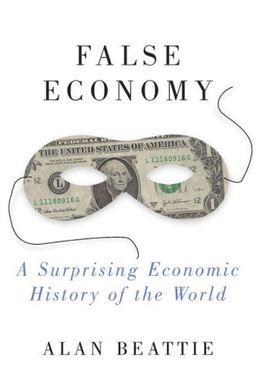
False Economy cover

False Economy

by Alan Beattie

False Economy offers a captivating exploration of global economic histories, revealing how nations'' strategic choices, rather than fate, determine their prosperity or downfall. Alan Beattie unpacks the complex dynamics of cities, resources, and trade policies to show how countries can influence their economic futures.

The Power of Economic Choices and Their Consequences

Why do some nations thrive while others seem trapped in cycles of poverty and instability? More crucially—if entire economies are built on choices, what can your own decisions, beliefs, and priorities teach you about prosperity and decline? In False Economy: A Surprising Economic History of the World, Alan Beattie invites us to rethink the “inevitability” of economic fate. He argues that a country’s success or failure is rarely written in its geography or natural resources—rather, it is shaped by a series of human decisions, often shortsighted, emotional, and path-dependent.

Beattie’s central claim is both sobering and empowering: economies are the sum of their choices. From colonial empires to modern democracies, governments and societies constantly make trade-offs—between openness and protectionism, innovation and tradition, the few and the many. Much like individual lives, these choices become habits, then institutions, and eventually the invisible architecture that holds a country either upright or underwater. The key, he suggests, is understanding how such decisions have been made in the past and why changing course is so painfully difficult once the wrong path has been taken.

Economics as Human Storytelling

Beattie does not write a dry economic report; he tells stories. His approach fuses the rigor of economic history with the empathy of narrative journalism. He dares to connect global trade patterns to simple human motives like pride, fear, and stubbornness. The result is a portrait of economics not as a science of numbers, but as a drama of human behavior unfolding through time. (He himself has worked as both an economist for the Bank of England and a journalist for the Financial Times, blending analysis with observation.)

This combination allows readers to see how quirks in seemingly unrelated areas—like language, culture, or even food—can lock entire societies into certain trajectories. For example, why do Western keyboards still follow the hard-to-use QWERTY layout, designed in the 19th century to slow typists and prevent jams? That same resistance to change mirrors how economic systems often cling to inefficient traditions out of habit or path dependency. These micro-decisions, when scaled up, can define nations’ destinies.

From Asparagus to Pandas: The Power of Economic Oddities

One of Beattie's gifts lies in tracing unexpected chains of cause and effect. Why, for instance, does your asparagus come from Peru? The answer lies in U.S. trade policies that shifted agricultural incentives in Latin America to steer countries away from cocaine production. Similarly, giant pandas are not simply symbols of conservation; they are costly products of political vanity—maintained at great expense because China sees them as ambassadors of soft power. These stories reveal Beattie’s belief that economic logic is intertwined with cultural and political motives. Rational or not, nations act as people do: they double down on previous choices, protect their self-image, and sometimes sacrifice efficiency for identity.

In False Economy, you explore a world where Africa’s failure to become a cocaine supplier, Argentina’s obsession with protectionism, and Saudi Arabia’s oil dependency are not merely consequences of geography or fate but conscious, if flawed, policy arcs. Economic struggle, then, becomes less an accident and more an accumulation of human choices framed by history.

Patterns of Prosperity and Decline

Beattie demonstrates that societies follow recognizably human behavioral patterns: they learn slowly, adapt reluctantly, and often confuse short-term applause for long-term benefit. Economic “luck,” as he puts it, is often just persistence in good decisions and the willingness to abandon bad ones. He likens the global economy to a living organism: a complex, adaptive system where feedback loops, myths, and memories influence performance as much as money supply or exports.

His stories range across continents and centuries, yet they orbit one essential truth: we make our economic realities. Geography sets the stage, but politics and psychology direct the play. Whether through a colonial governor’s decree, a dictator’s whim, or a democratic vote, societies define their futures through the narratives they believe about themselves. Beattie’s book, therefore, becomes an argument for reflection—a reminder that “economic destiny” is not destiny at all.

Why These Ideas Matter Today

At a time when globalization, automation, and inequality redefine what prosperity means, Beattie’s lessons are unnervingly relevant. The missteps of the past—colonial resource extractions, ideological extremities in planning or deregulation, and the entrenchment of elites—still shape the choices we face now. Reading this book is like watching history rhyme; you begin to see how economic choices today will reverberate into tomorrow’s “inevitable” outcomes.

His central invitation is this: recognize choice where others see fate. Whether you’re running a country, a company, or your household, every economic structure around you was once a deliberate act, not an accident. Knowing that empowers you to ask better questions—about where your wealth comes from, how your institutions evolved, and what hidden beliefs sustain your own version of “economic destiny.”

Throughout the summary that follows, you’ll dive into specific domains of Beattie’s argument: from cultural inertia and resource traps to protectionism, innovation, and the psychology of progress. Together, these ideas form a dynamic tapestry—showing how the history of the world’s economies is ultimately a mirror, reflecting humanity’s strengths, mistakes, and surprising capacity to change.


Path Dependence: How Mistakes Become Systems

Beattie’s concept of path dependence explains how countries get stuck in inefficient habits. Even when better alternatives emerge, existing systems—economic or cultural—are hard to change without massive disruption. The QWERTY keyboard, chosen over faster designs simply because early typewriters required it, becomes a powerful metaphor. Similarly, nations continue policies not because they are logical, but because so much infrastructure, training, and identity depend on them.

The Cost of Inertia

Once a decision is made at a national level, switching paths requires dismantling entire networks of expectations. Economic systems resist change for the same reason people often do—they’ve invested too much in a flawed structure. Argentina’s protectionist policies, for instance, created a self-reinforcing cycle: industries that couldn’t compete globally lobbied the government to maintain tariffs. Thus, inefficiency became institutionalized.

Institutions as Memory

Institutions, Beattie argues, act like a nation’s collective memory. They encode the stories a society tells itself about what works, even if those stories no longer fit present realities. Changing them is not merely a technical act—it means rewriting identity. For you as a reader, this lesson hits close to home: in business, habit, or government, the patterns you inherit often need questioning long before they collapse.

“The hardest thing for nations,” Beattie implies, “is not learning what’s right, but unlearning what once worked.”

Understanding path dependence helps explain why some economies adapt quickly to innovation while others stay locked in outdated practices. More importantly, it reminds you that being aware of history’s grip is the first step in breaking free from it—whether you’re managing policy or personal finances.


Geography Is Not Destiny

One of Beattie’s most provocative claims is that geography isn’t the defining factor in a nation’s wealth. Economic history, he insists, is full of countries that turned poor locations into advantage—or squandered abundance through poor decisions. The Middle East’s oil wealth, for instance, produced immense riches but also dependency, while resource-poor nations like Japan built prosperity through innovation and discipline.

The Resource Trap

The so-called “resource curse” manifests when abundance breeds complacency. Easy income from oil, diamonds, or gold often discourages governments from developing diversified industries or inclusive policies. Beattie points out that this short-term convenience leads to corruption, inequality, and vulnerability. The true wealth of nations, then, comes not from natural resources but from the institutions that manage them responsibly.

Turning Weakness into Strength

By contrast, scarcity can spark creativity. For example, Singapore’s lack of natural resources pushed it to prioritize education, logistics, and finance, becoming a hub for innovation and trade. Beattie’s lesson for readers is timeless: constraints can be designed into strengths, but only through disciplined choice and vision.

Ultimately, geography gives you raw materials—but what you make of them depends on leadership, culture, and courage. Every thriving economy, past or present, began with the question “What can we build from what we have?” rather than “What are we missing?”


Culture and the Psychology of Decision

Culture, in Beattie’s telling, acts as the invisible hand behind economic choices. It determines what societies value, which industries they protect, and how they structure incentives. For countries, culture shapes how risk, failure, and long-term thinking are perceived—factors that define success as much as GDP growth.

Stories That Nations Tell Themselves

Every country, like every person, builds a narrative of its past. Beattie shows how national myths—about independence, resilience, or exceptionalism—can empower or limit economic reform. For instance, countries that glorify self-sufficiency often struggle to engage globally. Argentina’s protective self-image, forged during its 20th-century prosperity, delayed necessary structural reforms for decades.

The Emotional Side of Economics

Economic theories may claim rationality, but decisions arise from emotion as much as logic. People resist change not only because of cost but also pride. The lesson, Beattie suggests, applies equally to personal and national behavior: until people are emotionally ready to let go of past certainties, economic reform remains abstract hope.

Understanding these cultural scripts helps you see economics as a deeply psychological drama—where belief often overrides evidence, and progress begins when stories evolve.


Trade, Power, and Global Interconnection

Trade doesn’t simply move goods; it reshapes power. Beattie highlights how global interdependence, from colonial spice routes to modern supply chains, has driven both prosperity and inequality. He uses vivid examples, such as Peru’s asparagus exports reshaping its agricultural economy, to illustrate how trade policies can transform entire regions—sometimes intentionally, sometimes not.

Winners and Losers in the Global Game

Trade can bind nations together or deepen divides. When wealthy nations impose subsidies or tariffs, poorer countries often lose their competitive edge. Yet Beattie also argues that clever governance—like Chile’s disciplined export strategies—can leverage global markets for stability. The line between exploitation and empowerment depends on whether policies align with long-term national goals.

Interdependence Today

In the globalized 21st century, Beattie’s analysis reminds you that every purchase you make—coffee, electronics, clothing—echoes through a network of choices made by nations and corporations. Seeing these links clearly turns passive consumers into informed participants in the economic story.

Trade, for Beattie, is not just about money—it’s about moral and political agency. When countries or individuals understand their role in the network, they can choose to reinforce fairness instead of perpetuating hidden inequities.


Learning from Failure and Reinvention

In Beattie’s worldview, failure is not a sign of destiny; it’s a signal to adapt. Nations that recover from collapse—such as Germany or South Korea—do so because they learn. They confront mistakes openly, reform institutions, and rebuild trust. Others remain trapped in cycles of denial, repeating outdated policies in search of different outcomes.

Breaking the Cycle

True economic renewal requires more than policy tweaks. It demands new narratives about who “we” are as a nation and what we value. Beattie observes that societies often get their second chance only when crisis forces them to face uncomfortable truths. This principle mirrors individual psychology—the moment you admit the old story isn’t working, you open space for something new.

Economics as Evolution

Economies that survive are not always the strongest; they are the most adaptable. This echoes Darwinian insight applied to human institutions. Beattie emphasizes that the ability to innovate, reform, and forgive past errors separates success from stagnation. Looking forward, his work encourages readers to keep questioning, keep adjusting, and, most importantly, keep choosing consciously.

In the end, False Economy isn’t just about nations making decisions—it’s about you, and the recognition that deliberate, reflective choice is the foundation of any enduring prosperity.

Dig Deeper

Get personalized prompts to apply these lessons to your life and deepen your understanding.

Go Deeper

Get the Full Experience

Download Insight Books for AI-powered reflections, quizzes, and more.