
Idea 1
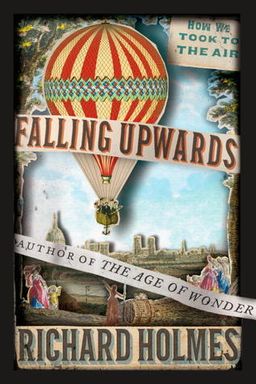
Falling Upwards: The Dream, the Drama, and the Science of Flight
Why are humans drawn to leave the ground? Falling Upwards by Richard Holmes tells the story of that urge—from Montgolfier’s first smoky globes to Glaisher’s near-fatal scientific ascent and Nadar’s spectacular Géant. Holmes argues that the history of ballooning is not just a tale of technical progress but a cultural mirror: a chronicle of how curiosity, danger, and imagination lift civilization itself. Ballooning, he writes, functions as a “romantic instrument of estrangement”—a way of looking back at Earth to see ourselves anew.
The Dream of Ascent
Holmes opens with a childhood vision—his Norfolk fête memory of a red balloon tugging skyward. That mixed feeling of delight and vertigo becomes his lifelong metaphor for Romantic inquiry. From Icarus to the Montgolfiers, humans have sought both transcendence and peril in the air. The balloon expresses this duality perfectly: it rises through invisible laws yet depends on thin membranes of silk or varnished paper. As you rise, the world shrinks into pattern; rivers, fields, and cities appear orderly and fragile. Holmes sees in this new perspective a symbolic equivalence between the aeronaut’s silk skin and the Earth’s seven-mile atmospheric skin—the barrier that keeps life glowing amid cosmic emptiness.
Drama and Discovery
Every ascent, Holmes contends, unfolds like a three-act play: the Launch (public spectacle and expectation), the Flight (solitude, revelation, or scientific experiment), and the Landing (comic, tragic, or redemptive). The structure applies equally to Major Money’s 1785 launch before a Norfolk crowd and to Andrée’s doomed Arctic flight a century later. The middle act lets the aeronaut see the world afresh—Dr. Alexander Charles watching the sun set twice at 10,000 feet, Glaisher recording temperatures past the limit of breath. The final act tests control and humility: some land dazed in hedgerows; others die in dramatic descent. For Holmes, this three-act rhythm reveals why ballooning has remained both theatre and science: airborne stories give stranger meaning to gravity itself.
From Wonder to Knowledge
Balloons began as illusions of fantasy. The Montgolfiers sold “clouds in paper bags” while thinkers like Tiberius Cavallo and Joseph Banks tried to redefine them as tools of learning. Cavallo insisted that balloons should probe the invisible atmosphere—barometric pressure, storms, auroras—rather than carry letters to Mars. His argument prefigures the shift to vertical exploration under Glaisher and Coxwell, whose ascents transformed weather lore into quantified meteorology. Holmes narrates how Glaisher’s thin-breath world—recorded in inches of mercury and degrees of frost—pushed human physiology to the brink, revealing that the breathable sky itself is perilously thin. When you consider modern climate science and satellite sensing, you can trace each instrument, each discipline, back to those wicker baskets hanging in silence over Britain and France.
Culture and Imagination
Holmes’s story is also about the imagination that flight inspired. Poets like Victor Hugo and scientists like Flammarion alike saw the sky as democratic space—a literal “right to fly.” Nadar turned the balloon into a photographic studio, a public spectacle, and a political platform; the Tissandier brothers painted cloud panoramas that fused art with meteorology. In besieged Paris, balloons even became communicative lifelines: Gambetta escaped the city by air, and Dagron’s microfilms attached to pigeons turned siege despair into innovation. Everywhere you look, the balloon bridges opposites—art and measurement, heroism and farce, solitude and publicity. And when engine-powered airships and airplanes finally eclipsed it, the symbol did not die. It reappeared in festivals, literature, and film—as visual shorthand for freedom, curiosity, and fragile optimism.
Core Idea
The history of ballooning is the story of modern humanity looking back at itself from above: a balance of dream and data, hubris and humility. It teaches you that every technological ascent begins as an imaginative one—and that falling upwards defines not only flight but the restless human desire to know and transcend.