
Idea 1
Faith, Creativity, and the Sacred Journey Through Grief
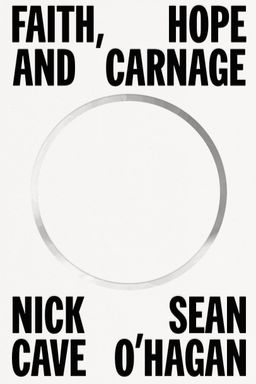
What happens when everything you believe in is suddenly torn apart—when faith, love, and creativity seem powerless against catastrophe? In Faith, Hope and Carnage, musician Nick Cave, in conversation with journalist Seán O’Hagan, explores that question through an extraordinary intertwining of grief, art, and belief. The book isn’t a memoir in the traditional sense. It’s a spiritually charged dialogue—part confession, part meditation—on how creation, loss, and love can coalesce into meaning when the world feels meaningless.
Following the death of his teenage son Arthur in 2015, Cave’s artistic work and worldview shifted profoundly. No longer preoccupied with mythic darkness or rebellion, he began to speak openly about transcendence, vulnerability, and faith—not as certainty, but as a “search for meaning in the ruins.” His conversations with O’Hagan unfold gradually across two years, covering everything from the devastation of grief to the alchemy of songwriting, from the possibility of God to the hard-earned humility of growing older. Together, they build what feels like a modern spiritual testimony.
Faith as Discipline, Not Belief
Cave’s notion of faith is not about dogma but about engagement—a practice of openness rather than a system of certainty. “Faith is spirituality with rigour,” he tells O’Hagan early in the book. He contrasts the modern, amorphous idea of spirituality (the “feel-good mysticism” of contemporary culture) with the deeper demands of religion, which challenge believers to wrestle with their own doubt. He doesn’t claim to possess unwavering belief in God; rather, he sees the possibility of God as a creative act in itself—a choice to move toward mystery. Faith, for Cave, is what you do, not what you prove.
That perspective gives him a language to navigate grief. Rather than asking if God exists, Cave asks if belief itself—belief in love, in creativity, in the sacredness of human life—can heal the fractured self that loss creates. His answer is tentative but radiant: yes, if you treat belief as a craft, something you practise like songwriting or prayer.
Art as a Form of Redemption
The second current in the book is Cave’s understanding of art as a redemptive act. Songwriting, he insists, is not about self-expression—it’s about listening for what seeks to be said. Describing his later albums such as Skeleton Tree, Ghosteen, and Carnage, Cave frames composition as a kind of spiritual collaboration between himself, the music, and an unseen presence. Improvisation becomes an act of “mindful surrender,” akin to meditation. He no longer hunts for “clever stories”; instead, he allows songs to emerge as ecstatic images—what he calls “astonishing ideas” discovered in the dark. The creative process itself becomes a faith practice: vulnerable, risky, but shot through with transcendence.
As grief softened into longing, music became the medium through which Cave could rejoin the world. Touring, he found, turned concerts into communal rituals of connection. The distinction between performer and audience vanished; together, they entered what he calls a state of “radical intimacy”—a shared experience of awe that, he believes, reveals the sacred dimension of art.
Grief as Transformation
Behind every chapter lurks Arthur’s death, and Cave refuses to sentimentalize it. Grief, he tells O’Hagan, is not a wound to be healed but a condition of being—a force that annihilates one life and births another. “We either go under or we become a person,” he says. That idea reframes tragedy as transformation: when meaning collapses, faith and creativity can reconstruct it piece by fragile piece. In Faith, Hope and Carnage, grief becomes the crucible through which compassion and imagination are reforged. Cave’s new art no longer rages against mortality; it listens for the whisper of grace within it.
Why It Matters Now
In a cultural moment often marked by cynicism and division, Faith, Hope and Carnage offers an antidote: sincerity, humility, and a deep belief in the enduring goodness of people. For anyone grappling with loss, doubt, or creative paralysis, Cave’s journey invites you to see art not as escape but as prayer, and faith not as knowledge but as kindness in action. As he puts it, “Hope is optimism with a broken heart.” His conversation with O’Hagan ultimately gestures toward a universal truth—that meaning, love, and beauty are still possible, even—especially—after devastation.