
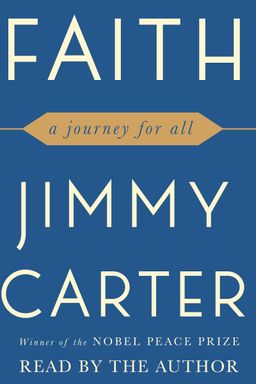
Faith cover

Faith

by Jimmy Carter

In ''Faith: A Journey For All,'' Jimmy Carter delves into the essence of faith, exploring its power to unite diverse beliefs and inspire action. Reflecting on personal experiences and global perspectives, Carter reveals how faith serves as a guiding force in navigating life''s uncertainties and fostering justice.

Faith as the Foundation and Lifeblood of Human Existence

How do you sustain hope and purpose when life’s certainties collapse—when nations falter, families fracture, and your own body fails you? In his deeply reflective Faith: A Journey for All, former U.S. President Jimmy Carter explores this timeless question, arguing that faith—whether in God, other people, or shared ideals—is the central force that releases humanity’s potential for goodness, creativity, resilience, and peace. Carter contends that without faith, both personal life and collective civilization lose coherence; with it, even suffering and mortality become meaningful avenues for growth and service.

Faith, as Carter defines it, extends far beyond religious belief. It’s devotion, confidence, loyalty, and relational trust—an invisible but powerful bond that links us to each other and to values higher than ourselves. Through stories from his ninety-plus years—submarine service during World War II, teaching Bible classes, promoting peace through The Carter Center, and surviving cancer—Carter shows faith as both verb and noun: something you hold, and something you live out.

Faith Beyond Religion

Rather than equating faith with blind religion, Carter opens with an appeal to its many meanings. Faith in mothers, in spouses, in colleagues, and in democracy itself sustains communities. Quoting Hebrews 11:1—“Faith is confidence in what we hope for and assurance about what we do not see”—he argues that faith is not belief despite evidence, but a courageous life that scorns consequences when acted in love. He recalls his earliest faith in his parents, then in democracy, freedom, and justice—each expanding from personal loyalty to a universal ideal. Faith, he insists, grows when shared; it’s a living contract among people and nations.

Faith as Moral Compass in a Changing World

Carter invokes the turbulence of modern politics and moral crisis—polarization, racial division, environmental degradation—and laments humanity’s weakening confidence in timeless principles like equality, truth, and goodwill. Yet, he maintains faith as his antidote to despair. This optimism, rooted in divine love, reminds readers that democracy and justice are sustained not by weapons or wealth but by trust in moral law—the same faith reflected in declarations like the U.S. Constitution and the Universal Declaration of Human Rights. (Carter signed key human rights covenants as president and saw such global agreements as secular expressions of faith.)

Faith as Relationship—Not Certainty

Drawing from theologians Karl Barth, Reinhold and Richard Niebuhr, and Dietrich Bonhoeffer, Carter explores faith as both individual trust in God and collective fidelity to shared principles. Niebuhr’s insight that all knowing involves a triad—two subjects and one transcendent object—suggests faith is always relational: we keep faith with one another through some higher reality. This reflects Carter’s own marriage to Rosalynn, which he calls his most important act of faith—a vow before God that mirrors divine fidelity.

Why Faith Matters Today

In a world saturated with fear, cynicism, and self-interest, Carter’s thesis is a rallying cry: faith is the seedbed of both love and hope. From early religious certainty to periods of skepticism, his journey mirrors every believer’s struggle. He asserts that doubts are not opposite of faith but a vital element of it, echoing Paul Tillich's teaching that doubt strengthens authenticity. Whether confronting cancer or nuclear crises, Carter’s faith remains active—even skeptical—yet unbroken.

Ultimately, Faith is a meditation on the possibility of goodness. Carter invites you to reimagine faith not as belonging to any creed but as a daily practice of trust, humility, compassion, and courage. He closes his reflections with the biblical reminder that beneath faith and hope lies something greater still—love. “And now these three remain,” he quotes from Paul, “faith, hope, and love. But the greatest of these is love.” Faith may keep us alive; love gives life its meaning. In Carter’s story, the two are inseparable.


Acquiring and Deepening Faith

Faith, Carter writes, rarely arrives in a single flash of revelation. It unfolds gradually—through experiences, doubts, relationships, and gratitude. To acquire faith, you must first desire it. That desire, he insists, primes the heart for God’s grace, which no one earns but everyone can receive. He describes this process as “leaping first, and then growing wings,” echoing William Sloane Coffin’s belief that faith involves risk and trust before understanding.

Faith as Gift and Action

From his Georgia childhood to his naval career, Carter felt faith as both inheritance and choice. His father’s Bible teaching instilled early certainty, but adult experience forced him to wrestle with skepticism. He explains that faith matures when tested—when anxiety meets courage and prayer transforms fear into peace. Referencing theologian Paul Tillich, Carter shows that fear responds to specific threats, but anxiety arises from existential vulnerability. By situating yourself within God’s love, you can convert anxiety into actionable fear—a problem you can face rather than a paralysis you endure.

Faith and Reason

Carter bridges faith and scientific inquiry, citing physicists and evolutionists like Stephen Jay Gould and Albert Einstein to argue that no discovery ever contradicts divine creation. He accepts the Big Bang and evolution as part of God's ongoing design. Faith and science, he says, are complementary—science explains the “how,” while faith concerns the “why.” This harmony, echoed in Gould’s Rocks of Ages, undercuts the notion of conflict between religion and knowledge. “No scientific fact that might be learned,” Carter insists, “can contradict God.”

Prayer and Relationship with God

Faith is sustained through conversation with the divine. Prayer, for Carter, is not magic but relationship. His humorous pastor used to say God answers prayers with “Yes,” “No,” or “You’ve got to be kidding!” That intimacy makes prayer transformative—it helps you face yourself honestly. Carter recalls praying during his cancer diagnosis not for healing but for strength to accept whatever came. True prayer doesn’t demand results but nurtures awareness of peace and gratitude.

Confronting Fundamentalism

Carter’s presidency exposed him to religious controversies. When fundamentalists accused him of “secular humanism,” he realized how pride and exclusion distort belief. In his words, the worst sin in both politics and religion is pride—the assumption that you alone hold divine truth. He identifies five traits of religious fundamentalism: authoritarian control, nostalgia for a mythic past, intolerance toward dissent, militancy, and isolation. For Carter, true faith instead embodies humility, equality, and openness—following Jesus’ example of breaking barriers between people.

Acquiring faith, then, means surrendering certainty and embracing growth. Carter’s spiritual life is active, curious, and self-critical. Faith doesn’t confine you within doctrine—it calls you to serve and to love. You can only grow wings, he reminds us, if you are brave enough to leap.


Religious Faith and Universal Truths

Religion, for Carter, is humanity's universal grammar for faith. Whether Christian, Muslim, Jewish, Hindu, or Buddhist, each tradition represents our yearning for transcendence and meaning. Teaching classes at Maranatha Baptist Church, Carter welcomed believers and skeptics alike, even nonreligious visitors who had never entered a church. He long argued that faith communities—when grounded in love, not dogma—can model coexistence.

Faith Expressed Through Action

Pulling from James’ epistle, Carter emphasizes that faith without deeds is dead. To claim faith yet ignore suffering contradicts the gospel. He pairs the parable from Matthew 25—feeding the hungry, visiting the sick, clothing the poor—with real stories from his humanitarian work: eradicating diseases, building homes, promoting peace. His interpretation rejects passivity; faith demands incarnation through compassion.

Faith and Science—No Contradiction

As a nuclear engineer turned theologian-reader, Carter defends harmony between science and religion. He quotes Miguel de Unamuno: “To believe in God is to desire His existence and act as though He existed.” Instead of viewing cosmology as challenge to creation, Carter sees discoveries—quantum particles, galaxies, DNA—as magnifying divine mystery. Science reveals facts; faith reveals meaning.

Faith as Response to Human Limitation

Religion also arises from our mortality. Humans uniquely know we will die, so we create gods to ensure continuity and moral order. This awareness should provoke humility, not fear: Jesus taught “We live by faith, not by sight.” For Carter, the unseen—peace, justice, forgiveness—are as real as gravity. They are eternal while all visible things fade. Faith lets us act with moral courage even amid ignorance or suffering.

Thus, religious faith becomes both universal and intimate. It’s not about proving God but desiring goodness and acting accordingly. You demonstrate faith, Carter reminds, through works—through love made visible.


Demonstrating Faith Through Service and Relationships

Faith manifests itself not in belief alone but in service—a lesson Carter learned through encounters with people of deep conviction. These portraits—missionaries, scientists, carpenters, and ordinary citizens—illustrate faith as work, not word.

Millard and Linda Fuller: Faith in Action

When Millard and Linda Fuller renounced wealth to found Habitat for Humanity, Carter saw the theology of the hammer at work: love turned into literal brick and mortar. “Faith,” he writes, “is no handout—it builds homes where dignity can dwell.” Their idea—volunteers and future homeowners working side by side—proved that service based on equality embodies Jesus’ teachings better than words could.

Jerome and Joann Ethredge: Missionary Faith

The Ethredges’ two decades in Togo are Carter’s favorite example of applied Christianity. They combined evangelism with engineering—drilling wells, building fish ponds, and erecting a 230-foot bridge across the Mono River. In this holistic ministry, faith literally gave life. “They demonstrated their faith behind ox-drawn plows,” Carter writes, showing that love and labor are indistinguishable.

Faith in the Face of Adversity

Other exemplars—Dr. Bill Foege, who eradicated smallpox; Annie Mae Rhodes, who rebuilt after losing everything in a flood; Admiral Hyman Rickover, whose excellence was moral faith in truth; and Carter’s mother, Miss Lillian, who nursed lepers—reveal how faith gives courage. Through them, Carter defines humility, discipline, and perseverance as spiritual virtues that change lives. Each lived the words of James: perseverance in trial produces completeness.

Personal Ties of Faith

Carter includes his brother Billy, whose recovery from alcoholism became testimony of faith in oneself and divine grace. Even President Anwar Sadat and Prime Minister Menachem Begin, whose peace negotiations Carter guided, emerge as men of faith across religions. Their shared reverence for Abraham showed that sacred trust can override political animosity.

For Carter, faith is visible only through relationships—those forged in compassion and mutual reliance. It’s no abstract creed but a hammer in hand, a well drilled, a life rebuilt.


Faith and Doubt: The Journey Toward Understanding

Carter admits his faith was hardly unshakable. As a boy, he prayed nightly: “And God, please help me believe in the resurrection.” These quiet doubts taught him that belief does not exclude questioning—it depends on it. Doubt, as Paul Tillich wrote, is an element of faith, not its opposite. When Carter lost his father or failed politically, skepticism sharpened his search for meaning.

Faith Tested in Defeat

After losing Georgia’s governorship to the segregationist Lester Maddox in 1966, Carter envied the certainty of others. His sister, evangelist Ruth Stapleton, reoriented him: “Consider it pure joy whenever you face trials of many kinds.” She urged him to serve instead of lament. Carter accepted a lay mission assignment to visit homes and speak of salvation. He discovered transformation through service—the moment his faith turned outward and took root.

Faith Amid Mortality

When diagnosed with melanoma in his nineties, Carter again faced uncertainty. Yet he experienced “equanimity and gratitude.” Prayer and medical science worked hand in hand—not miracles, but peace. Recalling submarine duty, he compared his health ordeal to sailing beneath the sea: confined, dependent, yet liberated by trust in others. Faith became awareness of shared humanity.

Faith’s Companions: Love and Grace

Carter clarifies the distinction between mercy and grace: mercy spares deserved punishment; grace grants unearned love. Accepting God’s grace in spite of failure allowed him to forgive himself. He realized that good works arise naturally from faith, but good deeds alone cannot earn divine favor. “It is not what we do for God,” he writes, “but what we let God do for us.”

When faced with doubt, Carter advises: pray, serve, and read broadly. He read theologians from Bonhoeffer to Kierkegaard, philosophers like Kant and Gould, seeking balance between science, ethics, and divine mystery. Faith survived precisely because he kept asking questions. The journey never ends; faith lives in its pursuit.


Faith in Public Life and Global Justice

In “Challenges to Faith,” Carter widens his lens from personal spirituality to moral politics. Having lived through war, depression, segregation, and terrorism, he asks: can nations keep faith when power tempts them to abandon justice? His answer is rooted in Reinhold Niebuhr’s teaching that politics must establish justice in a sinful world. Faith, therefore, must reach beyond church walls to shape policies of peace, equality, and truth.

Faith and Peace Among Nations

Carter recounts his presidency’s haunting responsibility—the control of nuclear arsenals capable of destroying humanity. Faith between superpowers like the U.S. and Soviet Union was literal trust against annihilation. This living tension taught him that political leadership demands moral faith. He argues that military might must never replace the moral authority of justice and peace.

Faith and Civil Rights

Carter’s personal encounters with racism in Plains, Georgia, underscore faith as moral courage. When pressured to join the White Citizens’ Council in defense of segregation, he refused—risking business losses and ostracism. His later gubernatorial declaration, “The time for racial discrimination is over,” stemmed directly from this conviction. Faith compelled him to align politics with Jesus’ commandment of love, not public approval.

Faith and Democracy

Modern America’s decline in trust, he warns, stems from money, polarization, and moral erosion. Governments must act as instruments of moral faith—defending equality and truth. He contrasts the U.S.’s weapon-heavy foreign policy with China’s domestic investment and calls for a renewed national faith focusing on peace, education, and compassion rather than dominance. He laments neglect of the poor, racial division, mass incarceration, and climate inaction, viewing them as betrayals of our spiritual calling.

Faith and Social Responsibility

Like Bonhoeffer and Gandhi, Carter elevates civil disobedience when government violates conscience. True faith may require opposition to unjust laws. His examples—from Martin Luther King Jr. to his daughter Amy’s protests against apartheid—illustrate that political action rooted in love becomes worship. Faith, he concludes, must remain active, public, and courageous: not partisan but prophetic.

In global perspective, Carter calls America to transform from superpower to moral power—a “paragon of generosity and truth.” His lifelong conviction mirrors Barth’s belief that democracy is the most faithful state to serve people. For Carter, faith demands justice—locally and worldwide—and the final hope that love will prevail.

Dig Deeper

Get personalized prompts to apply these lessons to your life and deepen your understanding.

Go Deeper

Get the Full Experience

Download Insight Books for AI-powered reflections, quizzes, and more.