
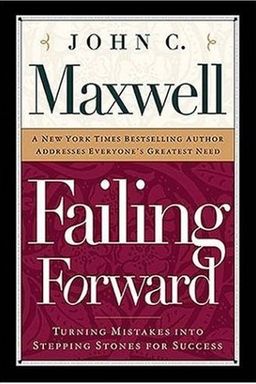
Failing Forward cover

Failing Forward

by John C Maxwell

Failing Forward by John C. Maxwell reframes failure as a crucial component of success. Through inspiring stories and practical advice, it empowers readers to embrace setbacks, learn from mistakes, and transform challenges into opportunities for growth and achievement.

Fail Forward: The Art of Turning Mistakes into Growth

Have you ever felt like failure defines you or that one mistake could derail your chances for success? In Failing Forward: Turning Mistakes into Stepping Stones for Success, leadership expert John C. Maxwell argues that failure is not the opposite of success—it’s a vital part of it. According to Maxwell, the difference between average people and achieving people lies not in talent, opportunity, or intelligence, but in how they perceive and respond to failure.

Maxwell contends that instead of avoiding failure, you must learn to fail forward—to turn setbacks and mistakes into learning experiences that propel you toward improvement and eventual victory. This mindset shift requires redefining what failure means, detaching your self-worth from your outcomes, taking responsibility for your actions, and developing resilience and risk tolerance.

Redefining Failure and Success

From childhood, most of us are taught to avoid mistakes. Schools grade us on correctness, not curiosity. Maxwell argues that this conditioning leads adults to fear failure instead of embracing it as a teacher. He introduces the idea of training for failure—learning to process mistakes constructively. True success, he writes, is not about avoiding failure but about persisting through it. Stories from figures like Mary Kay Ash, who founded her cosmetics empire after career rejection, illustrate that navigating failure with courage and perspective is what separates achievers from quitters.

Why Failing Forward Matters

Failing forward is critical because it redefines the meaning of setbacks. Maxwell shows that your response, not your result, shapes your growth. Drawing on examples from business, sports, and history—like Amelia Earhart’s daring flights and Joseph Lister’s medical innovations—he reveals that risk and failure open the door to progress. People who try and fail repeatedly possess deeper self-awareness and greater resilience. Avoiding risk, on the other hand, leads to stagnation. By viewing failure as feedback, you transform obstacles into stepping stones.

What Readers Will Learn

Across fifteen foundational steps, Maxwell guides you through the process of failing forward. You’ll learn to:

  • Recognize the mindsets that make people afraid to fail and replace them with growth-oriented thinking.
  • Accept responsibility instead of assigning blame.
  • Transform negative experiences into opportunities for wisdom and maturity.
  • Overcome fear by taking calculated risks.
  • Develop persistence, knowing that success often requires falling down many times first.

Why It Matters Now

In today’s volatile world—where careers, relationships, and markets shift faster than ever—the ability to fail forward is a competitive advantage. Maxwell emphasizes mindset as the ultimate differentiator. Whether you’re an entrepreneur navigating setbacks, a leader overcoming team challenges, or an individual striving for personal growth, embracing failure with courage transforms pain into purpose.

Ultimately, Failing Forward is a manifesto for resilience. It teaches that success is not final and failure is not fatal; both are simply part of the process. Like a skilled climber ascending a mountain through many slips and holds, you succeed not by never falling—but by learning to climb higher after every fall.


The Difference Between Average and Achieving People

John Maxwell begins by identifying the single greatest differentiator between those who achieve and those who stagnate: their response to failure. In his view, achievers are not immune to failure—they simply interpret it differently. While average individuals internalize failure as a statement about their self-worth, achievers detach failure from identity and treat it as feedback.

Failure as Process, Not Event

Maxwell asserts that failure isn’t a one-time event but a process of learning, adjusting, and persisting. Through his own experiences—like discovering thirty-one votes of approval as a young pastor instead of the unanimous vote he expected—he learned that setbacks reveal unrealistic expectations, not incapacity. Schools train us to fear failure, he argues, by emphasizing perfection over progress. As a result, adults seek certainty rather than growth.

Changing the Lens

For Maxwell, success depends on viewing failure as a teacher rather than a verdict. Using examples like Mary Kay Ash—who built a multimillion-dollar cosmetic empire after rejection—he illustrates that those who continue learning are those who rise. He contrasts achievers’ internal dialogue (“What can this teach me?”) with the defeated thinker’s (“Why do I always fail?”). That subtle shift unlocks courage and consistency.

The Failing Forward Mindset

Maxwell’s model contrasts two approaches: “failing backward” and “failing forward.” Backward failure blames others, ignores lessons, and quits prematurely. Forward failure accepts responsibility, learns quickly, and perseveres. As he writes, “The key to overcoming problems doesn’t lie in changing your circumstances—it’s in changing yourself.” This principle mirrors Carol Dweck’s concept of the growth mindset: both emphasize learning over perfection.

By embracing failure as a process, you liberate yourself from perfectionism and open doors to creativity. Every major success story—from Thomas Edison’s thousand failed bulbs to Michael Jordan’s missed shots—reveals an unbreakable truth: perseverance, not perfection, is the foundation of greatness.


Learn a New Definition of Failure and Success

In one of the book’s most practical chapters, Maxwell redefines failure not as a life event but as mismanaged learning. He insists that failure is neither avoidable nor objective—it exists primarily in perception. Real failure, he suggests, happens only when you quit trying or refuse to learn.

Seven Myths About Failure

Maxwell dismantles common misconceptions: that failure is avoidable, final, or stigmatizing. Using entrepreneur stories like Sergio Zyman’s New Coke flop (which eventually led to Coca-Cola’s resurgence), he shows how losses can generate innovation. Every success, Maxwell writes, is built on the foundation of past setbacks—reflecting Thomas Edison’s view that failure simply reveals what doesn’t work.

Adjusting Your Scorecard

We often grade success by external results—money, recognition, or applause. Maxwell proposes a healthier scorecard: effort, growth, and resilience. He reminds readers that baseball hero Tony Gwynn struck out more than 5,000 times yet became one of the most accomplished hitters because he never let outs define him. Likewise, Chick-fil-A founder Truett Cathy’s famous failures (fires, surgery, and financial loss) birthed the idea for the chicken sandwich empire when he refused to see catastrophe as final.

Purpose Beyond Performance

When you widen your definition of success beyond results, failure becomes education. Life’s score isn’t determined by one strikeout or one lost job—it's measured by persistence of purpose. By redefining failure and success as partners rather than enemies, Maxwell helps readers detach their identity from performance and rediscover courage to start again.


Taking Responsibility and Owning Your Mistakes

If failure is inevitable, then responsibility is the lever that turns defeat into development. Maxwell argues that most people stay stuck on the 'failure freeway'—the cycle of blowing up, covering up, speeding up, or giving up—because they refuse to own their part in mistakes. Genuine progress begins when you admit, 'I was wrong.'

Escaping the Failure Freeway

Using stories like rogue trader Nicholas Leeson—whose cover-ups bankrupted Barings Bank—Maxwell illustrates how denial magnifies failure. The exit, he teaches, starts with confession and change. Accepting responsibility converts destructive energy into growth energy. This step parallels Peter Drucker’s insight that ‘the better a man is, the more mistakes he will make, for the more new things he will try.’

Responsibility Builds Character

From NFL quarterback Chris Chandler to countless corporate leaders, Maxwell highlights that responsibility is the foundation of sustainable success. Mediocrity, he warns, grows where excuses take root. By facing your role—without shame, without blame—you build integrity, which ultimately builds trust, which builds results. Responsibility is not punishment; it’s power.

When you stop dodging accountability, you transform from victim to decision-maker. In Maxwell’s terms: ‘Every failure is a fork in the road. It’s your choice whether to turn right toward responsibility and growth or left toward stagnation and blame.’


Overcoming Fear Through Action

Fear of failure is perhaps the most common barrier to progress. Maxwell dissected this fear through powerful stories—from Samuel Langley, whose despair after failing to fly crushed his spirit, to George Handel, who rebounded from bankruptcy to compose Messiah. The central lesson: you don’t wait to feel brave; you act yourself into courage.

The Fear Cycle

Maxwell describes a loop familiar to many: negative experiences create fear, fear causes inaction, inaction breeds incompetence, and incompetence deepens fear. The remedy? Movement. ‘You’re more likely to act yourself into feeling than feel yourself into action,’ psychologist Jerome Bruner wrote—a quote Maxwell repeats often. For him, stagnation is never protection; it’s paralysis.

Breaking the Cycle

Acting despite fear creates momentum. Each small victory erodes anxiety and builds confidence. Handel’s triumph came only when he threw himself into composing after personal collapse. Likewise, entrepreneurs who take imperfect action learn faster than those perfecting plans. Fear is not conquered in contemplation but in motion.

Maxwell reframes fear not as an alarm to avoid effort but as confirmation you’re stretching. 'Every morning in Africa,' he writes, quoting a parable, 'a lion and a gazelle wake up knowing they must run to survive.' Whether you’re prey or predator, the only safety is forward motion.


The Power of Risk and Resilience

To fail forward, you must dare greatly. Maxwell’s stories of Amelia Earhart and Joseph Lister show that progress demands both courage and endurance. Risk, he insists, should never be judged by fear or odds of success, but by the value of the goal. Fear tempts you to play small, but stagnation is riskier than any bold leap.

Two Kinds of People

Maxwell contrasts two archetypes: 'Don’t-Dare-Try-It' people, who avoid discomfort, and 'Don’t-Dare-Miss-It' people, who pursue challenge with passion. The first group finds safety but never significance; the second fails more often but grows exponentially. Earhart embodied the latter. Despite crashes and criticism, she kept flying because 'women must try what men have tried.' Her life—and even her disappearance—symbolized daring itself.

The Six Traps of Playing It Safe

Maxwell exposes six psychological traps that keep people from risking boldly: embarrassment, rationalization, unrealistic expectations, fairness, timing, and inspiration. Each one disguises fear as reason. The cure? Take intelligent risks anyway. 'If there is no wind,' he quotes a Latin proverb, 'row.' Success, he insists, belongs to those who act before perfect conditions.

Whether soaring across the Atlantic or testing antiseptics on patients, true pioneers like Earhart and Lister remind us that every breakthrough begins with one person willing to look foolish for a future that doesn’t yet exist.


Learning Through Adversity

Maxwell reframes adversity as a classroom for maturity. Each failure, whether professional or personal, contains a hidden assignment designed to grow character. He argues that resilience isn’t gifted—it’s built through hardship. 'The person interested in success,' he quotes psychologist Joyce Brothers, 'has to learn to view failure as a healthy, inevitable part of the process.'

The Gifts Hidden in Struggle

Adversity teaches flexibility, perseverance, and humility. For instance, Milton Bradley’s first printing venture failed, but from its ashes he created board games and educational tools that shaped American childhood. Difficulty cultivates maturity, as it forces you to row when there is no wind. Each obstacle, Maxwell writes, can yield progress if you stop asking “Why me?” and start asking “What can this teach me?”

Pain as a Teacher

Citing Joseph’s story from the Bible—betrayed by his brothers, imprisoned, then elevated to leadership—Maxwell shows that adversity can become destiny’s doorway. Every “no” in his life prepared him for a larger “yes.” Similarly, business failures often plant the seeds of future innovation. Rather than break you, Maxwell insists, adversity shapes you for the work you were meant to do.

When viewed through a lens of purpose, adversity stops being punishment and starts being preparation. Each trial whispers the same message: growth rarely feels good, but it always produces wisdom.


Persistence: The Thin Line Between Failure and Success

One of Maxwell’s most empowering revelations is how slim the difference is between success and failure. By tracing the life of R.H. Macy—who started and failed at five businesses before creating the iconic department store—he shows that persistence, not luck, is the pivot on which achievement turns.

The Power of Sticking With It

Persistence transforms failure into momentum. Every setback Macy encountered—bankruptcy, relocation, missteps—refined his resilience and sharpened his methods. Maxwell notes that those who keep getting up build 'success muscle.' As historian Napoleon Hill once wrote, 'Effort only fully releases its reward after a person refuses to quit.'

Four-Part Strategy for Staying the Course

Maxwell advises building persistence through four steps: finding purpose (your inner fuel), eliminating excuses, creating incentives for small goals, and cultivating determination even when progress stalls. Real winners, he claims, are defined by habits, not hope. The courage to continue is a skill that compounds.

Through stories like popcorn innovator Orville Redenbacher, who perfected his product over decades before success, Maxwell demonstrates that breakthroughs are rarely instant—they result from ordinary people who keep showing up long after others stop trying.


Make Failure Your Best Friend

Maxwell’s philosophy reaches maturity in his argument that failure can become your greatest ally. Citing Dr. Beck Weathers—who survived the 1996 Mount Everest disaster and lost his hands yet gained new purpose—he illustrates how tragedy can deepen gratitude and clarity. To fail forward is to make failure your mentor, not your master.

A Teachable Mindset

Teachability, Maxwell contends, is what converts mistakes into mastery. He contrasts people who deny error (like editor John Holiday insisting a misspelling must be right) with learners who ask, “What can this teach me about myself?” Strong character comes not from avoidance but reflection. Failures reveal what success conceals: your true values and resilience.

Eight Questions That Turn Loss into Learning

He outlines a practical framework: identify the true cause, assess whether expectations were realistic, extract small wins, draw lessons, express gratitude, turn pain to purpose, seek wise counsel, and plan your next move. Maxwell even applies this process to his own heart attack, viewing it as a teacher that forced him to live healthier and appreciate life more deeply. 'Don’t let learning lead only to knowledge,' he writes. 'Let it lead to action.'

Embracing this philosophy transforms setbacks from sources of shame into catalysts for renewal. Every failure, Maxwell reminds us, whispers the same truth: the most painful lessons often deliver the most profound growth.

Dig Deeper

Get personalized prompts to apply these lessons to your life and deepen your understanding.

Go Deeper

Get the Full Experience

Download Insight Books for AI-powered reflections, quizzes, and more.