
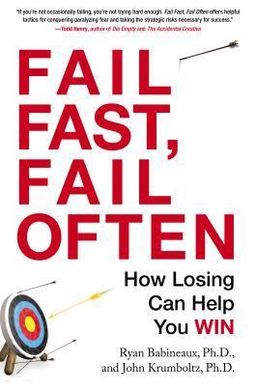
Fail Fast, Fail Often cover

Fail Fast, Fail Often

by Ryan Babineaux, PhD and John Krumboltz, PhD

Fail Fast, Fail Often challenges the fear of failure that holds us back, advocating for a life of risk-taking and exploration. By embracing mistakes, we can achieve happiness and success, discovering new experiences and personal growth along the way.

Fail Fast, Fail Often: Embrace Mistakes to Succeed

What if the key to happiness, creativity, and success lies not in careful planning but in boldly making mistakes? In Fail Fast, Fail Often, Ryan Babineaux and John Krumboltz argue that our obsession with perfection, fear of failure, and addiction to overplanning keep us from living fulfilling lives. Their core message is simple yet transformative: stop waiting for the perfect plan—start acting, failing, learning, and adjusting today.

The authors, both Stanford-trained counselors, distill decades of research and coaching experience into a radical yet practical philosophy of action. They contend that happiness and success stem from continually engaging with the world—not from sitting back and overanalyzing. Their mantra, “fail fast, fail often,” encourages you to trade perfectionism for progress, doubt for discovery, and fear for joyful experimentation.

Rethinking Failure and Success

Failure has long been seen as a personal shortcoming to avoid at all costs. But Babineaux and Krumboltz reframe it as a vital ingredient for achievement and happiness. Drawing on experiments, entrepreneurial success stories, and psychology research, they show that the fastest path to mastery, creativity, and fulfillment runs through repeated small failures. Like the pottery students who made dozens of imperfect pots until they stumbled into mastery, success is a cumulative outcome of trial and error.

Rather than strive to be flawless, you should aim to act frequently, learn quickly, and make course corrections. For the authors, every failure is not a setback—it’s a feedback mechanism. It teaches what works, what doesn’t, and what might be worth exploring next. This ability to act, reflect, and adapt is the “fail fast” mindset that distinguishes amateurs from innovators, and bystanders from creators.

Why Action Beats Planning

Babineaux and Krumboltz discovered through years of counseling that “happy and successful people spend less time planning and more time acting.” The world’s great innovators—from Jerry Seinfeld to Ed Catmull of Pixar—don’t wait for certainty to begin. Instead, they take immediate, imperfect action that leads to momentum, feedback, and discovery. The act of doing unlocks insights that can’t be found through analysis alone.

In contrast, excessive planning often leads to paralysis. People get trapped in hypothetical scenarios, endlessly researching, comparing, and preparing. As the authors observe, “We have Ph.D.s in planning but kindergarten educations in doing.” True innovation, whether in art, career, or personal life, requires a bias toward action—not more thought.

Joy as a Compass

At the foundation of their philosophy is an idea the authors call the “Happiness Tipping Point.” Drawing on psychologist Barbara Fredrickson’s research on positivity, they argue that cultivating at least three positive experiences for every negative one unlocks an upward spiral of creativity and motivation. Joy, they insist, isn’t just a reward—it’s a strategy. The more often you engage in enjoyable activities and explore what excites you, the more opportunities, people, and ideas you attract.

This joy-first approach is not naive optimism; it’s an evidence-based method. Studies by Harvard researcher Teresa Amabile show that people are most productive and creative when they’re enjoying their work—not when they’re chasing external rewards. So instead of delaying fun until after you “figure things out,” you should build happiness into your daily routine now.

Failing Into Opportunity

To fail fast doesn’t mean being reckless. It means intentionally taking small, reversible actions to test your assumptions. The authors borrow from the lean startup philosophy: build the “minimum viable product” for your life—small experiments that help you learn quickly with minimal risk. Whether it’s volunteering in a field you’re curious about or trying a beginner course, these micro-actions spark momentum and often lead to surprises.

The book’s many stories—from Sara, who abandoned crime-scene investigation after seeing it firsthand, to Jack Dorsey’s meandering path from botanist to Twitter founder—illustrate that careers and passions rarely emerge from careful planning. They emerge from curiosity, trial, and adaptation. Every “failure” along the way is a stepping stone toward meaning and mastery.

The Freedom to Act

Ultimately, Fail Fast, Fail Often is a manifesto against hesitation. The authors urge you to act despite fear, boredom, or doubt—to move your mood by moving your body and your mind into action. They blend practical advice (“test your assumptions,” “start before you’re ready”) with deep psychological insight (“resistance is lying to you”). Their message is liberating: You don’t have to get it right—you just have to get going. In doing so, life becomes richer, funnier, and endlessly surprising.


The Happiness Tipping Point

If you could measure your joy like your sleep or diet, what would your emotional nutrition label reveal? Babineaux and Krumboltz argue that happiness isn’t a luxury—it’s a prerequisite for success. Drawing on positive psychology, they introduce the concept of the “Happiness Tipping Point,” the idea that your life transforms once positive emotions outweigh negative ones by a ratio of at least three to one.

Why Joy Fuels Success

Researcher Barbara Fredrickson found that positive emotions broaden your thought patterns, helping you think creatively and spot opportunities. This “Broaden-and-Build” theory shows that joy literally expands your mental horizons, while negative emotions narrow them into problem-focused survival mode. In contrast, when you’re happy, you notice connections, ideas, and chances that you might otherwise miss.

Harvard’s Teresa Amabile similarly discovered that people are most creative when they experience small daily progress at meaningful work. Even minor wins—sending an email, finishing a sketch, submitting a proposal—create psychological momentum. These “small wins” feed your happiness, reinforce motivation, and spiral into lasting growth. In short, joy isn’t frivolous—it’s the fuel of innovation.

Finding Joy in Action

The authors suggest that “fun” is the most practical decision-making tool you’ll ever have. Through the story of Madison, a frustrated legal analyst who rediscovered joy by forming an office acting group, they show that adding enjoyable experiences transforms not just mood but career direction. As Madison rekindled her love of creativity, she realized law wasn’t her calling and pivoted toward student engagement—work that aligned with her authentic energy.

By tracking moments of joy and mapping where you feel most alive—whether at home, in nature, or in conversation—you create what they call a “joy map.” This visual exercise reveals your joy hotspots, guiding you toward activities, environments, and people that energize you.

Cultivating Daily Positivity

Babineaux and Krumboltz insist that you don’t need massive life overhauls to cross the tipping point—just consistent daily doses of positivity. A good day, like a balanced diet, includes nutritious portions of curiosity, gratitude, learning, and laughter. Keeping a “joy journal” can help ensure you get enough daily joy servings, tracking what activities produce real happiness and growth.

“If you want a successful, happy, and meaningful life, you must choose to spend your time doing things that fill you with joy. It’s that simple,” the authors remind. In essence, happiness isn’t the result of success—it’s the cause of it.


Fail Fast to Learn Fast

When was the last time you truly learned something by doing it wrong? Babineaux and Krumboltz invite you to experiment recklessly—not because mistakes are fun, but because they’re essential to growth. Drawing from artists, entrepreneurs, and scientists, they reveal that the path to mastery is paved with flops, false starts, and course corrections.

The Power of Quantity Over Quality

One of the book’s defining parables comes from Art and Fear. A pottery instructor divides students into two groups: one graded on quantity, the other on quality. The “quantity” students, who made dozens of imperfect pots, ended up producing the best work by the end of the term. Practice and iteration beat perfection every time. As the authors note, “Success arises out of hundreds of mistakes and failures.”

Failing Forward

Silicon Valley entrepreneurs call this “failing forward.” Pixar’s Ed Catmull puts it vividly: “Be wrong as fast as we can.” This process of rapid prototyping and feedback allows people to quickly filter out bad ideas and refine promising ones. The faster you fail, the faster you learn. Jerry Seinfeld and Chris Rock apply this principle to comedy—testing hundreds of failed jokes before producing a polished set that kills on stage.

Even billion-dollar companies rely on this mindset. Starbucks’ founder Howard Schultz began with a failed idea—Italian opera cafés—and refined it through constant trial until discovering what customers loved. Every success story, the authors argue, is actually a “highlight reel of failures” edited in hindsight.

Redefining Failure

To fail fast, you must redefine failure itself. Instead of proof of incompetence, failure becomes “product testing,” “prototype feedback,” or “data gathering.” Every misstep moves you closer to clarity. When you stop fearing mistakes, you unlock experimentation, creativity, and resilience. The authors encapsulate this in a challenge: “If you want to succeed, you must first be bad at it.”


Be Curious and Act on It

Curiosity is life’s compass, the authors assert, but many adults talk themselves out of following it. As children, curiosity drives exploration—touching, tasting, questioning. As adults, we replace curiosity with caution and overanalysis. Babineaux and Krumboltz show how reclaiming curiosity can redirect your life toward opportunity and joy.

Curiosity Overcomes Fear

Like Walt Disney and Steve Jobs, relentlessly curious people connect seemingly random experiences into breakthroughs. Jobs once said, “Creativity is just connecting things.” The authors show how following curiosity, even when it seems impractical, sparks discovery. Bill Strickland’s life-changing detour into a high school art room led him from a troubled neighborhood to building Manchester Bidwell, a world-renowned creative education center that transformed thousands of lives.

Curiosity Has an Expiration Date

When something catches your interest, act now. The authors warn that curiosity fades fast if left unfulfilled. Many people, like Marie—the woman with a dusty guitar—never act on their interests because they wait to “feel ready.” Yet readiness only comes through doing. Acting on curiosity builds energy, while hesitation drains it.

Turning Curiosity into Action

The authors suggest keeping a “fun-to-try list”—small, joyful experiments that cost little and spark learning. Try one thing each week, from learning a language to taking Tai Chi to baking bread. Every new experience expands your network, reveals hidden strengths, and cultivates confidence. As the authors say, “You can’t predict even the broadest outline of how life will unfold—but you can guarantee it’s more fascinating if you follow your curiosity.”


Think Big, Act Small

Grand goals are inspiring—but they can also paralyze you. Inspired by psychologist Karl Weick’s concept of “small wins,” Babineaux and Krumboltz show how enormous dreams become achievable when broken into small, visible, rewarding steps. It’s not about lowering your ambition—it’s about keeping momentum alive.

The Trap of Big Wins

When goals are too ambitious, they lead to overwhelm and burnout. The story of Allan, the engineer who tried to transform from sedentary coder to marathoner overnight, illustrates this problem. Within weeks of pushing himself too hard, he quit completely. Big hairy audacious goals (“BHAGs”) can kill motivation when the reward is too far in the future.

Similarly, business research (like Harvard’s “Goals Gone Wild” study) reveals that stretch goals cause tunnel vision, stress, and bad decisions—like the infamous Ford Pinto, rushed to meet unrealistic targets. The authors argue that success isn’t about intensity but iteration—small, enjoyable steps that create momentum.

Small Wins, Big Change

Whether it’s cleaning your home for five minutes or writing one paragraph, small wins compound into big success. Tom Fatjo’s story exemplifies this: what started as a single garbage truck investment grew into Waste Management International, a billion-dollar enterprise—because he learned by doing, one truck at a time.

These micro-actions break inertia, build confidence, and reveal new options. As the authors write, “Once a small win has been accomplished, forces are set in motion that favor another small win.” Acting small gives you leverage to think—and live—big.


Overcome Resistance and Procrastination

Why do we delay what we most want to do? Babineaux and Krumboltz identify our inner saboteur—what novelist Steven Pressfield calls Resistance. It’s the voice in your head whispering that you’re too tired, unready, or unqualified. The authors expose Resistance as a liar and offer practical tools to shut it up through action.

Don’t Wait to Feel Ready

You’ll never wake up fully “in the mood.” Motivation follows action, not the other way around. The authors illustrate this with Laney, who missed her dream job by waiting for the perfect emotional state to apply. By acting, you shift your emotional chemistry—what they call “move your mood.” Want energy? Start exercising. Want confidence? Start speaking. The physical act changes the psychology.

The Malodorous Middle and the Power of Grit

Even exciting projects hit a “stinky” middle—when novelty fades and effort spikes. The authors cite IDEO CEO Tim Brown’s “project mood curve,” reminding you that persistence through the valley leads to creative breakthroughs. Psychologist Angela Duckworth calls this “grit,” the mix of passion and perseverance that defines success. Like muscle, grit strengthens the more you use it.

Act Small and Daily

Using Neil Fiore’s The Now Habit, the authors recommend the “unschedule”: commit to only thirty minutes a day on important work. Most procrastination melts once you start. The key is consistency, not intensity. Turn “someday” into “today” by doing one meaningful thing daily—even if it’s just a paragraph, a call, or a single bold email.


It Takes a Community

Despite our culture’s myth of the lone genius, Babineaux and Krumboltz reveal that real success is never solitary. Every transformation—personal or professional—arises within community. They redefine networking as genuine connection: not collecting contacts but cultivating allies, mentors, and collaborators.

The Power of People

Drawing on Solomon Asch’s conformity experiments and Nicholas Christakis’s research on the contagion of habits, the authors emphasize: your social circle shapes your reality. Surround yourself with curious, enthusiastic, growth-oriented people, and you’ll naturally emulate their energy and courage. Community isn’t optional—it’s a performance multiplier.

Build Diverse Relationships

Innovation thrives at intersections. The book advocates for “idea networking,” connecting with people unlike you—different fields, ages, and backgrounds. Sociologist Ron Burt calls this “structural holes”: the gaps between groups where new ideas flow. Sheila, the architect who found her niche designing medical clinics, only discovered her career breakthrough through conversations outside her usual circle.

Small Steps to Connect

The authors provide easy, human ways to build community: meet one new person weekly, revive old friendships, form “mastermind groups,” and say yes to social invitations. Teaching, volunteering, and interviewing experts also expand your circle organically. For introverts, they suggest lowering expectations—attend for one good conversation, not a perfect night. The reward, they assure, will be joy, serendipity, and support beyond imagination.

“The quickest way to get over the sting of rejection,” they write, “is to not let it stop you.”

Dig Deeper

Get personalized prompts to apply these lessons to your life and deepen your understanding.

Go Deeper

Get the Full Experience

Download Insight Books for AI-powered reflections, quizzes, and more.