
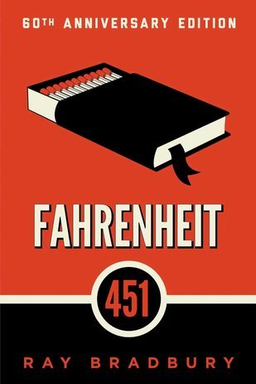
Fahrenheit 451 cover

Fahrenheit 451

by Ray Bradbury

In Ray Bradbury''s ''Fahrenheit 451,'' firemen ignite fires to burn books in a future devoid of intellectualism. One fireman, Guy Montag, encounters a free-spirited neighbor who prompts him to question his role and the oppressive society he serves. This dystopian classic challenges readers to value intellectual freedom and resist conformity.

The Fire of Conformity and the Power of Thought

What would happen if reading—something you do to think, to imagine, to connect—became illegal? Ray Bradbury's Fahrenheit 451 invites you to imagine precisely that world: a society in which firemen do not save homes but destroy them, burning books to preserve public happiness. Bradbury’s haunting reflection isn't simply about literal censorship—it’s about how people willingly surrender their capacity for independent thought and empathy. In this sense, the book’s central fire is not only physical; it is psychological and cultural, a blazing erasure of curiosity.

Written in the shadow of McCarthyism, atomic fears, and the rise of television in the 1950s, Bradbury’s short novel is a parable about how distraction and obedience threaten the individual soul. He argues that the true danger is not an authoritarian regime alone but a populace that stops reading, stops thinking, and stops questioning. He called it speculative fiction—an “If this goes on...” story—that took a troubling element of his own time and magnified it into a totalitarian nightmare. (As Neil Gaiman remarks in his introduction, it’s less about predicting the future than about warning the present.)

Fire as Control and Symbol

The title itself—referring to the temperature at which paper burns—embodies the paradox of human progress. The same fire that can warm and illuminate is here used to control and erase. Guy Montag, the fireman-protagonist, begins the story proudly burning books, repeating slogans like, “It was a pleasure to burn.” Fire represents purity, a way to cleanse conflicting ideas and dangerous questions. Yet as Montag’s awareness grows, fire becomes a symbol of both destruction and potential rebirth—the creative spark of rebellion and of knowledge.

The Loss of Curiosity

Bradbury’s dystopia runs on apathy disguised as contentment. People immerse themselves in wall-sized televisions, “seashell” earbuds, and high-speed thrills. Montag’s wife Mildred is emblematic: her mind is saturated by her “family” in the TV screens, yet she cannot recall where she met her husband. The question Montag later asks—“Are you happy?”—becomes the novel’s quiet detonator. Clarisse, the curious seventeen-year-old who loves walking and asking questions, reawakens his mind simply by noticing the world. Her death—killed by a speeding car—underscores how fatal the loss of slowness and reflection can be.

Reading as an Act of Resistance

In the world of Fahrenheit 451, reading is dangerous because it fosters difference. Captain Beatty, Montag’s complex superior, articulates the logic of censorship perfectly: with so many opinions and groups to offend, it’s easier to simplify everything and make everyone the same. Books disturb this false peace, because they preserve the messy variety of thought. The society Bradbury imagines does not burn books to suppress a few radicals—it burns them to suppress discomfort. Freedom, he suggests, depends on the right to be disturbed, to encounter other minds without moderation or distortion.

Memory and Rebirth

By the story’s end, Montag escapes his city’s destruction to join a band of drifters—the “Book People”—who have memorized entire texts to preserve them. Their survival through memory, not paper, transforms the novel’s title into irony: ideas cannot truly be burned. The novel closes not with despair but renewal. The city is destroyed by war, yet the Book People intend to rebuild civilization. Their leader, Granger, explains that humanity is like the phoenix—forever burning itself, yet capable of remembering its mistakes. In this hope, Bradbury’s warning becomes guidance: the book asks its readers to live so that memory, meaning, and empathy cannot be extinguished.

This overview captures the living tension at the novel’s heart—the danger of a society that trades thinking for comfort and the enduring human impulse to ignite the mind. Across its pages, Fahrenheit 451 portrays fire as both instrument of oppression and symbol of rebirth, reading as rebellion, and memory as survival. Ultimately, Bradbury challenges you to ask: in a world of noise and speed, will you be the fireman or the reader?


The Seduction of Comfort

Bradbury’s world extinguishes thought not through overt terror but through convenience. People no longer need to read because everything is provided effortlessly: entertainment, news, and instruction are streamed directly into their senses. The result is what Neil Gaiman calls an “age of distraction,” where pleasure replaces happiness and reaction replaces reason. You don’t need government censors when people volunteer for their own numbness.

Pleasure without Meaning

Television walls surround Mildred, who laughs, cries, and speaks lines written into her shows—her “family” that replaces real human connection. She represents a culture that confuses noise for communication. Clarisse’s gentle curiosity feels alien because leisure has become a void. In Bradbury’s vision—mirroring Aldous Huxley’s in Brave New World—cultural anesthesia is more effective than brutality. When Montag’s wife overdoses on sleeping pills, two indifferent technicians revive her with machines, not empathy. Her emptiness is the emotional symptom of a society that no longer feels deeply enough to despair.

Speed as Distraction

Cars race recklessly; billboards have been expanded to two hundred feet so drivers can see them as they fly by. Everything moves too fast for reflection. Clarisse’s uncle is jailed merely for walking. Bradbury foresaw the culture of acceleration that philosopher Hartmut Rosa now calls “social speed-up.” When life becomes a blur, there’s no time for memory, questioning, or compassion. The novel suggests that thought requires slowness—time to walk, watch, and listen. By forbidding slowness, this society forbids depth.

The Hollow Pursuit of Happiness

Captain Beatty admits that censorship was not forced from above—it emerged because people wanted life to be painless. As he explains, “Ask yourself, What do we want in this country, above all? People want to be happy.” But happiness without meaning decays into apathy. The freedom to think involves discomfort, contradiction, and even grief. Bradbury’s insight is that imitation joy demands burning anything capable of complexity—books, art, introspection. In the end, comfort becomes the furnace that consumes individuality.

Today’s world of frictionless technology and infinite screens proves Bradbury’s foresight. His fiction cautions you that convenience can be its own tyranny: the more easily information arrives, the less you notice what’s missing. The antidote, he suggests, isn’t rejecting technology but recovering deliberate awareness—taking the time, as Clarisse did, to watch the dew on the grass before it vanishes in the rush of morning.


Censorship’s Hidden Face

The lessons of Fahrenheit 451 go beyond bonfires and banned books. Bradbury’s great twist is that censorship in his world began not from tyranny but from tolerance gone wrong. To avoid offending anyone, society eliminated everything that might provoke disagreement. Beatty’s cynical history lesson to Montag reveals how mass conformity grows from fear of conflict: each minority demanded fewer words, fewer ideas, less discomfort—until nothing remained worth reading.

The Tyranny of Consensus

“You must understand that our civilization is so vast that we can’t have our minorities upset and stirred,” says Beatty. “Ask yourself, what do we want in this country, above all? People want to be happy.” In stripping away offense, the culture also stripped away passion. Bradbury’s insight anticipates today’s debates about “cancel culture” and algorithmic feeds that show only agreeable opinions. Censorship isn’t just the state’s decree—it’s the internalized whisper that says, “Don’t think that, someone might disagree.”

Books as Dangerous Speech

To burn a book, Beatty insists, is to remove a loaded gun. Bradbury reclaims this metaphor, showing that while books can indeed threaten the status quo, their danger is precisely what makes them essential. Montag discovers that each book contains a different voice; together they form a conversation. His theft of a single volume is an act of dependence on complexity. In an era afraid of contradiction, reading itself becomes a revolutionary act.

The Irony of Beatty

Beatty, the philosopher-pyromaniac, reveals Bradbury’s most tragic paradox: those who destroy books may love them most. Beatty quotes literature even as he condemns it—Shakespeare, Pope, and Sir Philip Sidney—demonstrating the intellect he has turned against itself. In one interpretation, his death by Montag’s flamethrower is suicide: he longs to be consumed by the fire he administers. Beatty stands for every mind that has capitulated to cynicism, knowing the truth but choosing silence.

Ultimately, Bradbury suggests that censorship doesn’t require dictators, just disinterest. The only safeguard is personal responsibility: to seek out challenging art, to defend difficult truths, and to read not for comfort but for transformation. The liberty of thought must be chosen again by every generation—or it vanishes in the warmth of its own complacency.


The Awakening of Guy Montag

At the heart of Fahrenheit 451 is a conversion story. Guy Montag's journey mirrors humanity’s slow return from numbness to awareness. He begins as a model citizen—a “happy” enforcer of conformity—but small cracks in that happiness expose the terrifying emptiness beneath. His awakening is painful, chaotic, and necessary.

Encounter with Clarisse

Clarisse McClellan embodies everything Montag’s society has forgotten: spontaneity, curiosity, intimacy with nature. When she asks him, “Are you happy?” Montag cannot answer. She is a pedestrian in a world of ceaseless motion, observing rain, leaves, and conversation as living miracles. Her death catalyzes Montag’s crisis—her absence as loud as any alarm, forcing him to see that beauty and thought have become crimes.

The Woman Who Burned with Her Books

At a routine burning, Montag meets resistance: an old woman who chooses to ignite herself along with her library. Her defiance is the book’s emotional fulcrum. The scene echoes historical martyrdoms—from early Christian burnings to political self-immolation. For Montag, her death clarifies what Beatty’s lectures obscure: if words are worth dying for, then they must contain something vital to life. Her courage turns fire from instrument of control to spark of conscience.

Finding Faber and Losing Fear

Montag’s eventual meeting with the retired English professor Faber provides him guidance. Through their hidden earpiece conversations, Bradbury stages a dialogue between ignorance and intellect—Montag’s raw emotion channeled through Faber’s cautious reason. Yet Faber admits his own guilt for cowardice; he symbolizes the intellectual who stayed silent too long. Together they form a single, conflicted consciousness: the thinker and the doer both reborn through risk.

Montag’s descent into rebellion ends with his literal flight from the city and figurative crossing into meaning. His path mirrors the reader’s: from passive consumption to active questioning. In awakening, Bradbury suggests, comes both suffering and salvation. The greater tragedy would be never to wake at all.


Fire as Destruction and Renewal

Few symbols in literature blaze as brightly as fire in Fahrenheit 451. Its meaning evolves alongside Montag’s journey—from the instrument of suppression to the spark of vitality. Bradbury, ever the poet of contrast, shows how the same element that consumes knowledge can also illuminate truth.

Fire of Control

At the beginning, fire is celebration. The opening line—“It was a pleasure to burn”—captures the hypnotic beauty of destruction. Fire cleanses difference, leaving uniform ash. For the firemen, it promises order through annihilation. Beatty romanticizes it as “perpetual motion,” a force that removes responsibility. The society worships fire because it erases consequences. In burning, people cleanse guilt, just as they cleanse memory.

Fire of Transformation

As Montag’s conscience awakens, he sees fire’s double nature. When he destroys Beatty, the flame is both execution and liberation—the first fire Montag uses not to erase but to choose. Later, with the “Book People,” he encounters another kind of flame: a campfire that warms rather than devours. “He hadn’t known fire could look this way,” Bradbury writes. The redemptive fire promises not purity but continuity, symbolizing regeneration after the city’s nuclear demise. Humanity’s capacity to remember—to rise from ash like a phoenix—survives within memory’s ember.

The Phoenix Motif

Granger’s final reflection completes the metaphor: humans, like the mythical bird, repeatedly destroy themselves but have one advantage—the ability to remember. For Bradbury, knowledge is the ash from which we rebuild. Fire therefore demands reverence, not rejection. It reminds you that progress can burn as easily as it warms, and that memory—like flame—must be tended lest it consume or fade.


The Persistence of Memory and Story

When books are outlawed, what remains of culture? Bradbury’s answer lies in memory. In the novel’s final act, the Book People memorizing entire works embody civilization itself surviving through individuals. Their mission transforms literature from object to organism, living through human minds.

The Book People’s Philosophy

Granger, their leader, explains that they don’t preserve books from nostalgia but duty—each person becomes a vessel of collective memory. This oral resurrection recalls ancient traditions: before writing, human history and myth thrived through recitation. Faber’s earlier question—“What does quality mean?”—finds its answer in them: true books have pores, they breathe, and so must humans if wisdom is to survive. In their wandering community, Bradbury reimagines the library as a living network of souls.

Destruction and Rebirth

When war finally erases the city, it fulfills the novel’s prophecy of self-destruction. Yet amid ruin, the Book People begin again. Granger’s speech about the phoenix underscores that memory is the only hope against repetition. Civilization, he implies, never avoids catastrophe—it endures it through remembrance. Here Bradbury fuses myth with moral psychology: forgetting is humanity’s original sin, remembering its redemption.

For you, the reader, their ritual challenges passive consumption. Memory becomes moral action: to read deeply, recall vividly, and live so that knowledge inhabits not shelves but consciousness. In a world of infinite storage but little wisdom, Bradbury’s closing image—a man walking north reciting Ecclesiastes—feels like both elegy and invitation.


Bradbury’s Warning for Our Age

Decades after its publication, Fahrenheit 451 reads less like prophecy and more like diagnosis. Bradbury foresaw earbuds, interactive screens, and even the numbing instantaneity of modern news. His true target wasn’t technology itself but how humans use it to flee introspection. In a 1953 essay, he joked that when he imagined seashell radios, he didn’t expect to see them on Beverly Hills streets within years. “I must write faster just to stand still,” he quipped.

Technology as Mirror

Bradbury refused to be labeled anti-science. What he feared was the spiritual laziness technology can amplify. The gadgets of his world are mirrors of their users’ shallowness. As in Neil Postman’s Amusing Ourselves to Death, entertainment becomes anesthesia. When Mildred joins her parlour “family,” she isn’t brainwashed—she’s pacified. The most chilling aspect is that no one forces her; she chooses the screen over thought.

The Eternal Relevance of Reading

To Bradbury, to read is to resist entropy. Books demand participation; they slow you down. They insist on dialogue rather than broadcast. In his later essays, he described writing the novel on a coin-operated typewriter in UCLA’s basement library—a literal fight for paid minutes of imagination. The irony underscores his faith: libraries are the cathedrals of free inquiry. When he received the National Book Foundation Medal, he said, “I spent three days a week in the library for ten years—and it’s better than college.”

Memory as Humanizing Force

In an era flooded with information but starved of synthesis, Bradbury’s insistence on remembering—holding entire books in mind—resonates as a call to depth. As Harold Bloom later wrote, the novel reminds us that “if you cannot remember, you cannot think.” Bradbury invites you not only to read but to carry what you love, to safeguard the stories that make us human. His fire still burns, asking each generation: what will you preserve when the lights go out?

Dig Deeper

Get personalized prompts to apply these lessons to your life and deepen your understanding.

Go Deeper

Get the Full Experience

Download Insight Books for AI-powered reflections, quizzes, and more.