
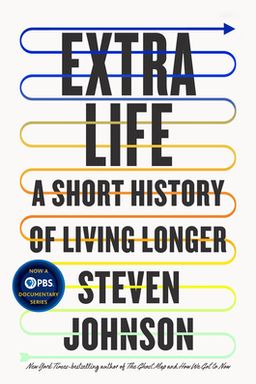
Extra Life cover

Extra Life

by Steven Johnson

Extra Life by Steven Johnson delves into the remarkable breakthroughs that have doubled global human life expectancy over the past century. From lifesaving medical advancements to safer technology and improved agriculture, this captivating narrative reveals the stories behind the innovations that transformed our world and extended our lives.

The Extraordinary Story of Extra Life

What if you could wake up tomorrow realizing that modern life has quietly granted you twenty thousand extra days? In Extra Life: A Short History of Living Longer, Steven Johnson asks that thought-provoking question to reveal the astonishing reality that human beings have doubled their life expectancy in just one century. Johnson contends that this transformation—the most significant development in human history—was not the result of one miracle drug or single genius, but a long, collaborative story of ideas, data, and determination.

Johnson opens with the haunting scene of the 1918 Spanish flu, where average life expectancy collapsed from fifty-five to forty-one years. Standing among piles of bodies in military camps and cities, early physicians believed civilization itself might vanish. Yet from that darkness emerged a century of unexpected progress. By tracing life expectancy from the grim days of World War I to today’s eighty-year norm, Johnson argues that modern humanity’s greatest achievement is invisible: our lengthened, healthier lives protected by a technological and social shield of public health innovations.

From Catastrophe to Collaboration

The book's central theme is how crises spark collaboration. Pandemics and wars, Johnson explains, are accelerators of innovation. The Spanish flu, like COVID-19 a century later, exposed the fragility of global health systems. Over time, those catastrophes bred resilience—the creation of vaccines, antibiotic treatments, public sanitation, and statistical systems that empowered scientists to see patterns of disease with unprecedented clarity. Johnson’s research illustrates that longevity emerged from large networks of unlikely heroes rather than famous inventors: from sanitation engineers to epidemiologists, from amateur reformers to visionary bureaucrats. Progress did not march forward due to destiny; it had to be fought for.

The Invisible Shield

Johnson invites readers to appreciate the protective barrier surrounding modern life—the “invisible shield” of public health. Chlorinated water, safe milk, rigorous drug testing, and traffic safety regulations guard us daily, though their quiet success rarely makes headlines. Unlike wars or elections, these victories happen incrementally and out of sight. Each innovation—from the toilet to the vaccine—added layers to that shield. The consequence: billions of people live long enough to see adulthood, parenthood, and old age, privileges unimaginable to their ancestors. Johnson calls attention to how our very forgetfulness about those earlier dangers leads to complacency and even mistrust of science, as seen in vaccine conspiracy theories and anti-mask protests during COVID-19.

The Power of Seeing and Measuring

At the heart of extra life lies a revolution in measurement. Johnson traces how seventeenth-century innovators like John Graunt transformed weekly death tallies from London into statistical insights—the first mortality tables. With each century, better data allowed society to understand disease, develop public health laws, and evaluate interventions. From William Farr’s “vital statistics” in Victorian England to Bradford Hill’s randomized trials in the twentieth century, the act of counting itself became a life-saving technology. Data turned invisible dangers into visible patterns, enabling practical prevention and precision medicine (a vision echoed by Hans Rosling in Factfulness).

Progress With Consequences

Johnson’s optimism is tempered with warning. Increased longevity unleashed an exponential global population boom, creating climate pressures and new vulnerabilities to pandemics. The same breakthroughs that freed humanity from smallpox gave rise to complex challenges—opioid crises, inequality, and ecological strain. The doubling of life expectancy was both triumph and cautionary tale, proving that technological solutions also reshape civilization’s equilibrium.

A Blueprint for Understanding Change

Ultimately, Johnson presents Extra Life as a blueprint for understanding meaningful social change. Progress arises through a mosaic of scientific insight, social advocacy, and institutional trust. He organizes his exploration into eight categories that define how humanity escaped the long ceiling of early death: measurement, vaccines, data and epidemiology, pasteurization and chlorination, drug testing, antibiotics, safety technology, and antifamine interventions. Each chapter is a story of people who saw what others ignored and fought to implement lifesaving ideas. In learning how we gained these twenty thousand days, Johnson invites you to see progress not as a series of miracles, but as a collective discipline—one that must be maintained, defended, and extended into the future.


Breaking the Long Ceiling

Steven Johnson begins his story with a puzzle: for ten thousand years, human life expectancy barely changed. Our ancestors mastered agriculture, built cities, and invented writing—but still, the average person lived only thirty to thirty-five years. So what finally shattered that long ceiling? Johnson transports you to seventeenth-century London, where a haberdasher named John Graunt used city death records to uncover the first true measure of life expectancy. By doing so, he discovered that data, not medicine, was the key to unlocking longer life.

Measuring Mortality to Reveal Progress

Graunt’s life tables converted random counts of deaths into recognizable patterns: the young were dying disproportionately, diseases clustered by location, and survival into adulthood was rare. These tables sparked curiosity—what caused such variation in survival? Over time, those numbers changed how societies saw themselves. Measuring deaths was no longer morbid bureaucracy; it was revelation. Out of these early numbers emerged the concept of life expectancy, a prediction that could be improved through action. Johnson vividly contrasts Graunt’s breakthroughs with Nancy Howell’s twentieth-century study of the !Kung people, a hunter-gatherer tribe in Botswana whose life expectancy of thirty-five mirrored Graunt’s London. The parallel proved how long humanity had been trapped beneath its ceiling.

From Data to Diagnosis

The power of measuring deaths led to identifying causes. In the nineteenth century, William Farr expanded Graunt’s vision by collecting birth and death data across industrial England. Farr’s charts exposed stark inequalities between cities and countrysides: Liverpool’s industrial workers lived twenty-five years on average—half as long as farmers in Surrey. This visualization of suffering became a catalyst for reform, motivating sanitary movements and the construction of London’s sewers. Johnson notes how Farr’s “data empathy” transformed abstraction into activism. Once mortality became numerical, it could be fought like any enemy.

The Discovery That Medicine Wasn’t Enough

Counterintuitively, early progress in life expectancy had little to do with doctors. As historian Thomas McKeown later proved, nineteenth-century medicine was largely ineffective—even harmful. Johnson recounts cases of ruthlessly misguided treatments, from bloodletting and mercury poisons to King George III’s arsenic-infused cures. People recovered more by chance than by physician skill. Instead, social improvements—clean water, nutrition, and sanitation—proved decisive. The heroes were not surgeons but engineers, data clerks, and reformers.

From Mortality to Momentum

By the mid-eighteenth century, British elites began living longer thanks to inoculations against smallpox and gradual increases in food supply. Life expectancy climbed past fifty for the first time in history. Johnson calls this the “great escape”: humanity’s breakthrough from the ancient equilibrium of short lives. Crucially, it wasn’t purely scientific brilliance—it was collective learning, measured by data and driven by reform. The lesson for you: true progress begins when societies learn to see their own failures clearly and act on the data. Counting lives, Johnson shows, is the first step toward saving them.


The Birth of Vaccines

Imagine facing a disease that kills children by the thousands every year—with no cure in sight. That was smallpox in the eighteenth century, a virus so feared it rewrote global history. In Extra Life, Johnson recounts how a handful of risk-takers transformed lethal contagion into immunity through variolation and later vaccination—a story that begins not with scientists but with an aristocratic woman and her curiosity.

Mary Montagu and the Power of Connection

Lady Mary Wortley Montagu, scarred from childhood smallpox, discovered an Ottoman practice where “old women” deliberately infected children with mild smallpox scabs to build immunity. Defying convention, she tested it on her own son and daughter, successfully immunizing them. As Johnson vividly shows, Montagu’s network of influence spread this “Oriental invention” to British elites, royal children, and eventually the throne itself. This act of cultural translation made variolation fashionable—and lifesaving. Montagu’s story highlights one of Johnson’s recurring insights: breakthroughs depend on communicators as much as discoverers. (Compare Yuval Noah Harari’s claim in Sapiens that knowledge spreads through storytelling.)

Edward Jenner’s Refinement

Decades later, rural doctor Edward Jenner realized milkmaids who caught cowpox rarely fell victim to smallpox. In 1796, he injected pus from a milkmaid’s blister into a boy’s arm, proving that exposure to cowpox prevented smallpox. This single act birthed modern vaccination. Yet Jenner’s success stood on Montagu’s shoulders—on global knowledge exchanged across continents long before his experiment. Johnson calls this difference between a “genius narrative” and a “network narrative,” arguing that collective collaboration, not solitary genius, defines human progress.

From Experiment to Institution

Smallpox vaccination demonstrated how science and government intertwine. Thomas Jefferson personally tested Jenner’s vaccine on his family, later supporting America’s first Vaccine Act in 1813. Britain’s Parliament followed with mandatory vaccination laws by 1853. Johnson notes how these measures birthed state involvement in public health, reshaping liberty itself—spurring both reformers like Charles Dickens, who promoted vaccination in his magazine Household Words, and early anti-vax activists, who feared government overreach. Vaccines, Johnson argues, made society confront an eternal tension between individual freedom and collective safety.

Erasing Smallpox from Existence

Johnson closes this chapter with humanity’s greatest triumph: smallpox eradication in 1979. Through D.A. Henderson’s ring-vaccination campaigns and global cooperation—even between U.S. and Soviet scientists—the World Health Organization achieved what Jefferson once dreamed: removing smallpox from the “catalogue of evils.” The story underscores Johnson’s thesis that longevity requires networks—of scientists, reformers, data collectors, and institutions. Progress, as you’ll see throughout the book, is not the lightning of genius but the long relay of human connection.


Seeing Life Through Data

Johnson calls data “the sense organ of modern health.” To understand disease, humans first had to see it—and they learned to do so with numbers. This key idea recounts how epidemiology evolved from simple death lists to a powerful lens that revealed societal inequalities and transformed urban life.

William Farr and the Geometry of Mortality

In industrial England, Farr organized the nation’s chaotic mortality reports into systematic charts of birth, disease, and death. His life tables compared cities like London, Surrey, and Liverpool, exposing that industrialization was devastating workers’ lives. Farr’s graphs looked like cliffs: in Liverpool, half of all children died before age fifteen. By transforming tragedy into geometry, Farr turned abstract suffering into reform. His numbers inspired Edwin Chadwick’s sanitary movements and the idea that cities could cure themselves through engineering, not prayer. (A comparison: Florence Nightingale later used similar visualization to demand hospital reform.)

John Snow’s Map and the Birth of Epidemiology

Johnson retells the legendary moment when Dr. John Snow mapped cholera cases around London’s Broad Street pump in 1854, connecting each death to contaminated water. Though Snow couldn’t see the microscopic cholera bacterium, his spatial data provided proof that disease spread geographically, not via “miasma.” His collaboration with local priest Henry Whitehead created an early model of community-based science—information, empathy, and local insight united against contagion. Johnson emphasizes how this map made disease visible, turning epidemiology into a practical defense system. The removal of the pump handle was not just symbolism; it marked the moment when data began saving lives.

From Data to Trust

Epidemiology transformed public faith in science. From Snow’s discovery came Joseph Bazalgette’s London sewers, Simon Szreter’s argument for “social intervention,” and the public realization that progress wasn’t divine but deliberate. Johnson uses Farr’s legacy to compare modern institutions like the Centers for Disease Control, arguing that our ability to chart disease and enforce collective action—the “flattening of the curve” during COVID-19—descends directly from those Victorian mortality tables. His message is clear: before you can cure a disease, you must learn how to see it, count it, and trust the pattern it reveals.


When Milk Became Safe

If you drink milk today without fear, you owe that privilege to crusaders who fought the industrial “slaughter of the innocents.” Johnson’s story of pasteurization and chlorination shows how chemistry and activism combined to defeat two invisible killers—tainted milk and water—that once decimated cities.

Frank Leslie and the Swill Milk Scandal

In 1858 New York, journalist Frank Leslie exposed urban dairies feeding cows distillery waste called “swill,” producing blue, bacteria-laden milk sold cheaply to the poor. Children died in droves. Leslie’s vivid exposé, complete with drawings by Thomas Nast, shocked the public and forced city councils to act. His crusade proved Johnson’s point: science alone cannot save lives without public persuasion. Activism translates data into change.

Pasteur and Straus: Chemistry Meets Philanthropy

Louis Pasteur’s discovery that heating milk killed bacteria took decades to reach America. Regulation stalled until Macy’s co-owner Nathan Straus turned pasteurization into a moral mission. After personal losses, Straus opened milk depots selling sterilized milk below cost and demonstrated its success with dying orphans. His experiments led to legislative reform championed by Theodore Roosevelt, who called unsafe milk “a national crime.” Johnson highlights this alliance of science, philanthropy, and publicity as the template for modern reform campaigns—a fusion of innovation and empathy.

Turning Contaminated Water Clear

Around the same time, John Leal secretly added chlorine to Jersey City’s water supply—a controversial move that nearly cost him jail. But it worked: cities that adopted chlorination saw infant mortality drop by more than sixty percent. Johnson shares Harvard researchers’ finding that two-thirds of global improvements in mortality between 1900 and 1930 came from clean water. A glass of safe milk or tap water may seem mundane, but Johnson calls these “quiet miracles of chemistry” that saved millions more than flashy inventions ever could. When you pour milk or water today, you’re holding history’s most ordinary miracle.


From Snake Oil to Science

Johnson’s fifth breakthrough examines how medicine evolved from guesswork and tragedy to genuine care. The transformation began not in the lab, but through moral outrage over deadly elixirs and phantom cures—a struggle that forged the modern FDA and the randomized trial method.

The Tragedy of Elixir Sulfanilamide

In 1937, pharmacist Samuel Massengill’s raspberry-flavored “Elixir Sulfanilamide” poisoned 105 Americans, including children. The drug dissolved antibiotics in toxic diethylene glycol—antifreeze—with no safety tests required by law. Outcry forced Franklin Roosevelt’s government to create the Food, Drug, and Cosmetic Act of 1938, empowering regulators to test drugs for safety. Johnson presents this event as a moral hinge in history: civilization transitioned from “testing for flavor” to testing for life.

Frances Kelsey and the Thalidomide Scandal

Two decades later, a young FDA reviewer, Frances Kelsey, refused to approve thalidomide—a “miracle sedative”—after noticing flawed data. Her caution spared thousands of American infants from birth defects that ravaged Europe. Kelsey’s stand earned Kennedy’s Distinguished Federal Civilian Service medal and symbolized patient protection through bureaucracy. Johnson reframes bureaucrats as heroes of hidden integrity—the guardians of progress rather than obstacles to it.

The Randomized Controlled Trial: Science Learns to Prove It

Johnson then introduces Austin Bradford Hill’s 1948 streptomycin trial—the first randomized, double-blind experiment—demonstrating tuberculosis treatment efficacy. The method transformed medicine from anecdote to evidence, empowering public health regulation and global research. When Hill and colleague Richard Doll later proved smoking caused cancer, their logic became medical orthodoxy. Johnson distills their legacy into a principle: until knowledge is tested statistically, it’s belief, not science. Every pill you take now carries the weight of their method—and the memory of those harmed before certainty existed.


Antibiotics and the Network of Discovery

If progress had a formula, Johnson suggests it would be this: accident plus collaboration. The story of antibiotics, beginning with Alexander Fleming’s moldy petri dish, captures how chance meets connected minds to transform civilization.

From Curiosity to Coordination

Fleming’s casual observation that mold killed bacteria remained dormant for a decade until Howard Florey and Ernst Boris Chain rediscovered it at Oxford. With the ingenuity of Norman Heatley—the lab engineer who built Rube Goldberg–style devices from cookie tins and bedpans—they produced enough penicillin to test on a dying policeman, Albert Alexander. He improved miraculously before supplies ran out. This moment proved antibiotics could conquer infection, but scaling it required the industrial power of America’s wartime network.

The U.S. Military and Moldy Mary

Florey carried penicillin samples to Peoria, Illinois, where scientists mixed mold with “corn steep liquor” to feed bacterial cultures en masse. The U.S. Department of Agriculture, the military, and pharmaceutical firms joined forces to hunt microbes worldwide—even collecting soil from mine shafts. Enter Mary Hunt, the bacteriologist who found a golden strain on a rotten cantaloupe. Her discovery allowed mass production, making penicillin available to soldiers by D-Day. Johnson marvels at how wartime urgency united academics, industry, and government in a cooperative mission—a model for future global health efforts.

Beyond Chance: The Pattern of Progress

Penicillin’s journey reflects Johnson’s central claim: great ideas evolve through networks, not solitary epiphanies. From farmers and engineers to military logisticians, each contributed to humanity’s leap beyond fatal infection. Strategic secrecy kept the Nazis from replicating penicillin—Hitler’s own doctor used stolen American sample vials. The drug’s triumph marked medicine’s redemption from centuries of heroic guessing. After antibiotics, hospitals became places to heal, not die. For you, this chapter reframes curiosity itself as civic duty: play, share, and connect ideas. The mold changed the world because someone noticed, someone measured, and others cared enough to amplify it.


Safety: Saving Lives by Design

Johnson’s exploration of automobile and industrial safety shows progress through engineering and advocacy. When machines began killing people en masse, inventors and reformers turned physics into protection—making survival a design problem.

From Fatal Accidents to Injury Science

The first recorded car fatality came in 1869, when scientist Mary Ward fell from a steam vehicle. By the twentieth century, cars outnumbered deaths in war. Injuries once deemed inevitable turned out to be solvable. Hugh DeHaven survived an airplane collision and realized survival depended on “packaging.” His egg-drop experiments showed that cushioning mattered more than velocity. Later, Colonel John Stapp strapped himself to rocket sleds traveling 628 mph to study deceleration forces. Their insights birthed “crumple zones,” seat belts, and airbags—proof that physics could be tamed for compassion.

Learning to Buckle Up

In Sweden, engineer Nils Bohlin invented the three-point seat belt in 1959, reducing deaths by 75%. Volvo released it as an open patent, prioritizing lives over profit. In contrast, American automakers resisted change until journalist Ralph Nader’s Unsafe at Any Speed exposed their negligence. Public pressure produced the 1966 National Traffic and Motor Vehicle Safety Act mandating seat belts and crash standards. Johnson aligns these crusaders with earlier reformers like Nathan Straus—outsiders forcing corporations to protect people.

From Survival to Autonomy

Cars evolved from steel coffins into intelligent guardians. Technologies now analyze driver behavior, monitor lanes, and even make ethical decisions—raised in Johnson’s speculation on self-driving vehicles that may someday choose between two lives. This moral frontier reflects the next stage in safety innovation, where algorithms gain empathy. The takeaway: safety is not the absence of danger but the presence of design. When physics meets ethics, progress enters its most human form.


Feeding a Growing Planet

For Johnson, conquering famine was as revolutionary as curing disease. This chapter tracks how chemistry, agriculture, and even accident saved billions from starvation by turning hunger into solvable logistics.

The Science of the Living Soil

In the nineteenth century, researchers discovered that soil was alive—a metabolic system teeming with microorganisms fixing nitrogen for plants. This insight, Johnson writes, became the “adjacent possible” that linked microbiology to future medical and agricultural revolutions. The same principles that helped cultivate antibiotics later fed humanity: from studying mold and bacteria came fertilizers that nourished crops.

War, Hunger, and Synthetic Fertilizer

Johnson recounts the Great Persian Famine of 1916–18, where drought and war killed 20% of the population. Industrial chemistry’s response, led by German scientists Fritz Haber and Carl Bosch, created synthetic ammonia—first for bombs, then for crops. This duality—destroying and sustaining life—characterizes modern progress. Artificial fertilizer doubled the planet’s carrying capacity, preventing mass starvation but also fueling climate change and population explosions. Johnson calls it humanity’s most powerful and perilous invention.

Chicken Farms and Global Calories

The story widens with Cecile Steele’s accidental order of 500 chicks in 1923, birthing industrial poultry farming. By turning chickens into efficient protein machines, humanity fed billions but created “the Anthropocene’s biological signature”: 60 billion slaughtered annually. Johnson views this paradox as emblematic—hunger solved, balance disturbed. The decline of famine stands as human triumph, yet the environmental backlash reminds us that every victory demands innovation’s second act: sustainability.


Unlocking Lessons of Progress

In his conclusion, Johnson asks what the future of human longevity teaches us about today—and tomorrow. The twenty thousand extra days we’ve gained stem not from luck but from systematic collaboration and moral courage. To extend that progress, we must recognize how it happened.

Equality and Collaboration

Global life expectancy is converging, with India and China closing the gap with the West. Johnson interprets this not as charity but feedback: improved health creates economic growth, which funds further health improvements. His data shows that true progress shrinks inequality—the poorest live longer, the richest only slightly more. Yet he warns that within nations, health deserts persist, like Brownsville in Brooklyn, where residents live nine years less than nearby neighborhoods. The invisible shield protects unequally; justice demands rebuilding its weakest sections.

The Future of Medicine and Risk

Johnson explores science’s next frontiers: gene editing, artificial intelligence, and immunotherapy that teaches the body to fight cancer as it once conquered smallpox. He envisions machine learning discovering new antibiotics faster than bacteria evolve resistance—digital explorers mirroring Mary Hunt’s search through molds. Yet he balances excitement with caution: overpopulation, environmental collapse, and inequality threaten to reverse the great escape. Every extra day we’ve gained could be lost if progress outpaces compassion.

The Meaning of Twenty Thousand Days

Johnson closes with reflection rather than triumphalism. The greatest lesson from centuries of extended life is humility: progress is neither inevitable nor free. It is earned through transparency, curiosity, and networks of trust. Your lifespan—the culmination of vaccines, data, sanitation, and safety—embodies humanity’s shared genius. But it also carries responsibility: to defend facts, value institutions, and sustain the planet that permits extra life. What we choose today, Johnson suggests, will decide whether those twenty thousand days become a legacy—or a borrowed miracle.

Dig Deeper

Get personalized prompts to apply these lessons to your life and deepen your understanding.

Go Deeper

Get the Full Experience

Download Insight Books for AI-powered reflections, quizzes, and more.