
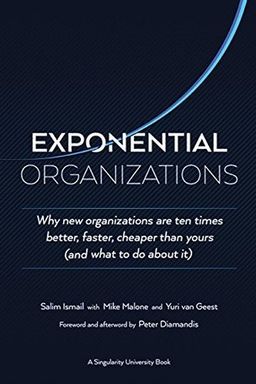
Exponential Organizations cover

Exponential Organizations

by Salim Ismail, Michael S Malone, Yuri van Geest

Exponential Organizations reveals how companies like Uber and Airbnb achieve exponential growth by leveraging technology and innovative business models. Discover strategies to transform your company into an agile, forward-thinking ExO, ready to thrive in a fast-paced world.

Riding the Wave of Exponential Change

The central argument of Exponential Organizations is bold but clear: as technology evolves exponentially, organizations that remain linear in strategy, structure or mindset will inevitably fall behind. The authors, Salim Ismail (with co-authors Michael Malone and Yuri van Geest), argue that the difference between stagnation and explosive growth lies in understanding—and exploiting—the dynamics of information-enabled acceleration. Exponential Organizations (ExOs) scale at least ten times faster than peers, not by hiring ten times more people, but by combining purpose, external leverage and agile internal systems.

From Scarcity to Abundance

Traditional firms are optimized for scarcity: they assume limited assets, predictable demand and linear progress. By contrast, ExOs operate in a world of abundance—where sensors, algorithms and networks turn every problem into a data problem. In that world, value creation decouples from physical production. Uber did not need to own cars, Airbnb did not need to own rooms, and Tesla could iterate software-style on vehicles. These examples embody the book’s foundational claim: once information enters a domain, it begins to follow exponential curves of improvement and cost reduction.

The Exponential Blind Spot

Human intuition is hardwired for linear extrapolation. We underestimate how quickly costs collapse and performance doubles once digitization begins. The authors call the misjudgment of exponential acceleration an “Iridium Moment,” named for Motorola’s failed satellite phone venture that collapsed while ground-based cellular technology advanced much faster than expected. Similar mistakes doomed Kodak, which invented digital photography yet clung to film profits. The lesson: when you plan linearly in an exponential world, your safe bets become dangerous anchors. To survive, you must learn to think in powers of doubling—tenfold, hundredfold, thousandfold change, not mere percentages.

Core Frameworks: MTP, SCALE and IDEAS

To harness exponential forces, the book introduces three interlocking frameworks. First, every ExO aligns around a Massive Transformative Purpose (MTP)—an aspirational mission like Google’s “organize the world’s information” or TED’s “ideas worth spreading.” The MTP creates emotional pull and community magnetism. Second, ExOs amplify that purpose through five external levers summarized as SCALE: Staff on Demand, Community & Crowd, Algorithms, Leveraged Assets and Engagement. These elements let companies grow fast with minimal internal weight. Third, ExOs sustain coherence through five internal mechanisms, IDEAS: Interfaces, Dashboards, Experimentation, Autonomy and Social Technologies. Together, they form an operating system for continuous adaptation.

Why This Matters Now

The authors argue this transformation is not optional. The convergence of AI, IoT, 3D printing, blockchain and synthetic biology will keep compressing cycles and democratizing power. Startups can leverage cheap cloud resources, crowdfunding and open data to scale at speed once exclusive to Fortune 500 giants. Incumbents that fail to decentralize, experiment and recode their business models risk what McKinsey calls the “half-life of incumbency"—shrinking relevance every few years. The authors show that even mid-market firms can adopt ExO principles at the edge while large corporates can experiment through ‘ExO Lite’ pilots and partnerships.

How the Book Unfolds

The narrative begins by explaining exponential change and the perils of linear thinking. It then shows how to define an MTP to galvanize teams and stakeholders. Next, it walks you through the external leverage model (SCALE) and the internal operating model (IDEAS), illustrating each with real-world examples—from Waze and TED to GitHub and GE’s FastWorks initiative. Later chapters present practical playbooks for startups, mid-sized firms and large enterprises, concluding with leadership imperatives for what the authors call the new “Exponential Executive.” The constant refrain is that agility, purpose and openness now outpace scale and control.

Key takeaway

The exponential era rewards organizations that think big and stay light—those that harness digital abundance through purpose-driven networks rather than rigid hierarchies. To thrive, you must build a company that grows faster than change itself.


Recognizing Iridium Moments

Iridium Moments are cautionary tales that reveal what happens when you underestimate the compounding impact of technology. The authors recount examples like Kodak, Nokia, and Motorola’s Iridium project, each falling victim to linear forecasts that ignored exponential acceleration. The Human Genome Project illustrates the opposite: midway through sequencing, progress seemed too slow—only one percent complete—but Kurzweil noticed the exponential doubling rate. Seven doublings later, completion arrived early and under budget. The point: exponential curves look deceptively flat at first, then explode unpredictably.

Why Linear Thinking Fails

Most managers rely on past trends to project future outcomes. This analytic comfort zone collapses when domains become information-enabled. McKinsey famously underestimated mobile adoption; Gartner erred predicting Symbian’s future dominance. Vinod Khosla’s review of forecasts revealed a consistent bias toward underestimating exponential compounding. These cognitive failures create stranded assets and missed transformations—the essence of an Iridium Moment. The authors urge you to train for exponential awareness—anticipating where doubling patterns could overwhelm current assumptions.

Practical Strategies

To avoid Iridium outcomes, monitor which assets or processes are becoming digital or data-driven. As costs halve and capabilities double, business models flip. Nokia’s massive Navteq purchase lost to Waze’s distributed mobile data model. Kodak’s digital camera invention meant nothing without cultural willingness to destroy its film empire. The lesson: optimize for optionality and small, fast feedback loops. Build iterative bets instead of fixed-plan megaprojects. Use scenario planning for 10x, 100x, 1000x possibilities to hedge psychological blind spots.

Core insight

The moment an industry digitizes, growth shifts from arithmetic to geometric. Fail to notice the exponential knee in the curve, and your organization's decline will look sudden but was mathematically inevitable.


Massive Transformative Purpose

Every ExO begins with a Massive Transformative Purpose (MTP)—its reason for existing beyond profit. Unlike mission statements that describe what a company does, an MTP articulates why it matters and inspires a global community to join. TED's “Ideas worth spreading” and Google’s “Organize the world’s information” illustrate this magnetism. They act as open invitations that align users, employees and partners. When you define an authentic MTP, it functions as both cultural glue and viral engine.

How an MTP Scales Influence

An MTP powers the “pull” effect—people voluntarily contribute to a cause they believe in. TEDx organizers multiply reach without extra costs; Red Bull’s “Giving you wings” energizes communities of athletes. By rallying identity around purpose, ExOs lower customer acquisition costs, attract superior talent and grow through engagement rather than advertising. Even startups like Dollar Shave Club used micro-MTPs (“A great shave for a dollar a month”) to mobilize loyalty.

Designing Your MTP

Craft your MTP by asking two “why” questions: Why do we exist? Why should anyone care? The answer must be Massive (big enough to inspire), Transformative (capable of real change) and Purposeful (emotionally resonant). Keep it public and simple. Authenticity is crucial—employees and customers will sense if it’s contrived. Millennials and Gen Z, in particular, seek meaningful work; your MTP becomes a differentiator in recruiting and retention.

Practical takeaway

Your MTP should be ambitious enough to outlive your current products but clear enough to guide daily choices. It turns your brand from a company into a movement.


SCALE: External Exponential Levers

SCALE represents five external mechanisms ExOs use to multiply output without proportionally increasing cost: Staff on Demand, Community & Crowd, Algorithms, Leveraged Assets, and Engagement. Together, they let organizations stay small yet act big.

Lever 1: Staff on Demand

Today’s flexible labor platforms let you scale skills without hiring. Kaggle, oDesk and Gigwalk illustrate this model—AMP replaced half its IT with contractors while Allstate sourced data scientists externally for a 271% model improvement. Use Staff on Demand to avoid bureaucratic load and to inject fresh expertise into projects rapidly.

Lever 2: Community & Crowd

Communities generate ideas, feedback and validation at scale. Local Motors crowdsourced car design; Kickstarter and eYeka channel creativity and funding. As with GitHub or DIY Drones, communities self-organize around shared purpose, lowering the barrier to innovation.

Lever 3–5: Algorithms, Leveraged Assets, and Engagement

Algorithms automate scaling—like Google’s PageRank or DeepMind’s learning systems. Leveraged Assets substitute ownership with access: Waze gathers traffic data through users’ smartphones rather than sensors, Airbnb lists rooms without real estate. Finally, Engagement transforms users into co-producers via gamification or competitions—the XPrize or EyeWire’s gamified neuroscience mapping show how engagement yields usable breakthroughs.

Action tip

Use SCALE selectively. Combine two or three levers aligned to your MTP—for instance, Community & Algorithms for data-driven feedback or Leveraged Assets & Engagement for cost-efficient user networks.


IDEAS: The Internal Operating System

If SCALE fuels external momentum, IDEAS provides internal coherence: Interfaces, Dashboards, Experimentation, Autonomy, and Social Technologies. This system lets you translate abundance from outside—crowds, data, assets—into executable insight and innovation speed.

Interfaces and Dashboards

Interfaces automate the flow of external inputs into your internal processes. Quirky’s voting system and Apple’s App Store serve as filters for crowdsourced ideas. Dashboards make performance transparent in real time. Using Google-style OKRs, you can focus teams and detect drift early. Replace vanity metrics with retention, engagement and NPS scores that reflect genuine value creation.

Experimentation and Autonomy

Lean Startup principles—MVPs, A/B tests, pivot-or-persevere logic—anchor experimentation. Netflix and Adobe rigorously test ideas and kill weak projects fast. Autonomy empowers small cross-functional teams, as at Valve or Morning Star, to make decisions near the action. Align autonomy with clarity—your MTP and OKRs provide consistency without central control.

Social Technologies

Slack, Asana and Yammer reduce communication latency and foster transparency. Distributed work becomes feasible when social tech is embedded into workflow. Transparency, not hierarchy, becomes the coordination mechanism. IDEAS thus converts complexity into adaptability—without it, external growth collapses into noise.

Rule of thumb

Treat IDEAS as your ExO’s transmission system. Calibrate interfaces and dashboards, empower small autonomous pods, and link everyone through real-time social tools.


From Linear Firms to Agile Networks

Legacy organizations are tuned for efficiency, not adaptability. They rely on hierarchy, forecast planning and control—methods effective under scarcity but lethal under exponential change. ExOs discard mass and authority in favor of networks and speed. Waze, with its cloud and community-based model, defeated Nokia’s asset-heavy traffic platform. The structural lesson: control slows response; openness multiplies it.

Shifting from Mass to Flow

A linear firm measures strength in headcount and ownership; an ExO measures flow—of data, insights and learning. Flattening hierarchies matters, but reducing institutional “mass” (fixed commitments) matters more. Fewer assets and layers, more external leverage and iterative loops create agility.

ExO Lite and Edge Initiatives

Large enterprises can’t rebuild overnight. The authors propose “ExO Lite” transformations—edge teams with autonomy and access to SCALE/IDEAS tools. Google’s 20% innovation time and Haier’s micro-enterprises are models. Even limited autonomy unlocks experimentation otherwise strangled by process.

Organizational advice

Don’t copy startups—free them inside. Build small, autonomous units that test exponential methods while shielding them from corporate immune systems.


Launch and Scale an ExO

Starting or transitioning into an ExO follows five practical steps: define your MTP, build a community, form a complementary team, validate through MVPs, and install the SCALE and IDEAS systems. The process mirrors Lean Startup discipline but scaled by purpose and platform thinking.

Steps and Risk Mitigation

Begin with passion and problem—your MTP clarifies direction. Build community early for feedback and advocacy, as Local Motors did with thousands of volunteer designers. Form diverse founder teams that blend product, design and business skill. Validate fast using landing pages or crowdfunding. Cloud and open hardware lower technology risk; early user validation lowers market risk. Execution risk shrinks when teams embrace experimentation and OKRs.

From Vision to Measurement

Translate your BMC into concrete hypotheses. Build MVPs that test value propositions, then instrument AARRR metrics: Acquisition, Activation, Retention, Revenue and Referral. This funnel turns learning into continuous optimization. Use OKRs as cultural scaffolding so teams stay data-informed without losing creativity.

Core reminder

Your MVP isn’t a polished product—it’s an insight generator. Each test narrows uncertainty and trains your team for exponential agility.


Reinventing Business Models

Technology alone rarely creates 10x outcomes; a 10x business model does. The authors, echoing Clayton Christensen, argue that disruption often arises from new logics of value—not just new gadgets. Using Alexander Osterwalder’s Business Model Canvas, you can map, experiment and reinvent your revenue engine rapidly.

New Value Levers

In the information era, abundance drives prices toward zero. Kevin Kelly’s eight value generators—immediacy, personalization, interpretation, authenticity, accessibility, embodiment, patronage and findability—offer ways to monetize freely available information. Examples include Patreon (patronage) and iTunes (embodiment). The challenge shifts from producing scarcity to orchestrating experiences.

Unbundling and Platforms

Startups succeed by unbundling incumbents’ offerings—think fintechs breaking banks into micro-services—then rebundling as platforms. Identify whether your advantage lies in being the unbundler, the rebundler, or the platform host. Google’s AdWords and Amazon Web Services show the compounding effect of platform-based models: each new participant strengthens the ecosystem.

Action question

What would your business look like if your margins approached zero but your reach increased 100x? That’s the starting point for 10x thinking.


Applying ExO Principles at Scale

Mid-market and enterprise settings can also go exponential. The book’s playbooks show adaptations from diverse fields. TED became global by opening TEDx; GitHub merged community with platform economics; GoPro combined product passion with user engagement. Case studies prove ExO levers scale across contexts—logistics, art, media, hardware.

For Mid-Market Firms

Smaller established companies can retrofit ExO attributes via small edge projects. Coyote Logistics used on-demand algorithms to optimize empty miles, while Studio Roosegaarde replaced fixed staffing with flexible collaboration. Each focused on a narrow problem under a clear MTP, ran fast cycles, and leveraged external assets to grow 50x or more.

For Large Corporations

Corporate transformation requires leadership education, strategic partnerships and protected innovation zones. GE co-developed with Quirky to crowdsource product ideas; Google[X] operates as a moonshot lab freed from core constraints. The authors propose “Disrupt[X]” teams with autonomy to attack the parent company’s model before competitors do. Where full transformation is unrealistic, ExO Lite procedures—like activating community inputs, deploying dashboards, and Lean experiments—still generate measurable learning and innovation.

Leadership imperative

Don’t wait for disruption to force change. Educate boards, sponsor edge ExOs and partner externally to prototype the future before it outpaces you.


The Exponential Executive

The book closes by reframing leadership for an exponential world. The future executive must become a “Chief Exponential Officer”—a hybrid of technologist, experimenter and purpose evangelist. Five frontier technologies—AI, IoT, blockchain, AR/VR and neuro-feedback—reshape how every C-level role functions. Understanding their intersections is now a strategic necessity, not optional knowledge.

Technology Meets Leadership

For CEOs, adaptability replaces predictability. For CMOs, data-driven personalization and community replace classic advertising. CFOs must manage blockchain transactions and assess “Return on Learning” alongside ROI. CTOs need to architect systems for openness, APIs and continuous experimentation. The meta-theme: exponential change requires exponential literacy at the top.

Mindset of an Exponential Leader

You must treat change as opportunity, not threat. Leaders should embrace orthogonal information—weak signals from adjacent domains—and tolerate internal disruption. As Amazon’s Jeff Bezos often notes, willingness to cannibalize your own business is the ultimate test of adaptability. In this context, trust and transparency become the new forms of control. Dashboards, not approvals, guide performance; reputation replaces hierarchy.

Final thought

The exponential future rewards leaders who think in networks, act through experimentation, and communicate through purpose. The slower your learning loop, the sooner you become obsolete.

Dig Deeper

Get personalized prompts to apply these lessons to your life and deepen your understanding.

Go Deeper

Get the Full Experience

Download Insight Books for AI-powered reflections, quizzes, and more.