
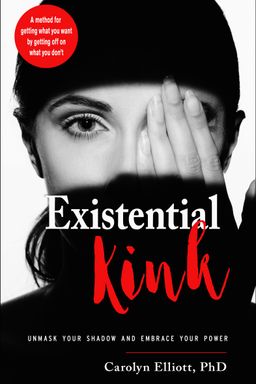
Existential Kink cover

Existential Kink

by Carolyn Elliott

Existential Kink unveils a transformative journey, teaching you to embrace your deepest desires and shadows. Through seven powerful axioms and practical exercises, unlock your true potential, turning perceived flaws into tools for growth and self-acceptance.

Embracing the Shadow to Transform Your Life

Why do the same painful patterns keep showing up in your life—whether it’s toxic relationships, money struggles, or bouts of self-sabotage? That haunting sense of repetition isn’t random fate, Carolyn Elliott argues in Existential Kink. It’s your unconscious mind finding kinky satisfaction in what seems to be your suffering. Elliott contends that, deep down, every frustration hides a strange secret: a pleasure that we refuse to acknowledge. The key, she says, is not to fight against our darkness but to celebrate it until it loses its power to control us.

The book builds on Carl Jung’s famous idea that “until you make the unconscious conscious, it will rule your life and you will call it Fate.” Elliott translates this into an audacious, sensual method—part psychology, part tantra, part magic—for freeing yourself from patterns that seem cursed. If we can learn to enjoy (yes, enjoy!) the sensations of fear, shame, or failure, we dismantle their grip. In Elliott’s world, the underworld isn't something to avoid—it’s the playground where transformation happens.

The Core Argument: Making Pleasure Out of Pain

Elliott’s radical claim is that humans unconsciously derive pleasure from their suffering—the secret delight Freud called “psychic masochism,” Lacan termed “jouissance,” and Jung referred to as the “Shadow.” This perverse pleasure, because it stays repressed, defines our fate. We end up magnetizing bad circumstances until we can consciously admit that some part of us enjoys them. The basic method, Existential Kink (EK), is a form of self-inquiry and meditation that invites you to find the dark turn-on in what distresses you. When you consciously feel the arousal in your pain or humiliation—without judging it—the pattern dissolves. It’s paradoxical, erotic, and profoundly liberating.

From Shadow Work to Divine Alchemy

Throughout the book, Elliott weaves modern psychology with ancient tantra and alchemy, reimagining “shadow work” as divine play. She uses myths like Persephone’s descent into the underworld to show how embracing darkness leads to sovereignty. Her writing fuses the mystical and the practical: by savoring the sensations we’ve labeled “bad”—like poverty, rejection, or jealousy—we transmute them, turning lead into gold. The practice becomes a magical act, a way of uniting the conscious and unconscious minds to change your external reality (a principle echoed in Hermeticism’s “As within, so without”).

Why This Matters

Elliott challenges the “love and light” culture of mainstream self-help, arguing that affirmations and visualizations can’t heal what you still repress. True transformation requires befriending the part of you that gets off on failure or chaos. That’s why so many people stay stuck: they only try to brighten the light without composting the shadow. In this book, you’ll learn how to consciously enjoy your own contradictions, uncover your “existential kink,” and in doing so—reach real integration and freedom. The payoff is not just inner peace but outer magic, because when darkness and light meet, your fate no longer controls you. You do.


The Shadow and Its Secret Turn-On

Elliott opens by confronting an uncomfortable truth: beneath our polished exteriors lies a reservoir of wrongness—a part of us we think is shameful, deficient, or dangerous. Far from being a mistake, this wrongness is where our greatest power hides. Everyone feels it, whether it’s the impulse to destroy, the fantasy of failure, or the need to suffer. Instead of covering it up with “positivity,” Elliott urges you to ask, what if that horrible feeling is actually exciting?

The Nature of the Shadow

Drawing on Jung, Elliott explains that the Shadow is the disowned part of our psyche that contains desires we’ve learned to repress. These aren’t just impulses toward cruelty or lust—they’re also the secret thrill of being small, victimized, or inadequate. When we hide these urges, they still express themselves unconsciously in our lives through recurring painful patterns. You might repeatedly pick controlling partners or sabotage your success because your Shadow enjoys the intensity of those experiences.

How Elliott Discovered Her Shadow

Elliott shares her own story of awakening while recovering from addiction in Pittsburgh. Listening to people “surrender to God” at 12-step meetings, she realized the divine itself must be kinky—creating a world full of pain and still finding pleasure in it. That insight flipped her perspective: maybe she was also a “kinky freak” who secretly loved her drama. By recognizing the thrill she found in toxic relationships and failures, she began to reclaim control over her fate. The result? She turned her life around, building a seven-figure business, a loving marriage, and creative freedom—all through embracing her darkness.

Turning Fear into Excitement

Elliott quotes Gestalt therapist Fritz Perls: “Fear is excitement without the breath.” Sensations we label as anxiety, humiliation, or stress are often just rejected pleasure. When we breathe into them, they reveal an erotic undercurrent—what the French psychoanalyst Lacan called jouissance—pleasure so intense we repress it. By consciously breathing through fear, she teaches that you can transform torment into ecstasy. This act of radical consent to reality becomes the foundation of Existential Kink.


The Unconscious and the Law of Desire

To Elliott, the unconscious isn’t just a mental storage room—it’s the most creative and magical part of you. Whatever it wants, it manifests. Even if those desires are taboo or “wrong,” you’ll still get them. That’s why, she warns, people often create “fated” experiences like loss or conflict: their unconscious is fulfilling disowned wishes. Making those desires conscious lets you reclaim mastery over your fate.

Freud, Jung, and the Pleasure of Fate

Freud called this tendency “the return of the repressed”—the unacknowledged parts of the psyche come back as external events. Jung extended it: “Until you make the unconscious conscious, it will rule your life.” Elliott adds a twist—your unconscious doesn’t just rule your life, it gets off on it. She illustrates this through Alex, a man who unconsciously longs to be taken care of. Even though he consciously wants independence, his repressed desire manifests through him getting fired and moving back with his parents. To his unconscious, it’s bliss.

Reclaiming the Creator Within

The moment Alex lets himself feel pleasure in his dependence—really savor the care—he gains power. He becomes able to move forward because he’s no longer resisting reality. Elliott argues that this process of “getting on the side of your shadow” is the real magic behind attraction and manifestation. Once the pleasure is made conscious, the pattern dissolves, and the energy becomes available for transformation. In essence, she says, you stop being the victim of fate and start being the author of it.


Divine Alchemy and the Great Work

What if God is one kinky-ass motherf***er? Elliott provocatively suggests that the divine delights in every facet of existence—from love to horror. In her view, to become magical, you must learn to mirror this divine attitude and rejoice in all experiences. This is the basis for her lesson on “Super-Freak Divine Alchemy,” where she connects Existential Kink to the alchemical Great Work—the transformation of the self into wholeness.

The Great Work: Becoming Whole

In alchemy, transformation happens through the formula solve et coagula: dissolve what’s stuck (the solve) and re-coagulate it into something higher. EK corresponds to the “solve” phase, where you melt down the stuck parts of your psyche—your shame, scarcity, and contradictions—by eroticizing them. When this darkness becomes conscious, the “coagula” follows naturally as new creation. Elliott likens this to the butterfly that dissolves into goo before re-forming its wings. The psyche must disintegrate before becoming whole.

The Divine Self and Erotic Reality

The universe, Elliott says, is God playing hide-and-seek with itself. When you resist the “bad stuff,” you’re refusing your own divinity. Becoming whole means uniting the masculine energy of Spirit (inspiration, direction) with the feminine energy of Soul (embodiment, emotion, sensation). Their union—portrayed as mystical sex—creates synchronicity, turning inner shifts into outer magic. That’s why she calls EK a practice of “practical magic”: it works because consciousness and reality are fractal mirrors of each other.

Making Your Fate

By making the unconscious conscious, you stop calling your pain “fate.” The Basque word for witch, sorginak, means “one who makes her own fate.” This, Elliott insists, is the witch’s path: the left-hand “lightning route” to awakening. It’s fast, shocking, and destroys illusions about who you think you are. When you unite with your Shadow, you stop fearing life’s extremes. You become what she calls a “force of nature”—a fully incarnate magician whose every desire, even the dark ones, serves transformation.


The Seven Axioms of Existential Kink

To make her philosophy usable, Elliott distills it into seven axioms—a set of working assumptions that guide shadow integration. Each is provocative yet practical, inviting you to shift perception from moral judgment to erotic curiosity.

  • 1. Having is evidence of wanting. If you have it, some part of you wants it—even the hard stuff. Recognizing this releases blame and shame. Like Jung’s dictum, it’s an excavation tool for unconscious desire.
  • 2. Pleasure and pain are choices of perception. Sensations are neutral; how you interpret them decides whether they feel heavenly or hellish (John Milton’s paradise insight comes alive here).
  • 3. Get off on every stroke. Life is a series of “strokes”—events that touch you. The challenge is to enjoy all of them, even the uncomfortable ones, as Orgasmic Meditation teaches.
  • 4. Turn-on equals approval. The more you approve reality as it is, the more energy flows. Resistance is the ultimate turn-off.
  • 5. Desire evolves through fulfillment, not repression. When unconscious desires are celebrated, they transform rather than repeat.
  • 6. Shame kills magic. Guilt and self-judgment suppress your creative power; shamelessness reopens the channel between conscious and unconscious.
  • 7. Truth is sensational. Real insight hits the body like electricity—it feels. Follow that current to know what’s true.

Each axiom dismantles the illusion that suffering is accidental. Together they form a philosophy of ecstatic consent: nothing has to change for you to experience freedom; only your willingness to feel must expand.


Practicing Existential Kink

Elliott’s core method is both ritual and meditation—a fifteen-minute practice designed to make the unconscious pleasure in painful patterns conscious. It’s somatic, erotic, and precise. The best time to do it? When you’re calm, not overwhelmed, and ready to face the truth with humor.

The Steps

First, relax your body—take deep breaths, light a candle, create a container. Then, identify a recurring “don’t like” situation: it could be scarcity, rejection, or conflict. Focus not on the situation itself but on the sensations it stirs. What emotion dominates it—fear, humiliation, or anger? Let yourself feel it fully and ask: could some part of me enjoy this?

Finding the Hidden Turn-On

Experiment with playful statements like, “I’m willing to stop pretending I don’t enjoy being broke,” or “It’s okay to feel my forbidden pleasure in rejection.” If arousal, laughter, or lightness arises, you’ve found your kink. If not, gently persist—Elliott warns that some desires hide under layers of shame and require patience. When you locate the pleasure, celebrate it. That’s the “get off.” Don’t try to manipulate outcomes or fake approval; your unconscious knows your honesty.

Why It Works

By deeply receiving the sensations of the “bad thing,” you satisfy the unconscious drive that created it. The habit no longer needs to persist. Elliott compares this to BDSM: once you bring conscious consent to pain, it transforms into play. The act also unites conscious and unconscious minds—the mystical marriage she calls unio mentalis. From that union, life reorganizes itself effortlessly. The irony? The minute you stop resisting your problem and get off on it, reality often shifts for the better.


Magic, Projection, and the Art of Transformation

In Part Two, Elliott turns shadow work into applied magic. She argues that our minds project reality like a movie—light passing through the film of our conditioning to cast the world before us. To change the projection, you must edit the film, not fight the screen.

Projection as Creation

Every experience “out there” mirrors a dynamic within us. Negative projection—seeing others as villains—keeps us powerless. Once we claim those projected traits as our own creation, we regain agency. Elliott uses the Greek story of Eros and Psyche: Psyche must journey to the underworld and reunite with her divine lover. Their child is named Voluptas, meaning “Joyful Pleasure.” Likewise, our own reunion of consciousness and shadow gives birth to joy.

Becoming Magic vs Doing Magic

Most people “do” magic—affirmations, rituals, prayers—to influence reality. But Elliott says true power comes when you become magic itself. When you embrace both light and dark, your entire being radiates synchronicity. Life begins to mirror your wholeness spontaneously. This is awakening through pleasure—the witchy version of enlightenment.


Getting Kinky with Life’s Chaos

In her final chapters, Elliott turns practical: she provides thirteen exercises that apply Existential Kink to everyday struggles—from money to love to creative shame. Each exercise follows the same principle: find the forbidden enjoyment in what annoys you, and watch it dissolve.

Examples of Transformative Kink

In “How to Stop Being Broke,” Elliott recounts her own years of poverty. Through EK, she admitted that scarcity turned her on—the drama of uncertainty gave her meaning. Once she savored that excitement, she became magnetically open to wealth. Another exercise, “How to Stop Sucking at Love,” reveals how she escaped abusive relationships by discovering her attraction to rejection. When she enjoyed that humiliation consciously, it vanished, paving the way for genuine intimacy.

The Art of Dreading the Wonderful

Her final exercise flips manifestation advice entirely: instead of affirming good outcomes, dread them. Say, “Oh no, it’s terrible that love and money are inevitably coming to me.” By doing so, you integrate your cynical part and create certainty about receiving. Faith born from dread, she notes, is more honest than forced positivity—it brings humor and magic together.

Real Stories, Real Transformations

Elliott includes vivid testimonials—from Angela healing family trauma to Louisa manifesting a new car by getting off on her poverty shame. Each story shows the method’s strange efficacy. Pain turns into creativity, resentment into freedom, and fear into play. The conclusion? When you stop pretending your misery isn’t part of your pleasure, life starts cooperating. The universe responds not to your wishes but to your willingness to enjoy everything it sends.

Dig Deeper

Get personalized prompts to apply these lessons to your life and deepen your understanding.

Go Deeper

Get the Full Experience

Download Insight Books for AI-powered reflections, quizzes, and more.