
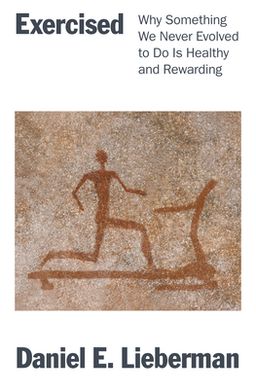
Exercised cover

Exercised

by Daniel E Lieberman

Exercised delves into the science and evolution of physical activity, offering groundbreaking insights into how our bodies are wired to conserve energy. By blending anthropology and modern research, Daniel Lieberman presents a compelling narrative on making exercise an enjoyable and essential part of life.

The Evolutionary Paradox of Exercise

Why do you need to make yourself work out when movement feels natural to other animals? The book argues that exercise as a planned, voluntary, repetitive activity is evolutionarily novel. Our ancestors moved because survival required it—hunting, foraging, carrying, dancing—not because they sought fitness. Modern people, by contrast, must invent reasons to move. This paradox—exercise is healthy but historically strange—forms the book’s overarching argument.

The treadmill metaphor

The author begins with the story of carting a treadmill into rural Kenya. The machine, once used as punishment, now symbolizes our cultural inversion: we pay to exercise in place despite evolved instincts to conserve energy. The villagers’ awkwardness on the treadmill exposes how exercise for health’s sake is a modern invention, powered by prosperity and leisure rather than necessity.

Evolutionary lens on activity

To understand physical activity, the book flips the scientific lens: instead of beginning with Western gym-goers, it starts with the Hadza, Tarahumara, and other active traditional peoples. Evidence shows that while they are more active overall, they do not “train.” They integrate endurance and strength into daily life—walking, carrying, running for ritual—without formal workouts. Their typical energy expenditure (PAL ~1.9) matches ours only if we add dedicated exercise sessions.

Inactivity and the energy economy

If you feel lazy, that’s biology, not failure. Natural selection favors saving calories for survival and reproduction. Apes sit most of the day; humans evolved slightly higher activity but still conserve energy whenever possible. The Minnesota Starvation Experiment proved this principle: under energy shortage, volunteers reduced movement and metabolism up to 40%. Evolution shaped an instinct to avoid needless exertion—a trait now maladaptive in an overfed world.

Mismatch and discomfort

The modern world creates mismatches between ancient adaptations and new environments. We’re sedentary by default yet need movement for health. Exercise feels hard because it costs energy without immediate survival reward. Recognizing this helps you move smarter, not guiltily—by embedding activity in routine life, making it social, or choosing forms resembling ancestral tasks: walking, chores, dance, or games.

Core insight

Exercise is culturally invented, biologically unnatural, and yet physiologically vital. We evolved to move for necessity—not wellness—so modern motivation must simulate that necessity through commitment, play, and social reinforcement.

Understanding the evolutionary roots of movement and rest reframes modern health problems as mismatches rather than moral failings. The solution isn’t guilt but design—creating lifestyles that align ancient bodies with modern realities.


Inactivity and Sitting as Adaptations

You may hear that “sitting is the new smoking,” but the truth is more nuanced. The book explains that inactivity and rest behaviors are anciently adaptive strategies to conserve energy, not inherently harmful moral choices. Our physiology evolved around alternating bouts of effort and rest, not around continuous motion.

Why conserving energy evolved

From apes to hunter-gatherers, long periods of resting are universal. Gorillas and chimpanzees rest much of the day. Human foragers, like the Hadza, spend a few hours daily in moderate activity and many hours sitting or engaged in light physical tasks. Rest was not laziness—it preserved calories for reproduction and growth. Our biology still reflects that calculus today.

The modern mismatch

Industrial life shifted humans to prolonged, uninterrupted sitting and sharply reduced daily energy expenditure—down by roughly 100 kcal since 1960. Studies show that people who sit for long bouts without breaks face metabolic risks: higher triglycerides, insulin resistance, and inflammation. But those who interrupt sitting regularly—even for short walks—avoid most of these effects.

Mechanisms behind sitting’s harm

Long immobile periods after meals disable the muscle-driven clearance of glucose and fats. Muscles act as endocrine organs—contracting releases myokines that suppress inflammation. When still, these anti-inflammatory signals fade. Organ fat increases quickly, sometimes within days of drastically reduced steps. But small, frequent motion—fidgeting or brief walking—is enough to reboot the metabolic machinery.

How to integrate healthy rest and sitting

Rest isn’t the enemy; pattern is. Break up sitting every 20–30 minutes, use active postures like squatting or kneeling, strengthen back muscles, and vary positions. These mimic ancestral resting behaviors—energy-efficient, yet metabolically alive. Think dynamic rest rather than still stagnation.

Key takeaway

Evolution designed humans to conserve energy efficiently. Modern habitats turn that adaptation into a health risk only when movement disappears entirely. Intermittent activity, not perpetual motion, defines healthy human rhythm.

Instead of condemning rest, treat it as ancient wisdom—just keep it punctuated by movement. Active rest sustains both comfort and health, honoring your biological legacy while defying modern stillness.


Endurance, Strength, and Human Design

You’re not the fastest mammal, but you are among the most enduring. The book outlines how evolution favored endurance capacity over raw strength or speed and how those traits interact through training and aging. Human anatomy—from Achilles tendons to sweat glands—reflects our specialization for sustained movement.

Endurance evolution

Humans can run prey to exhaustion thanks to elastic tendons, head-stabilizing ligaments, and cooling sweat systems. The endurance-running hypothesis connects these traits to persistence hunting practiced by early Homo. Cultural echoes persist: Tarahumara runners cover miles daily, not through disciplined exercise but ritual and lifestyle. Their movement is purposeful and social, not purely athletic.

Strength and trade-offs

Muscular strength evolved for functional tasks—lifting, carrying, digging—not aesthetic hypertrophy. Hunter-gatherers are lean yet strong, avoiding the caloric cost of bulk. Modern resistance training imitates those ancestral loads. Two weekly strength sessions preserve muscle, metabolic health, and bone integrity, combating age-linked sarcopenia and fall risk.

How endurance and power coexist

Muscle fibers vary between fast and slow types, adjusted by genetics and training. You can modify them: interval work enhances power; steady cardio builds endurance; mixed modes optimize both. The Tarahumara and Ironman comparison shows that culture shapes motive—ritual versus sport—yet both reveal human capacity for sustained stress adaptation.

Core message

Humans evolved as versatile movers—strong enough for survival tasks, enduring enough for long pursuits, adaptable enough to train across modes. Exercise works best when it mirrors this evolutionary balance.

Recognizing endurance and strength as evolutionary complements—not opposites—helps you design fitness that preserves healthspan rather than chasing extremes. Movement diversity is your body’s ancestral script for resilience.


Exercise as Biological Repair

Every workout is controlled stress. The book’s central physiological insight is that exercise serves as a repair signal—a trigger that activates maintenance systems your body evolved to use during active life. A bit of tissue damage sparks healing processes that rebuild you stronger, cleaner, and more resilient.

Hormesis and adaptation

The author describes hormesis—the beneficial overrepair that results when the body responds to mild stress. Exercise temporarily raises inflammation and oxidative stress; then repair responses overshoot, reducing baseline inflammation, generating antioxidants, and renewing mitochondria. This wave of healing is what delivers long-term benefit, not the workout itself.

The recovery cascade

After activity, parasympathetic systems calm your heart and cortisol, while cells tidy up proteins, fix DNA, and add new mitochondria. This energetic cleanup—the 'afterburn' or excess post-exercise oxygen consumption (EPOC)—is the invisible second half of every workout. It’s how your body recalibrates its resilience engines.

Why pills fail as substitutes

Experiments like Michael Ristow’s 2009 study showed that taking antioxidants while exercising blunts benefits, because pills short-circuit the stress signals needed for adaptation. Your body evolves best under lived stress, not pharmacological imitation. Supplements can mute the very processes exercise activates.

Evolutionary logic of maintenance

Maintenance systems are expensive; evolution made them responsive rather than constant. They switch on during activity or damage—when repair is needed and energy is available. Sedentary lifestyles leave these systems idle, leading to chronic decline. Exercise, therefore, re-engages the cellular economy that your genes expect.

Key takeaway

Exercise isn’t magic—it’s maintenance biology. You stress the system a little so it invests energy into repair. Without stress, the repair crews retire, and aging accelerates.

In short, activity renews you at molecular scale. Move not for perfection but to keep the repair machinery switched on; that’s how evolution intended healthy longevity.


Exercise, Disease, and Longevity

Across chronic diseases—from diabetes to dementia—the book shows that exercise works as multi-system prevention and treatment. Active bodies better metabolize fuel, manage stress hormones, fight inflammation, and protect the brain.

Metabolic and heart health

Regular aerobic and resistance activity reverses metabolic syndrome mechanisms. It boosts insulin sensitivity, burns organ fat, and improves circulation. Landmark studies—from Jeremy Morris’s bus conductors to Paffenbarger’s alumni—demonstrate lower heart-disease deaths among the active. Cardiovascular adaptation—bigger, more elastic hearts and better lipid profiles—anchors most exercise benefits.

Cancer and inflammation control

Moderate-to-vigorous exercise reduces risk for colon and breast cancer up to 40–50%. Movement dampens hormones like estrogen, lowers glucose, and boosts immune surveillance via active natural-killer cells. Regular exercise cultivates low-grade anti-inflammatory signaling—a key preventive against tumor growth.

Brain and mental resilience

Exercise promotes neuroplasticity and mental health by increasing BDNF and oxygenation. Studies link lifelong activity to roughly 45% lower Alzheimer’s risk and better mood stability. Dancing and social movement may amplify these effects through endorphin and endocannabinoid pathways—reminding that movement often heals mind and body together.

Healthspan versus lifespan

The “compression of morbidity” principle (James Fries’ runner studies) reveals that exercise doesn’t necessarily extend maximum lifespan but reduces years of disability before death. Runners in Fries’ Stanford study stayed functionally “younger” by about 15 years compared with sedentary peers. Exercise keeps you capable longer.

Practical synthesis

Activity is medicine for most chronic conditions. Cardio and resistance combine to reduce disease risk, while movement across life compresses morbidity—a better, healthier span even if total years barely change.

Ultimately, exercise restores evolutionary balance. You age better not because you avoid death but because you keep living well until it arrives.


Motivation, Reward, and Habit

Knowing exercise is vital doesn’t guarantee action. The book closes by exploring how to make movement happen in a world where necessity vanished. Humans evolved to move when obliged or rewarded—so modern engagement must recreate those conditions.

Necessity and social enforcement

The Björn Borg company’s mandatory 'Sports Hour' illustrates engineered necessity: staff work out together weekly, and those who stay report greater wellbeing. You can replicate that by embedding commitment—scheduled classes, pre-paid registrations, or team accountability that turns voluntary motion into structured obligation.

Fun and emotional reward

Pleasure and social bonding trump pure discipline. Shared workouts—like Dr. Jordan Metzl’s Ironstrength sessions—make effort enjoyable through community and music. Pain transforms into purpose when the experience is meaningful, as seen in the author’s Boston Marathon example. Find activities that connect rather than isolate.

Nudges and shoves

Behavioral tactics help bridge instinct and compliance. 'Nudges' include placing workout clothes visibly or scheduling fixed times. 'Shoves' add stakes: commitment contracts where missed sessions cost money or reputation (one participant donated to a disliked charity if she skipped). Social loss aversion drives consistency more than vague goals.

Institutional change

The author advocates embedding physical education throughout life—schools, universities, and workplaces—to make activity default behavior. Treat exercise like learning: routine, structured, rewarding. This echoes evolutionary consistency, where movement was communal and built into daily survival.

Final lesson

You can’t reason yourself fit—you must design environments that make movement the easiest choice. Obligation, play, and connection are the psychological equivalents of ancestral necessity.

In the end, staying active means aligning purpose, pleasure, and culture with biology. Exercise endures not by willpower alone but by making motion feel inevitable and meaningful again.

Dig Deeper

Get personalized prompts to apply these lessons to your life and deepen your understanding.

Go Deeper

Get the Full Experience

Download Insight Books for AI-powered reflections, quizzes, and more.