
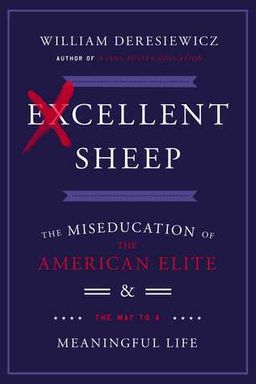
Excellent Sheep cover

Excellent Sheep

by William Deresiewicz

Excellent Sheep critiques the educational practices of America''s elite universities, exposing their role in stifling independent thought and perpetuating class inequality. It advocates for a meaningful life through critical thinking, creativity, and the appreciation of liberal arts.

The Crisis of Meaning in Elite Education

What if all your hard work—the perfect grades, the test prep, the prestigious college admission—leads not to fulfillment but to emptiness? In Excellent Sheep: The Miseducation of the American Elite and the Way to a Meaningful Life, William Deresiewicz challenges the idea that success equals happiness. Drawing from his years teaching at Yale, he argues that elite education produces students who are talented and driven, yet anxious, conformist, and spiritually adrift. They are, in his provocative phrase, “excellent sheep.”

Deresiewicz contends that America’s top educational system, from the high-pressure childhoods of the privileged to the universities that crown them, has lost sight of education’s true purpose: to cultivate self-knowledge, independent thinking, and moral character. Instead, it trains students to excel at jumping through hoops—what he calls “the preparation for preparation”—without questioning where the hoops lead. The results are tragic: a generation of students who can ace any exam but struggle to answer life’s biggest questions—Who am I? What do I believe in? What kind of life should I live?

The Making of “Excellent Sheep”

Deresiewicz begins with a disturbing portrait of the modern elite student: hyperachieving, over-scheduled, and plagued by fear of failure. Raised in competitive suburbs by anxious parents, these young people treat life as a résumé. They fill their youth with “leadership positions” and service trips designed for college applications, not for self-discovery. By the time they reach the Ivy League, he observes, many are exhausted and emotionally fragile—some masking depression and anxiety behind a polished facade, a condition students themselves nickname “duck syndrome.”

In Deresiewicz’s analysis, this dynamic begins early. Parents, driven by fear of economic insecurity, try to engineer perfect lives for their children. They hover and micromanage, convinced that elite schooling is the only path to safety in an increasingly unequal world. Schools, especially expensive preparatories, reinforce the anxiety, turning education into a form of status reproduction. By the time these teenagers arrive at elite colleges, he argues, they are “accomplished adult-wranglers”—experts at pleasing authority but unsure of how to think independently.

What College Should Be For

Deresiewicz insists that college should be the place where you step back from the world and ask fundamental questions about meaning and purpose. Yet colleges have largely abdicated this role. Instead of nurturing curiosity and character, universities have turned into career factories obsessed with research rankings, donor relations, and student satisfaction surveys. Students, treated as customers, are encouraged to seek courses that boost GPAs, not those that challenge their assumptions. Professors are rewarded for publishing obscure research papers rather than guiding undergraduates through intellectual discovery.

A true education, Deresiewicz argues, is not about credentialing but soul-making—the process of building a self. College should help you learn to think critically, question inherited opinions, and develop the inner resources necessary to lead an authentic life. Drawing on philosophers from Socrates to John Keats, he describes the liberal arts as “a vale of soul-making,” a crucible where pain, failure, and reflection forge real individuality. “If you find yourself the same person at the end of college as at the beginning,” he writes, “then you did it wrong.”

Reclaiming Humanity in an Age of Achievement

Deresiewicz goes beyond personal critique to a national one. Elite education doesn’t just distort students’ lives; it shapes America’s leadership class. The “best and the brightest,” he claims, govern institutions that have lost vision and moral imagination, producing technical competence without purpose. From Wall Street to Washington, our leaders are what he calls “high-IQ morons”—experts at managing systems but incapable of reimagining them. As a result, society becomes as spiritually impoverished as the students who inherit it.

But the book is not a rejection of excellence—it is a call to redefine it. Deresiewicz urges students to take responsibility for their own education: to pursue what truly moves them, to embrace the humanities as essential to citizenship and self-knowledge, and to have the courage to invent their own lives rather than conform to expectations. In doing so, they not only become freer individuals but also better citizens, capable of empathy, creativity, and leadership rooted in moral clarity.

Why It Matters Today

In an era obsessed with return on investment, Excellent Sheep asks you to measure success by more than salary or status. Its message resonates far beyond college: that the pursuit of external validation can erode one’s inner life; that democracy depends on citizens who think critically, act with conscience, and value meaning over money. Just as Aldous Huxley warned in Brave New World against trading freedom for comfort, Deresiewicz warns against trading our humanity for achievement.

Ultimately, Excellent Sheep is both diagnosis and manifesto—a passionate plea to reclaim college as a place to ask who you are, what you love, and what kind of life is worth living. The book’s great provocation is that education, and life itself, must be about becoming fully human, not merely successful.


How Elite Education Breeds Anxiety and Conformity

Deresiewicz begins his critique with the students themselves. On the surface, today’s high achievers embody perfection: top grades, multiple extracurriculars, glowing resumes. But beneath that sheen, he finds exhaustion, depression, and emptiness. They have mastered the game of achievement but lost touch with their own desires. As one Yale student confessed, “I might be miserable, but if I weren’t miserable, I wouldn’t be at Yale.”

The Making of the “Super Kid”

These students do not emerge from nowhere. In suburban strongholds of affluence, family life revolves around resume-building. Parents, terrified their children might “fall behind,” choreograph every hour from kindergarten onward. Sports, music lessons, volunteer work—each chosen not for love but for leverage. As psychologist Madeline Levine (author of The Price of Privilege) notes, affluent children suffer some of the highest rates of depression and anxiety, because their value is measured by performance, not personhood. Deresiewicz sees this dynamic as a microcosm of modern America: fear disguised as ambition, love expressed as control.

Infantilization and the Illusion of Control

In this world, independence is a myth. Overbearing parents tie shoelaces for eight-year-olds, then demand calculus tutors for seventeen-year-olds—the same mentality, different outfit. Students learn that safety lies in obedience; mistakes are intolerable. The “helicopter parent” merges with the “tiger parent” in a toxic blend of overprotection and overinvestment. Amy Chua’s Battle Hymn of the Tiger Mother becomes, to Deresiewicz, a self-parody of this culture: a mother’s need for her child’s success as proof of her own worth. The result is what he calls infantilization: adults who look polished but remain dependent on approval, authority, and the next gold star.

The Education of the Soul—or Its Substitution

Instead of cultivating self-knowledge, the system drills conformity. Students learn to anticipate professors’ expectations and regurgitate fashionable opinions—what ancient philosophers like Plato called doxa, or mere opinion, as opposed to truth. Even creative fields are tamed: fine arts students worry more about grades than inspiration. The result, Deresiewicz warns, is a generation of intellectual technicians—bright but unoriginal, self-assured but hollow. True curiosity, he laments, has been sacrificed to the cult of “relevance.”

The High Cost of Perfection

Perfectionism, he argues, becomes a form of addiction—a psychological treadmill where praise functions as the next fix. Failure, even mild, triggers identity crises. Quoting psychoanalyst Alice Miller’s The Drama of the Gifted Child, he explains how children raised for achievement develop “false selves”—personalities crafted to please rather than to live. They oscillate between grandiosity (“I can do anything”) and despair (“I’m worthless”), emotional poles he summarizes as “hot shit/piece of shit.”

Society calls these children “success stories,” yet they grow into adults who chase external validation at the expense of authenticity. By the time they join the professional class—the consultants, bankers, lawyers—they are skilled at playing roles, not making meaning. “They have learned to be a student,” Deresiewicz writes, “but not to use their minds.”

“We are not teaching our children to think, but to perform.”

Deresiewicz urges readers to see the cultural cost: a society that idolizes achievement but forgets what achievement is for. Without purpose, intelligence mutates into anxiety, and ambition decays into conformity.


The Lost Purpose of College

What is college really for? Deresiewicz argues that we’ve forgotten. In the modern discourse of “return on investment,” college is treated as a financial bet: four years of debt in exchange for a better paycheck. But this utilitarian view, he insists, betrays the deeper purpose of education. “To ask what college is for,” he writes, “is to ask what life is for, what people are for.”

Beyond ROI Thinking

Most policy debates reduce education to economic utility—more engineers, more “STEM” jobs, higher GDP. Deresiewicz doesn’t deny that people need employment; he challenges the idea that employment is the summit of human existence. Money matters, he admits, but it’s not the whole matter. “Life is more than a job; a job is more than a paycheck.” By fixating on marketable skills, we risk reducing students to economic units and society to output statistics.

College as Sanctuary for Thought

Deresiewicz sees college as “an interval of freedom” between dependence on your family and submission to your career. It’s the one time you can step back and question the world. Quoting Andrew Delbanco’s College: What It Was, Is, and Should Be, he calls it a “precious chance to think and reflect before life engulfs you.” The dorm bull session, the midnight conversation about God or morality—that’s not wasted time. It’s the soul of education. As Yale alumnus Lewis Lapham recalled, “Most of what I learned at Yale, I learned in what I now remember as one long, wayward conversation.”

Thinking as Freedom

To Deresiewicz, the first goal of education is to teach you how to think—not in the cliché sense of clever argumentation, but as liberation from “doxa,” the mass of unexamined opinions that society drills into you. College should make you skeptical, reflective, and unsettlingly self-aware. Professors, if they do their jobs, don’t give you opinions; they dismantle them. They “bring you into the uncomfortable condition of doubt.” That discomfort, he argues, is the birth of freedom.

This process requires good teaching—the Socratic model of dialogue and challenge—and good teachers, who act as mentors and midwives for thought. “You need some people in your life whose job it is to tell you when you’re wrong.” You also need peers to test your ideas against: real conversation, not social media performance. Together, these form an intellectual community that helps students grow minds as well as identities.

“A real education sends you into the world bearing questions, not resumes.”

College, he concludes, should leave you changed—not just informed or credentialed. If you graduate with the same values you arrived with, you haven’t been educated, only processed.


Building a Self Instead of a Resume

Elite education, says Deresiewicz, trains students to build resumes, not selves. They chase credentials but neglect character. What education should cultivate, he insists, is the ability to build an inner life—what Keats called “soul-making.” This is not mystical talk; it’s practical psychology. Without a self, you have nothing stable to guide your choices in a world of pressure and noise.

The Self as Work of Art

Developing a self, Deresiewicz argues, is creative labor. It requires introspection, pain, and risk—the willingness to ask, as Mark Lilla puts it, “What is worth wanting?” Like a sculptor chiseling at marble, you slowly shape identity through reflection and experience. College is supposed to supply the tools for that work: philosophy to question meaning, literature to connect to others’ humanity, art to awaken perception. If done right, education doesn’t fill your mind; it cracks it open.

The Courage to Doubt

Deresiewicz aligns this process with spiritual traditions. You might enter college “as at the beginning of a pilgrimage,” he says—not toward dogma, but toward truth. That journey demands courage: to doubt inherited values, social approval, even your major. Real education puts “everything at risk.” The reward, paradoxically, is freedom—the ability to think, feel, and live authentically.

He cites Allan Bloom’s idea that liberal education “puts everything at risk and requires students who are willing to risk everything.” It’s not comfort but transformation that marks true learning. As Lewis Lapham’s mentor told him, “An education is a self-inflicted wound.” You might emerge bruised, but you’ll also be reborn.

The Habit of Reflection

In the end, soul-making is not a one-time epiphany but a lifelong habit of reflection. Deresiewicz dismisses the phrase “develop a meaningful philosophy of life” as too static. Instead, he urges the development of “the habit of reflection—the capacity for change.” A self, he says, is not something you possess; it’s something you practice. The real failure is to finish college unchanged—to “graduate the same person you were when you arrived.”


The Humanities as a Path to Truth

If college is about building a self, the humanities are its scaffolding. Deresiewicz defends the liberal arts not only as cultural enrichment but as essential training for being human. In an era obsessed with “useful” majors, he insists that “the ultimate purpose of a liberal arts education is to help you learn to reflect in the widest and deepest sense—for the sake of citizenship, for the sake of a creative self, for the sake of living well with others.”

Why the Humanities Matter

The humanities, he explains, are not about reading old books for trivia’s sake. They are how modern society contemplates meaning, morality, and beauty—our substitute for religion. When you read Dostoevsky, listen to Beethoven, or study art, you join humanity’s ongoing conversation about what it means to live. Art, he writes, is “the axe for the frozen sea within us” (citing Kafka). It teaches empathy by letting you live other lives and confront uncomfortable truths.

Beyond Measurable Knowledge

Science measures; the humanities interpret. They don’t offer data but insight, asking not “Is it true?” but “What does it mean?” Deresiewicz borrows Stephen Jay Gould’s term “non-overlapping magisteria” to describe their relationship: science teaches us the external world; the humanities, our internal one. By immersing in stories, you develop moral imagination—the ability to see the world through others’ eyes. Literature, he writes, lets you say, “That’s me!” and, just as importantly, “That’s not me—but I understand.”

Humanities and Real-World Skills

Ironically, this reflection also has practical consequences. Employers now value creativity, communication, and adaptability—the very capacities the humanities cultivate. Deresiewicz cites surveys showing that liberal arts majors close the initial wage gap after a decade, thriving in careers that demand flexibility. “Hard skills can be learned,” he quotes one CEO, “but soft skills must be developed.” The liberal arts, he concludes, prepare you for your whole career, not just your first job.

“Art gives you names for experience.”

Through art, literature, and philosophy, you articulate the unspoken—your struggles, desires, and contradictions—and thus begin to know yourself. That, Deresiewicz insists, is the highest function of education.


Inventing Your Life and Embracing Failure

The middle chapters of Excellent Sheep turn from criticism to guidance. Having unmasked the emptiness of achievement, Deresiewicz coaches readers on inventing their lives. This means replacing the question “What should I do to succeed?” with “What am I called to do?” Vocation, he reminds us, comes from the Latin root for “calling.” You don’t choose it so much as recognize it—the thing you “can’t not do.”

Finding Purpose

Self-knowledge isn’t introspection for its own sake; it’s the foundation for meaningful work. Deresiewicz quotes Lara Galinsky of Echoing Green: “People find fulfillment where what they love intersects with what the world needs.” He urges students to replace the fantasy of endless potential with the courage of commitment. Freedom is not keeping options open forever—it’s choosing decisively and accepting risk.

Lessons from Literature and Life

His model of moral courage comes from literature: Dorothea in George Eliot’s Middlemarch, who defies convention to seek a meaningful life; or Joyce’s Stephen Dedalus, who vows to “fly by the nets” of religion, nationality, and conformity. Deresiewicz weaves these examples with stories of his students: a Harvard senior torn between social work and law school, a Yale graduate leaving banking to teach. The challenge, he insists, is not to find your passion but to trust it—to risk failure in pursuit of what you love.

The Value of Failure

In a culture terrified of imperfection, he champions failure as a teacher. Citing Beckett—“Fail better”—he argues that setbacks build resilience and humility. Learning to fail, he says, is the only way to stop fearing it. Real growth may even hurt; as he admits of his own journey from Yale professor to writer, “An education is a self-inflicted wound.” But “you can’t be free,” he warns, “if you’re afraid to be wrong.”

“The only real grade is how well you’ve lived your life.”

The task, he concludes, is not to chase prestige but to cultivate purpose—to measure success not by credentials but by integrity, curiosity, and courage.


Redefining Leadership and Service

Elite schools love to proclaim that they “train leaders,” but Deresiewicz dismantles this mantra. What they actually produce, he argues, are bureaucrats and technocrats: smooth operators who climb hierarchies rather than question them. The word “leadership” has been emptied of moral content and reduced to ambition—what he calls “gung-ho followership.”

From Duty to Careerism

Once, leadership meant stewardship—duty, service, courage, and ethical responsibility. Now it means personal advancement. Students run clubs not to improve them, but to secure the title “president.” Administrators laud “leadership potential” as a euphemism for networking skill. The result is what Deresiewicz calls the corporate soul of higher education: self-branding mistaken for character.

Resistant Minds and Real Citizenship

Real leadership, he insists, begins in resistance—the courage to dissent from one’s peer group or challenge conventional wisdom. He draws on Joseph Conrad’s Heart of Darkness to illustrate the bureaucratic mind: the manager who “originated nothing” but kept the routine going. Our institutions, from finance to politics, are run by such people—competent but visionless. What we need instead are citizens capable of moral imagination and critical thought, “resistant minds” who can say no when the system is wrong.

From Charity to Justice

Deresiewicz makes a similar intervention in the language of “service.” Colleges preach “giving back,” but often in self-congratulatory ways—short-term volunteerism that flatters privilege without challenging inequality. True service, he argues, isn’t noblesse oblige but solidarity. It means fighting injustice, not performing charity. He urges students to move beyond “doing well by doing good” and toward genuine moral commitment—“not giving 5 percent, but changing 100 percent.”


How Elite Education Corrupts Leadership and Society

The book’s final chapters widen the lens from classrooms to country. Deresiewicz asks a damning question: What kind of leaders has our meritocracy created? His answer: brilliant yet visionless elites who preside over stagnation, inequality, and moral decay.

The Failure of the “Best and Brightest”

Borrowing David Halberstam’s phrase, Deresiewicz calls the modern ruling class “the best and the brightest”—and reminds us the term was ironic. It originally described the technocrats whose arrogance led America into Vietnam. Today’s equivalents—politicians, executives, experts—are also products of elite education. They are overconfident in intellect, underdeveloped in wisdom. “Brilliant, gifted, energetic,” he writes, “but anxious, greedy, bland, and risk-averse.” They make the trains run on time, but “don’t know where they’re going.”

From Meritocracy to Hereditary Aristocracy

Our supposedly open meritocracy, he argues, has morphed into a hereditary caste. Elite colleges claim to reward talent, but their admissions policies—favoring legacies, athletes, and donors’ children—reproduce class privilege. By 2006, 67% of students at top schools came from the upper quartile of income, while only 3% came from the bottom. As education costs soar, opportunity narrows. The result: “a system that launders privilege under the guise of merit.”

Reimagining Democracy Through Education

Deresiewicz concludes with a call for reform: free, high-quality public higher education; admissions practices based on class, not legacy; and renewed investment in teaching and the humanities. “We need to create a world,” he writes, “where you don’t have to go to the Ivy League to get a first-rate education.” Ultimately, he envisions education as the foundation of democracy—a means not for producing winners, but for cultivating citizens.

“We’ve tried aristocracy. We’ve tried meritocracy. Now it’s time to try democracy.”

Deresiewicz’s closing plea is moral as much as political: to love our neighbor’s children as our own. Only by rejecting the obsession with advantage, he argues, can we build a just and meaningful society.

Dig Deeper

Get personalized prompts to apply these lessons to your life and deepen your understanding.

Go Deeper

Get the Full Experience

Download Insight Books for AI-powered reflections, quizzes, and more.