
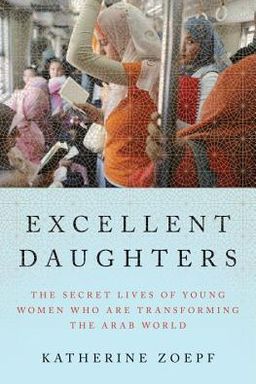
Excellent Daughters cover

Excellent Daughters

by Katherine Zoepf

Excellent Daughters by Katherine Zoepf offers a riveting exploration of the secretive lives of young Arab women who are courageously challenging cultural norms. This book unravels their stories of struggle and perseverance as they navigate a path toward education, independence, and empowerment in a rapidly changing world.

Becoming 'Excellent Daughters' in a Changing Arab World

How do young women come of age in societies where tradition dictates every aspect of their lives, yet modernity tempts from every screen and street? In Excellent Daughters, journalist Katherine Zoepf explores this question through more than a decade of reporting across the Middle East. She argues that the Arab world’s future is being quietly reshaped by women—often not through revolutions or protests, but through the small, daily acts of defiance, patience, and ambition that shift expectations from within.

Zoepf contends that while Western discussions about Arab women tend to dwell on oppression, veils, and victimhood, the true story is more complex. Across Syria, Lebanon, Saudi Arabia, Egypt, and the United Arab Emirates, a generation of young women are pushing at boundaries—they study at universities once closed to them, work in malls and offices, and even join political protests. Yet their progress often unfolds in societies still shaped by deep patriarchal norms and religious conservatism. The book reveals not just suffering or submission, but also imagination, ingenuity, and courage.

Under the Veil: Daily Life and Quiet Transformation

Zoepf begins her journey in Damascus, where she learns that understanding a society built on community duties rather than individual rights requires unlearning Western assumptions. A workman may ask her for tea, not out of arrogance, but because, in his world, hospitality is everyone’s duty. A young Muslim woman’s choice to veil is not necessarily submission—it may be self-expression, a form of dignity, or even a way to carve out freedom under social scrutiny.

These early chapters set the stage for a broader argument: that modern Arab womanhood operates in the tension between inherited moral codes and a rapidly globalizing culture. The same society that venerates modesty now also produces women lawyers, scientists, journalists, and flight attendants. Zoepf watches this evolution from the inside, living among women who pray, laugh, and sometimes rebel quietly—each gesture a negotiation with a world unsure how to contain their ambitions.

From Shame to Solidarity: Gender, Honor, and the Law

In one of the book’s most haunting sections, Zoepf recounts the story of Zahra al-Azzo, a sixteen-year-old Syrian girl killed by her brother in an "honor killing." Her supposed crime—being kidnapped and raped—became a turning point for Syrian activists who sought to reform laws that excused such murders. Zoepf shows that change emerged not from outrage alone, but from how sympathetic figures like Zahra and her husband, Fawaz, forced the nation to reconsider its silence on shame and justice. Here, readers confront the paradox of law and culture: men could kill in defense of family honor and be released the same day. Yet under authoritarian repression, women’s networks found creative ways to campaign—from legal petitions to quiet debates with clerics.

This theme of “washing away the shame” recurs, revealing how ideas of female purity continue to shape power, violence, and reform across the Arab world. But Zoepf doesn’t dwell on horror; she focuses on the advocates, lawyers, and teachers who redefine what honor could mean—integrity, truth, or courage, rather than control over women’s bodies.

Faith, Desire, and the Search for Balance

As Zoepf moves to Beirut, she portrays Lebanese women juggling Western openness with conservative expectations. They are, as sociologist Samir Khalaf jokes, “the most promiscuous virgins in the world”—girls negotiating their sexuality in societies that demand both allure and chastity. Meanwhile, in the Emirates, young women like Randa, a Syrian turned flight attendant, discover independence through work abroad, only to find that returning home means social exile. Whether through quiet defiance or professional success, these women redefine femininity in subtle ways.

Throughout the book, Zoepf argues that transformation in the Arab world may not come from revolutions or Western-style feminism, but from these small, human contradictions. A conservative woman opening a lingerie shop in Saudi Arabia or girls studying the Qur’an to argue for their rights are just as revolutionary as protesters. It’s in these small gestures—choosing to study, to work, to speak—that they are becoming the “excellent daughters” of their generation: dutiful and daring all at once.

By the final pages, readers understand that what looks like conformity can conceal resilience; that progress often grows from within tradition rather than in opposition to it. Zoepf invites you not to pity these women, but to listen—to see how, in their own language and context, they are changing history one decision at a time.


Faith, Gender, and Power in Syria

In Damascus, Zoepf immerses herself in a society where religion is the organizing principle of life—and where understanding Islam’s gender codes is key to understanding power itself. She meets Enas, a brilliant young Qur’an teacher, and learns how faith can serve both as constraint and liberation. Through Enas’s story, Zoepf charts a complicated reality: religion doesn’t just repress women—it can also give them authority, education, and a sense of purpose.

The Power of Piety

Enas comes from a family of Islamic scholars and memorized the Qur’an by age ten. Her life is shaped by the belief that “religious education is a great protection for a woman.” She teaches young girls that knowledge of the Qur’an allows women to challenge ignorance, even patriarchal misinterpretations. To Zoepf’s surprise, these women see themselves as intellectuals, not subordinates—they interpret Islam rather than merely obey it. This contradicts Western stereotypes of passive veiled women and shows how devotion can become a tool for empowerment.

The Qubaisi Sisterhood

Zoepf investigates the secretive Qubaisi movement—an underground network of conservative, all-female Islamic teachers led by Munira al-Qubaisi. Banned and later tolerated by the government, it represents both spiritual renewal and political risk. Members gather in private homes to study scripture, adopting specific scarf colors that mark their ranks. To the regime, they are potential subversives; to their followers, they are mentors and protectors. The sisterhood teaches self-restraint but also forms formidable female solidarity. For many women, joining means finding education and community within limits acceptable to the state.

Zoepf argues that this religious revival, though conservative, also produces unexpected freedoms. In a society where men dominate public life, female religious teachers—sheikhas—achieve unprecedented moral authority. The paradox is stark: in a system built to contain women, the mosques have given them new power.

Faith as a Double Edge

In Syria’s authoritarian context, faith fills the gap left by the absence of political freedom. Many women turn to religion for meaning, yet their faith also becomes the instrument through which the regime monitors and contains them. Zoepf’s chapter captures this tension vividly: the same madrassas that nurture a woman’s curiosity can also teach obedience. Religion, she concludes, is not simply a battleground between oppression and liberation; it’s a mirror of Syria itself—a place of profound devotion and unspoken dissent.


Honor, Law, and the Weight of Shame

Few stories in Excellent Daughters are as searing as that of Zahra al-Azzo, murdered by her brother in the name of family honor. Through Zahra’s life and death, Zoepf lays bare the cultural logic of shame—how a family’s reputation can outweigh a woman’s life—and the growing resistance to this norm among Syrian reformers.

The Logic of 'Washing Away the Shame'

In Zahra’s village, a raped girl is considered dishonored, regardless of consent. When Zahra’s cousin Fawaz marries her to restore her reputation, the family seems reconciled—until her brother kills her, insisting the family’s “shame was not yet washed away.” Syrian law reflects this moral code: killers acting in “defense of honor” often go free. Hundreds of women die this way each year, their names erased and their deaths celebrated as purification.

Turning a Crime into a Cause

When activists like Maha Ali, lawyer Daad Moussa, and Yumin Abu al-Hosn publicize Zahra’s case, it becomes a national scandal. Clerics debate it in public, newspapers cover it, and even Syria’s grand mufti condemns the killing. Fawaz, Zahra’s husband, sues her brother—an unthinkable act of defiance. For a brief moment, Syria faces its contradictions: laws inspired not by Islam but by Napoleonic codes allow “honor killers” to walk free, even as Islamic scholars argue that such killings are un-Islamic. Reformers see a crack in the wall.

Honor and Despair

Zoepf finds that obsession with honor deepens amid political stagnation. In societies stripped of civic pride or honest work, men cling to the one domain they can still control—women. As Bassam al-Kadi explains, “Honor used to mean being honest. Now it means guarding your sister’s virginity.” This collapse of public morality into private policing reflects deeper corrosion: dictatorship, economic despair, and the hollowing of community values. Yet from within this grief, Zoepf sees the seeds of activism—a reminder that even despair can give birth to reform.


Between Liberation and Desire in Lebanon

Lebanon, Zoepf writes, is “the world’s most promiscuous conservative society.” On Beirut’s streets, women dance on bars and flaunt designer bodies while returning home to curfews and chaperones. Here, Western consumer culture collides with tribal anxieties about chastity, producing what she calls an “erotic paradox.”

Liberation or Performance?

In post-civil war Beirut, youth culture thrives amid ruins: Botox clinics coexist with bomb-scarred buildings. Yet this liberation is often theatrical rather than real. Sociologist Samir Khalaf observes that Lebanese women must “reconcile two irreconcilable things”—to look desirable without being sexual. Virginity becomes a performance, even a commodity. Zoepf meets women who undergo hymen reconstruction surgery (hymenoplasty) to preserve the illusion of purity while navigating modern relationships.

The Economy of Appearance

Plastic surgeon Ramzi Shehadi tells her that beauty is Lebanon’s currency: women save for months for cosmetic procedures that may secure their social standing. Younger women like Dina and Zeina defend this as a form of self-respect, not vanity—they want to be “perfect women: feminine, but taken seriously.” For them, beauty is agency. Zoepf presents this not with judgment but as evidence of how power adapts. In a fragile economy and patriarchal culture, new forms of femininity become survival strategies.

Performing Freedom

Ultimately, Beirut’s women mirror Lebanon itself: bright, resilient, and conflicted. Their glamour hides economic insecurity and social restraint—the city’s “ceremonial expenditure” disguising both class tension and trauma. What looks like liberation may, paradoxically, preserve patriarchy by keeping women invested in visibility rather than voice. But Zoepf suggests that even this performance can be subversive: by claiming space as sexual beings, these women force society to look at what it denies.


Living Between Tradition and Freedom in the Emirates

The United Arab Emirates, polished and prosperous, seems worlds away from Syria’s repression or Lebanon’s chaos. Yet for young Emirati women, modernity poses its own challenges: how to study, work, and travel without breaking the strict codes of family honor. Zoepf’s chapters on Abu Dhabi and Dubai reveal a new female frontier—the educated, ambitious generation reshaping Gulf society.

Education as a Revolution

At Zayed University and Abu Dhabi Women’s College, Zoepf meets students like Alyazia and Sara who dream of careers in media, law, and design. These young women graduate at higher rates than men, yet their futures depend on family permission. Some see marriage as a route to freedom: a supportive husband can allow a wife to work or study abroad. As Sheikha Lubna, the country’s first female minister, advises them, “Marry early—then pursue your career.” Paradoxically, marriage here can be emancipation.

Work, Migration, and Female Agency

Beyond the Emirati elite, Zoepf profiles pioneers like Randa, a Syrian who becomes a flight attendant to escape her family’s control. In Abu Dhabi’s multinational boom, she joins a “pseudo-West” filled with opportunity and isolation. Alongside Egyptian nutritionists, Moroccan concierge staff, and Jordanian executives, Randa discovers both freedom and loneliness. Many cannot go home; independence makes them “unmarriageable.” Their stories echo early Western feminists who found empowerment through labor, only to be punished by their communities.

A Generation Between Worlds

By tracing these women’s lives, Zoepf uncovers the contradictions of Gulf development: skyscrapers rise faster than social attitudes shift. Education and employment have given women financial autonomy, but emotional and sexual independence remain taboo. Still, each working woman, each student abroad, subtly redraws the map of possibility for the next generation. In quiet ways, the Emirates’ “excellent daughters” are changing what it means to be Arab, female, and modern.


Saudi Arabia: Rebellion Behind the Abaya

Saudi Arabia, Zoepf writes, is both the most restrictive and paradoxically the most dynamic of Arab societies. Here, where women cannot drive and gender segregation defines every public space, small rebellions carry revolutionary weight. Through the stories of girls like Reem, Nouf, and activists like Wajeha al-Huwaider, she reveals how women assert control within a system designed to contain them.

The World Behind Closed Doors

Zoepf’s entry into Riyadh’s hidden women’s world feels almost anthropological. She attends parties where girls in tank tops discuss arranged marriages, hajj pilgrimages, and Mickey Mouse earrings. In a society that bans public gender mixing, such gatherings are their only free spaces. Friendship becomes survival. As one woman tells her, “Before we get married, we have each other.” Once married, wives often vanish into domestic isolation, forbidden social contact even with old friends.

Challenging Guardianship

Under Saudi law, every woman requires a male guardian’s permission for work, study, or travel. Activists like Wajeha al-Huwaider mock the system with wit—distributing black “freedom ribbons,” posting protest videos on YouTube, and staging mock border crossings without male chaperones. Yet Zoepf also shows the backlash: campaigns like “My Guardian Knows What’s Best for Me,” led by conservative women, reveal that patriarchal control is often defended by women themselves. This internal conflict exposes how deeply social norms shape identity.

From Cars to Conversations

In later chapters, Zoepf traces the evolution of Saudi activism—from the 1990 women’s driving protest to the social media campaigns of 2011. What began as a call for mobility became a larger battle over adulthood and citizenship. Women like Norah al-Sowayan, once beaten and imprisoned for defying the ban, now counsel marriage equality and legal reform. Younger Saudis, meanwhile, practice subtler resistance: running lingerie shops, managing law offices, or debating on Twitter. Change, Zoepf suggests, may start not with grand speeches but with small acts of courage repeated until they become normal life.

Saudi Arabia thus becomes the book’s most vivid example of quiet transformation. Beneath the black abayas, Zoepf finds humor, intellect, and rebellion—a reminder that freedom need not only mean unveiling but also being seen and heard in one’s full complexity.


Revolutions, Rights, and the Price of Dissent in Egypt

When Egypt’s Arab Spring began in 2011, women flooded Cairo’s Tahrir Square alongside men, demanding freedom and equality. For a brief moment, gender seemed to dissolve into solidarity. Zoepf follows several of these women as the revolutionary dream curdles into violence, revealing both the power and peril of visibility.

From Protest to Predation

Samira Ibrahim’s story epitomizes this transformation. Arrested for protesting, she was tortured and subjected to a forced virginity test by the military. Her decision to speak publicly about the abuse was unprecedented: naming herself shattered a national taboo. While a civilian court ordered the practice ended, her attacker was acquitted. The army’s message was clear—revolution had limits. Yet Samira’s courage sparked nationwide debate about dignity and gender violence, making her a folk hero and a symbol of Egypt’s unfinished revolution.

Progress and Backlash

During the revolution, women discovered new voices. Activists like Asmaa Mahfouz and Esraa Abdel Fattah led movements; teenagers like Hadir took off their veils; others faced mutilation or death. But with the fall of Mubarak came new patriarchy: Islamist lawmakers rolled back legal gains, blaming rape victims and promoting child marriage. Even feminists disagreed on strategy—some focused on class revolution, others on legal reform. As Nawal El Saadawi warned, “If women revolt, that’s the end—and that’s why they fear us.”

Hope and Reckoning

Zoepf closes her Egyptian chapters by contrasting public discourse and private resilience. Women once silenced by fear now tweet, campaign, and sue. They are redefining activism in a country that still punishes them for speaking. If Zahra’s story in Syria was about rescuing honor from shame, Samira’s story is about reclaiming the body itself as political territory. Both point to the same truth: the Arab world’s revolutions are not only about regimes—they are about redefining what it means to be free and female.


Small Gestures that Change History

At the heart of Excellent Daughters lies a radical idea: change in the Arab world doesn’t only happen on the streets or in parliaments. It happens when one woman quietly decides to study, to drive, or to keep her daughter in school. Zoepf demonstrates how these private choices accumulate into public transformation.

Everyday Acts of Revolution

Whether it’s a Saudi mother defying norms to work, an Emirati student debating family approval, or a Syrian lawyer defending a victim of honor killing, Zoepf’s subjects change their societies by example. They challenge the assumption that feminism must be imported from the West. Their feminism is pragmatic: grounded in religion, family, and self-respect. As Zoepf notes, “The world changes because a daughter makes slightly different decisions from the ones a mother made.”

Listening Instead of Saving

Zoepf rejects the Western savior narrative. Her reporting privileges listening over lecturing. In societies built on modesty and community, even defiance must wear politeness as armor. The women she follows rarely call themselves feminists—they are engineers, teachers, mothers—but their resilience carries feminist meaning nonetheless. Like Fatima Mernissi and Leila Ahmed before her, Zoepf shows that Muslim women are not behind the West but on their own historical trajectory.

The Future of 'Excellent Daughters'

By the epilogue, the metaphor of “excellent daughters” crystallizes: these are women who excel within the roles society permits, yet transcend them through will and intellect. Whether selling lingerie in Jeddah, fighting court cases in Damascus, or organizing protests in Cairo, they reclaim the idea of excellence—once defined as obedience—and turn it into agency. For readers, Zoepf’s message is both sobering and hopeful: revolutions can be crushed, but ideas that begin in women’s hearts continue to move silently under any regime.

Dig Deeper

Get personalized prompts to apply these lessons to your life and deepen your understanding.

Go Deeper

Get the Full Experience

Download Insight Books for AI-powered reflections, quizzes, and more.