
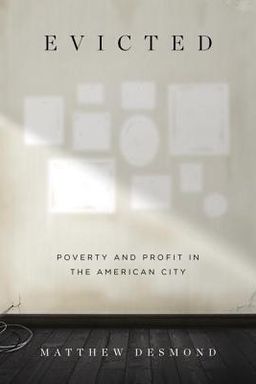
Evicted cover

Evicted

by Matthew Desmond

Evicted by Matthew Desmond delves into the heartbreaking world of eviction in American cities, revealing how systemic injustices and economic inequality trap families in poverty. Through powerful storytelling, it highlights the urgent need for housing reform and social justice, offering readers a profound understanding of the housing crisis.

Eviction: America's Hidden Housing Crisis

When you picture home, what comes to mind? A place of comfort, a refuge after a long day, maybe even a symbol of safety and belonging. But what happens when that security is suddenly stripped away—not because of a hurricane or fire, but because you couldn’t afford rent last month? This unsettling question lies at the heart of The Alarming Normalcy of Evictions, a powerful exploration of the growing eviction crisis across the United States.

The book argues that eviction has quietly become one of the defining social problems of modern America—especially for low-income families, single mothers, and people of color trapped in a cycle of poverty and unstable housing. It shows how eviction isn’t just the result of personal failure or bad luck, but a structural failure rooted in rising rents, stagnant wages, inadequate welfare, and housing markets tilted toward profit rather than safety.

The Scope of the Crisis

Throughout towns and cities, eviction has become so common that it’s almost invisible. Citing examples like Milwaukee—where one in eight tenants faced eviction over three years—and New York City, which processed nearly 80 eviction cases daily, the book exposes how widespread this issue is. Even census data undercounts it because many evictions occur informally, without ever reaching a courtroom. That means countless families have their belongings dumped on sidewalks without any record or appeal.

The author notes that eviction, once considered morally unacceptable, has become routine. During the Great Depression, for example, communities rallied to defend neighbors facing eviction—sometimes bringing thousands of protesters into the streets. But today, despite similar economic hardships, that kind of solidarity has faded. Eviction is now normalized, a quiet crisis unfolding behind closed doors.

The Economic Roots of Eviction

At the core of the problem is a widening gap between rents and incomes. Housing studies from Harvard show that between 2001 and 2014, rents rose seven percent while incomes fell nine percent. As a result, more than half of low-income families now spend over half of their income on rent—while a quarter devote more than 70 percent. When you’re that stretched, a single missed paycheck, medical bill, or welfare error can mean losing your home. For a veteran like Lamar in Milwaukee, an accidental overpayment led to a debt repayment and ultimately to eviction, even after selling food stamps and working for his landlord in vain attempts to catch up.

Profit Over People: The Landlord Perspective

The book doesn’t shy away from showing how landlords profit from this system. Owners like Sherrena Tarver and Tobin Charney treat their tenants as sources of steady income, even when their properties are unsafe. After a deadly fire in one of Tarver’s units—where smoke detectors hadn’t been installed—her concern was not the tragedy, but whether she was legally responsible or had to refund rent. When she learned she wasn’t, she moved on without remorse. The message is clear: for many landlords, exploitation is part of the business model.

Eviction as Social Control

Evictions don’t fall evenly across society. In Milwaukee, three-quarters of those summoned to housing court are black, and black women bear the heaviest burden. Although they make up only nine percent of the population, they account for 30 percent of all evictions. This disparity doesn’t just reflect income inequality—it’s a form of structural discrimination. Black women, often single mothers, face landlords who deny larger apartments, courts that favor property owners, and systemic neglect from laws like the Fair Housing Act, which never accounted for family status discrimination. Only ten percent of tenants have legal representation; seventy percent never even appear in court because they know they’ll lose.

The Human Cost of Displacement

The book’s stories are deeply human. It reminds you that eviction isn’t just about losing shelter—it’s about losing hope, stability, and dignity. Many evicted mothers suffer clinical depression for years. Housing-related suicides doubled between 2005 and 2010 as rents soared. Domestic violence survivors risk losing their homes simply for calling the police. Once evicted, families face hunger, sickness, lost jobs, and disconnection from their social networks. Research shows that eviction increases the chance of job loss by 15 percent and family hardships by 20 percent. It’s a downward spiral that pushes families into worse neighborhoods and deeper poverty.

Housing as a Human Right

Ultimately, the author calls for a moral reawakening: to see housing not as a privilege, but as a human right. Without stable homes, communities can’t thrive, children can’t learn, and parents can’t pursue happiness. The book proposes solutions—chief among them an expanded housing voucher system modeled after successful programs in Britain and the Netherlands. These programs help families pay rent without disincentivizing work, proving that housing stability and economic productivity can coexist. The author urges America to reclaim the principle that a home is the foundation of life, liberty, and the pursuit of happiness.

So this book isn’t just an exposé—it’s a call to empathy and reform. It asks you to see eviction not as someone else’s misfortune but as a collective failure that affects us all. Because when housing becomes insecure, civilization itself begins to crumble. And maybe, if enough people care, we can reverse this alarming normalcy before it becomes irreversible.


Rising Rents and Falling Incomes

One of the most striking aspects of America’s eviction epidemic is how predictable it has become. The book shows that the math simply doesn’t work: rents keep rising while wages decline, especially for low-income households. Between 2001 and 2014, researchers found that average rents increased by seven percent, but incomes fell by nine. This widening gap creates an impossible situation for millions of families who must choose between paying for housing or paying for food, medicine, and transportation.

The 30 Percent Rule and Its Breakdown

Economists often use the “30 percent rule” to measure housing affordability—you shouldn’t spend more than 30 percent of your income on rent. Yet census data shows most low-income tenants spend over 50 percent, and more than a quarter spend over 70 percent. That leaves little room for emergencies or life’s surprises. A single glitch—like a missed payment or overpayment of welfare funds—can spiral into poverty and eviction. Lamar, a disabled veteran in Milwaukee, illustrates this reality. After receiving an erroneous welfare check and using it for school supplies for his sons, he was told he must repay it. Selling food stamps and working maintenance jobs failed to save him; he lost his home anyway.

The Shrinking Job Market

The book connects this struggle to decades of job loss. Manufacturing once supported cities like Milwaukee, but the industry collapsed as jobs moved overseas. Between 1979 and 1983, 56,000 jobs were lost in that city alone. Today, half of working-age black men there are unemployed, and welfare barely covers living costs. It’s a reminder that eviction isn’t just about personal mismanagement; it’s about dismantled economic structures that no longer support stability.

A Systemic Poverty Trap

In a system where rent rises faster than income, families live on the financial edge every day. Eviction becomes the final stage of a long series of small defeats—minor crises that accumulate until survival becomes impossible. The author suggests that unless housing policy addresses this imbalance, eviction will remain inevitable for millions. Like Matthew Desmond’s Evicted, this book reveals how unstable housing isn’t just a symptom but a cause of deepening poverty.


Profit Over Safety

Once tenants fall behind on rent, their vulnerability becomes an opportunity for exploitation. The book explores how landlords often prioritize profit at the expense of safety and ethics. This dynamic turns housing into a predatory market, where survival depends not on fairness or justice but on power.

The Case of Sherrena Tarver

Sherrena Tarver represents the dark side of property management. After a deadly fire destroyed one of her apartments—killing a baby—her first concern wasn’t human loss but whether she’d be held legally responsible. When inspectors confirmed she was not liable and didn’t have to refund rent, she expressed relief and moved on. Her negligence, especially regarding smoke detectors, symbolized how landlords view tenants as replaceable sources of income rather than lives in their care.

Tobin Charney’s Trailer Empire

Similarly, Tobin Charney owns 131 trailers in Milwaukee, making $400,000 annually while spending almost nothing on maintenance. His properties are overcrowded, poorly maintained, and often unsafe. Meanwhile, his tenants live without legal protection or financial flexibility. Their fear of eviction prevents complaints; their silence keeps his profits secure.

Fear as a Business Tool

This fear creates a feedback loop. Landlords use eviction threats to maintain control. Tenants tolerate broken toilets, holes in walls, or lack of heat rather than risk losing shelter. The system incentivizes exploitation because evictions replenish supply—another desperate tenant will always replace the previous one. Profit thrives in instability. As the author emphasizes, the equation of housing with capital—rather than human need—is fundamentally corrupt.


Racial Disparity and Gender Targeting

The book’s most devastating revelation is how race and gender intersect to make eviction a weapon of discrimination. In Milwaukee’s housing courts, black tenants represent 75 percent of those summoned, and black women face eviction rates three times higher than their population share. This reality exposes systemic racism and sexism embedded in housing policy.

Black Women and Eviction Risk

Even though black women make up only nine percent of Milwaukee’s population, they account for 30 percent of its evictions. One in five black women will be evicted compared to one in fifteen white women. Why? Lower wages, single motherhood, and rental discrimination mean fewer housing options and greater financial vulnerability. Landlords often refuse to rent larger spaces to single mothers, trapping them in overcrowded units and charging disproportionate rents.

Legal Inequities in Housing Court

Court procedures reinforce this bias. Ninety percent of landlords have lawyers; only ten percent of tenants do. Worse, seventy percent of tenants don’t attend court at all—they can’t miss work, afford childcare, or believe they’ll win. The Fair Housing Act of 1968 outlawed racial discrimination but failed to address family status. Single mothers, thus, exist in a legal blind spot.

Segregation Reinforced

Milwaukee’s deep segregation is not accidental—it’s perpetuated by real estate practices. White tenants often fear moving into black neighborhoods, even poorer ones, while black families are rarely offered decent units outside their communities. The result is a housing market that stratifies poverty along racial lines. Eviction becomes not just an outcome but a mechanism for maintaining segregation.


The Psychological Toll of Eviction

Eviction isn’t only a financial loss—it’s an emotional and psychological trauma. The book traces how displacement destabilizes families, triggers depression, and even leads to suicide. These hidden costs make eviction one of the most harmful yet least understood forms of modern suffering.

Depression and Despair

Half of mothers who have been evicted report clinical depression lasting years. Losing a home produces shame, exhaustion, and hopelessness. Children absorb that pain too—they lose schools, friends, and routines. When housing insecurity becomes chronic, mental health declines, creating generational damage. Between 2005 and 2010, the number of housing-related suicides doubled, prompting psychiatrists to label eviction a “precursor to suicide.”

The Hidden Triggers

Evictions aren’t always about missed rent. Domestic disputes or police calls can be grounds for removal. Victims of abuse risk homelessness simply for seeking help. These policies reflect institutions that punish vulnerability rather than protect it.

Cascading Consequences

After eviction, survival becomes a constant uphill battle. Families lose possessions, face hunger or illness, and often miss out on benefit checks sent to old addresses. Job loss rates rise by 15 percent among evicted individuals, and hardship rates—like lack of heat or phone service—rise by 20 percent. The instability intensifies poverty and relocates families into more dangerous neighborhoods. In short, eviction doesn’t just reflect poverty—it amplifies it.


Housing as a Human Right

The book ends with a powerful moral appeal: housing must be recognized as a fundamental human right. A house is more than shelter—it’s the foundation of psychological security, family stability, and the social fabric of communities. Without secure housing, the American ideal of life, liberty, and happiness is unattainable.

The Cultural Meaning of Home

The author highlights how ancient cultures equated home with family and motherhood. The Egyptian hieroglyph for home also meant mother, while in Chinese, “jiā” signifies both family and home. These linguistic parallels underline the emotional and cultural depth of the concept. Home is civilization’s heart, not just property.

Policy Solutions

To treat housing as a right, the author proposes expanding voucher systems. Families below a certain income level could spend 30 percent on rent, with vouchers covering the remainder—similar to food stamps for housing. Britain’s Housing Benefit and the Netherlands’ allowances prove such systems work, maintaining employment rates while promoting stability. Critics claim such assistance weakens work ethic, but most studies show no decline in labor participation.

The Ethical Imperative

Evictions erode empathy and community spirit. The author argues that reversing this trend demands a cultural shift: to view housing as shared responsibility, not private luck. When homes are secure, children flourish, communities strengthen, and society heals. Without stability, democracy itself loses its moral grounding. The book’s final challenge is simple yet profound—if the nation’s founding values mean anything, housing must be part of the promise.

Dig Deeper

Get personalized prompts to apply these lessons to your life and deepen your understanding.

Go Deeper

Get the Full Experience

Download Insight Books for AI-powered reflections, quizzes, and more.