
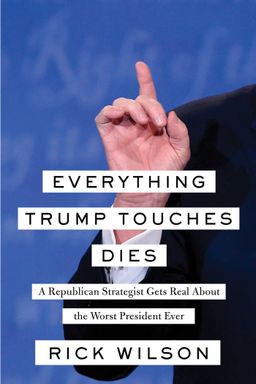
Everything Trump Touches Dies cover

Everything Trump Touches Dies

by Rick Wilson

In ''Everything Trump Touches Dies'', Republican strategist Rick Wilson delivers a searing critique of how Donald Trump''s presidency has eroded the core values of the GOP. Wilson exposes the party''s shift towards authoritarianism and white nationalism while offering a roadmap for conservatives to reclaim their principles and reshape the party''s future.

The Machinery of Trumpism

How did a reality TV figure become president, and why did the system enable him? In Everything Trump Touches Dies, Rick Wilson argues that Donald Trump’s rise was not an accident or an insurgent miracle—it was the product of a political, cultural, and economic machinery that valued power, spectacle, and profit over principle. You can’t understand Trump’s dominance, Wilson explains, without mapping the network of party elites, media moguls, donors, and voters who made him plausible.

The Enablers

Wilson coins the term “Vichy Republicans” for the political and institutional figures who surrendered their standards to accommodate Trump. Reince Priebus legitimized him with a loyalty pledge to avert a third-party rebellion. Paul Ryan traded reputation for policy wins. Chris Christie hoped for influence and got humiliation. Roger Ailes and Rupert Murdoch monetized Trump’s theatrics for ratings. Conservative institutions like CPAC provided a platform, cementing his transformation from carnival act to nominee. Each pursued short-term benefits—in money, attention, or access—while abandoning traditional conservative principles of restraint, character, and constitutionalism.

The Media Ecosystem

The book shows that Trump did not merely use media; he lived inside it. Cable networks treated him as spectacle, while Fox News became both enabler and mirror. Sean Hannity functioned as host and adviser, collapsing the line between coverage and coordination. Breitbart and Infowars amplified conspiracies that validated the base’s anger. The result was a feedback loop—Trump watched, tweeted, and governed reacting to stories that validated his impulses. This dynamic converted infotainment into national policy direction. (Note: Wilson’s account resembles Neil Postman’s warnings in Amusing Ourselves to Death about the transformation of political discourse into entertainment.)

The Base and Bargains

At the ground level, Trump’s rise relied on emotional transactions rather than ideological coherence. His base—older, whiter, and economically anxious—wanted vengeance on elites and cultural restoration. Evangelical leaders accepted him as a necessary evil in exchange for judges and policy favors. The Wall became not merely an immigration policy but a symbol for cultural preservation and grievance. Wilson captures this vividly: Trump offered them someone to blame, and they saw themselves reflected in his defiance.

The Author’s Thesis

Wilson’s core argument is simple but devastating: Donald Trump is not the disease but the symptom of a deeper rot in conservative politics. The Republican Party’s institutions, donors, pundits, and voters built the environment that elevated him. When values yield to opportunism, when propaganda replaces policy, and when personality displaces principle, every institution that touches the movement begins to corrode. That, Wilson says, is why everything Trump touches dies—including the GOP’s credibility, moral authority, and future as a governing force.

Key idea

Trump’s presidency is less the story of one man’s chaos and more a mirror of what happens when politics, media, and morality collapse into a marketplace of outrage. Wilson’s narrative exposes a system that traded its soul for spectacle—and found itself consumed by it.

Across chapters, Wilson uses vivid portraits—consultants, media figures, White House staff, and family—to reveal a common pattern: self-interest elevated over governing ethics. You watch reputations erode, institutions break, and a party trade its principles for temporary wins. The book’s arc, from the rise of enablers to the implosion of governance, forms a unified diagnosis of a democracy infected by opportunism and loyalty cults rather than leadership. The tragedy, Wilson insists, is institutional as much as personal: the GOP and its governing apparatus learned too late that moral compromise, once normalized, devours everything in its path.


The Price of Enabling

You watch how Trump’s rise owes as much to enablers as to the candidate himself. Wilson depicts a gallery of political, corporate, and media figures who turned skepticism into complicity, either for access or influence. Reince Priebus’s loyalty pledge granted Trump legitimacy; Paul Ryan sacrificed principle for tax cuts; Rupert Murdoch and Roger Ailes ignited a ratings explosion that made Trump omnipresent. Behind the curtain, donors and consultants rationalized their capitulation as pragmatism—the belief that 'winning' excused endorsement of chaos.

Why They Did It

Wilson explains that every enabler thought short-term: secure policy wins, preserve the donor pipeline, or ride the populist wave. Reince Priebus avoided civil war in the GOP; Ryan wanted a corporate tax overhaul; McConnell coveted judicial seats. Media executives chased profits, excusing moral rot with Nielsen ratings. Each decision, made in isolation, collectively dismantled conservative ethics. The Faustian exchange created a new party ethos: loyalty over liberty, emotion over evidence, and personal survival over civic duty.

Consequences

As the book unfolds, these transactions have cumulative effects. The party’s philosophical spine dissolves. Governing becomes reactive, defined by spectacle. Institutions become afraid to assert independence. The swamp, Wilson notes, was not drained—it expanded with new tent poles of opportunism. (In contrast to Barry Goldwater’s 1964 defense of principle against expediency, Wilson shows how modern Republicans retreated from integrity when faced with populist pressure.)

Core insight

Trump’s enablers did not simply tolerate him—they constructed the scaffolding on which his political house stands. The price of enabling a demagogue is not temporary embarrassment; it’s permanent institutional damage.

If you want to see how principle decays, Wilson’s catalog of enablers explains it vividly: one small compromise at a time, validated by success until conscience disappears. The book’s tone alternates between forensic and moral, documenting choices that transformed idealism into complicity. Wilson’s message is blunt: when elites justify the indefensible in pursuit of short-term gain, they erase the foundation of governance built on trust and ethics.


Inside the Chaos Presidency

Wilson portrays the Trump administration as an operating model of dysfunction. Decisions flow from impulse, paranoia, and ego, not deliberation. You see it in the travel-ban rollout, the firing of James Comey, and the endless staff churn at the White House. Each example illustrates an unmanageable leadership style that replaces planning with spontaneous rage-tweets. Wilson repeatedly returns to the idea that chaos isn’t incidental—it’s the presidency’s governing philosophy.

Personnel and Turnover

Senior hires—the so-called grown-ups like John Kelly, Rex Tillerson, and Jim Mattis—enter as stabilizers and exit as casualties. Kelly’s integrity erodes amid scandals; Tillerson gets fired by tweet; Mattis departs as the last remaining adult. Below them, press aides like Sean Spicer and Sarah Huckabee Sanders transform briefings into propaganda theater, while loyalists like Kellyanne Conway and Stephen Miller sustain the chaos through manipulation and ideological rigidity. Wilson calls this churn 'government by implosion'—a self-devouring organism that fears competence.

Institutional Damage

When professionalism collapses, recruiting talent becomes impossible. Bureaucrats flee, experts refuse appointments, and governance degrades. Wilson compares the environment to kleptocracies where paranoia replaces policy. Staffers spend days worrying about leaks, legal exposure, and reputation rather than public service. The long-term consequence is institutional corrosion: agencies lose memory, decision-making slows, and public trust erodes. (Note: The author’s analysis mirrors Hannah Arendt’s observation that authoritarian systems ultimately destroy competence as they reward loyalty over ability.)

Lesson

Leadership defined by insecurity and vengeance guarantees instability. When every aide fears humiliation and exit, the government stops governing and begins surviving.

This section shows the human cost of loyalty-first politics: careers destroyed, institutions hollowed out, and national credibility diminished abroad. Wilson’s diagnosis is both personal and structural—Trump’s inability to be saved ensures his White House cannot function. The moral? Competence cannot coexist with chaos; neither can democracy when loyalty outranks law.


The Family Business of Politics

In Wilson’s portrayal, the Trump family operates not as public servants but as brand managers monetizing the presidency. Jared Kushner and Ivanka Trump are presented as central figures—polished but unqualified, mixing ambition with financial desperation. Kushner’s vast portfolio covers Middle East peace, China relations, and innovation, all while he carries debt on 666 Fifth Avenue. Ivanka’s fashion empire blurs public and private, transforming policy into marketing. The collision of family and state defines the administration’s ethical decay.

Conflicts and Corruption

Wilson documents how lack of divestment converts public office into a sales opportunity: foreign governments and domestic lobbyists flock to Mar-a-Lago and the Trump International Hotel to buy access. Don Jr.’s entanglement in the Trump Tower meeting makes the family part of the Russia investigation, while Eric manages decaying business ventures that still profit from governance. Even Melania, portrayed with sympathy, becomes a symbolic casualty—her constrained role exposes the personal wreckage that mirrors national dysfunction.

A Syndicate of Power

Wilson’s term “family syndicate” is deliberate: nepotism collapses accountability. Without checks, errors multiply and self-dealing thrives. Jared’s unreported meetings, altered disclosures, and ongoing investigations reveal how personal desperation intersects with policy vulnerability. The system becomes transactional: access, loyalty, and immunity traded for profit. (Parenthetical note: Wilson’s critique echoes Robert Caro’s longstanding insight that family and personal networks are the most powerful instruments of corruption when merged with executive authority.)

Key takeaway

You can’t run a country like a family business. Nepotism without expertise converts the government into a hub for conflicts of interest, reputation loss, and foreign leverage.

Across the family narrative, Wilson’s tone shifts from indictment to warning: moral boundaries are not optional in governance. When public office becomes a vehicle for private enrichment, legitimacy collapses. The presidency, by becoming brand extension, turns democracy into a storefront—an open invitation to corruption masked as charisma.


Ideology and Its Deformation

The book’s middle sections trace how Trumpism rewrote Republican ideology. Once committed to limited government and free markets, the party now embraces a form of punitive, nationalist statism. Wilson catalogs the ideological reversals: massive defense budgets, tariffs replacing free trade, and executive overreach justified as 'patriotic necessity.' Fiscal restraint evaporates with the passage of the 2017 tax bill—a case study in crony capitalism.

From Principle to Appetite

The tax bill permanently cut corporate rates to 21 percent but offered only temporary personal benefits. Wall Street executives like Gary Cohn and Steve Mnuchin oversaw legislation benefiting their networks. Coal barons like Robert Murray lobbied for regulatory rollbacks, proving the merger of political access and industry self-interest. Wilson calls it 'bad big-government capitalism'—the state becomes an instrument for private enrichment. Fiscal conservatism dies not through debate but through apathy.

Economic and Moral Collapse

Trade wars with China hurt the very communities that elected Trump. The ideological pivot—from small-government conservatism to state-managed vengeance—marks the end of consistency. Evangelical alliances add religious cover to moral compromise; promises of national revival morph into moral inversion. (Note: This echoes Christopher Lasch’s analysis of populism as emotional politics detached from principle.)

Insight

Trump’s version of conservatism uses power not to limit government but to weaponize it. What once guarded liberty now enforces loyalty.

Wilson’s ideological autopsy reveals not just hypocrisy but transformation. The GOP, once defined by market freedom and civic restraint, now functions through patronage, protectionism, and resentment. The conservative project, he warns, cannot survive under those terms—the principles are gone, leaving only slogans.


How Movements Collapse and Parties Rebuild

Wilson closes with both autopsy and hope: the party is poisoned but not beyond repair. Trump’s electoral footprint shrinks Republican viability everywhere outside the core base. Through state and congressional races—Virginia, Pennsylvania, Alabama—the author demonstrates how Trump’s toxic tone repels moderates and women. 'But Gorsuch' isn’t enough, Wilson mocks; one Supreme Court seat cannot justify long-term decline among suburban voters.

Patterns of Decline

Trumpism’s policies and scandals depress GOP prospects. The party bleeds talent through retirements and alienates younger and minority voters. Short-term populism yields long-term fragility. Media rationalizations (Trumpsplaining stages: embarrassment, rationalization, whataboutism, magical thinking, and amnesia) recycle denial instead of reform. Wilson warns that these cycles guarantee institutional decay until courage replaces complacency.

Blueprint for Renewal

Restoration requires moral, structural, and message reform. Wilson urges Republicans to purge racists, rebuild ethics rules, and reclaim constitutional discipline. The party must speak again about opportunity rather than fear, competence rather than grievance. He imagines a 'Big Reset'—a movement returning to optimism, integrity, and diversity akin to Eisenhower or Reagan traditions. (Note: Wilson’s prescription resonates with Jonathan Haidt’s view that moral foundations, not tactics, restore credibility.)

Final message

The future of American conservatism depends not on defending Trump but on rediscovering courage to stand for character, truth, and competence. The reboot begins where complicity ends.

Wilson ends with urgency, not despair. Trump may have hollowed out the party, but voters and leaders can still rebuild by rejecting outrage as governance. The book’s moral: democracy survives when leaders decide that integrity is not nostalgic, courage is not optional, and competence is not partisan.

Dig Deeper

Get personalized prompts to apply these lessons to your life and deepen your understanding.

Go Deeper

Get the Full Experience

Download Insight Books for AI-powered reflections, quizzes, and more.