
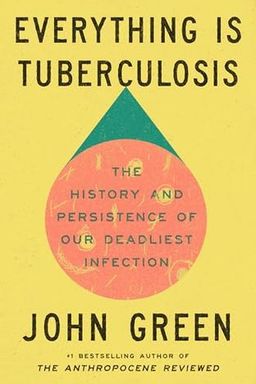
Everything Is Tuberculosis cover

Everything Is Tuberculosis

by John Green

The author of “The Anthropocene Reviewed” chronicles the fight against the deadly infectious disease tuberculosis.

Tuberculosis as a mirror of injustice—and our choice

What if the deadliest infectious disease in the world today is curable—and we are simply choosing not to cure it? In Everything Is Tuberculosis, John Green argues that tuberculosis (TB) isn’t just a microbe; it’s a mirror. It reflects how we build systems, distribute power, and assign worth. Green contends that TB operates along the trails of injustice we lay down: crowded housing, malnutrition, stigma, underfunded clinics, and profit-first drug markets. We’ve had the tools to end mass TB deaths since the 1950s. The persistent gap between where the cure is and where the disease is amounts, Green argues, to a moral, political, and imaginative failure.

In this guide, you’ll discover how TB shaped and was shaped by culture—from the Romantic era’s “flattering malady” to the racialized myths that followed Koch’s bacillus. You’ll meet Henry Reider, a teenager in Sierra Leone whose story anchors the book, and the clinicians (like Dr. Girum Tefera) and activists who refused to let him die. You’ll track how colonial extraction, structural poverty, and underinvestment in public goods produce the conditions where TB thrives. And you’ll learn about modern roadblocks—cost-effectiveness rules that ignore real costs, patents that prioritize profit over people, and diagnostics priced beyond the reach of the communities that need them most.

The core claim

TB is a disease of injustice. Green threads this through intimate losses—James Watt’s son Gregory (1804), Green’s great-uncle Stokes (1930), and modern-day friends like Indian student-activist Shreya Tripathi (2018). The data are stark: in 2023, TB killed about 1.25 million people, more than malaria, typhoid, and war combined, and likely over a billion across two centuries. Yet TB is curable. The mismatch between biology and reality is, Green insists, a human-made gap.

Why this matters now

We’ve seen, in real time, what happens when the rich world mobilizes against an infection (Covid-19). Green shows TB could benefit from that same urgency: scale molecular testing; fund active case-finding; shorten and tailor therapy; make lifesaving drugs and diagnostics public goods. And because TB follows malnutrition, HIV, diabetes, and poor ventilation, it’s also a tracer of whether we invest in people’s lives beyond the clinic. As physician Paul Farmer framed it, the point isn’t just TB control; it’s TB care—rooted in accompaniment, food, housing, dignity.

What you’ll learn

You’ll see how ideas about disease shape who lives and dies. In the 1800s, TB was romanticized as a disease of beauty and genius (spes phthisica). After Koch (1882), it became racialized as a disease of the “uncivilized.” Each narrative supported whose suffering counted and whose didn’t. You’ll move through sanatoria’s strict regimes, the tuberculin debacle (and Arthur Conan Doyle’s clear-eyed critique), and the mid-century antibiotics that emptied Western wards but never reached many poor communities. You’ll examine DOTS—a standardized program that expanded access but often treated patients as problems to be controlled rather than people to be cared for. And you’ll confront modern blockages: Johnson & Johnson’s evergreening around bedaquiline; Danaher/Cepheid’s razor-and-blade pricing for GeneXpert TB tests; and the way “cost-effectiveness” can be a moving target that hides real costs in future deaths and disability.

Stories that stick

Green’s anchor is Henry, a Sierra Leonean teen who looked nine because prolonged malnutrition and TB had stunted his growth. He endured painful injectables that stole his hearing—because safer oral regimens weren’t funded. Lakka Hospital had no steady electricity, little water, and no budget line for food, so hunger itself pushed people to abandon therapy. Then came a turning point: a tailored regimen with modern drugs, flown and driven across borders, overseen by Dr. Girum. Henry’s lymph nodes closed. His appetite returned. He went home, finished therapy, re-entered school, and now advocates publicly to shatter stigma. His life is a rebuke to resignation.

“The cure is where the disease is not, and the disease is where the cure is not.”

—Dr. Peter Mugyenyi, echoed throughout the book

Where the book lands

Green closes with a plan that’s both practical and moral: STP—Search (active case-finding and rapid diagnostics), Treat (shorter, safer, person-centered regimens), Prevent (one-month preventive therapy for close contacts). It’s not pie-in-the-sky. The WHO estimates each dollar invested in TB yields $39–$46 in benefits. But more than a spreadsheet win, it’s a test of who we are. He argues we can choose a world where no one dies of TB—if we treat medications, diagnostics, and care as public goods and refuse to outsource life and death to markets. Or we can choose the world we have now. TB, Green shows, is about everything because everything we value decides who gets to breathe.


How stories about illness shape lives

Green shows you that how we imagine disease isn’t window dressing; it’s triage. In the 18th and 19th centuries, Europeans romanticized “consumption” as a disease that refined the spirit while wasting the body—spes phthisica. That myth made TB seem almost desirable for poets and lovers. After Koch proved TB was infectious in 1882, the narrative flipped: TB became a disease of the poor and the racialized. Both stories served social order before they served patients.

The old romance: beauty, genius, and a “good” death

Victorians saw “hectic” cheeks, pallor, and thinness as beauty. Women used belladonna to dilate pupils; magazines taught rouge techniques to mimic fever’s flush. Writers fed the myth: Dickens in Nicholas Nickleby; Byron’s quip about dying of consumption to be “interesting”; and Henry Peach Robinson’s staged deathbed photographs (Fading Away). Doctors joined in: Arthur Jacobson wrote TB patients’ lives were “shortened physically, but quickened psychically.” The illness of the lungs—breath, spirit—was framed as ennobling (Frank Snowden notes, “lungs are more ethereal than bowels”).

But the bodies said otherwise. Keats’s postmortem found lungs “completely gone.” Masaoka Shiki, bedridden with TB, wrote stark haiku about drowning in phlegm and the loneliness of watching snow through a hole in a door—truths that puncture romantic haze. (Compare with Susan Sontag’s Illness as Metaphor, which argues that metaphors burden the sick.)

Gendered and racialized shifts after Koch

Once TB became “infectious” rather than “inherited,” European and American medicine declared it a “disease of civilization”—and then of white people. Beauty guides equated “alabaster” skin with virtue; medical texts claimed Black and colonized peoples had different or nonexistent TB. When data contradicted this, racism reasserted: Black Americans were said to be biologically more susceptible due to chest size or emancipation itself (J. F. Miller, 1896). In Canada’s residential schools, TB mortality soared to 8,000 per 100,000 per year—evidence, as Lena Faust and Courtney Heffernan argue, of deliberate neglect. The point isn’t past ignorance; it’s that cultural scripts kept (and keep) clinicians from seeing what’s in front of them.

Stigma replaces romance

Today, TB is framed as a disease of poverty, moral failing, or choice. Patients told Green: better to have cancer, because TB brings more shame. Mongolian survivor Handaa Enkh-Amgalan was warned to hide her diagnosis to remain marriageable. A Sierra Leonean woman said, “To them I am not a person.” Stigma doubles suffering—sickness + social death—and pushes people away from care. As Green puts it, we give diseases meanings to reassure ourselves: “I won’t get it because I’m not like them.”

Key Idea

The stories a society tells about TB—romance, race, or blame—decide who gets attention, funding, and empathy. They’re not metaphors; they’re policies.

Why this matters to you

You navigate health stories daily—about mental illness, long Covid, obesity, addiction. If you accept moralized narratives, you’re more likely to support “control” (surveillance, punishment) over “care” (food, transport, therapy). Green invites you to notice the scripts you’ve inherited and ask: do they help people breathe? Or do they let you off the hook?

(Context: Sontag argues metaphors stigmatize; Farmer argues for “a preferential option for the poor.” Green threads both together—changing minds and changing systems are inseparable.)


Colonial extraction made TB’s highways

If you want to see why TB thrives where it does, Green suggests you look at a map—of Sierra Leone’s railroads. They don’t connect people to each other; they connect mines to ports. That’s the legacy of British rule: infrastructure for export, not life. This isn’t abstract history; it’s the air Henry and his mother, Isatu, breathe.

How extraction built risk

Sierra Leone is rich—diamonds, iron ore—but wealth flowed out for centuries. Green cites Stephen Greenblatt’s 16th-century account of a razed town—admired for its cleanliness, burned for its utility. The slave trade kidnapped hundreds of thousands along routes whose names became people’s names (“Kaw-we-li”). Colonial institutions trained servants, not clinicians. By 1950, life expectancy in Britain was 69; in Sierra Leone, under 30. Post-independence, debt regimes and foreign ownership kept budgets thin, especially for health. (Joia Mukherjee details how structural adjustment capped public spending across the Global South.)

Isatu’s life across crises

Born in 1968, Isatu grows up Mende—woven into a village’s social fabric. War unravels it. During Sierra Leone’s civil war (1991–2002), she flees to Freetown, pregnant with Henry, dodging militias, hungry, and often without shelter. Later, her daughter Favor dies for lack of a surgical fee. Then Ebola (2014–16) collapses clinics; 221 health workers die. “Acute-on-chronic,” Ophelia Dahl calls it—crises layered on scarcity. Amid it all, Isatu prays for Green’s family by name. Care circulates, even when money doesn’t.

What “poverty” hides

Green insists Sierra Leone isn’t “a poor country”; it’s a rich country made poor by extraction and policy. That framing matters. If you think poverty is natural, you’ll prescribe short hemlines and no spitting (as early 20th-century TB campaigns did). If you see poverty as policy, you’ll fund wages for community health workers, reliable power for labs, and food for inpatients with TB. Isatu describes Lakka Hospital as “where hope and despair intertwined”—with three meager meals a day and no budget line for food. People left treatment because hunger hurt more than TB.

Key Idea

TB clusters where past and present policies make breathing risky: crowded rooms, low wages, bad transport, and clinics without water or electricity.

What you can see differently

Next time you hear, “Health systems are weak there,” ask: Who weakened them? Where are the rails pointed—to people or to ports? Who sets medicine prices? Green’s answer shapes everything that follows: TB is not only biological. It’s the sum of roads, budgets, and whose lives we choose to make light.

(Comparison: Vidya Krishnan’s Phantom Plague makes the same case in India—industrialization without justice is TB’s accelerant.)


From romance to bacillus to backlash

TB moved from mystery to microbe across the 19th century—and the journey mattered as much as the destination. Green traces the scientific turn: Robert Koch isolates Mycobacterium tuberculosis (1882), ending the “inherited” paradigm. But breakthroughs happen in human time, with rivalries, errors, and ethics shaping who benefits.

Koch, Pasteur, and the urge to cure

Koch proves anthrax is bacterial; Pasteur vaccinates against it. National pride frames science (“German science” vs. “French cures”). Eager to match Pasteur’s vaccines, Koch rushes tuberculin—a brown serum he believes will cure and prevent TB. It doesn’t. It triggers immune reactions in those already infected and kills infected tissue without killing bacteria—“like picking up rat droppings without removing rats,” as Arthur Conan Doyle observes in Berlin. Thousands travel to die in boardinghouses while seeking injections. Koch’s reputation plummets.

A useful failure

Conan Doyle realizes tuberculin’s real value: diagnosis. Exposing skin to the substance reveals prior infection (a precursor to modern PPD). It can’t tell dormant from active disease, but it maps silent spread—crucial in settings where most people harbor latent TB. Even missteps, Green suggests, can become tools—if humility guides us.

Sanatoria: control over care

Pre-antibiotics, the main therapies are rest, food, air, and light. Sanatoria proliferate (by 1925, the U.S. has 536 with 673,338 beds). They control every detail—when you speak, write, even feel. Sheila Rothman calls it “too prisonlike to be a hospital, too hospitallike to be a prison.” Gale Perkins spends 12 childhood years in casts; when she cries at night, nurses punish her with isolation screens. Her friend Angie dies after months of letters penned by a father imitating a dead daughter’s handwriting, because bad news was deemed dangerous to health. Sanatoria reduce transmission and help some recover, but their moral math—compliance first, dignity second—echoes today in rigid TB programs.

Key Idea

TB care has always wrestled with a question: Are patients problems to be controlled, or people to be accompanied?

Why this matters now

When modern TB programs demand daily observed swallowing, deny visitors, or ignore food, they echo tuberculin’s hubris and sanatoria’s control. Green isn’t anti-science; he’s pro-humility—learn from errors, measure what matters (lives lived), and never let systems forget the person in the bed.

(Context: Thomas Goetz’s The Remedy tells this saga; compare Green’s ethical lens with Frank Snowden’s broader history of epidemic societies.)


A cure arrives—and gets rationed

By the 1940s–60s, TB becomes curable: streptomycin, para-aminosalicylic acid (PAS), isoniazid, pyrazinamide, ethambutol, rifampin. Sanatoria empty out in rich countries. But in much of the world, TB mortality in 1990 mirrors the U.S. in 1882. Green asks: Why did the cure stop at some borders?

DOTS: scale with strings attached

In the 1970s–90s, the WHO backs DOTS (Directly Observed Therapy, Short-course): diagnose with sputum microscopy, treat with a standardized 6–9 month RIPE regimen, and require daily observed swallowing. Reporting is tidy; drug stockouts should be reduced; costs are kept low. Millions of lives are saved.

But DOTS misses half of cases (microscopy fails especially in kids). It isn’t built for drug-resistant TB. And its ethic centers on “compliance,” not care. A Haitian teen named Robert does everything right—four-hour travel, family sells land for meds—but stockouts and undertreatment drive his TB to multidrug resistance. He dies at 28. Farmer’s critique lands: call this a surveillance problem, not a patient problem.

Control vs. accompaniment

Randomized trials find directly observed swallowing isn’t better than patient-centered dispensing when support is strong. Yet DOTS’ distrust persists. Green notes no other field treats patients as presumptive liars at this scale. People stop meds for reasons you’d recognize: hunger, depression, distance, side effects, stigma. If you can forget your own daily meds (as Green does, despite easy pharmacy access), imagine remembering 14 pills while nauseated, shamed, and hungry.

What fair care looks like

Where teams brought food, cash, and companionship into homes, cure rates rivaled the best hospitals. In Peru’s shantytowns, Partners In Health (PIH) paired community health workers with tailored regimens and direct financial support. Cure rates: ~85% for MDR-TB in 1998—then the WHO expanded guidelines. When you start with dignity, medicine works better.

(Comparison: Tracy Kidder’s Mountains Beyond Mountains chronicles PIH’s model; Green carries it forward into 2020s TB.)


Drug resistance, bad incentives, and brave activists

Antibiotic resistance isn’t a surprise; it’s evolution. For TB, it’s worsened by our choices: few new drugs in 46 years (1966–2012), rationing modern orals, and clinging to toxic injectables. Green details both failures and fights that changed the odds.

A preventable tragedy: injectables vs. orals

Henry receives kanamycin—ototoxic, kidney-toxic—because safer bedaquiline-based regimens are unaffordable or unavailable. He wakes partially deaf and keeps silent, fearing treatment stoppage. This isn’t rare; hundreds of thousands still get injectables despite better options. Why? Price. Johnson & Johnson priced bedaquiline far above cost during its monopoly, placing it out of reach for ministries of health.

Shreya, Phumeza, and the power of survivors

Indian student Shreya Tripathi knows bedaquiline is “what my body needs.” Denied by national guidelines, she sues and wins—but her lungs are too scarred; she dies in 2018. South African student-athlete Phumeza Tisile loses all hearing from injectables, survives 3 years and 8 months of treatment, then co-leads a patent challenge (with journalist Nandita Venkatesan) to block J&J’s evergreening in India. After public pressure, J&J backs down globally. Price drops >60% overnight, making cures possible for thousands.

The “cost-effectiveness” trap

Green shows how “value” calculations can fossilize scarcity. In the 1960s, rifampin is underdosed at 600 mg because it was costly; today it’s cheaper, but the low-dose norm persists, possibly extending infectiousness and fostering resistance. If we let yesterday’s prices set today’s doses, we bake in failure. Farmer’s axiom applies: not treating MDR-TB is what’s truly expensive—future infections, lost work, disability, and death.

Key Idea

When meds and diagnostics are treated as market luxuries, resistance isn’t just biological—it’s policy-driven.

Hope in motion

The endTB trials (MSF, PIH, Unitaid) show ~90% MDR-TB cure with all-oral regimens in 6–9 months for about $300/drug course—down from $15,000 in the 1990s. That drop exists because survivors and clinicians refused the “too expensive” story. Your takeaway: when people closest to the problem lead, systems move.


The missing pieces: diagnostics, food, and time

Cure isn’t just pills; it’s also tests, calories, and fewer wasted days. Green spotlights two chokepoints that kept Henry and others stuck: overpriced rapid diagnostics and unfunded nutrition—plus the lost time that turns treatable disease into permanent harm.

Diagnostics priced like razor blades

The GeneXpert system (by Danaher/Cepheid) can confirm TB and flag rifampin resistance in hours—vital for tailoring therapy. But cartridges were priced at $9.98–$14.90 (now partially reduced), while manufacturing costs were estimated under $5. Danaher’s CEO called it a “razor-blade model in a mission-critical application.” In Sierra Leone, testing two cartridges per person eats more than half the per-capita health budget. Labs buy machines…but can’t afford blades. So hospitals default to smear microscopy and X-rays—slower, less sensitive, and blind to resistance—while patients like Henry wait, worsen, and spread disease.

Hunger as a side effect of poverty

TB kills appetite; treatment brings it roaring back. At Lakka, meals are meager and “food is not considered essential” in TB budgets. Marie—five foot three, under 70 pounds—dreams of eating mud soup and sticks. People stop treatment because it hurts to swallow pills on an empty stomach. A mother tells Green: money “whipped away on sickness.” If you were hungry, would you keep taking meds that made you sicker without food?

Case-finding and prevention buy back years

When clinicians go to people (mobile X-ray vans in mid-century U.S., Bethel, Alaska’s house-to-house prevention), TB rates plummet—Bethel cut incidence by 69% in one year. Active case-finding stops transmission chains, allows earlier, gentler care, and offers preventive therapy to exposed households. In Sierra Leone, little of this was funded—so patients arrived with “basically no lungs,” as Dr. Girum says. Time had done what microbes alone could not.

Key Idea

If budgets ignore tests and food, they bake failure into “treatment.” TB care must include diagnostics and calories—or it isn’t care.

(Context: Andrew McDowell’s Breathless captures the dehumanizing clinic encounters Green describes; both call for redesigning delivery around respect.)


From vicious cycles to STP—and Henry’s return

TB thrives in vicious cycles: poverty → malnutrition → TB → deeper poverty; HIV → weak immunity → TB → death; underfunded clinics → stockouts → resistance → more death. Green argues you can flip them—if you choose policies that privilege people over profits and control.

A practical blueprint: STP

Search: fund active case-finding with rapid tests and mobile X-ray/AI. Treat: shorter, safer, all-oral regimens, tailored when needed, with food and cash support. Prevent: one month of preventive therapy for household contacts. The WHO estimates each $1 invested in TB returns $39–$46; Green notes benefit–cost analyses now show close to a million deaths averted per year if scaled. The plan is not theory; it’s what worked in Karachi, Lesotho, Bethel, and Peru—just not yet everywhere.

What “victory” looks like

A young man in a cinder-block room gets to breathe, finish school, and laugh with his mother under a leaky roof. Henry’s tailored regimen starts; within weeks, ruptured lymph nodes heal “like magic.” After three years hospitalized, he goes home, completes therapy, and re-enters high school at 18, then university. He starts a YouTube channel, fundraises for neighbors, visits Lakka to de-stigmatize care (“This place is not a bad place”), and calls Green “Dad,” the earned kind. His life isn’t a miracle; it’s what happens when a clinic, a doctor, an NGO, a court case, and a global chorus say: not this time.

We are the cause—and the cure

Green asks a devastating practical question to TB doctor KJ Seung: “Of the 1.3 million who will die of TB this year, how many would die if they had the healthcare I have?” Answer: “Zero.” Total elimination is hard (animal reservoirs, vast latent pools). But eliminating TB deaths is policy, not fantasy. It will require calling meds and diagnostics public goods, building electricity and water into “care,” paying community workers, and funding science open-access. It will also require imagination—the refusal to let yesterday’s prices, borders, and metaphors decide who breathes tomorrow.

Key Idea

Tuberculosis is about everything because everything—roads, budgets, beauty standards, patents—decides whether a person gets to breathe.

(Note: Green’s closing echoes Farmer’s life work and aligns with Joia Mukherjee’s call for “a preferential option for the poor.”)

Dig Deeper

Get personalized prompts to apply these lessons to your life and deepen your understanding.

Go Deeper

Get the Full Experience

Download Insight Books for AI-powered reflections, quizzes, and more.