
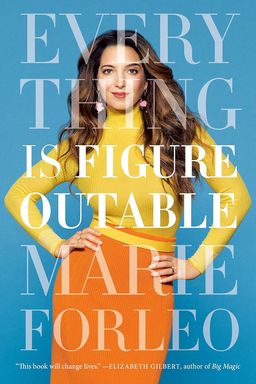
Everything is Figureoutable cover

Everything is Figureoutable

by Marie Forleo

Marie Forleo''s ''Everything is Figureoutable'' offers an empowering approach to tackling life''s challenges. Learn to dispel self-doubt, embrace fear as a motivator, and take actionable steps toward your dreams. Forleo''s philosophy encourages readers to turn obstacles into opportunities, fostering growth and success in personal and professional realms.

Everything Is Figureoutable: The Power of Belief in Action

What would you attempt if you were absolutely certain you could figure it out? In Everything Is Figureoutable, Marie Forleo builds an unshakable case for one transformative conviction: no matter what challenge you face—be it financial, professional, emotional, or personal—there is always a way forward. The key lies in training your mind to see obstacles not as impassable walls but as puzzles waiting to be solved. Her central idea, inherited from her resourceful mother, is deceptively simple but profoundly powerful: everything is figureoutable.

Forleo argues that this belief isn’t mere optimism—it’s a discipline. By adopting the mindset that everything can be figured out, you rewire your brain for creativity, persistence, and purpose. It’s not about pretending life is easy; it’s about believing in your intrinsic capacity to meet life with ingenuity. This approach, Forleo insists, is the gateway to resilience, confidence, and meaningful success. Through stories, exercises, and “Insight to Action” challenges, she takes readers on a journey to confront limiting beliefs, escape perfectionism, and take action despite fear.

The Origins of a Mantra

Forleo begins with the story of her mother—a woman with the resourcefulness of June Cleaver and the vocabulary of a truck driver. In the pre-Google era, her mother could fix leaky roofs, rewire electronics, or re-tile bathrooms without instructions. Her secret? She believed every problem had a solution if you cared enough to find it. Watching her mother repair a broken Tropicana orange-shaped radio, Forleo asked how she knew how to do all these things. Her mother simply said: “Nothing in life is that complicated. You can do whatever you set your mind to if you just roll up your sleeves. Everything is figureoutable.” That phrase became both Forleo’s personal ethos and professional mission—a mental operating system capable of transforming inertia into innovation.

This philosophy powered Forleo through personal adversity—from escaping an abusive relationship to building a multimillion-dollar business with no funding, connections, or advanced degrees. She presents the mantra not as motivational fluff but as a pragmatic tool for self-reinvention. When you repeat “everything is figureoutable,” you are training your subconscious to search for solutions instead of excuses.

Why We Need This Philosophy Now

Forleo situates her book in a world teetering on burnout. She points to disengagement at work, depression, inequality, and environmental collapse as evidence that humanity’s greatest failures stem not from lack of potential but from lack of belief. Before we can change systems, she argues, we must first restore belief in personal efficacy. In her words: “There can be no significant change in the world unless we first have the courage to change ourselves. And in order to change ourselves, we must first believe we can.”

This makes Everything Is Figureoutable part manifesto, part workbook, part conversation with a tough-love coach. Forleo blends cognitive behavioral principles, neuroplasticity, and the science of belief formation with real-world stories that prove her theory—from survivors of abuse to entrepreneurs and activists. Through this, she reframes self-help as skill-building rather than wishful thinking.

From Insight to Action

Each chapter builds on a “figureoutable” mindset through actionable practices: training the brain for growth, eliminating excuses, confronting fear, defining clear dreams, and starting before you feel ready. Forleo’s “Insight to Action Challenges” serve as on-the-page coaching sessions, turning philosophical insights into measurable progress. She insists that insight without action is worthless. From dismantling fears to rewriting limiting beliefs, every step is designed to strengthen self-efficacy—the conviction that you can influence your own outcomes (a principle shared with Carol Dweck’s concept of the growth mindset and Angela Duckworth’s research on grit).

At its heart, the book challenges the illusion of helplessness. Forleo’s readers are not passive consumers but active learners. Whether you’re confronting grief, systemic adversity, or simple procrastination, she promises that adopting this mantra will unlock creativity and emotional sovereignty. The real power, she says, lies not in external resources but in your willingness to engage, experiment, and persist.

Why It Matters

In a time of uncertainty, Everything Is Figureoutable offers a counter-narrative to despair. It’s not about relentless positivity but resilient realism. Forleo invites you to rewrite your beliefs about what’s possible and reclaim authorship of your own life. Her message echoes C.S. Lewis’s wisdom that “you can’t go back and change the beginning, but you can start where you are and change the ending.” Ultimately, Forleo’s book is both philosophy and call to arms—a reminder that no matter what happens, there is always a next step, and it’s figureoutable.


Train Your Brain for Growth

One of Forleo’s first practical steps toward making life “figureoutable” is to retrain your brain—to question the habitual thoughts that sabotage progress. She identifies two mental “viruses”: “I already know this” and “This won’t work for me.” These judgments, similar to what psychologists call cognitive distortions, prevent learning and experimentation. Whenever those phrases appear, Forleo challenges you to swap them for better questions: “What can I learn from this?” and “How can this work for me?”

By doing so, you transform passive thought into active curiosity. This shift mirrors research in neuroplasticity: the brain grows and rewires itself in response to purposeful questioning. Repetition of empowering thoughts builds neural pathways that support adaptability and confidence.

Try It Before You Deny It

Forleo urges readers to suspend cynicism and test her philosophy. She offers three playful “rules of play” as guardrails for applying the mantra:

  • All problems or dreams are figureoutable.
  • If a problem isn’t figureoutable, it’s a law of nature—like death or gravity.
  • If you’re not making progress, you may simply not care enough to figure it out yet—and that’s okay.

By reframing resistance as lack of interest rather than lack of capability, you disarm self-criticism. As Forleo notes, recognizing that you choose not to pursue something can free you from guilt and focus your energy on what truly matters. This radical ownership of choice echoes the Stoic principle (found in Epictetus’s writings) that we control our attitudes, not external events.

Do the Work

Yet Forleo refuses to stop at theory. “Insight without action,” she says, “is worthless.” Handwriting, reflection, and daily repetition are tools to reprogram your mind. She cites studies showing that writing by hand connects cognition and emotion more effectively than typing. The act of physically putting thoughts on paper slows the mind, strengthens understanding, and crystallizes commitment. In her view, every exercise and challenge in the book is a mini apprenticeship in mental focus.

She likens the process to fitness: repetition builds muscle. Similarly, practicing “everything is figureoutable” rewires your mental circuits. Repetition plus emotion equals transformation—a formula supported by neuroscience and performance psychology.

Community Power

Finally, Forleo emphasizes community. Learning becomes exponential among supportive peers. Through MarieTV, podcasts, and online programs, she has created a global network of “figureoutable” thinkers who share solutions and celebrate progress. As she puts it, “Nothing in this book will work unless you do—but when you do, and connect with others doing the same, you’ll be unstoppable.” This collaborative approach reflects modern learning theory (Vygotsky’s “zone of proximal development”)—we learn best in community, not isolation.


The Magic of Belief

Forleo argues that the foundation of figuring anything out lies in belief. Your beliefs, she says, are “the hidden scripts” that program your thoughts, emotions, and behaviors. They shape your self-worth, dictate what opportunities you see, and set the limits of your potential. To change your reality, you must first change your beliefs.

Belief as a Creative Force

Forleo invites readers to look around: every man-made object—from smartphones to novels—once existed only as an idea. In her simple equation, creation follows the sequence: Belief → Thought → Feeling → Behavior → Result. Everything, she says, begins on the level of belief. She supports this with stories from science, such as placebo surgeries that yield healing outcomes purely because patients expect success. The human body, as shown by Dr. Jerome Groopman’s research in The Anatomy of Hope, literally releases chemicals like endorphins and enkephalins in accordance with belief.

When Belief Becomes Liberation

To illustrate this, Forleo recounts the story of Marva Collins, a legendary Chicago teacher who refused to accept that her students—many labeled “unteachable”—could not learn. Collins’s unwavering belief in their potential turned failure into triumph; one former student, once deemed “borderline retarded,” went on to graduate from college. Forleo uses this story to argue that belief doesn’t just change perception—it alters destiny.

Where Beliefs Come From

She identifies five sources of belief: environment, experience, evidence, examples, and envisioning. Many of our limiting beliefs are hand-me-downs from families, teachers, and culture—accepted without question. Confirmation bias then reinforces them: the brain filters reality to confirm what it already believes. To expand, you must actively challenge those beliefs through awareness, experimentation, and repetition. The mind’s “plasticity” allows old neural patterns to weaken and supportive new ones to strengthen.

Forleo’s antidote is the meta-belief itself: “everything is figureoutable.” Like a master key, it unlocks every mental door. Say it aloud daily, she urges, until it becomes your default worldview. The words you repeat shape your life because, as she writes, “The most powerful words in the universe are the words you say to yourself.” This echoes the self-perception insights of psychologist William James and aligns with CBT techniques that replace distorted thoughts with empowering truths.

In essence, Forleo redefines belief as a tool, not a trait. When you take conscious control of your internal narratives, you shift from passive observer to active creator of your reality—turning belief from a limitation into liberation.


Eliminate Excuses and Take Responsibility

Forleo’s next challenge is ruthless honesty. “The worst lies,” she writes, “are the ones we tell ourselves.” Excuses are seductive forms of self-protection that disguise fear, resistance, or apathy as logic. Whether it’s “I don’t have time,” “I can’t afford it,” or “I don’t know how,” the core message behind every excuse is: I’m not taking responsibility.

Her linguistic intervention is simple but potent: replace “can’t” with “won’t.” When you affirm “I won’t,” you reclaim agency. Instead of being a victim of circumstance, you acknowledge that you’re making a choice. This echoes Albert Ellis’s concept of personal responsibility in Rational Emotive Therapy—your emotions and actions are within your control even when external events are not.

Time, Money, and Know-How—The Three Great Excuses

Forleo dismantles these classic barriers:

  • Time. Everyone gets 24 hours. Saying you “don’t have time” usually means it’s not a true priority. Track your schedule for a week, and you’ll see where your time silently leaks—social media, email, or entertainment. She even prescribes a “time audit” and challenges readers to reclaim just two hours a day, noting that these reclaimed hours, multiplied over a year, can transform your health, wealth, or creativity.
  • Money. Resource limits can spark resourcefulness. Forleo herself built her empire with multiple side jobs—bartending, teaching fitness, and cleaning toilets—until her business produced sustainable income. She affirms Tony Robbins’s idea: it’s not about resources; it’s about resourcefulness. Today, free education abounds, from edX to Khan Academy. Where there’s commitment, options multiply.
  • Know-how. In an era of infinite information, ignorance is a choice. Tutorials, mentorships, and MOOCs can teach virtually any skill. The challenge isn’t lack of knowledge—it’s lack of action.

Inspiring Examples of Responsibility

Forleo’s philosophy comes alive through stories. She highlights Bethany Hamilton, who returned to surfing after a shark attack took her arm, and Malala Yousafzai, who continued her activism despite an assassination attempt at fifteen. The most stirring example is Dr. Tererai Trent, the Zimbabwean woman who buried her written dreams under a rock and later achieved all—earning her PhD and founding a nonprofit to educate girls. They refused to let lack of resources or privilege define them. Forleo’s message: no excuse can stand before genuine desire.

When you treat excuses as lies and responsibility as liberation, you unlock your greatest superpower: self-determination. As Forleo reminds us, “If it’s important enough, you’ll make the time. If not, you’ll make an excuse.”


Face Fear and Use It Wisely

Fear, for Forleo, is not an enemy to defeat but a messenger to decode. Drawing on personal stories and research, she reframes fear as an internal GPS guiding you toward growth rather than danger. The secret, she says, is to act while afraid—not to wait until courage magically appears.

Fear as Friend, Not Foe

Recalling a scooter accident in Sicily, Forleo admits she could have let fear calcify into caution. Instead, she got back on the scooter—shaking but determined. “A fall is never final unless you stay on the ground.” Fear’s biochemical roots keep us safe; however, in modern life, it often guards comfort zones rather than physical survival. She reminds us: “Waiting to stop feeling afraid is the real enemy.”

The Fear–Intuition Distinction

Not all fear is directional. To decide whether fear is warning or invitation, Forleo offers the “expansion vs. contraction” test. Ask your body: Does saying yes to this make me feel open or tight, light or heavy? Joyful anticipation signals intuition; dread signals a genuine no. This embodied strategy mirrors mindfulness-based wisdom from teachers like Tara Brach—trust the wisdom beneath thought.

Metabolize Fear Through Action

When fear overwhelms, write out your worst-case scenario. Rate its probability from 1 to 10 and then craft a recovery plan. Usually, the imagined catastrophe loses power when made concrete. Then, list the best-case outcomes to restore balance. This exercise, drawn from stoic premeditation and popularized by Tim Ferriss’s “fear setting,” reduces anxiety by replacing vague dread with actionable clarity.

Forleo also teaches language alchemy: naming fear something harmless—like “shooshie” or “nooney.” Humor disarms intensity (“Laughter is poison to fear,” she quotes). Even Bruce Springsteen, she notes, interprets his pre-show jitters as excitement, not terror. Rename your sensations and their meaning changes. Meaning shapes emotion; emotion shapes action.

Ultimately, fear is a compass pointing toward your most meaningful work. As Steven Pressfield writes in The War of Art, “The more fear we feel about a calling, the more sure we can be that we have to do it.” Acting through fear turns it into fuel—the essential ingredient in any figureoutable life.


Define Your Dream and Commit to a Goal

Before you can figure anything out, you must know what you’re aiming to create. Forleo insists that clarity comes from engagement, not thought. You can’t think your way to purpose; you have to test, do, and adjust. Using her own story of artistic confusion in her twenties, she shows how action—not overthinking—reveals what you love.

From Chaos to Clarity

After drifting from Wall Street to publishing, Forleo felt fragmented—part businesswoman, part artist, unsure of her “one true calling.” Her decision to take a beginner’s dance class ignited an emotional awakening that clarified her creative identity. The lesson? Don’t wait for confidence; experiment. Each small step produces feedback that guides you forward.

Why Clarity Matters

Without a defined dream, you drift. Forleo observes that many people are burned out not from overwork but from misdirected work—pursuing goals that aren’t truly theirs. Clear, heart-aligned purpose turns confusion into direction and transforms everyday choices into meaningful action.

Activating the Reticular Activating System (RAS)

Forleo links neuroscience with manifestation by explaining the RAS—the brain’s filtering system that decides what to notice. When you clearly define your goal, your brain interprets it as “important” and begins to spot relevant opportunities. It becomes your inner GPS. This process echoes Daniel Levitin’s neuroscience research in The Organized Mind: awareness directs attention, and attention directs action.

She strengthens this with an unusual statistic from psychologist Gail Matthews: you’re 42% more likely to achieve goals if you write them down. Clarity, specificity, and physical documentation transform wishes into commitments. Write daily, she urges; put pen to paper and declare what you’re working toward so your brain—and life—can align around it.

When you finally define your dream, tie it to something beyond yourself—a contribution that elevates others. Purpose fuels persistence, and persistence makes everything figureoutable.


Start Before You’re Ready

Perfectionism’s favorite lie is “I’ll start when I’m ready.” Forleo’s antidote? Start before you are. Every major leap in her life—from auditioning for dance instructor roles to producing for MTV—happened when she felt unprepared. Action, she argues, precedes confidence; you can’t think your way into readiness, but you can act your way into it.

Action Breeds Courage

When Forleo was invited to audition for a teaching role after only months of dance classes, panic flooded in. But she used what she calls the Ten-Year Test: “Will I regret not doing this ten years from now?” The answer—“absolutely”—propelled her forward. This future-oriented reflection is strategic “future tripping,” transforming long-term regret into present motivation (similar to Jeff Bezos’s “regret minimization framework”).

Get Skin in the Game

To fight procrastination, Forleo advises creating real stakes—financial, social, or emotional. She joined Toastmasters despite fear of public speaking because paying the membership made her accountable. Apps that fine users for missed commitments exploit what behavioral economists call loss aversion: we work harder to avoid loss than to secure gains. Use it to your advantage.

Step Into the Growth Zone

Starting early forces you into what Forleo labels the growth zone—a discomfort zone where all learning occurs. Like a muscle subjected to resistance, you grow stronger through strain. Over time, the growth zone becomes your new comfort zone, and your capacity expands. This concept resonates with Carol Dweck’s research on growth mindset and with Elizabeth Gilbert’s view that creativity thrives “in the uncomfortable middle.”

The message is clear: stop waiting for certainty. Begin messy, imperfect, wobbly, afraid—and iterate. Momentum begets motivation; readiness is a consequence, not a prerequisite, of courageous action.


Progress, Not Perfection

Among Forleo’s most liberating principles is “progress, not perfection.” She distinguishes healthy standards from destructive perfectionism, calling the latter “self-abuse of the highest order.” Where high standards motivate improvement, perfectionism paralyzes action and breeds shame. It’s rooted not in excellence but in fear of inadequacy.

Start Small and Sucky

Forleo recounts her first public workshop in a friend’s basement—five attendees, handmade workbooks, total awkwardness. Yet she calls it a triumph because she began. “Starting small and sucky,” she says, “beats staying stucky.” Initial failures are proof of progress, not evidence of worthlessness. Every master starts as a novice; comparing your beginnings to someone else’s middle only breeds paralysis (echoing Ira Glass’s “creative gap” theory).

Mind the Gap

Glass’s insight—that our taste outstrips our ability in early stages—helps creatives endure imperfection until skill catches up. Forleo turns this into a mantra: respect the gap between your ambition and your ability, and bridge it through consistent work. This process is nonlinear: progress zigzags, stalls, and restarts. The only failure is quitting too soon.

Strategies for Sustained Progress

Forleo recommends micro-actions: small, daily steps that compound into transformation. Plan for problems ahead, expect self-doubt, and when setbacks arise, ask, “What’s the next right move?”—an echo of Oprah Winfrey’s advice. She also advocates “positive quitting”: ending goals or projects that no longer serve your growth. Quitting purposefully, she says, is not failure but evolution.

Finally, she champions patience. Success in art or entrepreneurship often takes years—Elizabeth Gilbert wrote for two decades before living off her craft, Steven Pressfield for seventeen. The journey to mastery is long, unpredictable, and worth it. When impatience tempts you to quit, remember Confucius’s reminder: “It does not matter how slowly you go, so long as you do not stop.”

Forleo’s refrain, “progress not perfection,” becomes a mental vaccine against fear and burnout. It keeps you in motion—the single most critical element in making anything figureoutable.


Refuse to Be Refused

Persistence is the backbone of the figureoutable philosophy. Forleo defines it through her phrase “refuse to be refused”—a commitment to stay resourceful until success emerges. Her humorous yet poignant story of saving a missed flight to Barcelona illustrates it. When told she couldn’t check her luggage, she dismantled it, bought a carry-on, sprinted through the airport, and boarded just in time. The message: rules are often negotiable; determination is not.

Lessons from the World Stage

Forleo aligns her idea with human-scale heroism. She recounts Leymah Gbowee and the Liberian women who ended a civil war by persistently protesting in white shirts, rain or sun, until peace talks succeeded. “Every day we were on that field,” Gbowee said, “we refused to go away.” From domestic obstacles to geopolitical change, the principle is universal: refuse defeat, reimagine solutions, and keep showing up.

Courage in the Face of Criticism

Refusing to be refused also applies to enduring rejection and judgment. Forleo uses her own stories—being dismissed by a sexist colleague who told her she must have a rich boyfriend, or losing commercial contracts—to illustrate how ridicule can fuel determination. She encourages readers to reframe criticism as “fuck-you fuel.” Only consider advice from those you respect; the rest is noise. As Paulo Coelho notes, “Haters are confused admirers.”

She reminds us: everything you love is despised by someone else. Even Harry Potter has one-star reviews. Validation cannot be the foundation of your courage. What matters is persistence aligned with purpose.

Purpose Fuels Persistence

Forleo ends this chapter with a vital distinction: motivation rooted in self-service fades, but purpose anchored in contribution endures. When your goal connects to something greater—family, community, or cause—you develop endurance beyond ego. From building her studio after rejection to Gbowee’s peace movement, every victory was powered by devotion to others, not prestige. “Striving to be your best is one thing,” Forleo writes, “but doing your best for the betterment of others makes you unstoppable.”

Refusing to be refused is both act and attitude—a refusal to surrender your sovereignty, even when the world says “no.”


The World Needs Your Special Gift

Forleo concludes with a moral imperative: your gifts are not optional—they’re obligations. “When you have an idea or a dream and don’t do everything you can to bring it to life,” she writes, “you are stealing from those who need you most.” This radical perspective reframes creativity as service. Every person has a unique mix of experiences and strengths; withholding them impoverishes the world.

No One Else Can Do It Like You

The book’s final chapters dismantle the myth that “it’s all been done before.” Forleo jokes that if restaurateurs believed that logic, we’d have no new Italian restaurants—or eggplant parmesan. Markets may be saturated, but authenticity never is. Your voice, timing, and combination of life experiences ensure your work is original. From Kris Carr’s wellness advocacy inspiring Forleo to change her habits to Oprah’s mentorship shaping her ambition, she shows how unique expression creates ripple effects.

Facing the Fraud Feeling

Even icons wrestle with imposter syndrome. Forleo cites Jennifer Lopez, Jodie Foster, and Maya Angelou, each confessing they’ve felt like phonies despite their success. To counter self-doubt, Forleo prescribes three tools: (1) confide in trusted allies—the “Fraud Squad”—to dissolve shame through honesty; (2) keep a Hype File of compliments and achievements to ground yourself in evidence; and (3) shine your attention outward by helping others. Service extinguishes self-consciousness faster than affirmation ever could.

Life-Changing Advice from the Dying

Echoing Bronnie Ware’s The Top Five Regrets of the Dying, Forleo ends on an existential note. The most common regret, Ware found, is not living a life true to oneself. Applying this to your present life, Forleo prompts journaling with “I wish I had…” twenty times. The exercise confronts mortality to spark urgency: if you knew your time was limited, what would you create, say, or change now? “Promise yourself,” she writes, “that from this moment forward, you won’t waste one more minute saying ‘I don’t know how.’”

Ultimately, the world doesn’t need another perfect person; it needs engaged, imperfect people who act with love. Forleo’s final charge is clear: believe in your figureoutable power, share your gifts without delay, and trust that your contribution—no matter how small—matters more than you can imagine.

Dig Deeper

Get personalized prompts to apply these lessons to your life and deepen your understanding.

Go Deeper

Get the Full Experience

Download Insight Books for AI-powered reflections, quizzes, and more.