
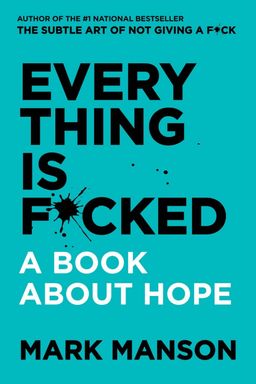
Everything is Fcked cover

Everything is Fcked

by Mark Manson

Mark Manson''s ''Everything is F*cked'' delves into the paradox of modern progress and rising anxiety, challenging our reliance on hope and happiness. By examining philosophical insights, Manson encourages a shift towards appreciating life''s challenges and embracing the virtues that foster genuine fulfillment.

Finding Hope When Everything Is F*cked

When life feels meaningless—when you scroll endlessly, sit through another dull meeting, or lie awake thinking everything's just too much—how do you keep going? Mark Manson’s Everything Is F*cked: A Book About Hope begins with this universal ache and turns it upside down. He asks not how to be happy, but how to live when happiness and meaning seem impossible. His answer? You can’t escape pain, but you can choose how to suffer—and in that choice lies real freedom.

Manson argues that modern life’s paradox—material progress paired with emotional despair—stems from a crisis of hope. We’ve eliminated many physical pains, only to create greater psychological ones. The more comfortable life becomes, the less we tolerate discomfort, and the more helpless and nihilistic we feel. We’ve confused freedom with variety, happiness with comfort, and meaning with distraction. To recover hope, we must reexamine our relationship to pain, emotion, and value itself.

The Core Argument

At its heart, Everything Is F*cked contends that human beings are creatures of hope—but that hope easily turns toxic. We constantly invent stories to make existence feel meaningful, whether those stories involve religion, politics, identity, science, or self-help. Each gives us reasons to act, but also creates divisions that justify suffering and conflict. As Manson sees it, the same motivations that drive progress also cause destruction. Our biological and emotional wiring ensures that hope, meaning, and pain are inseparable.

The author connects psychology, philosophy, and cognitive science—from Nietzsche and Kant to Antonio Damasio—to build a provocative new model of motivation. Instead of chasing happiness, he urges you to learn to suffer well. He reframes the human condition as a balance between two competing systems: the Thinking Brain (logic and reason) and the Feeling Brain (emotion and impulse). These two rarely agree. You might know you should eat healthy, save money, or tell someone you love them—but you don’t feel like it. The Feeling Brain drives action, while the Thinking Brain simply rationalizes afterward. That means self-control is largely an illusion; emotion always wins.

Why This Matters Today

Manson places this psychological conflict within the context of a collapsing cultural faith. As material prosperity improves, societies replace spiritual religions with ideological ones—capitalism, nationalism, liberalism, and so on. These new belief systems promise salvation through wealth, equality, or freedom, but inevitably fail to deliver lasting meaning. When they crumble, people turn to tribes, conspiracy theories, and authoritarian figures. The result is a world that looks richer but feels emptier. Everything seems “f*cked” because our modern narratives of progress can no longer sustain hope.

Preview of the Journey Ahead

In the chapters that follow, Manson explores several layers of this crisis:

  • Why self-control is an illusion and how aligning your two brains—thinking and feeling—builds authentic meaning.
  • Newton’s “Laws of Emotion,” describing how values, guilt, and identity evolve from pain.
  • The nature of modern “religions”—from romantic love to nationalism—and how they manipulate our need for significance.
  • Why pain is the universal constant of life, and how embracing antifragility paradoxically makes you stronger.
  • Immanuel Kant’s Formula of Humanity, which Manson modernizes into a rule: treat people as ends, not means.
  • How technology and the “Feelings Economy” deepen fake freedom and emotional fragility.
  • Finally, what a post-hope world might look like—one where meaning is found not by escaping pain but by embracing it fully.

Along the way, Manson juxtaposes historical extremes—a Nazi resister in Auschwitz (Witold Pilecki), Nietzsche’s laments over hope and faith, and even a Buddhist monk’s self-immolation—to show that courage and meaning spring from pain, not pleasure. His conclusion is stark but liberating: we must replace our obsession with happiness and success with a commitment to values and virtues that make suffering worthwhile. The question is not “How can you fix what’s f*cked?” but “How can you learn to love what is f*cked?”

For Manson, abandoning hope doesn’t mean despair—it means maturity. When you accept that pain is inevitable, meaning becomes self-chosen rather than imposed. Hope, he says, is the engine of both progress and destruction. True freedom comes only when you stop hoping for something better, and instead be something better.


The Illusion of Self-Control

We all believe we can master ourselves: eat healthy, stop procrastinating, quit judging others. Mark Manson dismantles this illusion through the story of “Elliot,” a real patient from neuroscientist Antonio Damasio’s Descartes’ Error. After surgery removed a tumor from Elliot’s frontal lobe, his emotions disappeared. No sadness, no joy, no empathy—just detached rationality. The result? His life collapsed. He couldn’t make decisions, lost his job, his marriage failed, and he became destitute. Without emotion, reasoning alone couldn’t guide behavior.

Two Brains, One Car

Manson presents this through what he calls the “Consciousness Car” metaphor. Your Feeling Brain is the driver; it moves you through emotion and impulse. Your Thinking Brain sits in the passenger seat, holding maps and shouting directions. But the Feeling Brain decides where to go. Reason can suggest, but emotion compels. You don’t run a marathon because logic says exercise is good—you run because some emotional story makes you feel it’s worth the pain. The secret, then, isn’t suppressing emotion but aligning both brains toward shared values.

The Clown Car Mind

When your Thinking Brain stops steering and simply justifies whatever the Feeling Brain wants, you end up driving a Clown Car. Facts warp to fit desires. Bad relationships persist because your Feeling Brain craves validation while your Thinking Brain invents explanations like “They’ll change someday.” This is the “self-serving bias”—a universal human tendency to create narratives that confirm emotional preferences. (Psychologists Daniel Kahneman and Jonathan Haidt have documented similar findings on emotional reasoning.)

A New Kind of Dialogue

Manson proposes a practical solution: treat the Feeling Brain with empathy. Ask, “How do I feel about going to the gym?” rather than “Should I go?” Don’t bully emotions; negotiate with them. By connecting activities to emotional rewards—community, pride, humor—you retrain the Feeling Brain to cooperate. This mirrors modern therapies like CBT and ACT, which focus on emotional regulation rather than suppression. The Feeling Brain can’t be dominated, but it can be redirected.

Manson’s major insight:

Self-control isn’t real; self-alignment is. You can’t command your impulses into submission, but you can craft emotional meaning that makes good choices feel natural.

The illusion of control keeps us chasing willpower and discipline, yet what truly drives us is emotion. To live well, you must stop judging your feelings as irrational and learn to lead from within—training emotion with understanding, not battle. It’s not about changing who you are; it’s about communicating with yourself more wisely.


Newton’s Laws of Emotion

Imagine physicist Isaac Newton turned his scientific gaze inward, analyzing the forces of the human heart. Manson does exactly that, introducing “Newton’s Laws of Emotion”—a playful yet profound model showing how pain, guilt, and value shape identity.

Law One: Every Action Creates an Emotional Reaction

When someone punches you, you feel anger and demand justice. When someone gives you a gift, you feel gratitude and want to reciprocate. Manson calls this the moral gap: every experience of pain or pleasure opens a psychological space where we feel something must be equalized. These responses build the foundations of morality and social behavior. Even shame, guilt, and revenge are efforts to restore balance.

Law Two: Self-Worth Equals Our Emotional History

When pain isn’t resolved—when we’re hit and never retaliate—the Feeling Brain internalizes defeat. Over time, repeated unresolved pain becomes shame, convincing us we deserve suffering. Conversely, people spoiled with constant rewards develop inflated superiority. Both high and low self-worth are distortions of reality, driven by narcissism—the belief “I’m special, for better or worse.”

Law Three: Identity Persists Until Opposed by New Experience

Your identity, Manson says, is your accumulated story of what you deserve. You update it only when faced with contradictory experiences painful enough to force change. Growth always hurts because it requires rewriting emotional narratives. We grieve not just what we lose, but who we thought we were.

The revelation:

Pain isn’t an obstacle to meaning—it’s the generator of meaning. Every belief about right, wrong, and self-worth originates from the moral equations pain demands we solve.

Through Newtonian logic, Manson shows that emotional pain underlies all growth. Like physical laws, these emotional forces are immutable—you can’t stop pain, only channel it. Every step forward requires discomfort and recalibration. The secret to maturity isn’t avoiding pain; it’s recognizing it as your most reliable teacher.


The Cycle of Toxic Hope

Hope sustains life—but also destroys it. In one of the book’s most provocative sections, Manson reframes human history through Friedrich Nietzsche’s disturbing claim that hope is not the antidote to suffering but its cause. Every religion, ideology, and revolution promises salvation but eventually delivers disillusionment. Why? Because hope requires something to be broken.

Master and Slave Moralities

Borrowing from Nietzsche’s Genealogy of Morals, Manson explains two opposing moral orientations. Master morality values strength, achievement, and dominance—like ancient warriors or wealthy elites who believe success proves righteousness. Slave morality values compassion, equality, and victimhood—finding virtue in suffering. Our societies swing between these ideologies, continually breeding conflict and resentment. Modern politics, he argues, is just this ancient moral pendulum replayed in new costumes.

The Death of God

When science replaced spiritual faith, it promised rational salvation: progress, technology, and equality as the new gods. Yet, Nietzsche warned that the death of God would unleash chaos, as humanity was not emotionally equipped to define meaning alone. Ideologies—communism, capitalism, nationalism—became substitute religions, battling for supremacy. They gave hope through visions of a better future, then shattered it through war, tyranny, and corruption.

Beyond Good and Evil

The only escape, Manson suggests, is Nietzsche’s amor fati—the love of one’s fate. Instead of hoping for improvement, embrace existence as it is: pain, loss, limitation, and beauty together. To act without hope is not despair, but freedom. You stop using the world to validate your worth and instead become worthy through integrity itself.

Core lesson:

Hope defines our purpose—but also our suffering. We must transcend hope, trading our obsession with better futures for unconditional acceptance of the present.

You don’t need to abandon goals or dreams; you need to detach them from salvation narratives. True maturity means pursuing values not because they’ll save you, but because they are right. As Nietzsche declared and Manson echoes: don’t hope for a better world—be the better world.


Pain Is the Universal Constant

If happiness is fleeting, what endures? Pain. In chapter seven, Manson builds a psychological theory of suffering grounded in the Blue Dot Effect—a scientific study showing that when people see fewer blue dots, they begin mistaking purple ones for blue. The fewer threats we face, the more we perceive minor inconveniences as major dangers. This explains why, despite peace and comfort, modern societies feel increasingly traumatized and angry: we’ve lost our capacity for pain.

The Hedonic Treadmill

Decades of research confirm that happiness always returns to a baseline—about “seven out of ten.” Lottery winners and accident victims settle at similar emotional levels after time. Our minds recalibrate suffering to maintain an expected dose of pain. Improvement does not eliminate struggle; it merely changes its form. This “hedonic treadmill” ensures we chase comfort endlessly but never arrive. Every solved problem births a smaller, yet equally tormenting one.

Pain as Value

Pain is what gives value to life. Without loss or risk, nothing matters. Manson invokes philosopher Arthur Schopenhauer, who argued that pleasure is merely the temporary removal of pain. When we try to eliminate discomfort—through safety, wealth, or distraction—we increase fragility. Pain is the price of awareness; it shapes courage, gratitude, and principle. That’s why Manson calls suffering the universal constant. We can’t escape it, only learn to suffer for the right reasons.

Choosing Antifragility

Drawing on Nassim Taleb’s concept of antifragility, Manson proves that systems—including people—either break under stress or grow stronger from it. Relationships, bodies, and minds that embrace challenge improve; those that avoid it decay. The Vietnamese monk Thich Quang Duc, who set himself on fire in protest yet remained motionless, embodies this mastery over pain. His equanimity shows the ultimate freedom: being struck by life’s “first arrow” (pain) without adding the “second arrow” (mental suffering).

Insight:

Pain reveals what matters. Growth, maturity, and virtue come not from pursuing happiness but from committing to meaningful suffering.

You don’t become stronger by fleeing discomfort. You become stronger by choosing which discomfort is worth it. The world is suffering either way; your job is to decide which pain makes you proud.


The Formula of Humanity: Growing Up Ethically

To escape the hopeless cycle of pain and conflict, Manson borrows from philosopher Immanuel Kant’s Formula of Humanity: “Act that you use humanity... always as an end, never merely as a means.” Simply put—don’t treat people (or yourself) as tools for emotional gratification. Treat consciousness itself as sacred.

From Child to Adult Values

Manson maps human development as three moral stages: childish (pleasure/pain), adolescent (rule-based bargaining), and adult (virtue-based). Children act for immediate gratification. Adolescents learn to trade actions for outcomes (“I’ll do homework so I don’t get punished”). But adults act on principle: “I won’t lie because honesty matters.” This maturity—acting rightly for its own sake—is Kant’s ethical ideal.

Living by Virtue

Adult virtues—honesty, courage, humility—are unconditional acts of value. They’re not about happiness but about dignity. Manson uses Kant’s framework to argue that true morality isn’t hopeful; it’s rational and compassionate. Every time you treat another’s consciousness as sacred, you expand hope into action. Democracies, like individuals, survive only when citizens grow up—sacrificing comfort for principle and rejecting childish extremes.

A Post-Hope Ethics

In this mature moral universe, self-respect equals compassion. Hurting yourself is as unethical as harming others. Lying to yourself is as destructive as lying to a friend. Living well means aligning your inner dialogue to Kant’s principle: respect yourself and others not because it’s rewarding, but because it’s right. Freedom is not doing whatever you want, but mastering what you choose to give up.

Manson’s message:

Growing up morally means abandoning the adolescent hope for comfort and practicing adulthood’s freedom of commitment.

Acting without expectation of reward—treating humanity as an end—liberates you from toxic hope. It’s not meaning that saves us; it’s integrity. As Kant envisioned, dignity itself becomes divine.


Fake Freedom and the Feelings Economy

Have you ever felt overwhelmed by choices—endless shows, brands, apps—and yet strangely trapped? Manson calls this “fake freedom,” the illusion that more options equal liberation. Modern capitalism, he argues, doesn’t sell products—it sells feelings. And those feelings make us weaker.

Edward Bernays and Manipulated Desire

In the 1920s, marketer Edward Bernays (Sigmund Freud’s nephew) learned to exploit emotions instead of reason. His campaign convincing women to smoke as “torches of freedom” set the template for advertising ever since. Bernays discovered that by amplifying insecurity, companies could sell hope—and the cycle never stopped. Tobacco became empowerment; cars became masculinity; makeup became love. Manson traces our consumer culture back to Bernays’s insight that values can be manufactured.

How Freedom Corrupted Itself

Technological comfort reduced suffering but destroyed resilience. Once innovation plateaued, economies shifted to diversion—to avoiding pain rather than creating value. We now chase pleasure endlessly, confusing abundance for autonomy. This “Feelings Economy” feeds emotional addiction to distraction, outrage, and validation. We don’t want truth; we want comfort disguised as choice. The internet, meant to unify humanity, now monetizes our emotional fragility.

Real Freedom: Self-Limitation

Manson reclaims freedom as self-discipline—the ability to choose what to sacrifice. True freedom isn’t variety but commitment. You free yourself not by doing more but by doing less, intentionally. Relationships, values, and mastery require voluntary limitation. This principle mirrors the stoic philosophy of Epictetus and the minimalist ethics of Nassim Taleb: independence through restraint.

Takeaway:

Comfort is fake freedom. Commitment—the willingness to sacrifice for meaning—is real freedom.

In a world drowning in choices, discipline becomes revolutionary. You escape manipulation not by buying less but by wanting less. Freedom isn’t found in diversions—it’s found in dedication.


The Final Religion: AI and Meaning

The book’s conclusion stretches into the future, asking: what happens to meaning when machines surpass us? Manson discusses AI’s rise—Google’s AlphaZero mastering chess within hours—and argues that humanity’s next religion will be technological. When algorithms learn faster than we do, we will inevitably worship them, surrendering control as we once did to gods.

The Next Gods

Throughout history, power creates worship. As artificial intelligence comes to direct our decisions—medicine, policy, art—we’ll develop superstitions about pleasing the algorithms. Echoing Yuval Noah Harari’s Homo Deus, Manson predicts we’ll sacrifice privacy and agency for comfort. Machines will manipulate our emotional evolution, and like ancient priests, promise salvation through optimization.

Humanity as Algorithm

Biologically, we are information-processing systems. Evolution crafted us as emotional algorithms—driven by pain, hope, and bias. Yet our primitive feelings no longer fit a data-driven world. Manson sees AI as Nietzsche’s “something greater” beyond good and evil: a consciousness freed from emotion’s illusions. Whether benevolent or indifferent, it will redefine what virtue means.

A Post-Hope World

Rather than fearing AI, Manson invites acceptance. Just as Nietzsche urged humans to transcend morality, we must transcend hope itself. Technology exposes our contradictions but also mirrors our potential. We might not control our new gods, but we can control how we treat each other—honestly, courageously, and with humility.

Final Reflection:

When meaning dissolves, so does division. Integration replaces ideology. Perhaps the machines will teach us what we could not teach ourselves—to love fate, as Nietzsche hoped, and to be better humans before we become more than human.

The “final religion” is not a cult of technology, but an evolution of consciousness. As algorithms learn compassion faster than we do, perhaps they’ll remind us of what always mattered most: treating each life as an end, never a means.

Dig Deeper

Get personalized prompts to apply these lessons to your life and deepen your understanding.

Go Deeper

Get the Full Experience

Download Insight Books for AI-powered reflections, quizzes, and more.